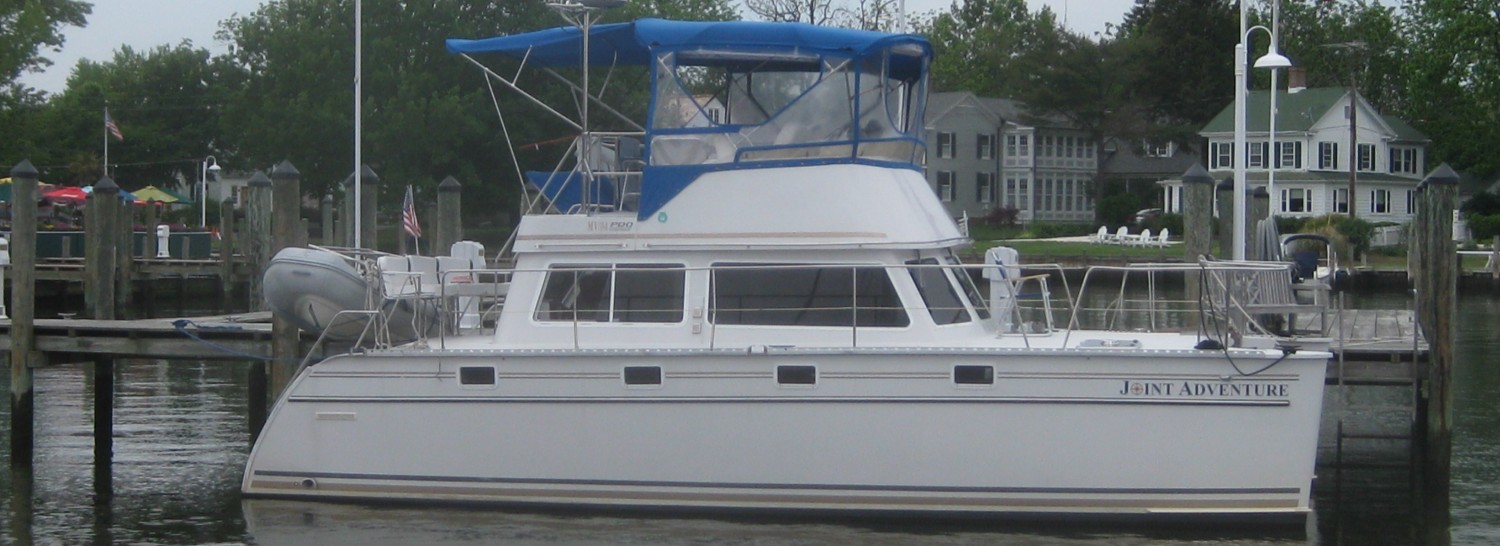
O CANADA! We’re now in Chambly, Quebec, about halfway to the St. Lawrence Seaway. We left on Saturday after having laid over for two rainy days in Burlington – what a great city! We were never bored – did boat chores, explored the city, provisioned, went to a movie each afternoon, ate ice cream each day (a requirement). Saturday morning was foggy, so we waited for the fog to lift (or so we thought) – a half hour later, we were in pea-soup fog with zero visibility in all directions:
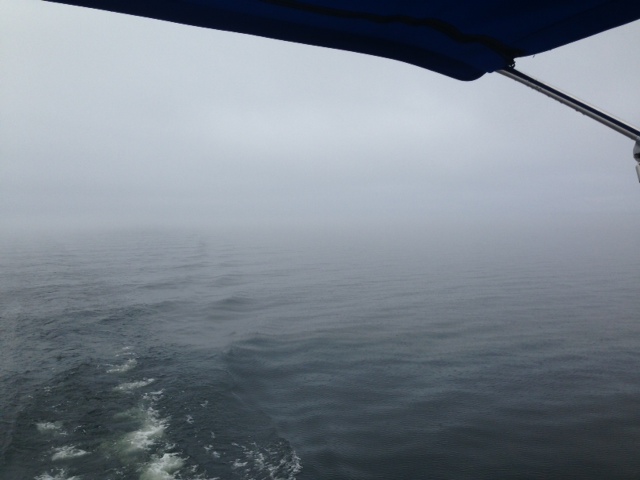
The fog closing in on us in Lake Champlain

The view from the helm in all directions in zero-visibility fog
We made good use of our radar which allowed us to see other boats and the outline of land on the screen. After an hour or so of slow running toward Rouses Point, the fog gradually lifted. Rouses Point is the northern-most village on the west side of Lake Champlain, mostly known for the Rouses Point Bridge which links Vermont and NY – the nearest bridge crossing Lake Champlain to the south is at Chimney Point, nearly 100 miles away. Similar to Whitehall, the town grew up around the water transport of goods when the Chambly Canal opened up a water route to Canada and the St. Lawrence River in 1843. By 1870, over 1800 canal boats were plying the canal, hauling lumber, farm products, and other raw materials. Today, Rouses Point is a sleepy border town, with many residents driving to Plattsburgh a half hour south for employment since Pfizer shed 3,000 jobs and all but closed a local plant in 2009. Some images of Rouses Point:
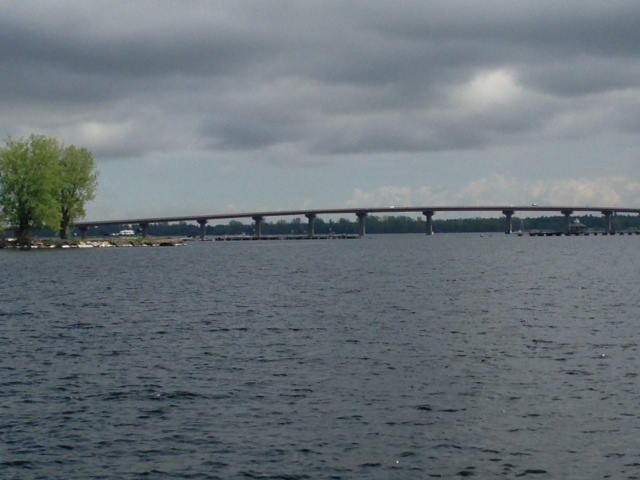
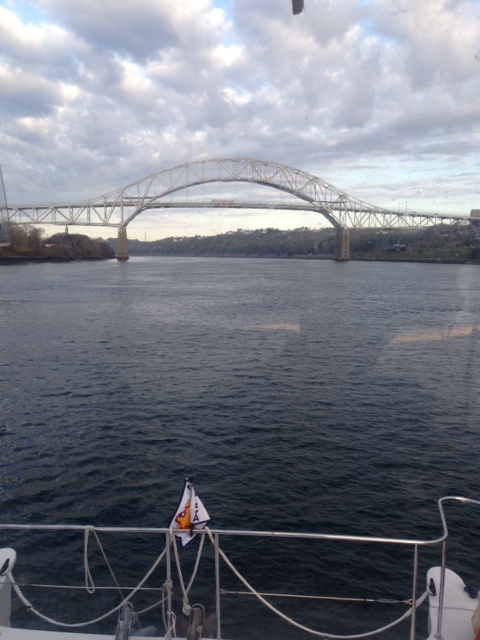
The Rouses Point Bridge linking Vermont and NY – we entered Quebec shortly after passing beneath the bridge

The French influence can be seen in some of the architecture in Rouses Point
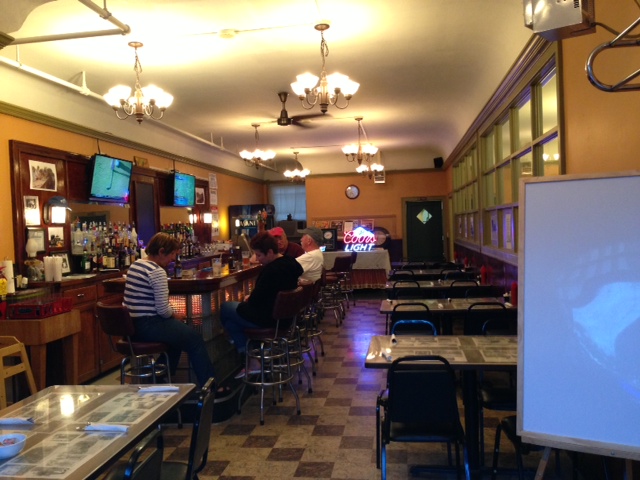
We typically eat breakfast & lunch aboard, but sometimes eat dinner out. In small towns, we look for a local diner or pub (tavern) where we can experience some local flavor. This is a the “Squirrel’s Next” where we ate in Rouses Point
As I stated in a previous posting, Lake Champlain and it’s adjoining rivers were militarily crucial to defending territory during the American Revolution and the War of 1812, with a number of strategically placed forts in addition to the most famous fort at Ticonderoga. Here are two more:

The fort at Rouses Point on the NY side, just north of the bridge

The fort in Chambly, Quebec in the Richelieu River
Running north from Lake Champlain, we entered the Richelieu River. Contrary to popular conception, Lake Champlain does not drain south to the Hudson River but drains north via the Richelieu River to the St. Lawrence. The first 18 miles heading north is a beautiful and navigable river. We encountered our first French village – Saint-Jean-de-Richelieu – at the first lock (known as Lock 9), which marks the beginning of the incredible 10 mile Chambly Canal, which has a total of 9 locks. After the first lock, one enters a narrow canal with 7 bridges but no locks in the first 9 miles. All the bridges are low and must be opened. The speed limit is 6 mph and passage through the canal is timed and controlled from when you pass through Lock 9. The bridge attendant then drives from bridge to bridge to open each bridge as you arrive. The bridges are old, quaint, and unique – here are pictures of two of them:

One of 7 very low drawbridges along the Chambly Canal – this was my favorite
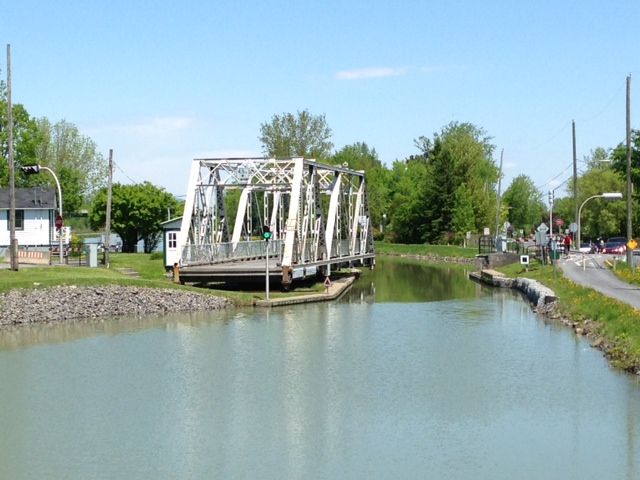
One of several very low swing bridges on the Chambly Canal
Some pictures along the Chambly Canal:
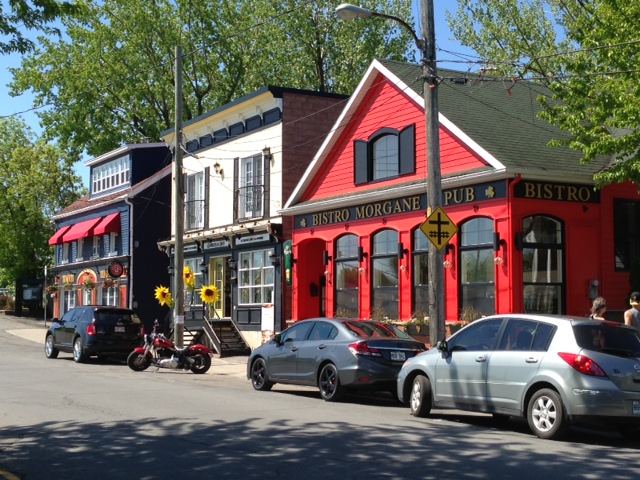
Saint-Jean-de-Richelieu, our first French village at Lock 9!

The Joint Adventure tied to the dock awaiting our turn for passage through Lock 9 then through the 7 bridges and 8 other locks at the north end of the canal
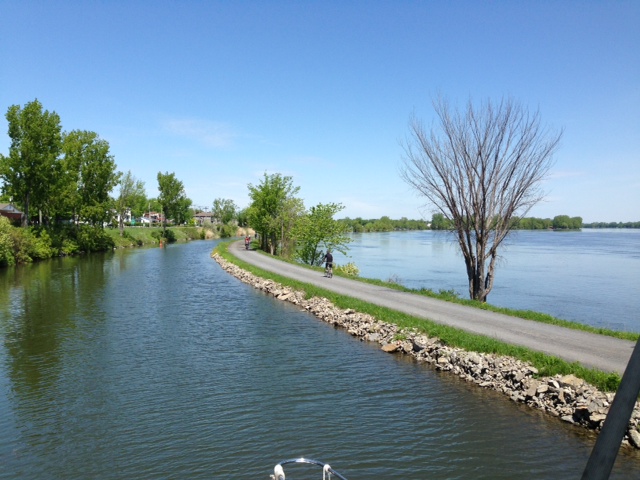
In many places, the narrow canal parallels the Richelieu River, bypassing rapids. A bike path runs along the canal the entire length, and had hundreds of people were walking or biking along the path on the beautiful Sunday afternoon when we transited the Canal

We passed farmland and small villages along the Canal – at times we were 15 feet above the surrounding landscape, looking down on farmland or the roofs of houses
The locks are all original from the 1843 opening of the canal. Locks 1-8 are all bunched together in a 1 mile section at the north end of the Canal in Chambly. The chambers are very small and narrow – the doors that hold the water back are constructed of wood and are hand operated with cranks by two attendants who move with you from lock to lock in a golf cart:

A lock attendant operating a hand crank to open the door
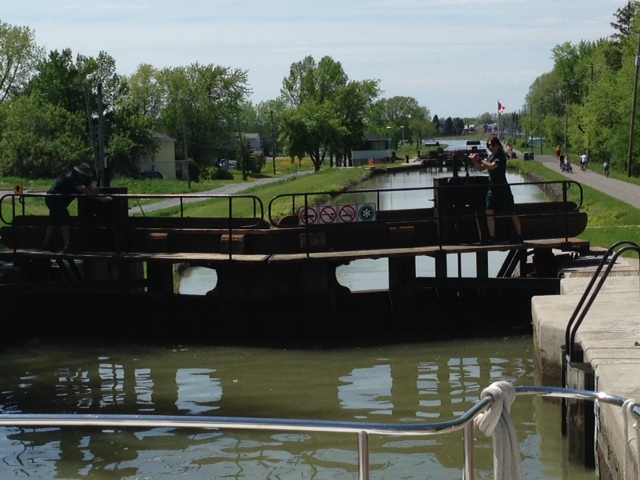
A lock attendant at each end opening the door to let us out of the lock. You can see the next lock in the series of locks 1-8 in the background

The ancient gear mechanisms still operate the locks since 1843

We often drew a crowd to watch us lock through – partly, I think, because it’s a funny-looking boat!
So – where does the “Mystery Bolt” come into play? With two lay-days in Burlington, we did some routine cleaning. While cleaning the bilge, I found a bolt laying on the floor under the engine. No one likes to find a bolt laying on the floor under the engine. After some investigation and noticing that the bolt looked like it had been there awhile, we convinced ourselves that it must have been dropped and abandoned by someone long ago. Off we went the next day up Lake Champlain to Rouses Point. After every day of running, I routinely check all engine fluids, shine my flashlight in the bilge, and look over the engine. Immediately upon opening the hatch in Rouses Point, the first thing I see is another bolt under the engine! Just sitting there! YIKES! Now it has our attention! After an hour of contorting myself in every way possible, I finally found where the bolt came from, apparently worked loose over time by engine vibration – it was one of 4 bolts that hold the engine support bracket holding up the engine. YIKES! After re-installing the bolt, I decided to check the other bracket – sure enough, a bolt missing – the other mystery bolt! I re-installed that one as well. Sure glad we do routine checks! Job well done. As a routine matter, let’s start up the engine. Turn the key – nothing happens. Impossible! I did nothing that would affect the starting or operation of the engine. Turn the key again. Nothing. Turn the key a hundred times. Nothing! Nothing! Nothing! I must have bumped a wire or knocked something loose while contorting myself in the engine compartment. Start at the battery – follow every wire. Nothing! Impossible! Then Tom notices a red knob near the cabin floor, 5 feet from the engine compartment. Check it out. It’s the battery switch for the engine – in the Off position. I must have inadvertently kicked it while rolling around on the floor reaching under the engine. Turn it to on. Turn the key. Engine roars to life.
Welcome to boating!
This will be the end of the post

























 Great Loop Adventure