LAKE HURON!!


Post #20 – July 26, 2014: On board:Dave & Joan Luciano, Pat & Paul Coates, Jim & Trish Koningisor

Four and a half billion years ago, in the area now known as Georgian Bay, the earth’s crust cracked and enormous amounts of molten rock rushed out of the earth below. It then cooled to form very hard, igneous rock – most of it hard granite, which are some of the oldest rocks in the entire world. Over ensuing eons, shallow lakes flooded the area, and sedimentary rocks were formed, intertwined with some of the ancient granite.  The earth’s crust moved time and again, and the rock formations became twisted, folded, and buckled.  Then, between 23,00o and 10,000 years ago (a blink of an eye in geologic time), tremendous ice sheets descended upon these rocks from the north – at times, the ice was over one and a half miles thick! As these enormous sheets of ice moved, they gouged out the softer sedimentary rock in places and scoured the hard, granite rock clean.  In addition, the tremendous weight of the ice sheets caused the earth’s crust to sag. When the ice finally melted, the result of all of these events is what we now call the Great Lakes, including the unique and spectacular landscape of Georgian Bay.

Georgian Bay, on the north side of Lake Huron, is separated from the rest of the lake by a long peninsula. Due to it’s enormous size, Georgian Bay was once considered to be a 6th Great Lake since it has it’s own currents, wave patterns, and weather systems – it is nearly as big as Lake Ontario. However, it was ultimately designated to be part of Lake Huron, and so it is.

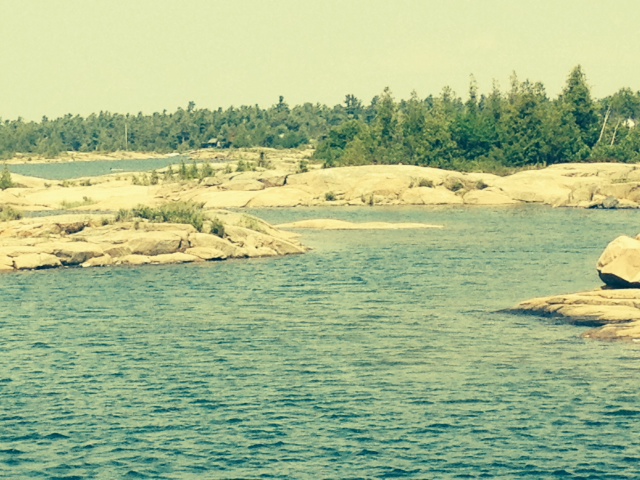
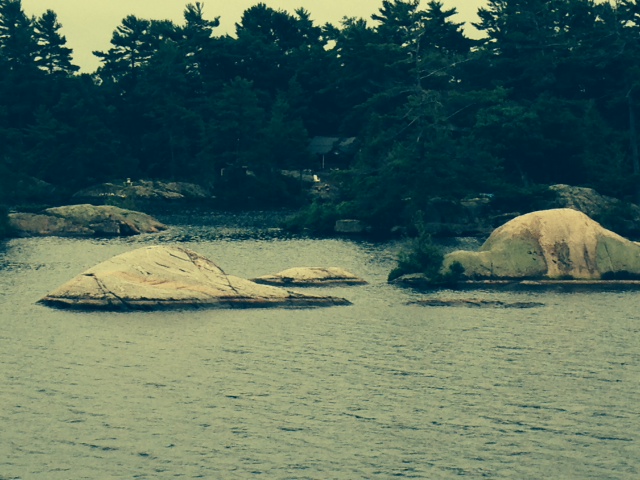
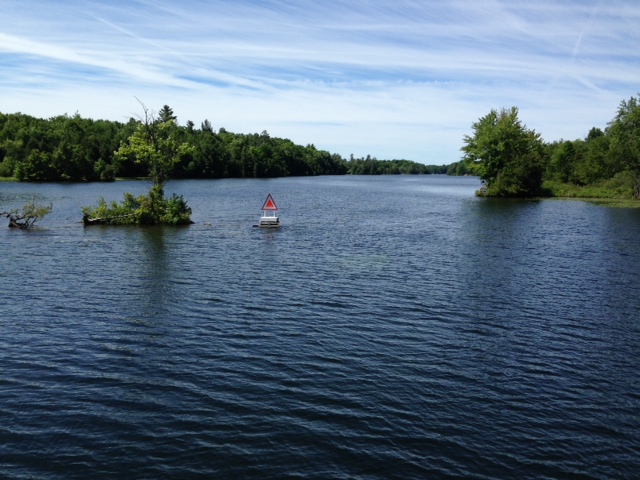
Our trip brought us along the northern edge of Georgian Bay, through what is known as the 30,000 islands.  In reality, there are over 100,000 islands if one considers all of the outcroppings of rock to be islands. A navigable route that winds its way among these islands has been charted and marked, and is known as the Small Craft Channel. While the winding channel and narrow, heart-stopping passages make the trip through the Small Craft Channel unforgettable, it is the incredible, one-of-a-kind rock formations that make this area unique in the world. The hard, bald, granite rock surfaces, scoured smooth by the glaciers, protrudes everywhere both above and below the water surface.  In places, the channel may be only 20 or 25 feet wide with granite bedrock on both sides, but the depth finder may show 40 or 50 feet of depth below the propellers.  In other places, we hold our breath as rocks seem to protrude everywhere as we slowly pick our way through the winding channel.  Here are some pictures:
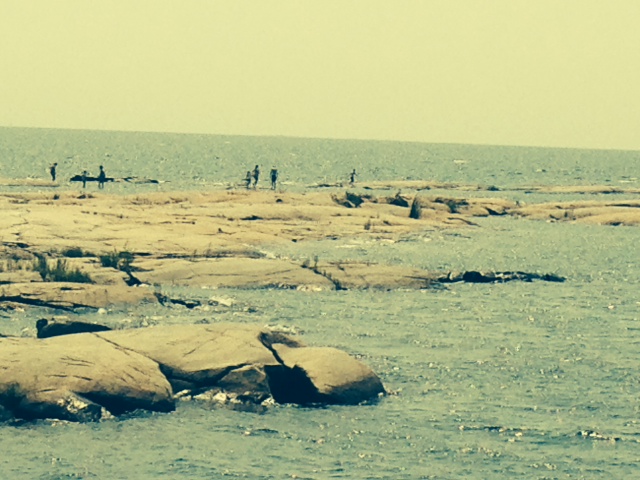
The smooth, almost polished granite rock formations, scoured clean by the glaciers. The people in this picture are from a local kids camp, exploring the rocks and swimming in the pools formed by the rocks - what a playground!

The smooth, almost polished granite rock formations, scoured clean by the glaciers. The people in this picture are from a local kids camp, exploring the rocks and swimming in the pools formed by the rocks – what a playground!

The sea of smooth rocks, both above and below the water, seems to go on forever
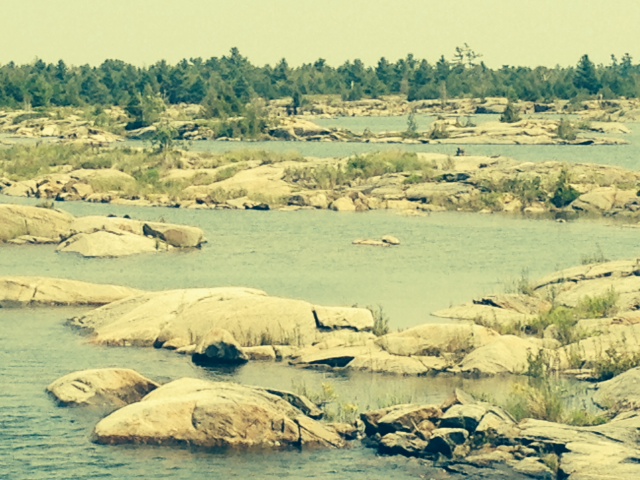
The sea of smooth rocks, both above and below the water, seems to go on forever

More rock formations along the channel
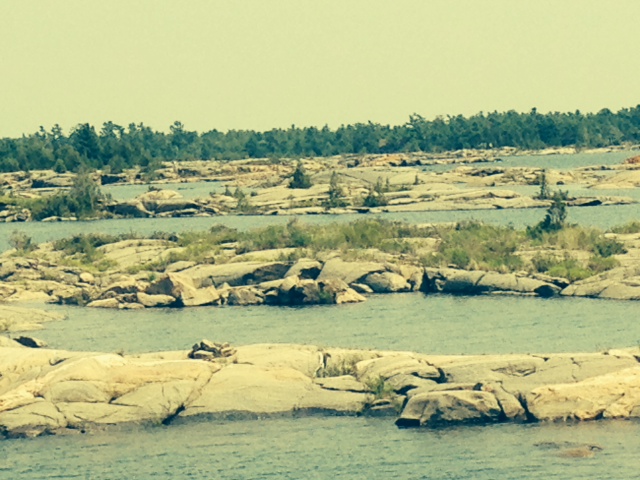
More rock formations along the channel

Where is the channel - YIKES!

Where is the channel – YIKES!

More amazingly beautiful seascape

More amazingly beautiful seascape

The channel is well-marked, but we sometimes find ourselves holding our collective breath as we pass through narrows laced with unforgiving rocks

The channel is well-marked, but we sometimes find ourselves holding our collective breath as we pass through narrows laced with unforgiving rocks

As we approached the end of the Georgian Bay closer to the North Channel (also part of Lake Huron), the rock formations became more vertical and the elevations higher
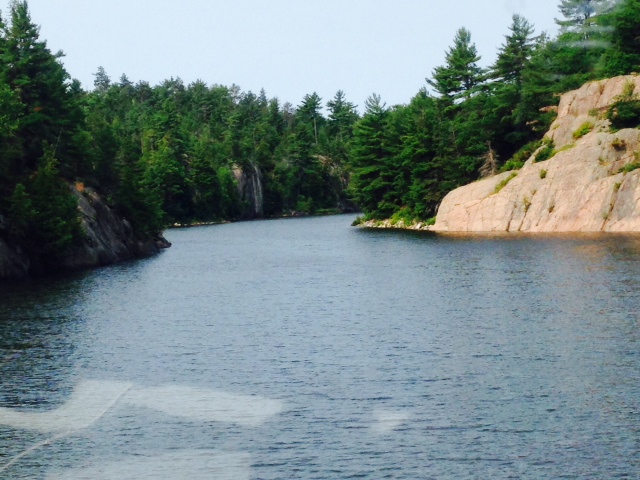
As we approached the end of the Georgian Bay closer to the North Channel (also part of Lake Huron), the rock formations became more vertical and the elevations higher

A narrow channel with 40 feet of depth

A narrow channel with 40 feet of depth

OK, enough about rocks.

We have now entered a new phase of the trip.  Technically, our Great Loop trip started in New York, not Boston – Boston is not on the Great Loop route, but we started there because that is where we live and where the boat was.  However, we technically entered the Great Loop route when we arrived in New York.  Since that time, in early May, we have been primarily on rivers, canals, and small inland lakes connected by rivers and canals.  To get from New York to Georgian Bay, we went through a total of 115 locks, ranging from small locks with an elevation change of a couple of feet in which we barely fit to enormous locks on the St. Lawrence River designed for ocean-going cargo ships to a single lock that raised us 7 stories in one lift to the two amazing lift-locks on the Trent Severn Waterway to the only-one-in-the-world marine railway at Big Chute. We now are in the continuously-connected waters of Lake Huron and then on to Lake Michigan. We have no more locks until we get to Chicago around Labor Day. Weather and especially wind will become even more important as we navigate through much more open waters in this next phase of our voyage.

So we left Midland Sunday morning with our new crew and stopped at Henry’s restaurant – another waterfront restaurant on an island accessible only by boat. Henry’s is a bit larger than The Waubic, but just as unusual in its own way. When communicating by radio with Paul, the Owner, regarding docking arrangements, I requested to be at the water-end of a long dock since we often leave before other boats in the morning and I didn’t want to get blocked in (the customer is always right, correct?). “Absolutely negative” bellowed Paul, without apology. What could I say?  “Roger that”. Paul had been doing this for 12 years and he know exactly how he wants things done. He turned out to be a great guy and shared a wealth of information with us. Here are a couple pictures of Henry’s:

Henry's Restaurant as seen from the bridge of the Joint Adventure while docked
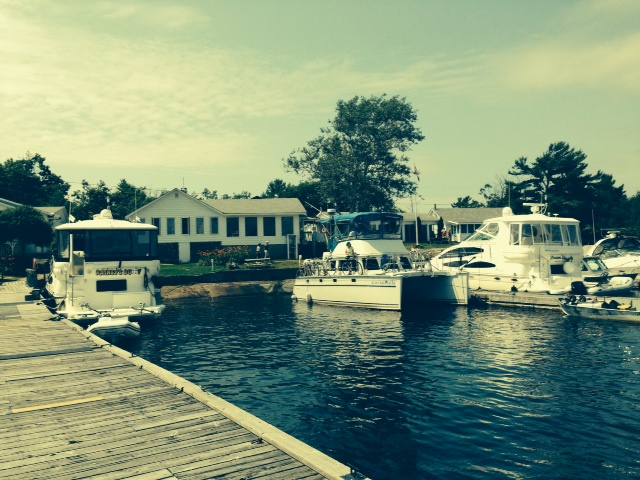
Henry’s Restaurant as seen from the bridge of the Joint Adventure while docked

Henry's with the Joint Adventure at the dock (at the inland end, per Paul)

Henry’s with the Joint Adventure at the dock (at the inland end, per Paul)

While at Henry’s that afternoon, a seaplane taxied up to the dock and dropped off three passengers to have a late lunch. Since the plane and its pilot were to sit idle while the passengers had lunch, we made a deal with the pilot to take our three wives for a ride on the seaplane.  Here they go!
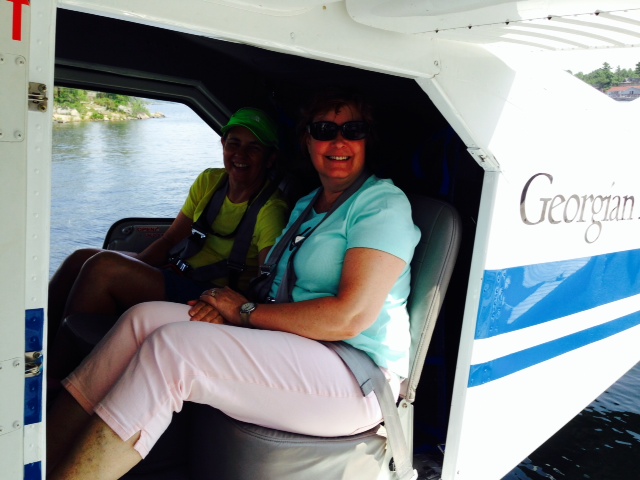
Trish and Joan in the back seat, ready for take-off
Trish and Joan in the back seat, ready for take-off

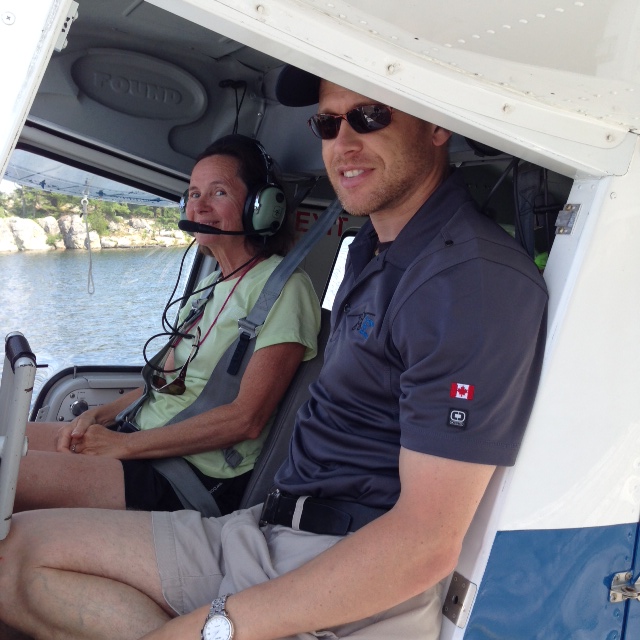
The pilot decided to let Pat fly the plane....

The pilot decided to let Pat fly the plane….

Off they go!
Off they go!

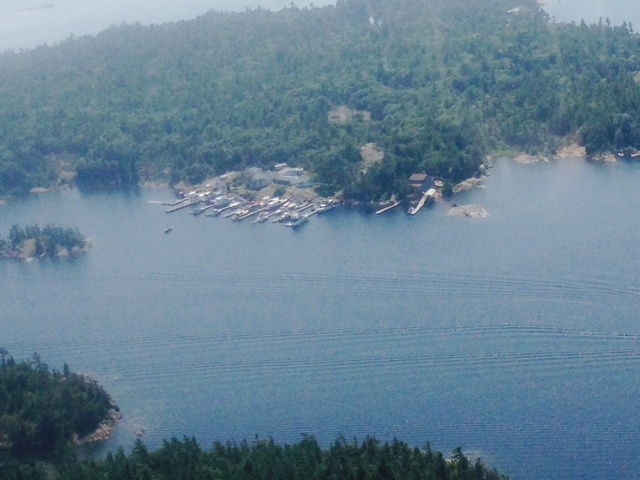
Henry's Restaurant and associated dockage, from the sea plane
Henry’s Restaurant and associated dockage, from the sea plane

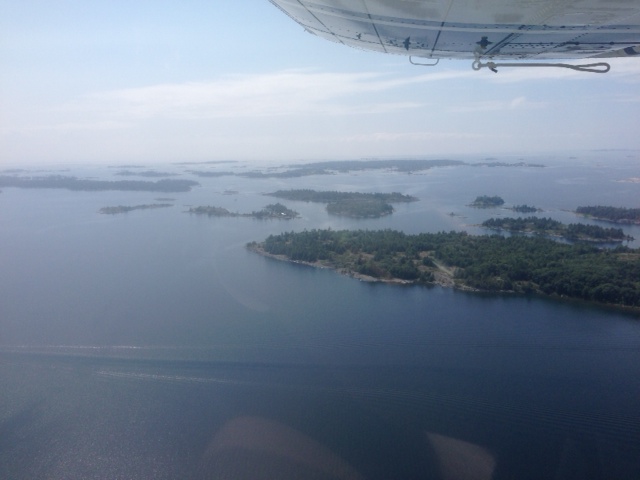
From the air -

From the air –

Also from the air -

Also from the air –

They made it back safely!  Pat made a perfect water landing

They made it back safely! Pat made a perfect water landing

Henry’s serves fresh fish – pickerel, perch, whitefish, or lake trout, all caught in Georgian Bay or Lake Erie. Paul explained that commercial fishing on the American side was closed in the recent past due to intense lobbying by the sportsmens’ lobby – only sport fishing is allowed. However, commercial fishing is allowed and thriving on the Canadian side, and Paul claimed to be the largest purchaser of fresh water pickerel in the world (I don’t think there are a lot of purchasers outside of Canada).

The day was warm and sunny, so we went for a hike among the rocky landscape and forest:
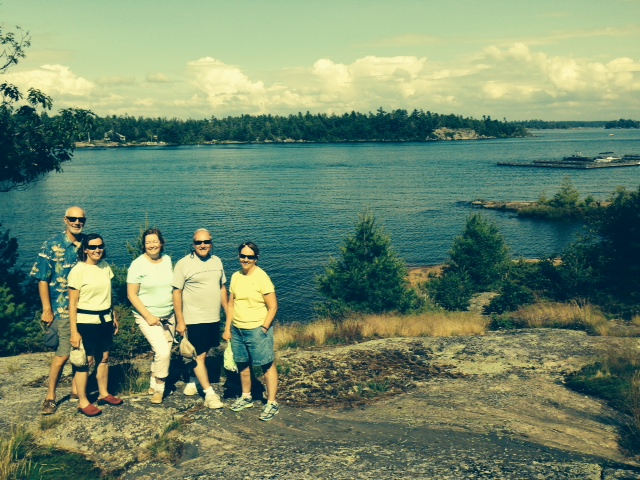
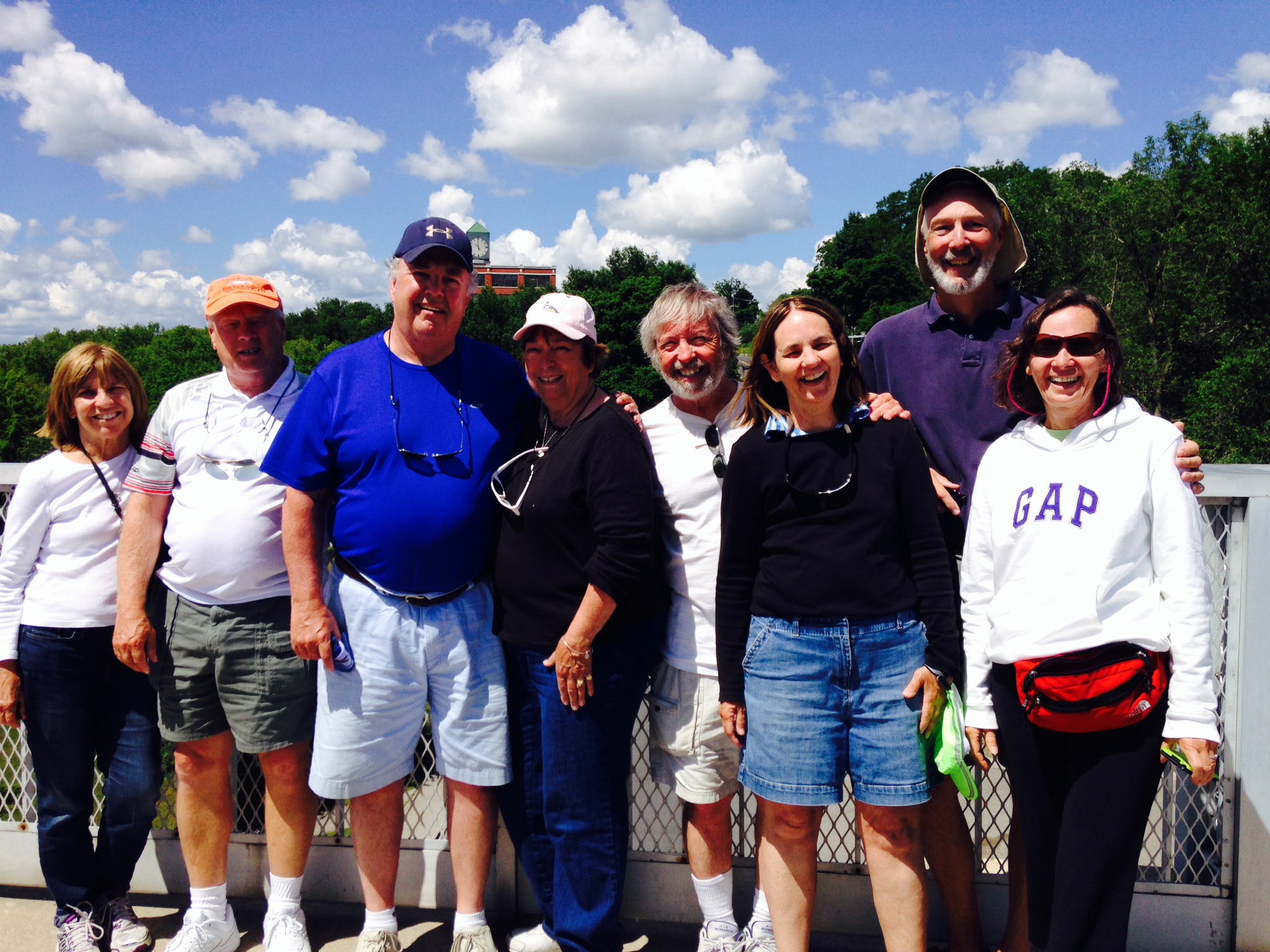
A stop along the rocky coastline. On the way back, the girls stopped at a rock outcropping and went skinny-dipping after sending us back to the boat. Sorry, I couldn't get any pictures to share

A stop along the rocky coastline. Left to right, Paul, Pat, Joan, Dave, and Trish.  On the way back, the girls stopped at a rock outcropping and went skinny-dipping after sending us back to the boat. Sorry, I couldn’t get any pictures to share

Our next stop was Bayfield Inlet.  Everyplace can’t be wonderful. The only thing at Bayfield was the marina, which was, shall we say, less than wonderful. The  single, unisex shower was in a run-down shed and was not piped with hot water. Dave found out that the cold water is VERY cold. The marina itself was run down. However, we made the most of a beautiful afternoon with a long and enjoyable bike ride to get ice cream at Point Au Baril, marred only by the horse flies that we couldn’t outrun, even on our bikes. Upon our return, we went for a swim while Dave suffered with his cold shower.

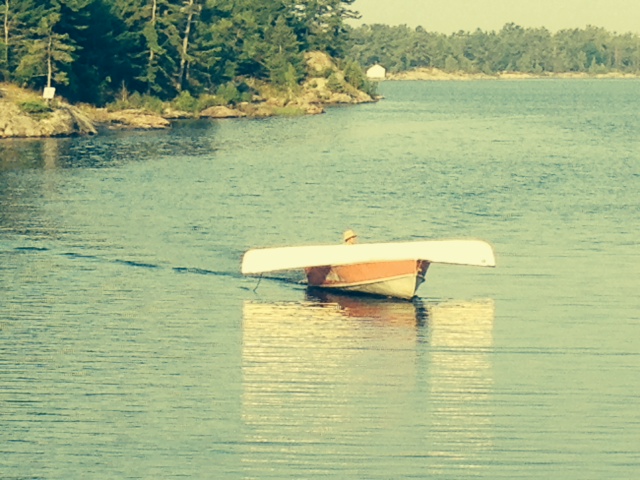
On to Byng Inlet. The wind kicked up and we got knocked around a bit as we navigated an amazing, zig-zag route that took us alternately between protected channels with rocks everywhere and the open bay with 3-4 foot waves. Byng Inlet was a treat, more for the people than the town, which was nearly non-existent.  The marina was family run, owned by four brothers from a family of 11 (many of whom we met). The brother who was overall in charge was also the chef at the on-site restaurant – “when you grow up in a family of 11, you learn how to cook”, he explained. However, he was a chef, not a cook. The next day was windy and the run to Killarney, our next destination, was 62 miles and included 20 miles of open water on the bay, so we stayed in Byng Inlet on Wednesday and caught up on chores. We went exploring on our bikes during the afternoon.  Here are some pictures from Byng Inlet:
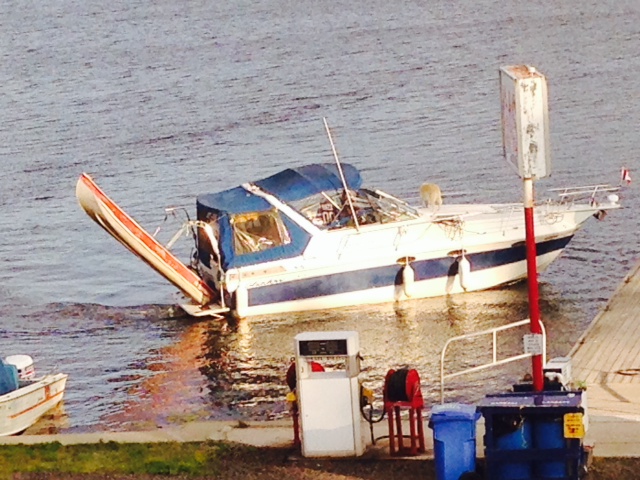
A unique way to carry a dinghy - I wonder what happens in a strong headwind?
A unique way to carry a dinghy – I wonder what happens in a strong headwind?

A unique way of carrying a canoe

A unique way of carrying a canoe

We ventured down a dirt road and came upon widespread outcroppings of smoothly scoured rock. The road in this picture is actually bedrock, with the painted arrow pointing the direction in which the road turns

We ventured down a dirt road and came upon widespread outcroppings of smoothly scoured rock. The road in this picture is actually exposed bedrock, with the painted arrow pointing the direction in which the road turns
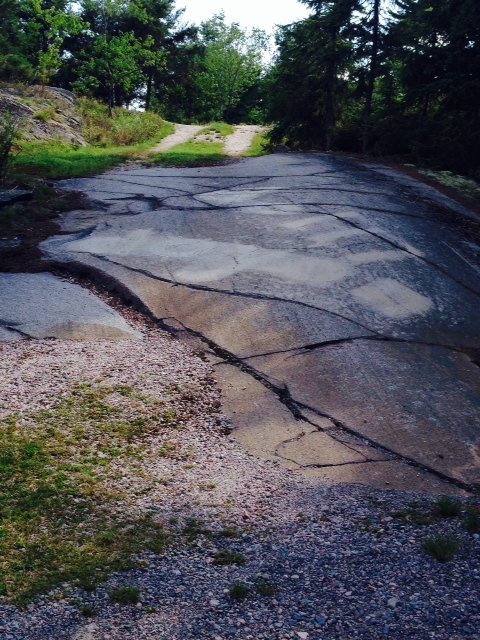
The first 50 feet or so of this driveway is simply exposed bedrock
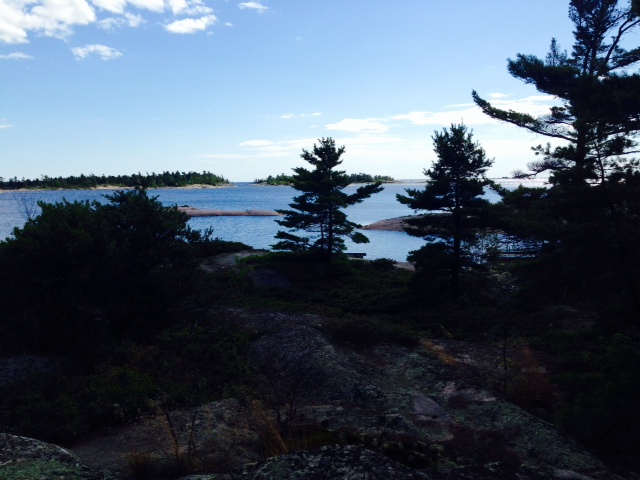
The first 50 feet or so of this driveway is simply exposed bedrock


A view from our bike ride
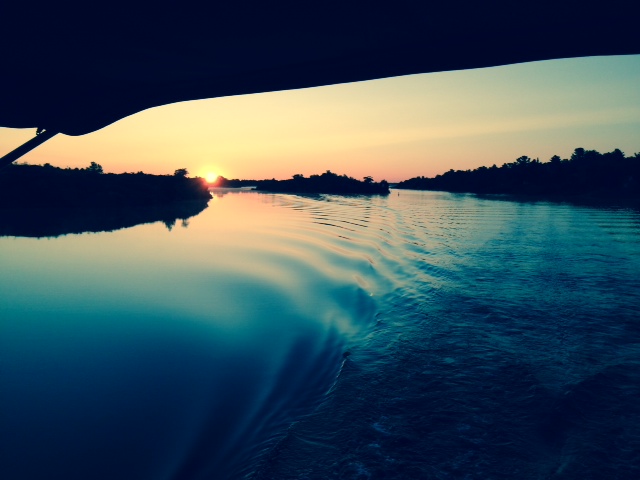
A view from our bike ride

Knowing we had a long open-water passage and with the wind predicted to increase during the day, we left Byng Inlet at first light, casting off before 6:00 AM - this is the sunrise as we headed out the inlet

Knowing we had a long open-water passage and with the wind predicted to increase during the day, we left Byng Inlet at first light, casting off before 6:00 AM – this is the sunrise as we headed out the inlet

Our 60 mile run to Killarney was uneventful, as the wind behaved and the ride was very pleasant. Killarney is at the crossroads of Georgian Bay and the North Channel, another renowned cruising ground that is a part of Lake Huron. It is a busy little town in July and August, as everyone passing between these two cruising grounds passes through and usually stops for a day or two in Killarney. There are 3 or 4 restaurants in town and 5 marinas along the narrow channel, the largest of which is the Sportsmans Inn where we stayed. A couple of pictures:

The Sportsman's Inn, taken from across the channel

The Sportsman’s Inn, taken from across the channel
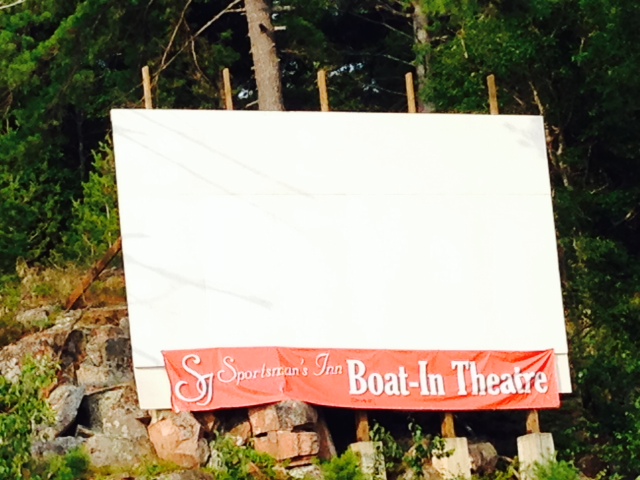
You've heard of a drive-in - Killarney has a boat-in.  The movie is projected on the screen which faces the docks and you tune into a particular channel on the FM radio and watch the movie from your boat

You’ve heard of a drive-in – Killarney has a boat-in. The movie is projected on the screen which faces the docks and you tune into a particular channel on the FM radio and watch the movie from your boat

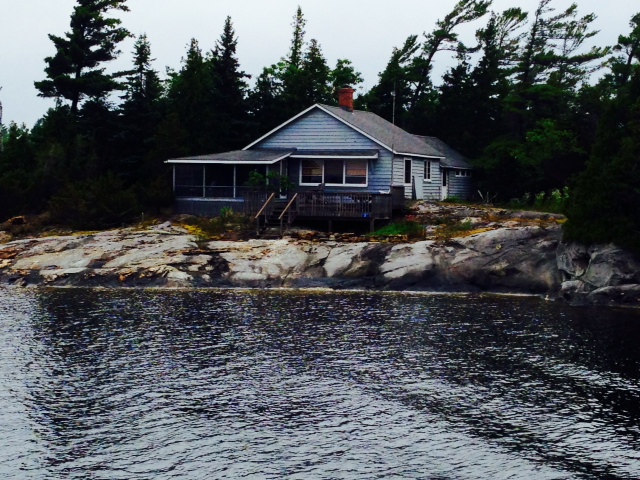
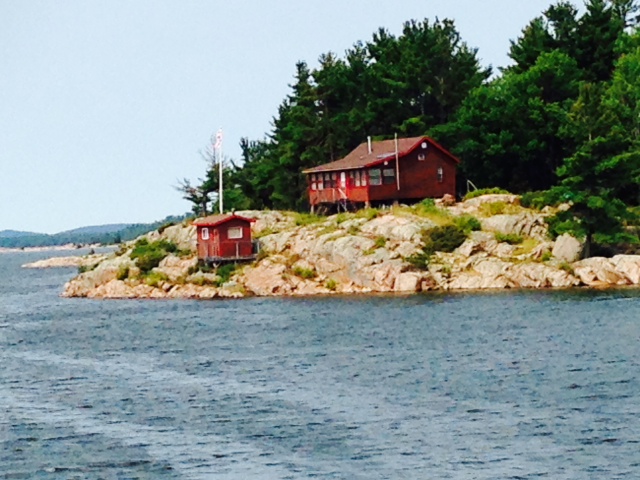
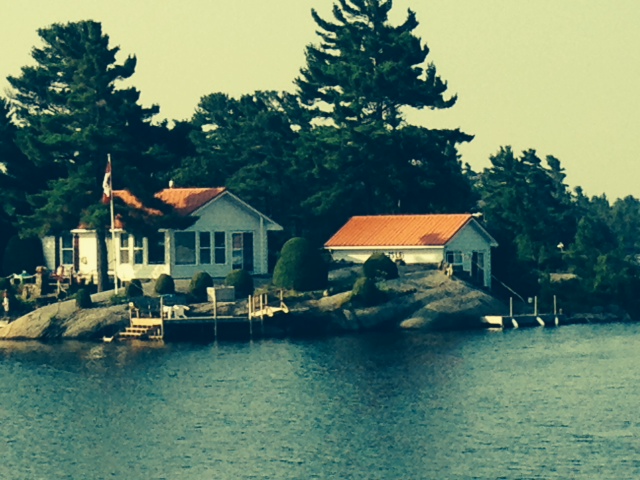
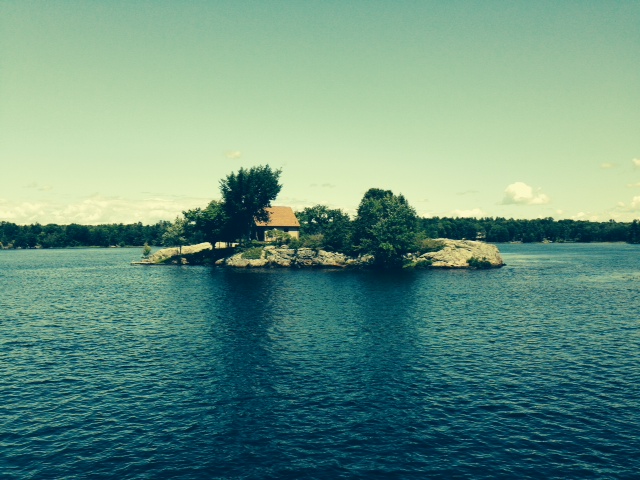
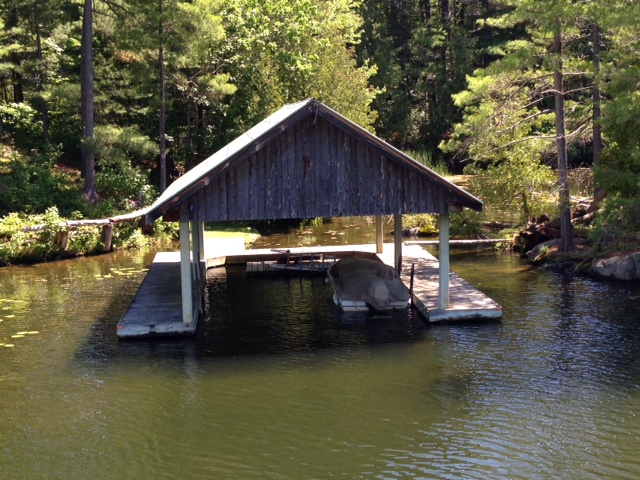
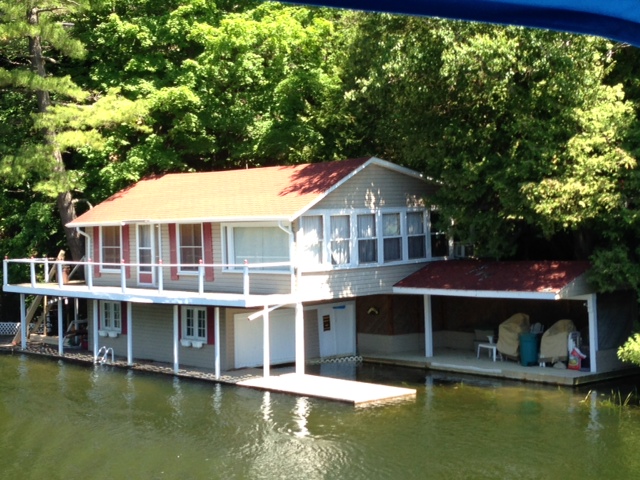
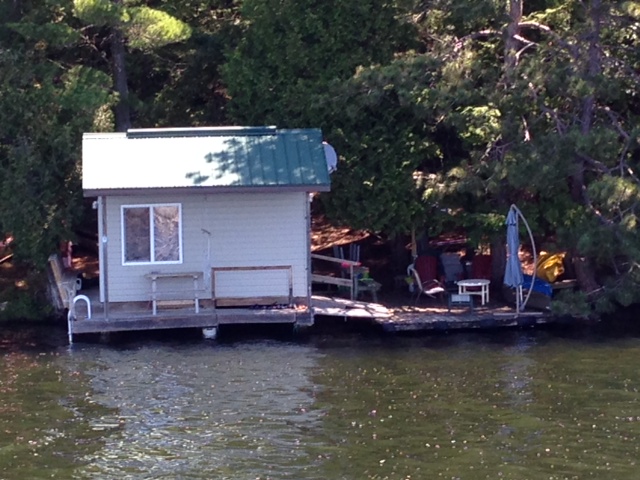
Our trip this week again brought us by hundreds of cottages of all types and sizes built on some of the thousands of islands along the way.  Here are pictures of just a few of them:

Just like the many island cottages along the Trent Severn....I could live here....

Just like the many island cottages along the Trent Severn….I could live here….
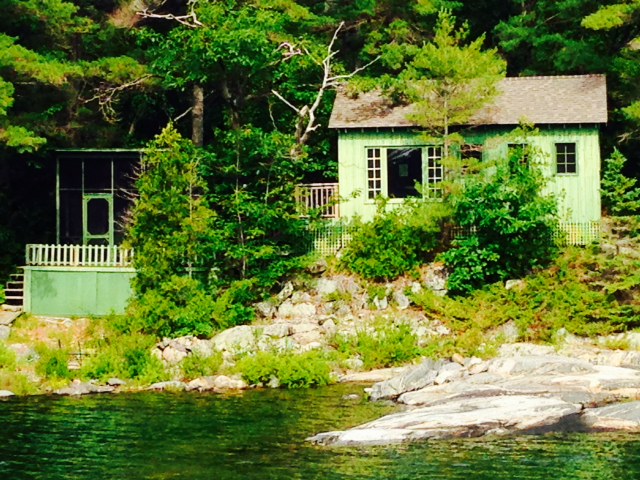
or here....

or here….

or here....

or here….

or here (even in the little house at the water's edge)....

or here (even in the little house at the water’s edge)….
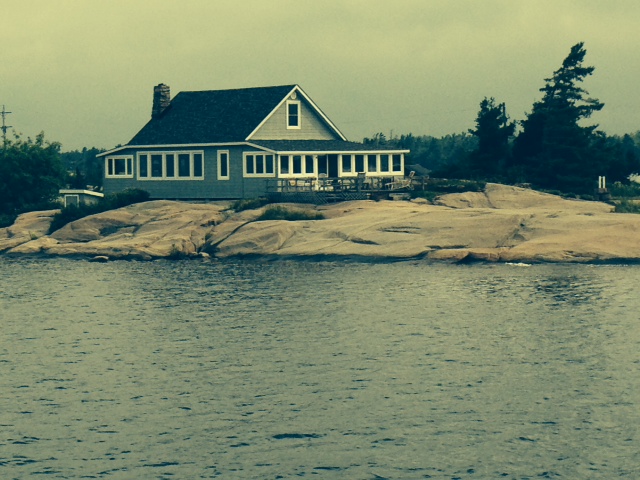
or here...

or here…

or here.

or here.

This is one of the larger, more elaborate houses that undoubtedly has been built more recently
This is one of the larger, more elaborate houses that undoubtedly has been built more recently

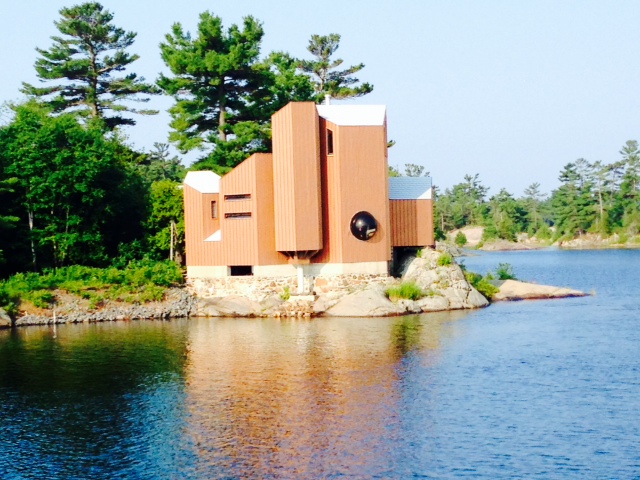
I couldn't resist taking a picture of this one - the geometric shapes are interesting, but to me, it looks totally out of place - it turns its back on the water, with virtually no windows or deck - in fact, there is a deck on the other side, facing into the island

I couldn’t resist taking a picture of this one – the geometric shapes are interesting, but to me, it looks totally out of place – it turns its back on the water, with virtually no windows or deck – in fact, there is a deck on the other side, facing into the island. I could have recommended a good Architect….

Doing everything by water becomes a way of life when you live on an island - islanders come to the market by boat to buy food and supplies

Doing everything by water becomes a way of life when you live on an island – islanders come to the market by boat to buy food and supplies
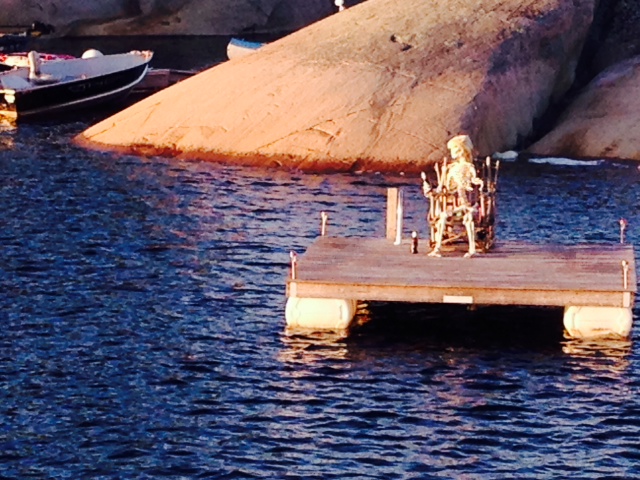
I know you're out there, fish - I'm going to catch you if it kills me!!

I know you’re out there, fish – I’m going to catch you if it kills me!!

On Friday, we officially entered the North Channel and docked at Little Current, located on Manitoulin Island – which is the largest freshwater island in the world!  Little Current is a thriving tourist town during the summer season, with boats coming and going all day long. Sadly, Dave and Joan will leave the boat from here today (Saturday), but happily Jim Small and Chrissie Bell will join us for the next week.

Here are some pictures from Little Current:
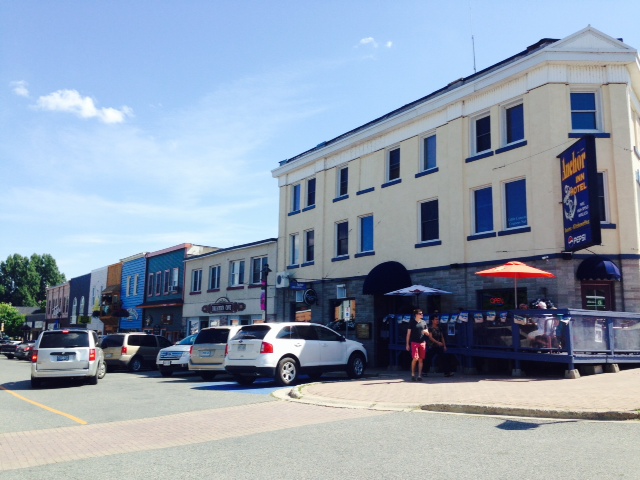
Main Street adjacent to the harbor has several restaurants and numerous shops

Main Street adjacent to the harbor has several restaurants and numerous shops

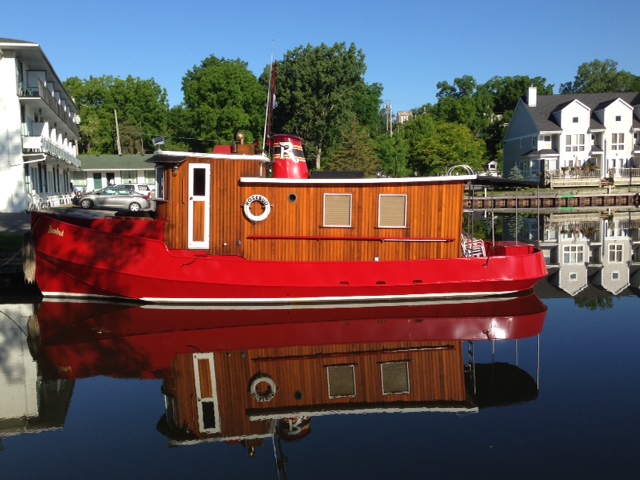
Our new friend Tania, whom we met along the way, was unable to get a place to dock at Little Current to stop for lunch, so she rafted up to us for a few hours. Her boat is a really cool 25' Nordic Tug that is perfectly set up for her

Our new friend Tania, whom we met along the way, was unable to get a place to dock at Little Current to stop for lunch, so she rafted up to us for a few hours. Her boat is a really cool 25′ Nordic Tug that is perfectly set up for her
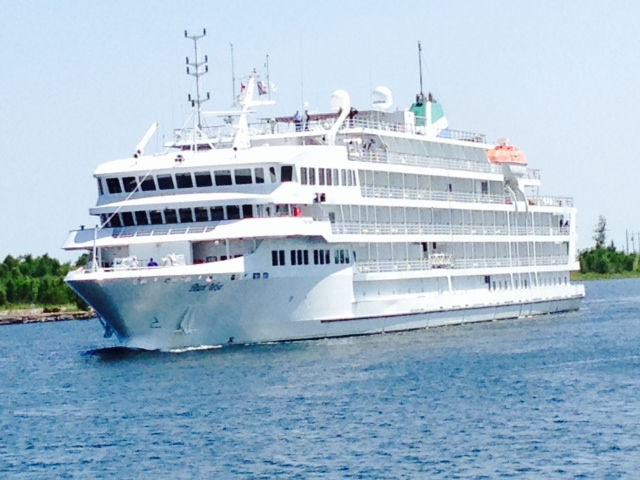
This cruise ship came into Little Current shortly after we docked - this picture is taken from the bridge of the Joint Adventure

This cruise ship came into Little Current shortly after we docked – this picture is taken from the bridge of the Joint Adventure
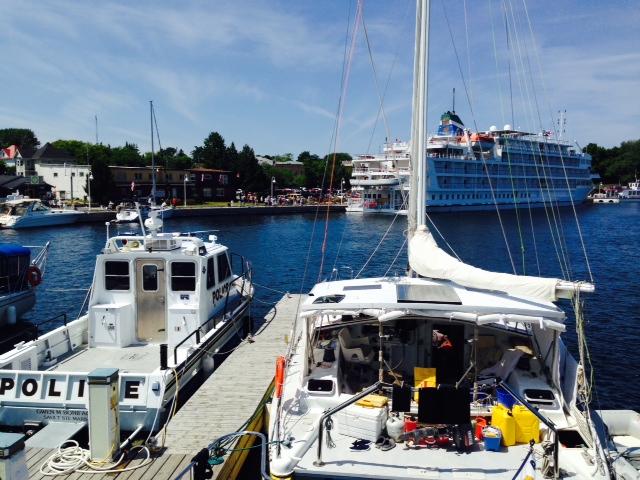
The cruise ship docked at the Little Current waterfront, also taken from the bridge of the Joint Adventure
The cruise ship docked at the Little Current waterfront, also taken from the bridge of the Joint Adventure

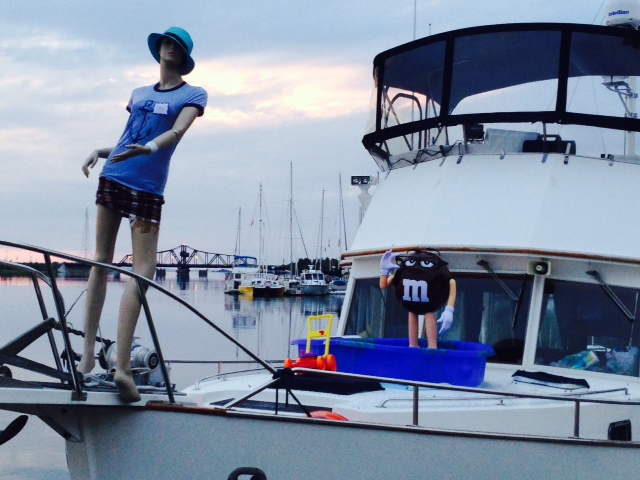
Four young guys on this boat were on the prowl yesterday - I guess this is the best they could do.

Four young guys on this boat were on the prowl yesterday – I guess this is the best they could do.

My kind of store....

My kind of store….

WHAT!!??!?   Mom always told me I AM special....

WHAT!!??!? Mom always told me I AM special….

Sure - NOW you tell me...

Sure – NOW you tell me…

Tomorrow we cast off to explore and transit the North Channel.
 

Standard

GREAT ENCOUNTERS

Post #19 – GREAT ENCOUNTERS – Day 78: Sunday, July 20, 2014. On Board: Pat & Paul Coates, Doug & Janet Lawson, Jim & Trish Koningisor

The scenery is spectacular, and the adventure and challenge are unforgettable, but some of the best moments derive from the people we’ve encountered. After arriving back on the boat early Monday evening from our jaunt to Vermont, we cast off the lines Tuesday morning and ran to Bolsover, Ontario. We stayed at Sunset Cove Marina and looked forward to a restaurant meal, only to discover that the nearby restaurant was closed. Not to worry – the owner of the marina, a wonderful, gregarious guy named Joe, tossed us the keys to his family’s minivan to drive the 10 miles or so to the nearest town. He didn’t even know if we had a drivers license!

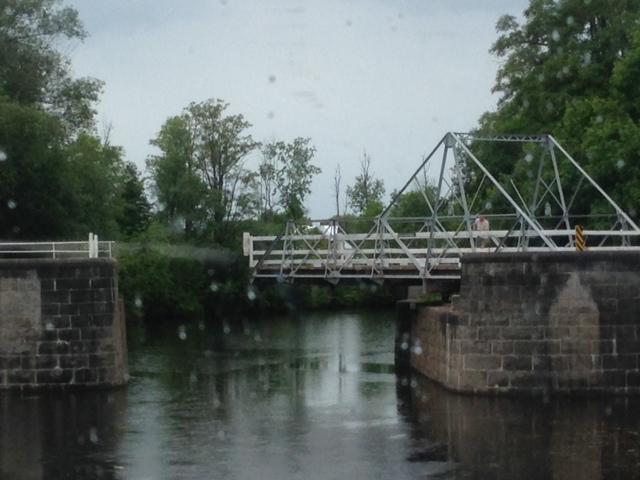
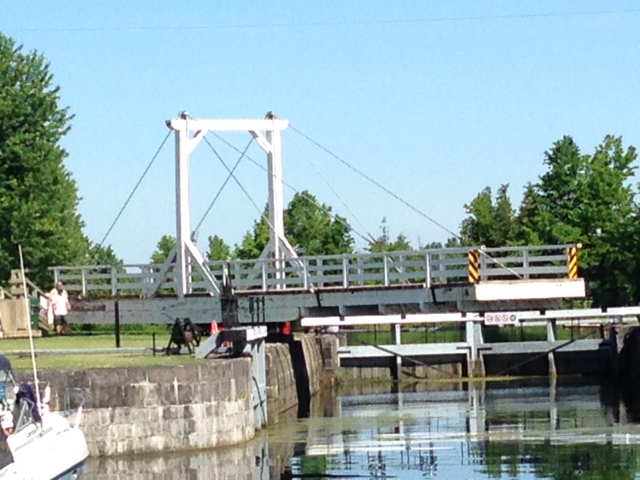
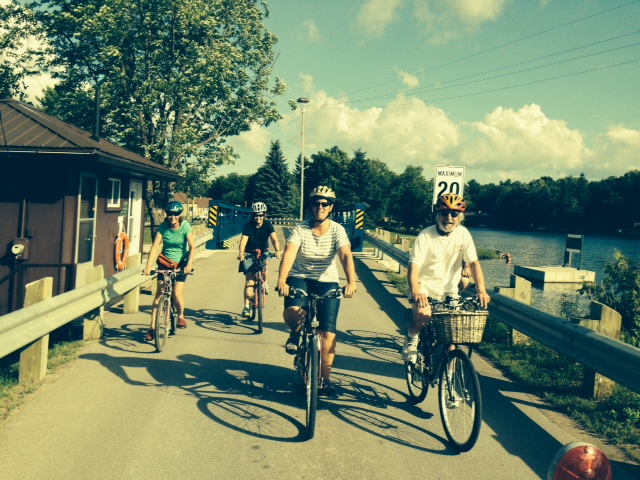
In the afternoon, we went for a bike ride and crossed a wooden swing bridge that we had passed through on the boat a few hours earlier. The bridge tender came out to chat, and we asked her to take a picture of us crossing the bridge on our bikes. In order to get the best picture and not be interrupted by cars, she closed the bridge gates to traffic – “ding-ding-ding-ding” – down came the gates! Cars waited while she took our picture!

Here are a couple of pictures that captured our day in Bolsover:

Biking across the bridge with the gate closed so we wouldn't be interrupted by traffic

Biking across the bridge with the gate closed so we wouldn’t be interrupted by traffic

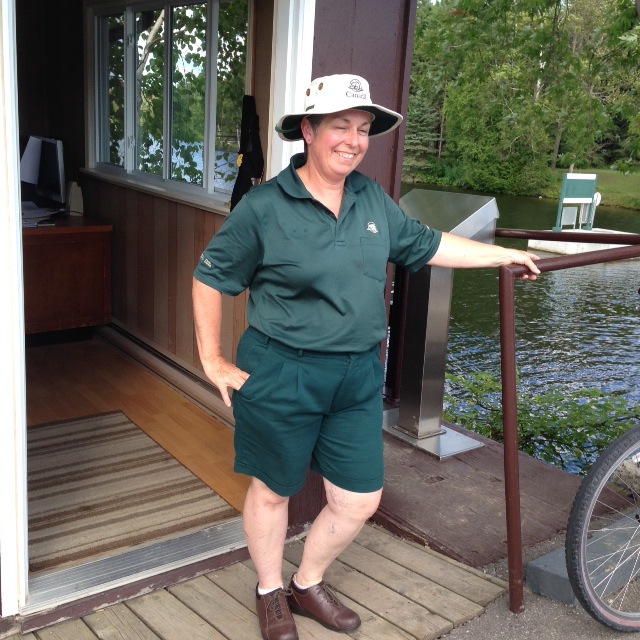
Jennifer, our favorite bridge attendant -

Jennifer, our favorite bridge attendant –


Exploring a dirt road on our three hour bike ride around Bolsover

Exploring a dirt road on our three hour bike ride around Bolsover


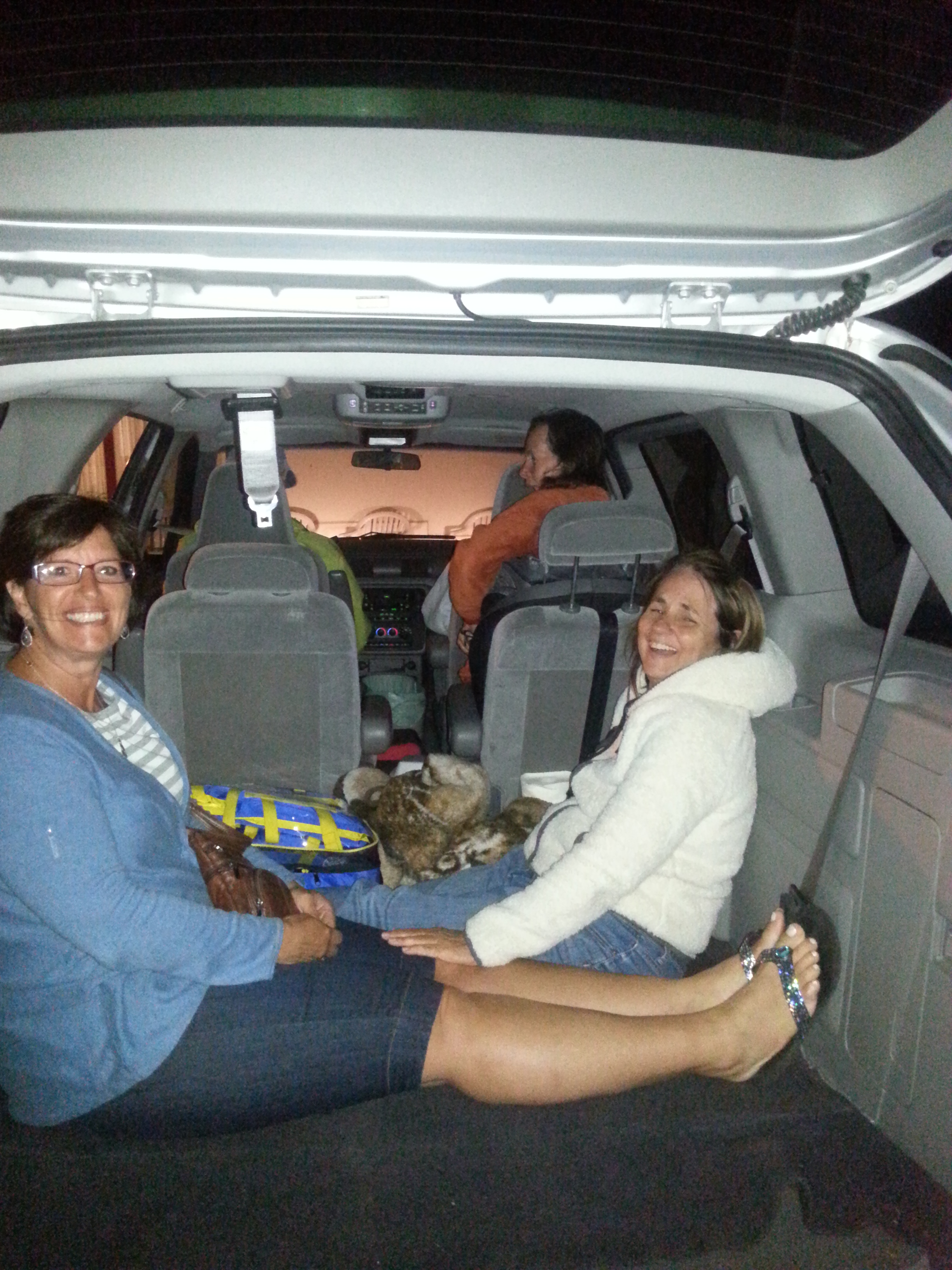
There were only 4 seats in the minivan, so Janet & Trish made do

There were only 4 seats in the minivan, so Janet & Trish made do

One of the 4 seats had a car seat firmly attached.  No problem for Pat - we're goin' out!

One of the 4 seats had a car seat firmly attached. No problem for Pat – we’re goin’ out!

A dance party in the boat after dinner - OK, we had a few glasses of wine....

A dance party in the boat after dinner – OK, we had a few glasses of wine….

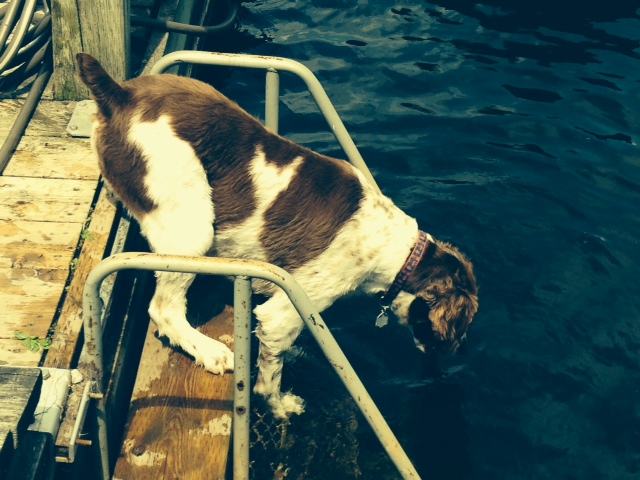
"I KNOW I can do this....OK, here I go...but the water will be SO cold...no, I'll be glad when I get in...OK, here I go...no, I can't do it...yes, I can...here I go...AARRGG!!!

“I KNOW I can do this….OK, here I go…but the water will be SO cold…no, I’ll be glad when I get in…OK, here I go…no, I can’t do it…yes, I can… I MUST go in – what will that cute poodle think of me if I’m too chicken to go in the water…OK, here I go…no, I can’t…AARRGG!!!

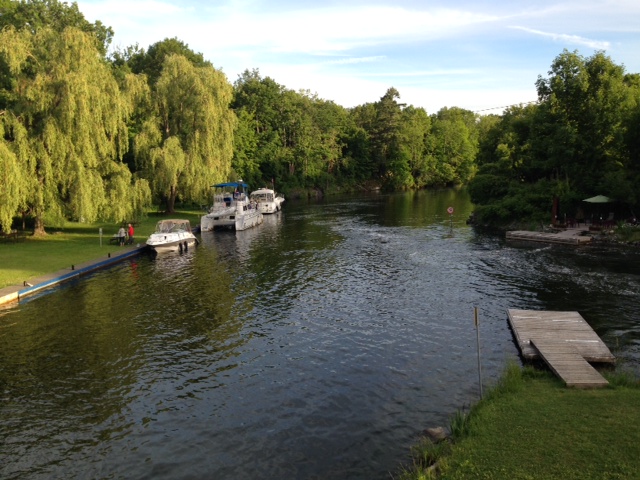
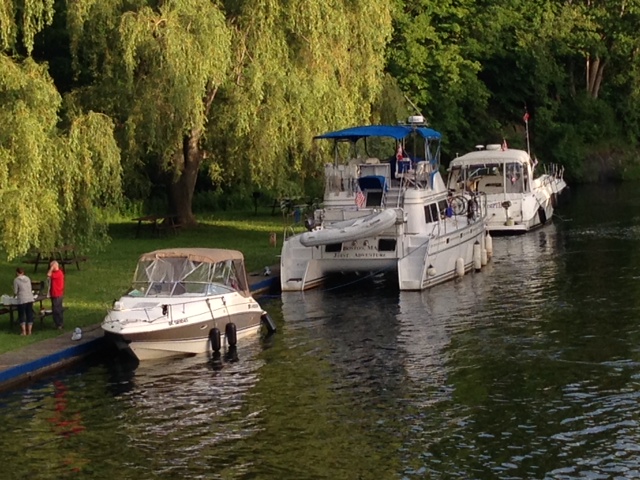
Our next potential challenge and physical barrier was crossing Lake Simcoe.  The fourth largest lake in Canada, Lake Simcoe is notorious for large waves and steep chop due to its large size, shallow depths, and windy conditions. The weather was cloudy and windy on Wednesday, so we decided to position ourselves near the entrance to the lake to try to cross it early the next morning when winds are typically lighter. We therefore ran about 20 miles and through 6 locks to a marina down a shallow, narrow creek – the kind of entrance I normally avoid at all costs. We crawled our way through, then planned an early start to get through a swing bridge and into Lake Simcoe.  A few pictures:

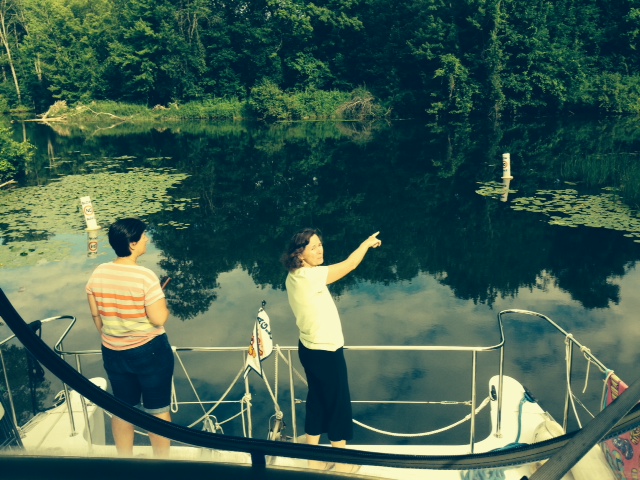
The shallow, narrow, winding creek to the marina, choked with weeds

The shallow, narrow, winding creek to the marina, choked with weeds


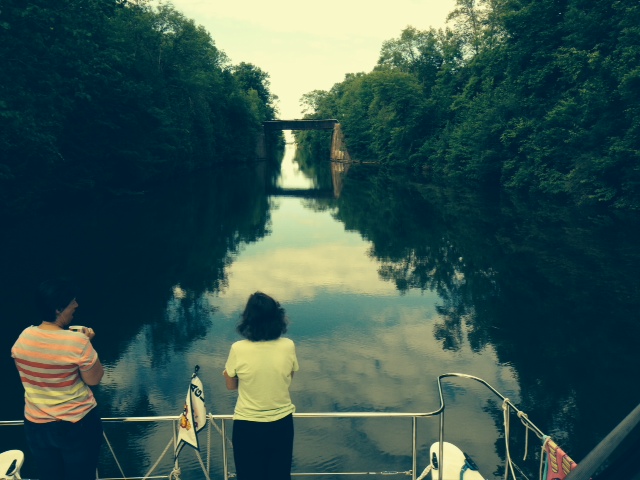
The canal leading to Lake Simcoe, with the last swing bridge up ahead

The canal leading to Lake Simcoe, with the last swing bridge up ahead

Dinner on the bridge - making good use of the table with the extension that my Dad built over the winter so we can have a sit-down dinner for six on the bridge

Dinner on the bridge – making good use of the table with the extension that my Dad built over the winter so we can have a sit-down dinner for six on the bridge

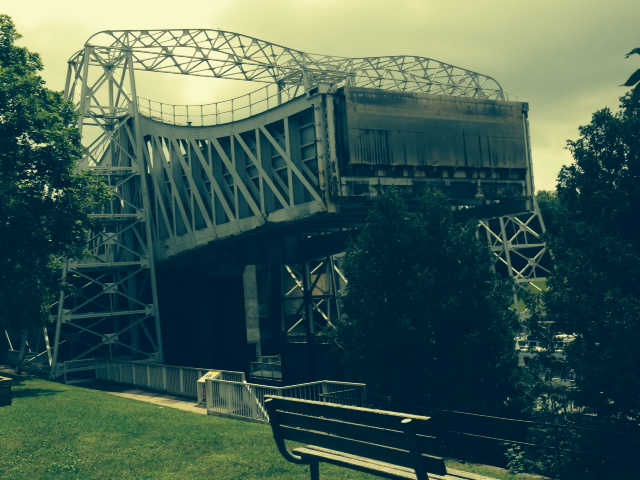
We successfully crossed Lake Simcoe in a moderate chop, a crossing of a bit less than two hours. Our next highlight was the Kirkfield Lift lock.  You may recall the incredible Peterborough Lift Lock from a previous blog.  Only eight lift locks were ever built in the entire world, and two of them are on the Trent Severn Waterway in Canada (the others are in Europe). Peterborough is the highest in the world (at 65 feet) and Kirkfield is the second highest in the world, at about 50 feet.  We’ve now passed the high point on the Trent Severn and are on our way down to the level of Lake Huron, so our trip on the Kirkfield lock was down.  Here are some pictures of this amazing engineering wonder from 100 or so years ago:

You may recall from the pictures of the Peterborough lock that the lift lock consists of two chambers that each connect to the canal at the upper and lower level. From the top, we drove our boat into the chamber, after which a submerged gate rises into position to separate the water in the chamber from the water in the canal.  A foot of water is added to the upper chamber and a valve is opened.  The extra weight of the upper chamber causes it to descend, while pushing the lower chamber up at the same time. A single piston about 5 feet in diameter supports the entire weight of each chamber as it rises or lowers - steel structure, water, and boats

You may recall from the pictures of the Peterborough lock that the lift lock consists of two chambers that each connect to the canal at the upper and lower levels. From the top, we drove our boat into the chamber, after which a submerged gate rises into position to separate the water in the chamber from the water in the canal. A foot of water is added to the upper chamber and a valve is opened. The extra weight of the upper chamber causes it to descend, while pushing the lower chamber up at the same time. A single piston about 5 feet in diameter supports the entire weight of each chamber as it rises or lowers – steel structure, water, boats, and all

The massive structure that is part of the lift lock

The massive structure that is part of the lift lock


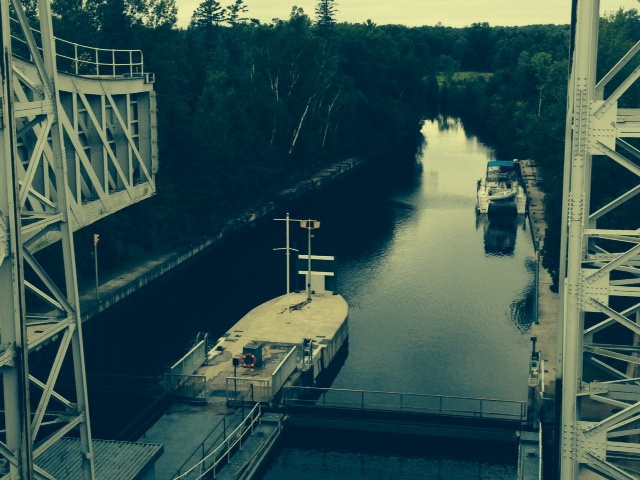
This picture is taken from the boat after we drove into the upper chamber of the Kirkfield lock. The solid wall at the front is the gate that will submerge and allow us to drive over it when the chamber reaches the lower canal, 50 feet down.  Doug is deciding whether or not to jump rather than spend the rest of the week on the boat with us

This picture is taken from the boat after we drove into the upper chamber of the Kirkfield lock. The solid wall at the front is the gate that will submerge and allow us to drive over it when the chamber reaches the lower canal, 50 feet down. Doug is deciding whether or not to jump rather than spend the rest of the week on the boat with us

I swear, Doug, the one that got away was THIS big!

I swear, Doug, the one that got away was THIS big!

This picture is taken from the walkway at the top of the lock after we descended - the right-hand chamber is at the bottom and you can see the left-hand chamber suspended in the air on the left side of the picture. The Joint Adventure is tied to the wall at the bottom.

This picture is taken from the walkway at the top of the lock after we descended – the right-hand chamber is at the bottom and you can see the left-hand chamber suspended in the air on the left side of the picture. The Joint Adventure is tied to the wall at the bottom.

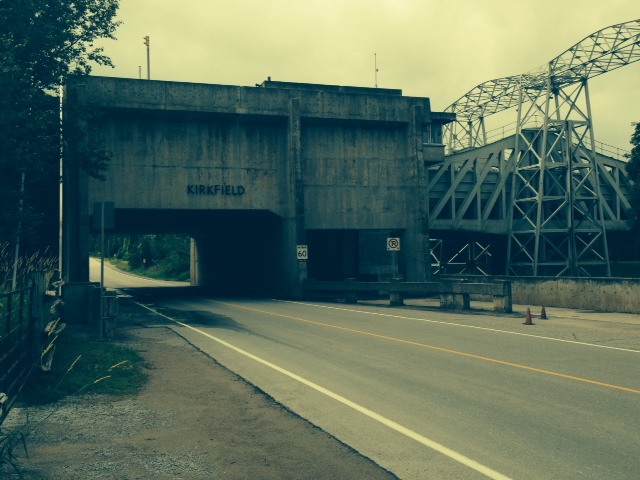
The canal at the upper level goes over the roadway - when approaching the tunnel, drivers often see a large boat above them, entering the upper chamber

The canal at the upper level goes over the roadway – when approaching the tunnel, drivers often see a large boat above them, entering the upper chamber

Thursday night we stayed at the docks of a unique restaurant that is located on an island, accessible only by boat, called The Waubic. George, the proprietor, is the friendliest guy you’ll ever meet. Now in his 70,s, he bought it about 12 years ago and refers to it as his “retirement gone awry”.  It was vacant and derelict when he bought it, serving as home to several raccoons. After nearly a year’s work, he opened the restaurant, which has now become a fixture on this end of the Trent Severn. Run by multiple members of his family, the restaurant has a unique ambiance, great food, and a happy camaraderie among the boaters and everyone involved in running the restaurant. Here are some pictures:

The Waubic, as seen from the Joint Adventure while docked out front

The Waubic, as seen from the bridge of the Joint Adventure while docked out front

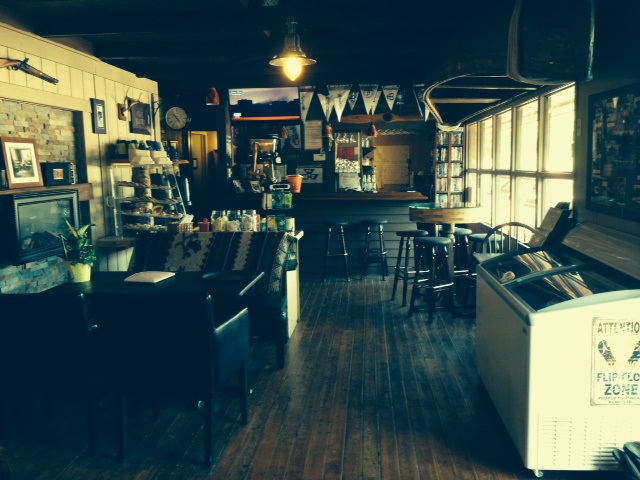
The cozy inside bar/dining area at the Waubic.

The cozy inside bar/dining area at the Waubic.

We decided to have our pre-dinner  "happy hour" at the bar instead of on the boat - from left to right: Paul, Trish, Pat, Doug, Janet, Jim

We decided to have our pre-dinner “happy hour” at the bar instead of on the boat – from left to right: Paul, Trish, Pat, Doug, Janet, Jim

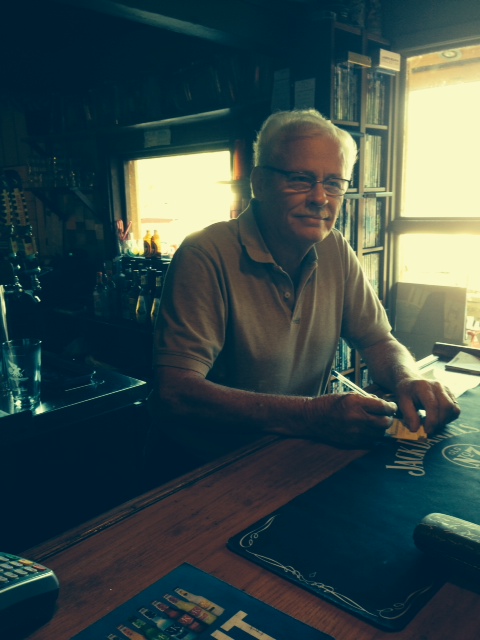
George, the proprietor of The Waubic.  He mentioned that he would like to bring his wife to Boston and/or to Tanglewood to see the Boston Pops - he has an open invitation to stay with us or Doug & Janet in Boston or with Pat & Paul in Stockbridge

George, the proprietor of The Waubic. He mentioned that he would like to bring his wife to Boston and/or to Tanglewood to see the Boston Pops – he has an open invitation to stay with us or Doug & Janet in Boston or with Pat & Paul in Stockbridge

Alright, the engineer in me is about to take over once more.  As amazing as the two lift locks are, on our last day on the Trent Severn, we descended the Big Chute Marine Railway – the only one of its kind in the entire world!  You may recall that the Trent Severn was built piecemeal over a 90 year period rather than as part of a master plan. However, early in the 1900’s, the only missing link was at Big Chute. Having dawdled for 90 years, suddenly completing the Waterway as quickly as possible became an urgent priority (it must have been an election year….).  Since a lock would take several years to build, the government decided to install a temporary marine railway to move boats from one water level to the other while the lock was being constructed.  The marine railway was therefore opened in 1917 among much fanfare.  Funds for the lock itself dried up following World War I, so the lock was never built.  In the meantime, the original marine railway has been upgraded several times over the years to carry bigger and heavier boats, and is today a marvel to see. In 1978, the government considered building a conventional lock to replace the marine railway rather than upgrade it (the marine railway is much more expensive to run), but decided against it because a lock would allow an invasive species – the lamprey, a species of eel – to spread.

So what is a marine railway, anyway? It is best explained with pictures:

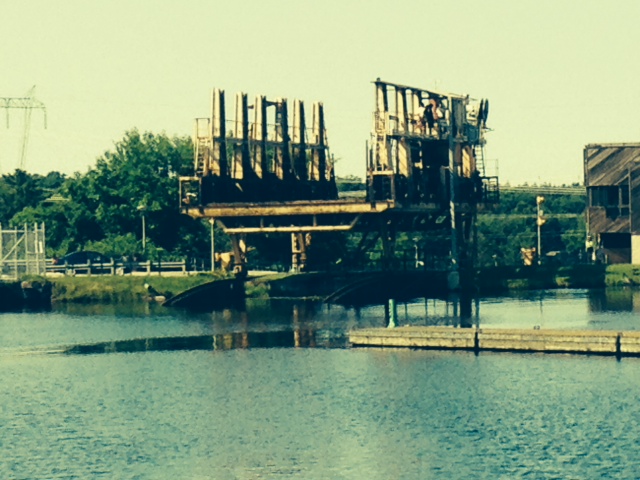
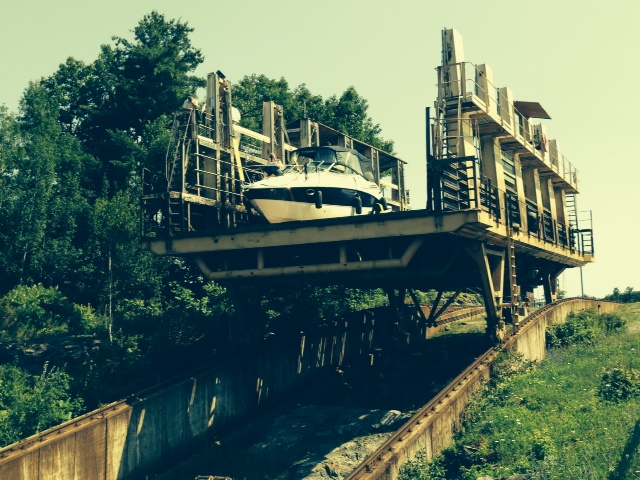
This is the carriage that holds the boats. It is mounted on a unique track system and is moved back and forth along the tracks by steel cables.  The tracks take the carriage into the water and partially submerges it so boats can drive into the carriage

This is the carriage that holds the boats. It is mounted on a unique track system and is moved back and forth along the tracks by steel cables. The tracks take the carriage into the water and partially submerges it so boats can drive into the carriage

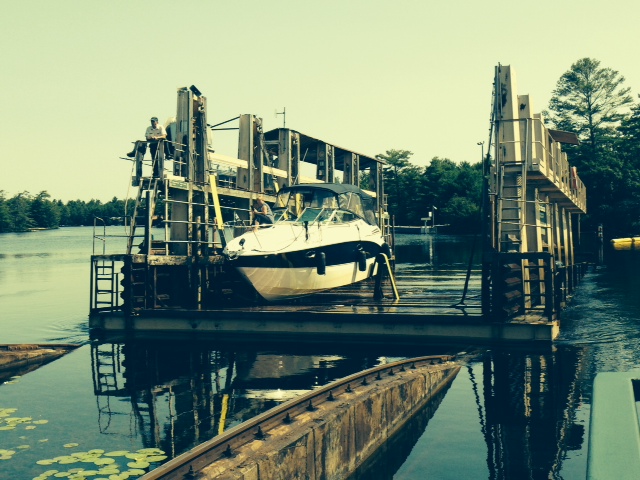
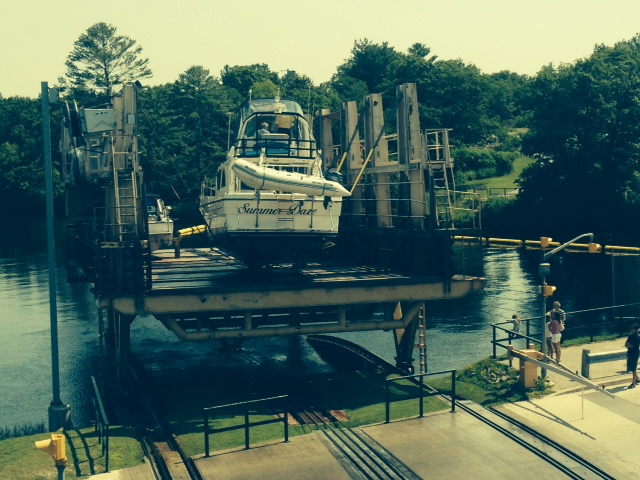
The carriage has been lowered into the water and a boat is being driven into it.  This sequence happens to be of a rather small boat and only one boat is in the carriage, but the carriage will accommodate boats up to 60 or 70 feet in length and can handle as many as 8 boats at a time, depending on their size

The carriage has been lowered into the water and a boat is being driven into it. This sequence happens to be of a rather small boat and only one boat is in the carriage, but the carriage will accommodate boats up to 60 or 70 feet in length and can handle as many as 8 boats at a time, depending on their size

The boat is on the carriage and the cables are pulling the carriage out of the water and up from the lake at the upper level

The boat is on the carriage and the cables are pulling the carriage out of the water and up from the lake at the upper level

The carriage is now at its highest point, and is passing over a roadway with its payload intact

The carriage is now at its highest point, and is passing over a roadway with its payload intact

The carriage has now started to descend the hill to the Severn River below

The carriage has now started to descend the hill to the Severn River below

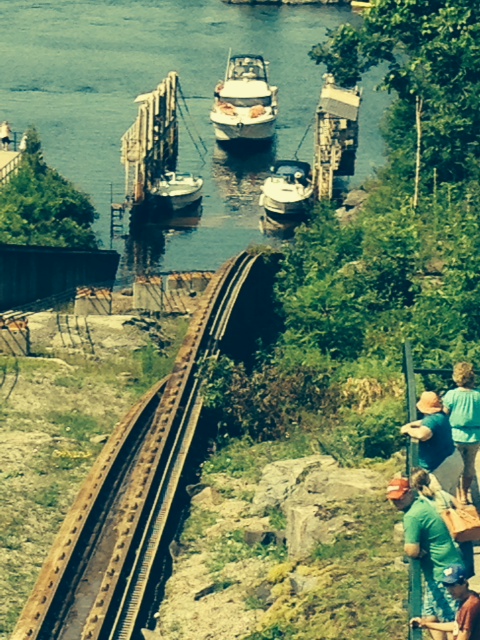
The carriage is massive. It actually rides on two separate tracks, which you can see in the picture - the tracks change elevation relative to one another as the carriage descends over the crest and down the hill - the front wheels are on a higher track and the rear wheels are on a lower track, allowing the carriage to stay level through its journey. The relative level of the tracks is the opposite at the other end

The carriage is massive. It actually rides on two separate tracks, which you can see in the picture – the tracks change elevation relative to one another as the carriage descends over the crest and down the hill – the front wheels are on a higher track and the rear wheels are on a lower track, allowing the carriage to stay level through its journey. The relative level of the tracks is the opposite at the other end

The carriage is about to descend into the water on the lower level of the Severn River

The carriage is about to descend into the water on the lower level of the Severn River

Once the carriage is submerged at the lower level, the boat simply drives off

Once the carriage is submerged at the lower level, the boat simply drives off

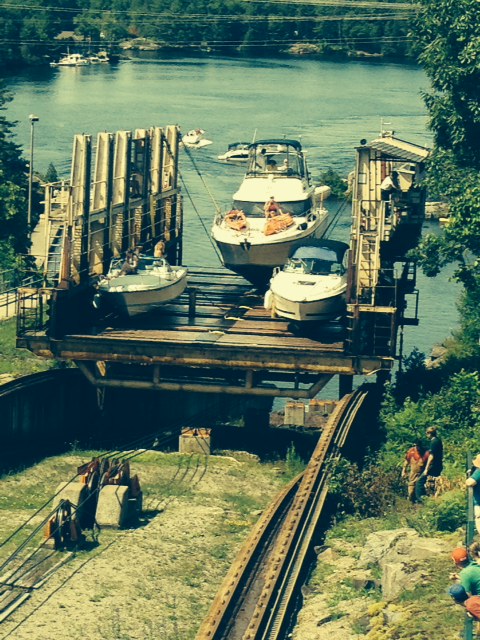
Three boats entering to be lifted from the lower level, including a larger boat of about 36'

Three boats entering to be lifted from the lower level, including a larger boat of about 36′

Notice that the larger boat is suspended from cables.  Smaller boats sit in cradles built into the carriage. The Joint Adventure, since it has two hulls,  sits directly on the wooden deck of the carriage.  Notice that everyone stays on the boat and rides with it as it transits the marine railway

Notice that the larger boat is suspended from cables. Smaller boats sit in cradles built into the carriage. The Joint Adventure, since it has two hulls, sits directly on the wooden deck of the carriage. Notice that everyone stays on the boat and rides with it as it transits the marine railway

The larger boat descending into the river above

The larger boat descending into the river above

These are the cables that pull the carriage up and down.  There are four separate redundant cables, each one of which is sized to support the entire weight of the carriage, fully loaded.

These are the cables that pull the carriage up and down. There are four separate redundant cables, each one of which is sized to support the entire weight of the carriage, fully loaded.

It's difficult to capture the ride with a camera, but this was taken as we ascended from the lake at the top and over the road

It’s difficult to capture the ride with a camera, but this was taken as we ascended from the lake at the top and over the road

Descending to the river below

Descending to the river below

Apparently the first man to run the original Big Chute railway – William “Billy” Jobe – was quite a character. If there were children among the passengers on a boat, he would ask them “Can you swim?” If they said no, he would grab them by the scruff of the neck and the seat of the pants and throw them in the water.  If the mother objected, he would say “They are your children, you don’t teach them to swim and I can’t watch them all the time.  I’ll teach them, but it will be the hard way”.

The people who ran the marine railway in the early days lived in stone houses with no plumbing and no heating system. They were on duty 24/7 from the time the canal opened around April until it closed in November.

OK – back to the rest of the trip.  This end of the Trent Severn is incredibly beautiful, with picturesque scenes of landscape, nature, and quaint cottages at virtually every turn, none of which can be truly captured by camera.  However, here are a few samples:

I could live here...

I could live here…

Or here...

Or here…

Or here...

Or here…

Or here...

Or here…

Or here...

Or here…

Or even here!

Or even here!

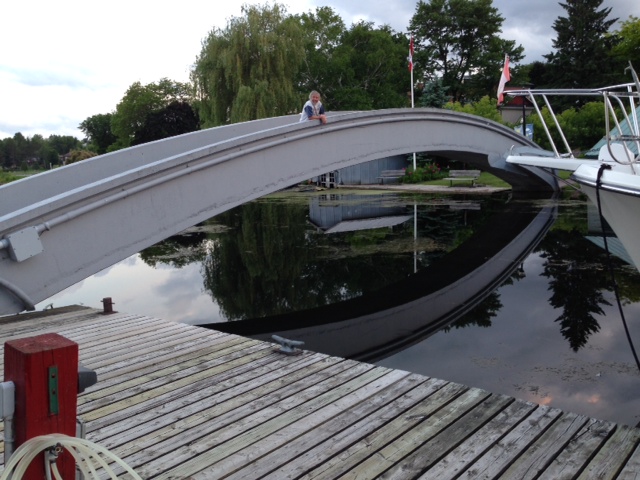
An arch bridge to test our attention

An arch bridge entering one of the many lakes that form a part of the Trent Severn Waterway

Trish with a steady hand on the helm

Trish with a steady hand on the helm

Doug & Janet watching the world go by as we mosey through the channel

Doug & Janet watching the world go by as we mosey through the channel

I hope SOMEBODY is driving this boat! From left to right - Trish, Pat, Janet, Jim

I hope SOMEBODY is driving this boat! From left to right – Trish, Pat, Janet, Jim

So on Friday after descending the Big Chute Marine Railway, we went through the final lock on the Trent Severn Waterway at Port Severn and entered Lake Huron – another major milestone!  We will transit Lake Huron through the Georgian Bay section of the lake, otherwise known as the 30,000 Islands.  More on that later. We went 5 miles into the bay to Midland, where we stayed through Sunday morning to change crews. Sadly, Doug & Janet had to leave us to go back to real life, but happily, Dave & Joan joined us for the next leg through Georgian Bay.  However, before parting, we had one last night with Doug & Janet.  After dinner, we went dancing to a rather loud rock band who referred to us throughout the evening as “the Americans”. Doug managed to drag several other innocent patrons onto the dance floor, including one gentleman (who turned out to be the father of one of the band members) who, after being spurned by Janet, Trish, & Pat, took a liking to Doug – he and Doug became best buddies. Preserved for posterity:

Doug and his new friend Bill - made for each other.   We made sure Bill didn't know where our boat was docked.

Doug and his new friend Bill – made for each other. We made sure Bill didn’t know where our boat was docked.

Tomorrow (Sunday) morning we cast off the lines again and start to pick our way through the 30,000 Islands of Georgian Bay.

Standard

TIME OUT #2

TIME OUT #2 – Post # 18 – Day 71: July 13, 2014.  On board:  No one

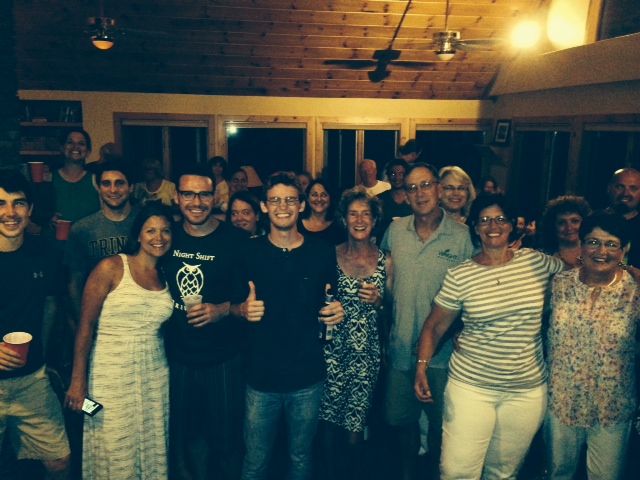
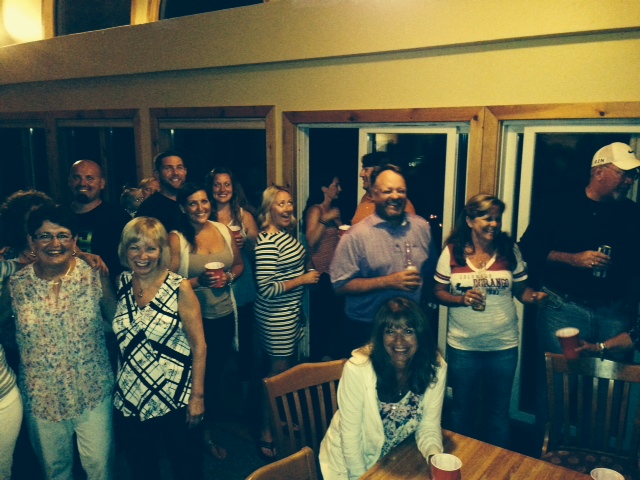
Forty years ago, the summer after we graduated from college, my friend and college roommate Dave Luciano and his two housemates decided to host a party at the small rented three bedroom suburban subdivision house where they lived. They had no idea who or how many would show up – about 75 people came.  Did I mention that it was a small three bedroom house in a suburban subdivision neighborhood?  Overflow sleeping arrangements comprised of tents scattered throughout the lawn. The third time the police showed up on Friday night, about 1:00 AM, as I recall, they were quite serious and made it clear that everyone had better be gone first thing in the morning (they were savvy enough not to force us to vacate that night, knowing that many people would have to drive). The next day, Dave & Company moved the party to a local state park, returning to the rented house in the middle of the night – very quietly, again with many people sleeping outside in tents. An hour or two before dawn, it started to get windy – VERY windy. Soon people were desperately trying to hold their tents on the ground.  The noise from the wind grew to a deafening roar, then gradually subsided.  The next morning, a path of total destruction was discovered a couple hundred yards from the house, taking down all the trees in its path and blocking the road with downed trees. A small tornado of the type that occur in western Massachusetts from time to time had passed a couple hundred yards from the “tent city” in the back yard.

So began a 40 year tradition – a party each July, usually attended by 75-100 family and friends. Starting with Year 2, the party has been held at a ski house in Vermont. It has evolved from what could generously be called “frat party” status in the early years through child-rearing years to a gathering that is now dominated by the twenty-something and thirty-something Second Generation (some “frat party” remnants still emerge from time to time…). We’ve managed to keep it fun and exciting each year, but we’ve been successful in avoiding the level of excitement of the first year of cops and tornadoes.

So we left the boat near Fenelon Falls, Ontario, rented a car, and drove to Killington Vermont to attend the FORTIETH annual party commemorating that first year. Here are some pictures from the long party weekend:

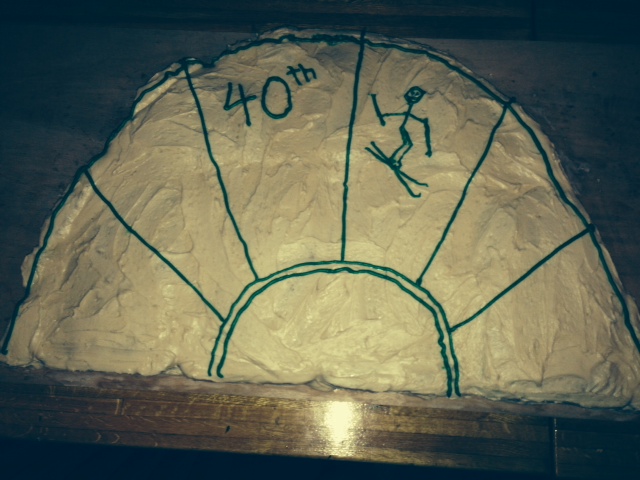
Jenny made a gigantic cake to commemorate the 40th

Jenny made a gigantic cake to commemorate the 40th

We started the tradition of a "kids vs. adults" soccer game when the kids were little and we could be assured of beating them.  That didn't last long. Now we arbitrarily divide into two teams and the older folks mostly just get in the way - but we're still out there playing!

We started the tradition of a “kids vs. adults” soccer game when the kids were little and we could be assured of beating them. That didn’t last long. Now we arbitrarily divide into two teams and the older folks mostly just get in the way – but we’re still out there playing!

We bring grills, food, beer, and everything else needed for lunch at the fields

We bring grills, food, beer, and everything else needed for lunch at the fields.  Wendy & Nif watching the show.

An afternoon softball game provides some great entertainment each year

An afternoon softball game provides some great entertainment for the spectators each year

A new tradition this year was a "cornhole" tournament, complete with brackets, playoffs, and trophies

A new tradition this year was a “cornhole” tournament, complete with brackets, playoffs, and trophies

The "cornhole" tournament finals were held back at the ski house Saturday evening

The “cornhole” tournament finals were held back at the ski house Saturday evening

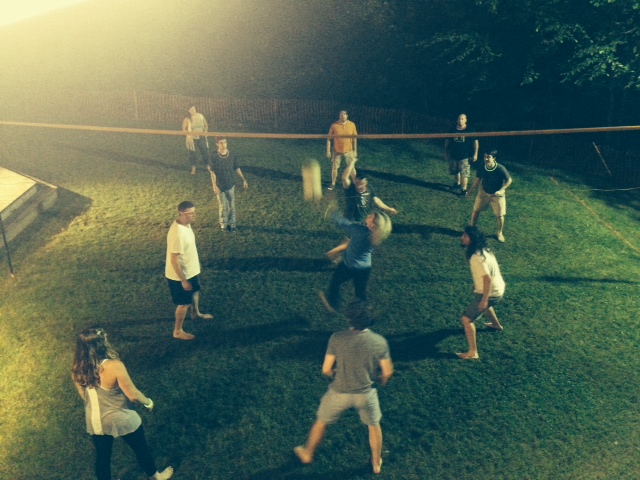
Volleyball games go on nearly non-stop through the weekend - when the competitive juices get flowing, at times it's not for the faint-hearted!

Volleyball games go on nearly non-stop through the weekend, both at the house and at the athletic fields. You’d better be prepared to sacrifice your body.  The court at the house is adjacent to a steep hill that goes about a half mile to the valley below (notice the orange fence).  Job One is to keep the ball from going over the fence and down the hill

There is a pool adjacent to the athletic fields - a great way to cool down throughout the day or to just hang out!

There is a pool adjacent to the athletic fields – a great way to cool down throughout the day or to just hang out! Left to right, Russ, Mary Beth, Barb, Trish, Louise, Elizabeth, Danielle, Colleen, Jen, and Ange

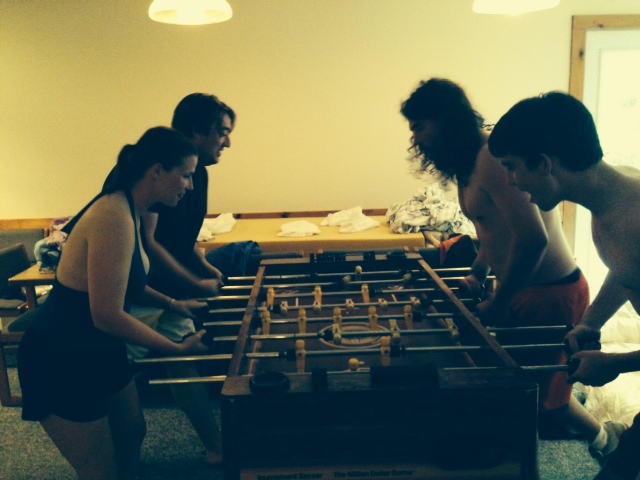
Back at the ski house in the evening, the foosball games become VERY serious!

Back at the ski house in the evening, the foosball games become VERY serious!

After a dinner spread, the serious partying starts - Joel & Kevin are the makers and purveyors of the margaritas, while others wisely stick to beer, wine, or their favorite drink

After a dinner spread, the serious partying starts – Joel & Kevin are the makers and purveyors of the margaritas, while others wisely stick to beer, wine, or their favorite drink

More partyers Saturday evening

Warming up Saturday evening

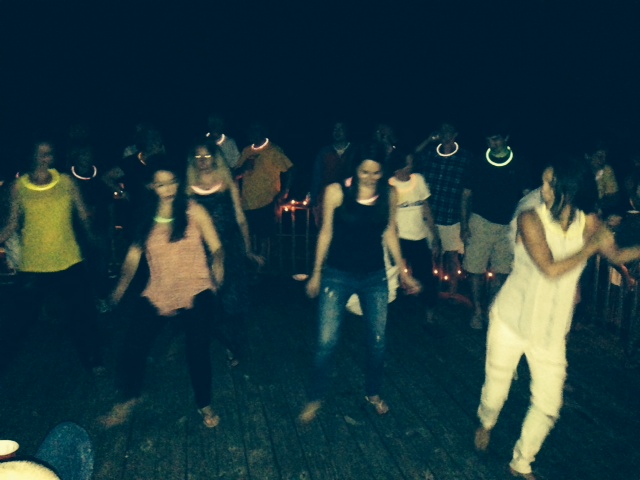
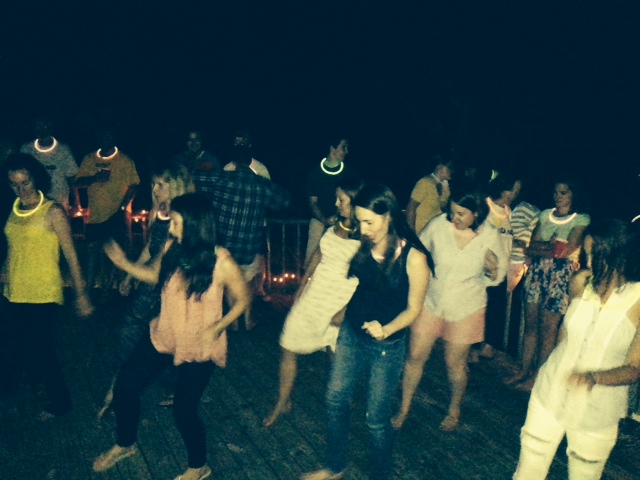
Saturday night features dancing on the outside deck till the wee hours.  This year, Laura & Emily rented DJ equipment and developed an awesome playlist including some classic "baby boomer" music with a healthy dose of "second generation" music mixed in. We ended the evening with our unlikely traditional last song - "My Way", by Frank Sinatra at 1:15 AM, to which we shamelessly sang along at the top of our lungs

Saturday night features dancing on the outside deck till the wee hours. This year, Laura & Emily rented DJ equipment and developed an awesome playlist including some classic “baby boomer” music with a healthy dose of “second generation” music mixed in. We ended the evening with our unlikely traditional last song – “My Way”, by Frank Sinatra at 1:15 AM, to which we shamelessly sang along at the top of our lungs – not a pretty sight (or sound!

The women often take to the floor for various line dances - I have no idea where they learn to do them - I think it's innate. I sometimes try to join in but usually end up hurting myself

The women often take to the floor for various line dances – I have no idea where they learn to do them – I think it’s innate. I sometimes try to join in but usually end up hurting myself

More line dancing which is far too complicated for me

More line dancing which is far too complicated for me

And still more dancing...

And still more dancing…

Carly got into the act as well...

Carly got into the act as well…

At about midnight, someone turned on the makeshift lights over the volleyball court. In between volleys, the players danced to the music, stopping briefly to hit the ball when it was served

At about midnight, someone turned on the makeshift lights over the volleyball court. In between volleys, the players danced to the music, stopping briefly to hit the ball when it was served

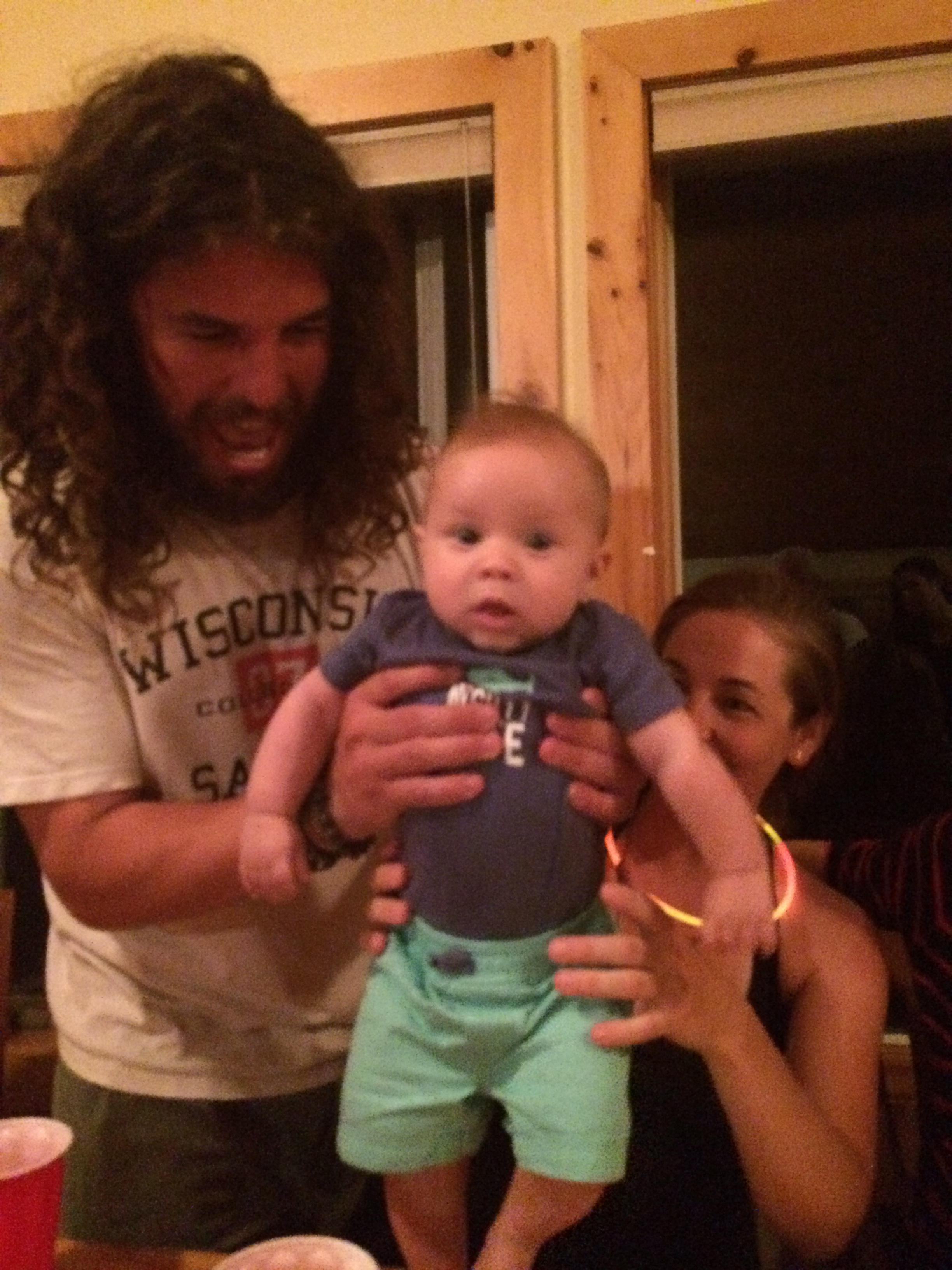
While the baton is in the process of being passed to the Second Generation, the Third Generation is starting to make their presence known - we had three Third Generationers this weekend, including Liam, Ryder, and Charlotte (Liam shown here)

While the baton is in the process of being passed to the Second Generation, the Third Generation is starting to make their presence known – we had three Third Generationers this weekend, including Liam, Ryder, and Charlotte (Liam shown here)

So now that the weekend is over – back to the Great Loop. We drive back to the Joint Adventure tomorrow (Monday), and plan to cast off the lines on Tuesday morning. In the meantime, our friends Jason & Kerrin sent us some pictures that they took of us as we cruised near them over the last couple of weeks.  Here are a few of them:

In Peterborough Harbor, approaching the village and the downtown marina

In Peterborough Harbor, approaching the village and the downtown marina


In the lock with Jason & Kerrin

In the lock with Jason & Kerrin


The joint Adventure departing a lock

The joint Adventure departing a lock


Our crew of eight from the week before last

Our crew of eight from the week before last

The Joint Adventure tucked in the corner in the marina at Bobcaygeon

The Joint Adventure tucked in the corner in the marina at Bobcaygeon

Standard

CHANCE ENCOUNTER

CHANCE ENCOUNTER – Post # 16 – Day 67, July 9, 2014. On board: Pat & Paul Coates, Jim & Trish Koningisor

We missed our crew of eight as soon as they left!  It did give us a chance to reinstate some order in the cabin (to a degree), but we wish they were here.  Peterborough charmed us for another day before we moved on – here are a few more pictures from our last day there:

I'm not much of a shopper, but this marketing strategy did cause me to park my bike and go in for a look...

I’m not much of a shopper, but this marketing strategy did cause me to park my bike and go in for a look in this store…

There was a rock concert in the park in Peterborough on Saturday night - the good news is that the Joint Adventure was docked immediately adjacent to the pavilion that housed the band. The bad news is that the Joint Adventure was docked immediately adjacent to the pavilion that house the band.  The music was hard rock - LOUD!

There was a rock concert in the park in Peterborough on Saturday night – the good news is that the Joint Adventure was docked immediately adjacent to the pavilion that housed the band. The bad news is that the Joint Adventure was docked immediately adjacent to the pavilion that housed the band. The music was hard rock – LOUD!

On our way out of Peterborough, we saw what looked like a huge school of fish churning up the water ahead - it turned out to be about 500 swimmers participating in the Peterborough Triathalon at 8:00 AM on Sunday morning - good thing we didn't cast a line...

On our way out of Peterborough, we saw what looked like a huge school of fish churning up the water ahead – it turned out to be about 500 swimmers participating in the Peterborough Triathalon at 8:00 AM on Sunday morning – good thing we didn’t cast a line…

Sunday we arrived at Young’s Point late in the afternoon, as the Peterborough Lift Lock was closed for repairs until noon.  Sometimes a Chance Encounter has surprising results. While we were fueling up at the dock, a grandfather with his son and two grandkids in tow (ages 3 & 4) asked if the kids could look inside the boat. After we were done fueling, we hoisted them aboard and gave the whole group a tour.  Later that evening, we happened to sit a few tables from them in the restaurant overlooking the dock.  Before we knew it, an order of bruschetta arrived, compliments of the grandfather. We finished dinner and were preparing to leave when a bottle of wine arrived, also compliments of the grandfather – not that we needed to drink another bottle of wine at that point, but what could we do?

The weather Monday was cloudy with rain predicted, but we decided to head to Bobcaygeon about 35 miles and three locks away.  Although the weather was cloudy and breezy and we did get some rain, the scenery was spectacular, with rock outcroppings, islands, and picturesque cottages galore. Here are some pictures from Monday & Tuesday’s runs:

Friends Jason & Kerrin that we met along the way and passed in Peterborough

Friends Jason & Kerrin that we met along the way and passed in Peterborough

Now that the Bill Burke aka "Mariner of the Year" has left us, his understudies Pat & Trish had to step up and carry on without him

Now that the Bill Burke aka “Mariner of the Year” has left us, his understudies Pat & Trish had to step up and carry on without him

Sometimes the sun just doesn't cooperate...

Sometimes the sun just doesn’t cooperate and the rain comes…but as my daughter Jenny says, it’s only water

The Kawartha Lakes section of the Trent Severn Waterway is spectacularly beautiful, but the helmsman had better pay attention - there are rock outcroppings everywhere both above and below the surface.  However, the channel is well marked.

The Kawartha Lakes section of the Trent Severn Waterway is spectacularly beautiful, but the helmsman had better pay attention – there are rock outcroppings everywhere both above and below the surface. However, the channel is well marked.

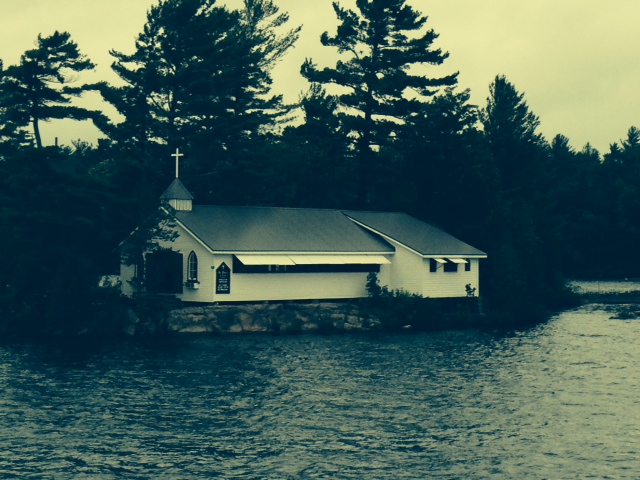
These folks take the boating lifestyle to a new level - this church is on a small island in Stoney Lake, accessible only by boat. I wonder how well-attended the service is on a rainy Sunday morning

These folks take the boating lifestyle to a new level – this church is on a small island in Stoney Lake, accessible only by boat. I wonder how well-attended the service is on a rainy Sunday morning

Rented houseboats abound on this section of the Waterway due to the abundance of lakes and the incredible scenery.  This one had a bit of a challenge maneuvering in the lock

Rented houseboats abound on this section of the Waterway due to the abundance of lakes and the incredible scenery. This one had a bit of a challenge maneuvering in the lock

Speaking of houseboats, if you are looking for a unique, relaxing, and spectacular vacation, consider renting a houseboat in this section of the Trent Severn Waterway which features calm and protected waters, many marinas and villages in which to dock and explore, great swimming and fishing, well-marked channels, and incredible scenery. They are easy to operate and the rental companies will provide on-water lessons on driving the boat if you need them.  Two local companies that rent them are Happy Days House Boats (www.happydayshouseboats.com – 705 738 2201) or Egan Houseboat Rentals (www.houseboat.on.ca – 800 720 3426).

We stayed in Bobcaygeon Monday & Tuesday nights. Bobcaygeon is a pleasant town with many interesting shops, including world-renowned Bigley Shoes & Clothing, which includes a mind-boggling selection of shoes. Bobcaygeon is also home to the Kawartha Settlers’ Village with 22 historic homes and buildings on 8 acres depicting life in the Kawartha region from 1830 to 1935, and the nearby Horseless Carriage Museum depicting early transportation and mechanical antiquities, including an 1890’s General Store.

As I mentioned in a previous blog, the Trent Severn Waterway was not built in response to a military need or a master plan, but resulted from the eventual linking of individual locks and sections over a period of 90 years.  The first lock to be constructed was in Bobcaygeon as a result of a government grant in 1833 (I guess there were earmarks even back then). It was made of wood and was intended to speed transportation between Sturgeon and Pigeon Lakes, and was to have a lift of 10 feet. However, when it was completed and the water let in, it was a disaster – it had been built on porous rock, so the water entering the upper level literally disappeared into the ground before reaching the lock. In addition, it was built at the wrong elevation, so there would have been insufficient depth even if the water hadn’t disappeared (sounds like a big Change Order in the making…).  After two years and the expenditure of a lot more money ( sound familiar?), the lock was finally opened in 1838. However, because it was still at the wrong elevation, the depth was not adequate nor was the lock long enough for the only large vessel on the lake at that time – therefore, it could be used only for small boats and logs. A new, usable lock was finally built in Bobcaygeon in 1857. Thus began the checkered history of the construction of the Trent Severn Waterway, today a unique gem that is a boaters dream.

Sometimes things just don’t go as planned, even when those plans were made weeks ago. On Wednesday, the weather was cold, cloudy, and windy, but we wanted to get to Fenelon Falls where we had made arrangements with a marina to leave the boat through next Tuesday. The marina was on Cameron Lake, so I was concerned about it being exposed to the weather – however, I was assured by the owner that there was a breakwater to provide protection.  We arrived in a stiff wind blowing across the entire length of the lake, directly into the marina – no breakwater.  After some scrambling, we found a place on a river about 4 miles away at the other end of the lake that could take the boat thru next Tuesday – so that’s what we did. Anyway, there were some interesting houses along the way – here are a couple of pictures:

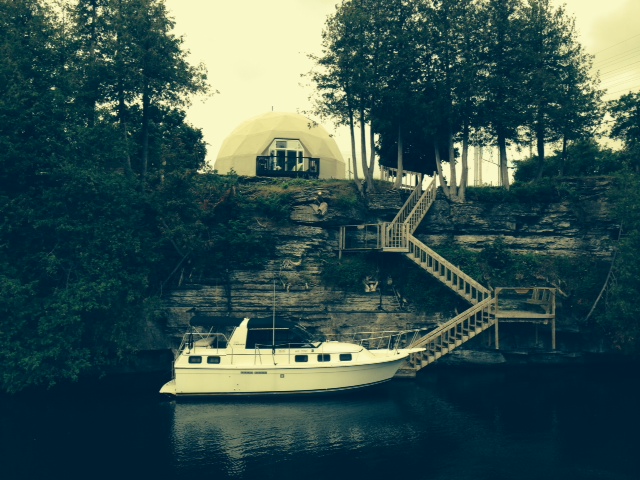
A long climb down to the water - notice the geodome house at the top

A long climb down to the water – notice the geodome house at the top

A family compound making full use of the island

A family compound making full use of the island

So back to Chance Encounters – this has to be the granddaddy of all Chance Encounters.  We’ve had a nagging but s0 far manageable problem with our shifting mechanism on the starboard (right side) engine since we bought the boat a year and a half ago. We thought we had it solved three different times, but after a while it recurs, and recently started to occur again, with increasing frequency. I decided that, whatever it took, I had to get it fixed once and for all. It’s a design and configuration that is somewhat unique to this model of boat (a PDQ), so we couldn’t find anyone who was familiar with or had experience with this system. Then, while we were in Campbellford, a gentleman on a sailboat (Michael) immediately recognized the boat as a PDQ and approached me to chat about the boat. He told me that his brother-in-law (James) had worked at the factory that built PDQ’s (they went out of business in 2007 after building 114 of them) and suggested I contact him to learn more about the boat. So I did.  The Joint Adventure is PDQ hull #10 (the 10th boat built).  It turns out that James (1) worked on the construction of many of the PDQ’s that were built, including hull #10 (2) commissioned hull #10 (3) performed warranty work on hull #10, and (4) is the only person from the original factory that routinely performs work on PDQ’s. He lives not far from Bobcaygeon so agreed to drive down and look at the shifting mechanism. Within 10 minutes he had diagnosed the problem, and 30 minutes later had it fixed – this is a problem that three different very good mechanics over the past year and a half had been unable to permanently fix. What are the odds that I would happen to run into the brother-in-law of the guy that helped build and commissioned this exact boat, and that would know exactly how to diagnose and fix the problem within minutes?

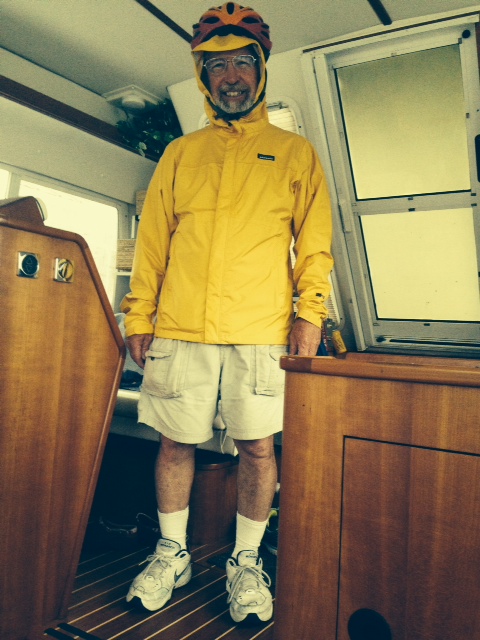
One last image – I really wanted to watch the Brazil-Germany World Cup semi-final, but the nearest pub with a TV was a quarter mile away and it was absolutely pouring rain and would not let up – so I decided to ride my bike through the rain. Pat snapped this picture as I was about to leave the boat and made me agree to put it in the blog.  Of course, the rain stopped 10 minutes after I got to the pub.

No, it'd not a creature from outer space....

No, it’d not a creature from outer space….


Standard

AND THEN THERE WERE EIGHT….

AND THEN THERE WERE EIGHT – Post #16 – July 5, 2014 – Day 64- On board: Jim & Trish Koningisor, Pat & Paul Coates, Red & Mary Beth Southerton, Bill & Kathy Burke

We had the great fortune to have Trish’s sister and brother-in-law Red & Mary Beth Southerton and our good mutual friends Bill & Kathy Burke join us in Trenton for a week on the Joint Adventure:

Our crew of eight - from left to right: Red Southerton, Bill Burke, Kathy Burke, Jim Koningisor, Trish Koningisor, Paul Coates, Pat Coates

Our crew of eight – from left to right: Mary Beth Southerton, Red Southerton, Bill Burke, Kathy Burke, Jim Koningisor, Trish Koningisor, Paul Coates, Pat Coates

The four musketeers getting ready for the voyage in Trenton

The four musketeers getting ready for the voyage in Trenton

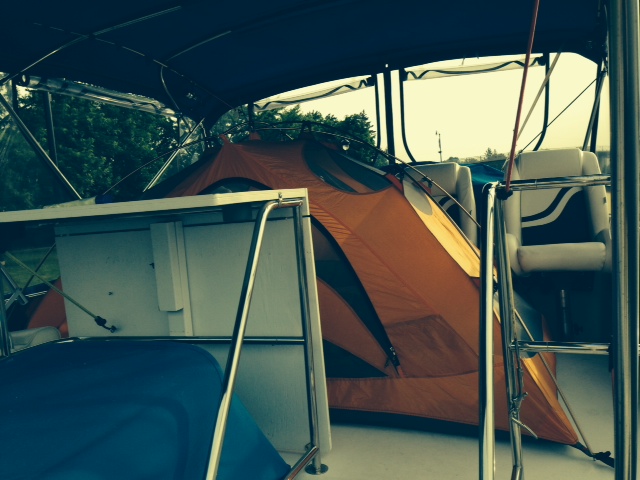
The boat is ideally designed for four and can be comfortable with six by converting the dinette into a bed – so eight is clearly stretching unless one gets quite creative regarding sleeping space. So I sleep comfortably on two stacked air mattresses on the floor of the main salon and Trish sleeps in a tent which we put up each night on the bridge (she opted for the tent over the floor inside – something about snoring…). The eight of us have great laughs together which more than makes up for the minor inconveniences:

Trish's sleeping quarters for the week - she's awesome!

Trish’s sleeping quarters for the week – she’s awesome!

Campbellford-tent 2


Our first day’s run included 6 locks in the first 6 miles up the Trent River, then an overnight stay above lock 7 at a place called Glenn Ross. I’m not sure why it is called that, because there is nothing there except a small convenience store – but that store serves GREAT ice cream, each a SUPERSIZED dish for $2. Although the areas below and adjacent to the lock were well-landscaped and lovely, we stayed above the lock in a “rustic” setting so we could get an early start in the morning before the lock opened. We swam in the river off an old abandoned railroad bridge and cooked on board, eating in the park area adjacent to the lock. Here are some pictures:

Dinner in the park area adjacent to Lock 7

Dinner in the park area adjacent to Lock 7 – we told stories and laughed till my stomach hurt.  I can’t believe we did some of the things we did when we were young and foolish (some last week)

I could lie and pretend this was me getting ready to jump off the top of the abandoned railroad bridge, but everyone knows I'm really a wuss - it's a local kid who came for swim late in the day

I could lie and pretend this was me getting ready to jump off the top of the abandoned railroad bridge, but everyone knows I’m really a wuss – it’s a local kid who came for a swim late in the day

YIKES!!!!

YIKES!!!!

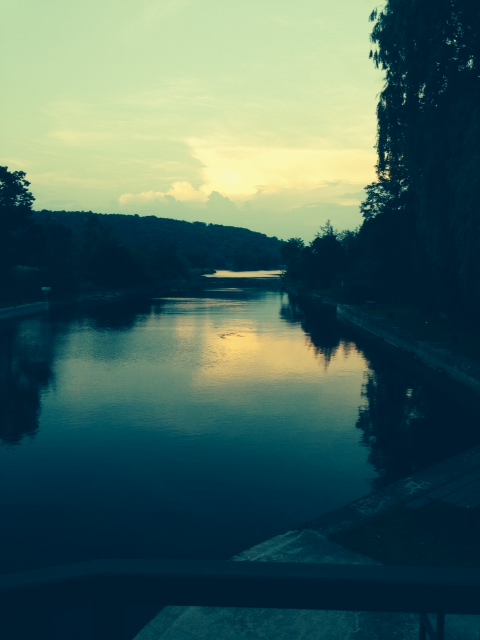
A view off the stern of the boat at dusk at Glen Ross

A view off the stern of the boat at dusk at Glen Ross

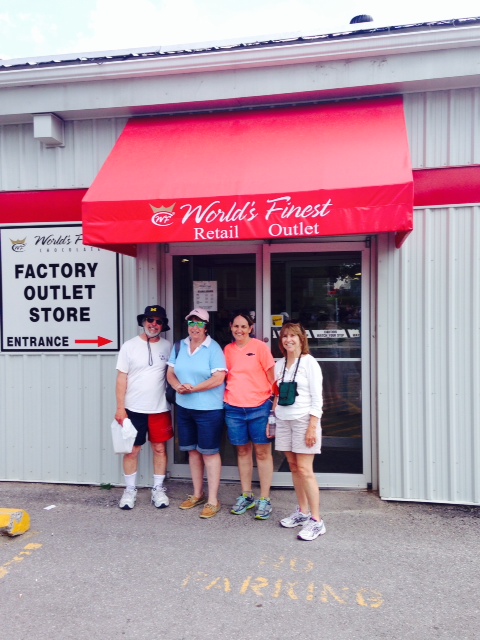
Our next stop was Campbellford, where we stayed for two nights – partly because it was such a pleasant place and partly because of thunderstorms in the forecast. We tied to the seawall in the middle of town adjacent to Old Mill Park.  It was Canada Day (equivalent to our 4th of July), so there were activities in the park all day – a $5 pancake breakfast, a petting zoo, music, etc.). A former industrial town in the late 19th and early 20th century, the town has successfully re-positioned itself as a tourist destination that has taken full advantage of the riverfront on both sides of the Trent River. Nothing could stop the four women from visiting the Chocolate Factory (I went too…):

The World's Finest Chocolate Factory (self-proclaimed)

The World’s Finest Chocolate Factory (self-proclaimed)

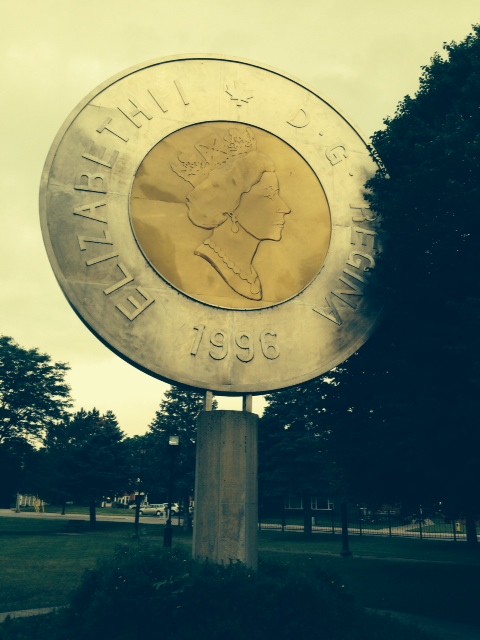
The woman who designed the Canadian $2 coin (affectionately known as the Tooney) was from Campbellford, so they built this enormous monument in the middle of the park

The woman who designed the Canadian $2 coin (affectionately known as the Tooney) was from Campbellford, so they built this enormous monument in the middle of the park

Since we had a lay-day in Campbellford, we took the opportunity to do some chores – which includes laundry. It was my turn for Trish & I, so off I went with a large load. When the wash was done, I dutifully moved it into a dryer – or so I thought. Why anyone would make a washer that looks like a dryer is beyond me. As soon as I put the money in and pressed the button, I realized that I had put the laundry into another washer. Nothing had happened yet, so I tried desperately to open the door, but it had locked, not to be opened until the machine went through it’s full range of cycles.  If this ever happens to you, please be advised that yanking the door with all your might and kicking the machine doesn’t help. So there I sat watching the clothes be washed a second time through every cycle of the machine.  Our clothes were REALLY clean – twice as clean, which means two things to me: (1) I can now wear them twice as long before washing them again, and (2) Trish has to do the laundry the next two times, since I have now done our laundry twice.

Our next stop was Hastings, a small town that has seen better days and suffers from a lack of planning – although there were some attractive and historic buildings in town, Main Street was a hodge-podge with 50’s-era non-descript buildings mixed in everywhere.  However, Kathy started us on a tradition that lasted the rest of the week – happy hour on the bridge with vodka gimlets, wine, cheese, crackers, humus – you name it:

Happy Hour with this crew quickly became a daily ritual at 5:30 - rain or shine!

Happy Hour with this crew quickly became a daily ritual at 5:30 – rain or shine!

Our next planned stop was at the Bensfort Bridge Resort (so-called). Here’s a picture to give you a flavor of this Resort:

The Bensfort Bridge Resort - notice, in particular, the Confederate flag prominently displayed

The Bensfort Bridge Resort – notice, in particular, the Confederate flag prominently displayed

So the large Confederate flag was our first clue that this place might be a bit different. We then noticed that there was not a single other boat now camper nor tent (it was also a campground) nor car in the parking lot.  Undeterred (we are on an adventure, right?), in we went to dock up. We then noticed that the posts holding up the docks were pine saplings pounded into the mud and that two docks were bound together with a come-along, apparently using one dock to hold up the other. Someone then came out to direct us where to tie up – remember the movie “Deliverance”? That will give you an image of his appearance, although I think the folks in Deliverance had bathed more recently that this gentleman. Anyway, we finally tied up after changing locations once due to my discomfort with the water depth then stirring up tons of mud despite the gentleman’s assurance that there was “plenty of water”. After a brief conference on board, we decided this might be a little more adventure than we wanted, so we cast off the lines and continued on our way – calling the gentleman to tell him we decided to move on only after we were around the corner and out of sight.

Now that the summer season is in full swing, the waterway has gotten busier.  Here are some pictures of our journey this week from Trenton to Peterborough, through about a third of the Trent Severn Waterway:

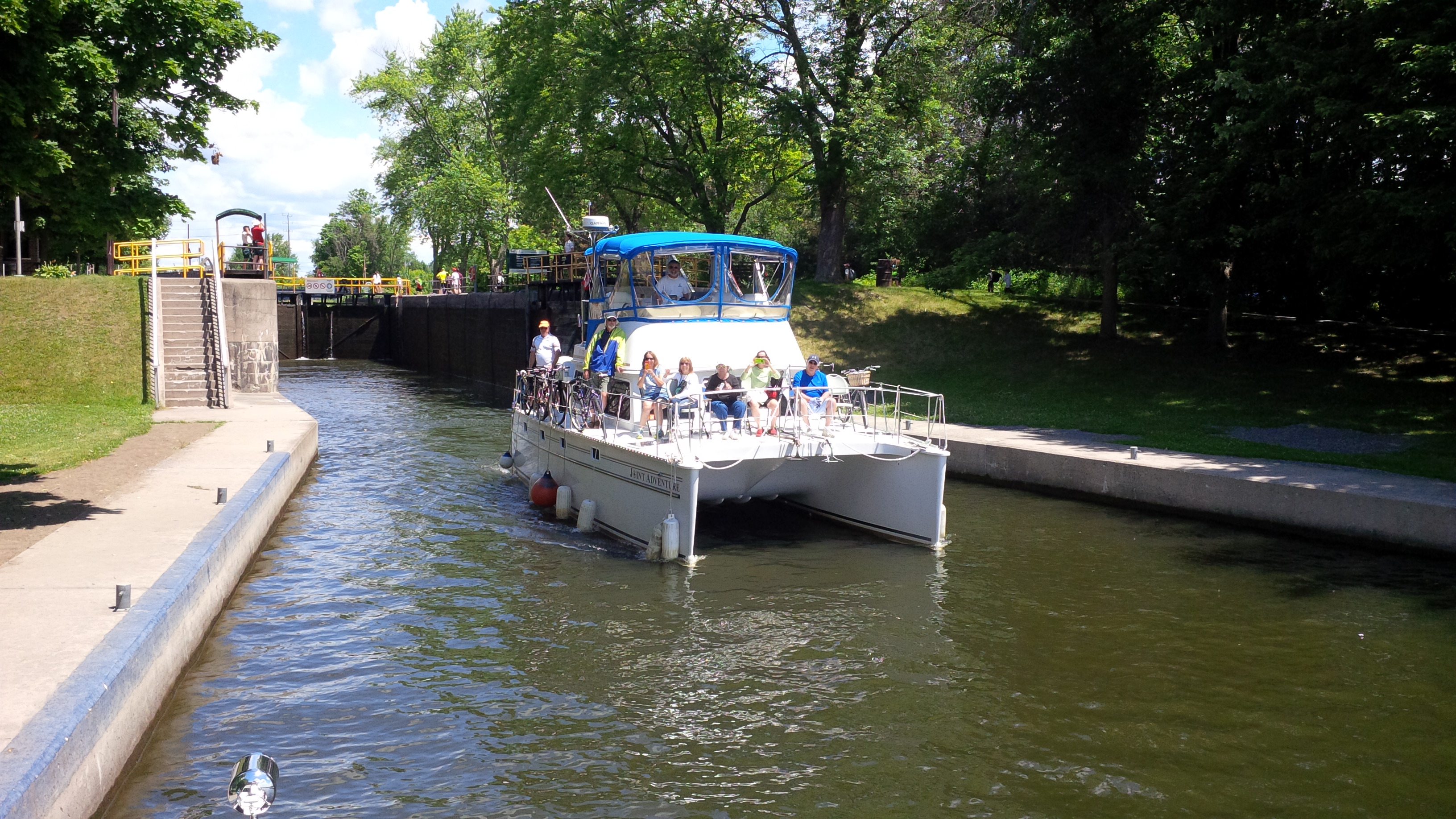
Squeezing into locks 11&12 at Ramsey Falls with three other boats - a combined rise of about 50 feet

Squeezing into locks 11&12 at Ramsey Falls with three other boats – a combined rise of about 50 feet

The view looking backwards from the top of locks 11&12

The view looking backwards from the top of locks 11&12

Bill making sure the wall doesn't get way as the lock fills

Mariner of the Year, Bill Burke, plying his trade.  If you see him around, ask to see his trophy

Earning "Mariner of the Year" is hard work - Bill resting up after the rigors of mastering his trade

Earning “Mariner of the Year” is hard work – Bill resting up after the rigors of mastering his trade


Red doing bow duty in one of the locks

Red doing bow duty in one of the locks

Mary Beth tending the lines of a boat rafted up to us in a lock

Mary Beth tending the lines of a boat rafted up to us in a lock

Paul taking a stint at the wheel through a narrow section of canal

Paul taking a stint at the wheel through a narrow section of canal

Relaxing on the front deck - affectionately known as the "front porch" - while cruising along the waterway

Relaxing on the front deck – affectionately known as the “front porch” – while cruising along the waterway

Soaking in the scenery on the front porch

Soaking in the scenery on the front porch

We shared one lock with three paddleboarders

We shared one lock with three paddleboarders

Lock 16 & 17 is a flight (double) lock - I was able to get off the boat and go up to the gate of the second lock to take this picture

Lock 16 & 17 is a flight (double) lock – I was able to get off the boat and go up to the gate of the second lock to take this picture

At the top of lock 16, about to enter the second chamber (lock 17) - what a funny looking boat!

At the top of lock 16, about to enter the second chamber (lock 17) – what a funny looking boat!

After leaving the Bensfort Bridge Resort, we pushed on to Peterborough, arriving around 4:00 PM (in time to tie up for Happy Hour). Peterborough Marina is next to a park immediately adjacent to downtown. Peterborough is a small city which, I’m told, has over 300 restaurants. There was a Blues Festival Friday night with a fabulous well-known Canadian band that comes to Peterborough once a year.  There is also a concert tonight in a pavilion in the park next to the boat, which we plan to attend. Yesterday we visited the Peterborough Art Gallery and the Canoe Museum – an unusual museum with a very interesting exhibition on the Aboriginal people that inhabited Canada before Europeans, and on the “voyageurs” who formed the backbone of the fur trade for nearly 150 years. One of their canoes could carry up to 8,000 pounds!  Half of that weight was food for the voyage, as each voyageur consumed 5,000 calories per day – their daily consumption of pemmican alone was equivalent to 11 Big Macs. In a typical day, each voyageur muscled 30,000 strokes of his paddle – about 50 strokes per minute!

A couple of images from Peterborough:

I think this is the mosquito that snuck into the boat and kept me up last night....

I think this is the mosquito that snuck into the boat and kept me up last night….

Now here's a guy who has his priorities straight....

Now here’s a guy who has his priorities straight….

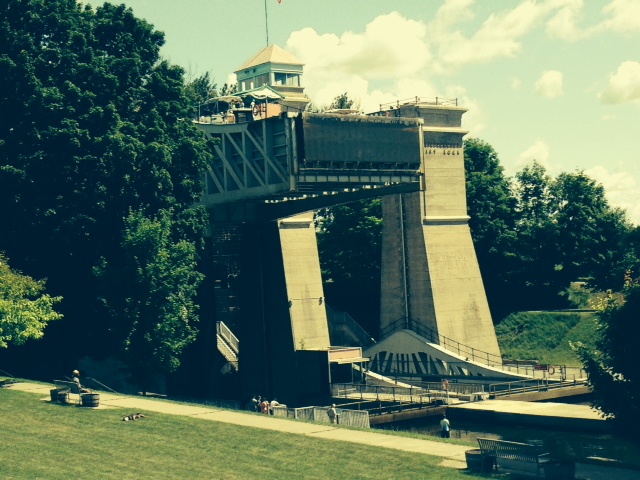
For boaters, Peterborough is home to one of the most remarkable engineering marvels of the late 1800’s, known as the Peterborough Lift Lock.  It is one of just 8 lift locks ever built, and is the highest in the world, lifting boats 6 1/2 stories in a single lift (one of the other 8 lift locks is also located on the Trent Severn, in Kirkfield). The Peterborough lock was the first lock in the world to use unreinforced concrete, cutting edge at the time.  It took 8 years to build, from 1896-1904.  As you will see from the pictures below, it is nothing like a conventional lock. Though the lift lock was far more expensive, it would have required at least 3 locks to raise boats the required height, so the lift lock was utilized because it significantly reduces the time required to pass through. The pictures can describe it far better than I can:

This is the view approaching the lock in the boat.  There are two chambers - the one on the right is in the air, at the level of the canal above, 6 1/2 stories higher than the level we are on.  We enter the chamber on the left after a gate at the entrance to the chamber submerges so we can pass over it

This is the view approaching the lock in the boat. There are two chambers – the one on the right is in the air, at the level of the canal above, 6 1/2 stories higher than the level we are on. We enter the chamber on the left after a gate at the entrance to the chamber submerges so we can pass over it

This is a side view of the lock with the right-hand chamber raised and the left hand chamber at the bottom. Filled with water, each chamber weighs 1700 tons and is supported by a single piston underneath the chamber. To activate the lock, the lockmaster adds about 1 foot of water, weighing 144 tons, to the upper chamber and opens a valve in a pipe between the two chambers. The extra weight causes the upper chamber to lower, and the lower chamber to simultaneously rise.  The weight difference alone powers the lock - there is no pump or electric power involved.

This is a side view of the lock with the right-hand chamber raised and the left hand chamber at the bottom. Filled with water, each chamber weighs 1700 tons and is supported by a single piston underneath the chamber. To activate the lock, the lockmaster adds about 1 foot of water, weighing 144 tons, to the upper chamber and opens a valve in a pipe between the two chambers. The extra weight causes the upper chamber to lower, and the lower chamber to simultaneously rise. The weight difference alone powers the lock – there is no pump or electric power involved.

This picture shows the two chambers passing each other as one goes up and the other down.  The chambers weigh the same whether there are boats in them or not, since the boat displaces an amount of water equal to it's weight (remember Archimedes Principle from high school science?)

This picture shows the two chambers passing each other as one goes up and the other down. The chambers weigh the same whether there are boats in them or not, since the boat displaces an amount of water equal to it’s weight (remember Archimedes Principle from high school science?)

In this picture, the right-hand chamber has now reached the bottom and the left-hand chamber has reached the top.  The gate at the other end of the top chamber will then submerge and the boats will proceed on their way into the canal at the upper level.

In this picture, the right-hand chamber has now reached the bottom and the left-hand chamber has reached the top. The gate at the other end of the top chamber will then submerge and the boats will proceed on their way into the canal at the upper level.

This is a view taken from the stern of the boat in the chamber after reaching the upper level - 6 1/2 stories high

This is a view taken from the stern of the boat in the chamber after reaching the upper level – 6 1/2 stories high

A truly amazing engineering marvel, especially for its time!  We went through the lock to the upper level, then tied to the canal wall and went to the Visitor Center/Museum adjacent to the lock.  We then went back down the lock and went back to the Peterborough Marina, about a mile away. This morning (Saturday), Red, Mary Beth, Bill, & Kathy left to go home – so now we are 4 again.  We’ll miss them!We plan to stay here today doing some chores (but not laundry) and some more sightseeing, and the plan to continue on tomorrow.  Next milestone – Fenelon Falls, where we plan to leave the boat next week for a long weekend.


Standard

THE UN-NEEDED WATERWAY

The Un-needed Waterway- Post #15 – Saturday, June 28, 2014.  On board: Jim & Trish Koningisor, Pat & Paul Coates

A major milestone!!

A major milestone!!

We have arrived in Trenton, Ontario – we’ve now reached the beginning of the Trent Severn Waterway – a major milestone on our journey! We arrived Friday after a 2-day, 75 mile run west from Kingston, Ontario, with an overnight stop in Picton.  Picton is a pleasant, moderate-sized town at the southern tip of a protected bay off the North Channel of Lake Ontario.  We arrived before noon then scrambled to a pub to catch the USA-Germany World Cup game over lunch. We cooked dinner on board and watched the sun set as we ate dinner and drank wine on the bridge. We’re now in Trenton, waiting for the arrival of the rest of the crew that will be with us for the next week.  Trenton is a pleasant waterfront town with a small, very friendly marina (Fraser Park Marina) at the mouth of the Trenton River next to downtown.  The waterfront park features live music several nights a week, a couple or restaurants with patios overlooking the park and the river, and a farmers market. The weather is sunny and hot!

The Trent-Severn Waterway has a distinct history, different from all the other canals and waterways on our trip. It is 240 miles long and contains 44 locks which raise and lower boats to the various levels of the lakes and rivers that make up the Waterway. One “lock” is not a lock at all, but is a marine railway that literally lifts the boat out of the water and carries it on rails to the next level.  I’ll provide pictures and more information on the marine railway and on two unique “lift locks” when we get there.  Building a canal to connect Trenton on the north shore of Lake Ontario to Port Severn at the northeast corner of Lake Huron for military purposes due to tensions with the United States was first examined in the 1780’s.  However, by 1815, it was ruled out as a military necessity and the idea dropped. Over ensuing decades, the idea was repeatedly revived and pushed by various special interests, but never gained traction or, more importantly, funding.  However, in response to economic needs and more demand to move people and goods around the area, numerous individual projects were undertaken, including constructing dams to raise water levels and individual locks at various locations linking adjacent lakes. After a re-examination, the Canadian government again concluded in 1875 that a continuous waterway from Trenton to Port Severn was not needed.  However, more individual locks continued to be built.  Then, around 1907, it was determined that combining locks with new hydroelectric power-generating dams would be an economic boon, so construction began in earnest – the locks were somewhat of a by-product of the hydroelectric dams.  By 1917, the lock at Big Chute was all that was needed for a continuous link. In order to accelerate the opening of the waterway, it was decided to construct a temporary marine railway at Big Chute for use while the lock was being constructed; as a result, the complete waterway opened in 1918 – 90 years after construction on the first lock had started! (contrast that with 5 years for the Rideau Canal and 8 years for the Erie Canal). However, in 1920, funds ran out, and the lock at Big Chute was never completed. Instead, the marine railway was enlarged in 1923 and remains in operation today – a historic and fascinating relic resulting from a quirk of history that was never intended .

Back to our trip. Most notably, Trish and Pat joined us in Kingston, so everything has changed! Here are some pictures:

Our celebratory dinner in Kingston upon the arrival of Trish & Pat!

Our celebratory dinner in Kingston upon the arrival of Trish & Pat!

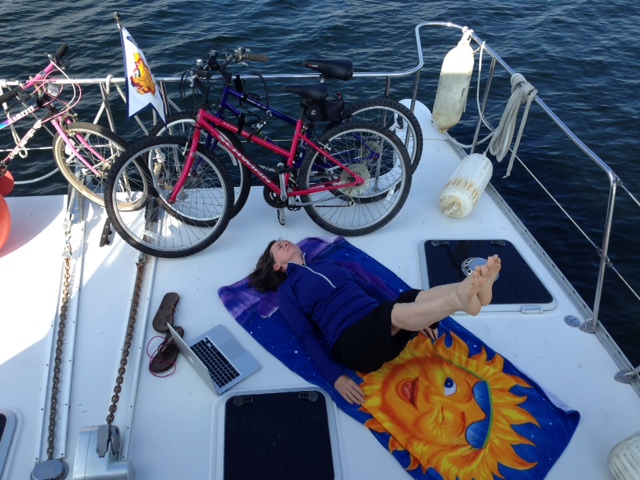
Pat finds the front deck of the Joint Adventure while underway on a calm day to be the ideal place to do her daily excersizes

Pat finds the front deck of the Joint Adventure while underway on a calm day to be the ideal place to do her daily excersizes

Trish joined Pat to do her daily excerizes as well - as seen through the windows of the main salon

Trish joined Pat to do her daily excerizes as well – as seen through the windows of the main salon

Dinner on the bridge in Picton on the table that my Dad made for the Joint Adventure

Dinner on the bridge in Picton on the table that my Dad made for the Joint Adventure

An interesting boat in Picton Harbor

An interesting boat in Picton Harbor

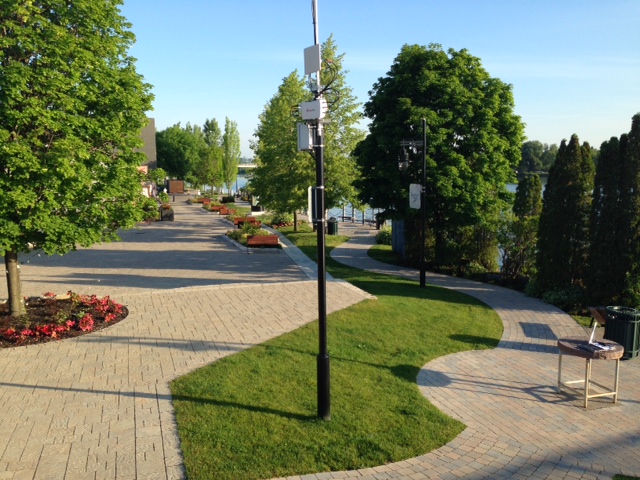
The waterfront park along the Trento River, early Saturday morning

The waterfront park along the Trenton River, early Saturday morning

You may recall that we were hampered with difficult-to-diagnose hydraulic steering problems early in our trip, despite having the steering system checked and serviced this spring before we left. I’m happy to report that the problem was corrected in Albany, and the steering has worked perfectly since then. The picture below is of the crew that checked and serviced the steering system before we left.

I think I picked the wrong work gang...

I think I picked the wrong work gang…

One more tidbit – you may recall from my last blog that we found ourselves at a restaurant in Kingston on “Stand Up And Sing Night”, in which you would get a free desert if you stand up at your table and sing a song – which I did. A few people have asked what song I chose – I sang “Mary Had A Little Lamb” – all three verses. Only a few people left.


Standard

GETTING READY TO HEAD WEST!

GETTING READY TO HEAD WEST! Post #14A – Day 54 – June 24, 2014. On board: Jim K, Paul Coates

A number of people have asked questions about the boat, our operation of the boat, and our daily routines. So here’s some general information:

We chose a power catamaran over a monohull for this trip for a number of reasons. First, it is much more fuel-efficient. A typical monohull of comparable size might get 3/4 to 1 mile per gallon of fuel at cruising (planing) speed, while the power catamaran gets close to 3 mpg. This is because a monohull gets its stability from a lot of weight down low, while a catamaran gets its stability from its width (17′ in our case). It therefore can be lighter and has to push less water out of the way and doesn’t have to push it as far because there are two smaller hulls instead of one larger hull. Second, because it is lighter and gets its stability from its width, it has a shallower draft (depth) than a comparable monohull – very important for shallow water areas and gives us more flexibility regarding where we can go. We draw less than 3 feet (that doesn’t mean we’re immune from going aground, however – we just have to work a little harder at it). Third, it has a lot of living space due to its width – it actually has two full-sized queen beds (though the cabins they’re in are quite small) and the dinette converts to a full-sized king bed. Lastly, the ride is quite nice in most conditions – it handles moderate seas quite well unless they’re from the beam (side) and it doesn’t roll like a monohull. That said, it has some disadvantages. It causes a very sharp motion if you take waves on the beam. Therefore, when steering, effort is made to avoid taking waves from that direction. Second, due to the hull design, access in the cabins and access to service the engines or other mechanical parts in the engine compartment is restricted. Lastly, since it is wider than most boats, finding dockage can be more challenging during busy times, but so far that has not really been a problem.

The primary tools we use for navigation are a Garmin chart plotter/radar with a touchscreen, and paper charts. For safety, we have redundancy – two older GPS units plus a hand-held GPS unit, plus we recently put a Garmin App on an IPAD. We have a full set of paper charts on board for everyplace we plan to go. Even so, we had a challenge on the Ottawa River. The chips in our electronic devices did not cover a section of the Ottawa River. Since we have paper charts and have experience navigating that way, we decided not to buy the extra chip (for $150) that covers all of upper Canada for that one little portion of the river, but decided that we would use the paper charts for that area (the old fashioned way). What we didn’t know, however, is that since we were on the river so early in the season, none of the aids to navigation would be in place yet. The river is quite wide in places with a lot of shoaling, so the channel meanders all over the place between the wide banks. With few natural features to use for identification, it was challenging at times to pick our way forward and stay in the unmarked channel.
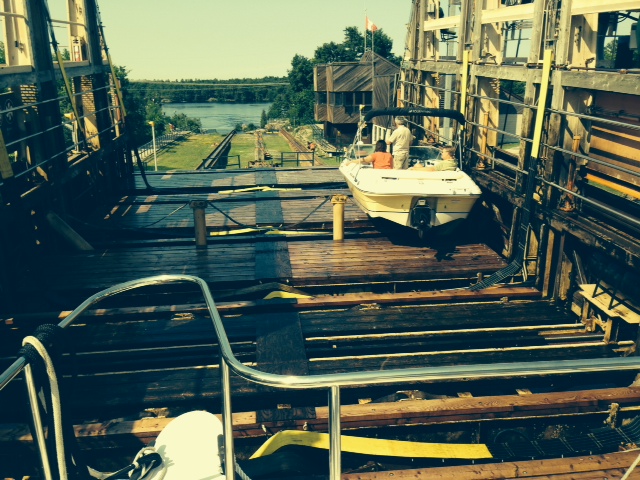
Our typical day when we plan to move starts fairly early, particularly in areas where the wind is likely to pick up or the weather deteriorate as the day goes on. We’ve been underway as early at 6:00 AM, although 7:00 – 8:00 would be more typical. If we plan a short run or have to wait for locks to open and/or wind or weather is not a factor, we might leave as late as 9:00 or 10:00. We like to arrive at our destination by early afternoon to have the afternoon to explore wherever we are. We typically eat breakfast and lunch on board, often underway, and might have dinner on board or at a local restaurant, diner, or pub. We like to meet and talk with the local people, so we often look for a local pub or diner for dinner. In smaller towns or villages, we usually leave the next morning (weather permitting), but in major cities we stay much longer to see the sights and experience the city (we stayed for a week in Ottawa and four days in Kingston).

Fuel costs generally between $4 and $5 per gallon.  We will probably travel 6,000 miles or so – at $4.50, fuel costs will run around $9,000 for the trip.  When divided up among those on board at any given time, the cost is not bad considering it is a year-long trip.  So far, we have stayed in marinas or tied to seawalls in towns and canals.  We purchased a season-long Canada Pass for $600 which pays for all our lockages in Canada and allows us to tie up to any available seawall for free, except for a $10/night charge for electric if it is available.  Many towns provide seawall space for free as well to encourage boaters to stop overnight – our 7 nights in downtown Toronto cost just $10/night for the electric hookup. Once we’re in the Great Lakes and beyond, we’ll likely do some anchoring and staying on moorings, which are cheaper than marinas.  Marinas usually cost between $1/foot and $1.75/foot in this part of the country (times 34 feet) – again, not too bad when divided among those on board.

So we have spent the last 4 days exploring Kingston, Ontario – a vibrant city with a strong military history. The city is strategically located at the confluence of three waterways that were critical for transportation and defense in colonial times – Lake Ontario, the St. Lawrence River, and the Rideau Canal.  In fact, Kingston was considered by the British to be the most important defensive position in all of Canada. It was primarily a French-speaking area until British royalist settlers flooded the area to escape the newly-independent 13 American colonies in 1783. As a result, the name was changed to King’s Town (later shortened to Kingston) to demonstrate loyalty to King George. A series of fortifications were built between 1832 and around 1850, during which time the British were quite concerned about a possible invasion by the Americans, who tried unsuccessfully to invade in several locations during the War of 1812. It’s interesting  to learn history here from the Canadian’s point of view – Americans were the aggressors in the War of 1812 and were successfully repelled from Canada, and Americans were the potential aggressors for the next 40 years – kept at bay by the defenses and strength of the Canadian military. Three fortifications were built in the Kingston area at that time, the most prominent being Fort Henry, built between 1832 and 1837, and several Martello towers – round stone fortifications in strategic locations.  Additional fortifications were built in the mid 1840’s when relations with Canada worsened over a dispute regarding the border of the Oregon territory.  Tensions eased when that dispute was resolved in 1846, but more fortifications were added in 1862-1863 as tensions again arose during the American Civil War. However, by 1870, relations between the two countries became friendly, and the decline in manning of the fortifications was underway. Today, the military history of Kingston is prominently displayed and is part of the fabric of the city. Here are some pictures:

Built in 1832-1837, Fort Henry was the main fortification to prevent the Americans from shutting off Canada's supply routes on the St. Lawrence and Rideau Canal  between Montreal and Quebec City to the east and Upper Canada (now Ontario) to the west

Built in 1832-1837, Fort Henry was the main fortification to prevent the Americans from shutting off Canada’s supply routes on the St. Lawrence and Rideau Canal between Montreal and Quebec City to the east and Upper Canada (now Ontario) to the west

A visit to Fort Henry provides a continuous series of re-enactments, including marching drills with the band, actual firing of one of the cannons, and other full-dress re-enactments

A visit to Fort Henry provides a continuous series of re-enactments, including marching drills with the band, actual firing of one of the cannons, and other full-dress re-enactments

Marching soldiers playing fifes at Fort Henry

Marching soldiers playing fifes at Fort Henry

Two of the 4 Martello Towers that still exist in Kingston - this picture is taken from Fort Henry, overlooking the mouth of the St. Lawrence River.  Martello Towers were used to add to the defense of the area because they could be built relatively quickly and cheaply and did not require a large contingency of soldiers to man

Two of the 4 Martello Towers that still exist in Kingston – this picture is taken from Fort Henry, overlooking the mouth of the St. Lawrence River. Martello Towers were used to add to the defense of the area because they could be built relatively quickly and cheaply and did not require a large contingency of soldiers to man

The inside of one of the Martello towers, which is now a museum

The inside of one of the Martello towers, which is now a museum

A prominent part of both Kingston's history and its vibrant present is the Royal Military College, often referred to as the War College, seen here from Fort Henry.  It is analogous to America's West Point

A prominent part of both Kingston’s history and its vibrant present is the Royal Military College, often referred to as the War College, seen here from Fort Henry. It is analogous to America’s West Point

Kingston is a beautiful city with great architecture and what seems to be a vibrant economy. It grew up based on the military and support services for the military and its location as a transportation hub.  Shipbuilding was a major industry, and when railroads came into being, the city turned to trains – over 3,000 locomotives were built here. Today, the city thrives as a college town with three major universities (the Royal Military College and Queens University being the most well-known). There is a great deal of activity in the city.  On Saturday there was an all-day music festival, followed by a concert/exhibition in the retail/restaurant district featuring a brass band, an acrobat, belly dancers, and two fire-eating performers.  Some pictures from our stay in Kingston:

A prominent part of both Kingston's history and its vibrant present is the Royal Military College, often referred to as the War College, seen here from Fort Henry.  It is analogous to America's West Point

A prominent part of both Kingston’s history and its vibrant present is the Royal Military College, often referred to as the War College, seen here from Fort Henry. It is analogous to America’s West Point

The acrobat at the street celebration Saturday evening

The acrobat at the street celebration Saturday evening

Dancing in the street to the four-piece brass band

Dancing in the street to the four-piece brass band

Kids mesmerized watching the fire-eating performance

Kids mesmerized watching the fire-eating performance

Celebrating a World Cup goal in the local pub

Celebrating a World Cup goal in the local pub

Kingston City Hall

Kingston City Hall

One of the many picturesque stone alleyways in Kingston - abundant limestone and a large supply of stone masons looking for work after the Rideau Canal was completed caused many of the buildings in Kingston to be constructed of stone

One of the many picturesque stone alleyways in Kingston – abundant limestone and a large supply of stone masons looking for work after the Rideau Canal was completed caused many of the buildings in Kingston to be constructed of stone

One of the many examples of historic homes in Kingston

One of the many examples of historic homes in Kingston

As seen from Kingston, 82 wind turbines have been erected on Wolf Island in the middle of the St. Lawrence river - enough to power 75,000 homes

As seen from Kingston, 82 wind turbines have been erected on Wolf Island in the middle of the St. Lawrence river – enough to power 75,000 homes

Kingston was the site of the first penitentiary to be built in Canada in the 1800's.  It has just recently been vacated and is not open to the public, but there is an interesting museum in the warden's house adjacent to the old women's section of the prison

Kingston was the site of the first penitentiary to be built in Canada in the 1800’s. It has just recently been vacated and is not open to the public, but there is an interesting museum in the warden’s house adjacent to the old women’s section of the prison

At dinner, we discovered that it was "Stand Up And Sing Night" at the restaurant we were at - if you stood up and sang, you got a free desert. I couldn't resist.  To put it in context - in the 6th grade, chorus was required of every student in the class - except my friend Matt Sibble and me.  We were "excused" from chorus and put in a remote study hall instead.  True story.  I've been traumatized ever since - however, a free desert was sufficient for me to overcome my trauma

At dinner, we discovered that it was “Stand Up And Sing Night” at the restaurant we were at – if you stood up and sang, you got a free desert. I couldn’t resist. To put it in context – in the 6th grade, chorus was required of every student in the class – except my friend Matt Sibble and me. We were “excused” from chorus and put in a remote study hall instead. True story. I’ve been traumatized ever since – however, a free desert was sufficient for me to overcome my trauma

Paul pretending to actually do some work

Paul pretending to actually do some work

So tomorrow we cast off the lines and head west. Trish and Pat arrived today (YAYY!), so now we are four. Our target is to reach Trenton, which is the entrance to the Trent-Severn Waterway, by Saturday, where Red & Mary Beth and Billy & Kathy will join us as well.


Standard

THE LOWER RIDEAU

THE LOWER RIDEAU (Post #14 – Day 51, Saturday, June 21, 2014). On board: Paul & Jim K

Three more days running south on the Rideau Canal have brought us to Kingston, Ontario – located on the northeast corner of Lake Ontario, where the lake transitions into the St. Lawrence River. The term Rideau Canal is often used for the entire waterway from Ottawa to Kingston, but it is a bit of a misnomer – heading south from Ottawa (as we did), the first part of the canal runs up the Rideau River, with canals and locks bypassing parts that are not navigable. A series of beautiful lakes (some created by dams when the system was built in 1832) are then connected by narrow cuts, locks, and short sections of canals. The southern part of the waterway that we just completed then follows the Cataraqui River, again with canals and locks bypassing parts that are not navigable. However, following convention, I’ll continue to refer to the entire waterway as the Rideau Canal.

The southern part of the Canal has fewer and smaller towns than the northern part.  Our next stop was Jones Falls, one of the prettiest rural lock areas on the Canal. Consisting of a series of 4 locks in series and basins above, between, and below the locks, there are multiple places to tie up for the night.  There is no town or village nearby, but fronting on the lower basin is a wonderful inn/restaurant called the Hotel Kenney – it contains a quaint and beautiful bar area, an upscale restaurant, lodging, and a wrap-around sun porch along the entire frontage. Here are some pictures:

Tied to the seawall in the upper basin at Jones Falls - here we met Steve & Karen, a wonderful couple whom we cruised with for the next couple of days

Tied to the seawall in the upper basin at Jones Falls – here we met Steve & Karen, a wonderful couple whom we cruised with for the next couple of days

Hotel Kenney overlooking the lower basin at Jones Falls.  The boat on the left is tied to the seawall awaiting passage the next morning through the 4 locks at Jones Falls

Hotel Kenney overlooking the lower basin at Jones Falls. The boat on the left is tied to the seawall awaiting passage the next morning through the 4 locks at Jones Falls

At Jones Falls is a fascinating dam built in 1831 by Colonel By (here goes the engineer in me again…).  No, this is really cool.  At the time, it was the tallest dam in North America and the third largest in the entire world – built in utter wilderness virtually by hand.  The enormous stone blocks were quarried and cut 6 miles away and hauled by oxen one by one over a road they had to build before they could even start the dam.  It is 6 stories high and was built in a horizontal arch (as you’ll see in the picture below) – the first of its type in North America.  Because the river roared through the gully where the dam had to be built, they first built a smaller 20′ high wooden dam with a sluiceway (bypass) to divert the water, then built the lower 20′ of the stone dam.  They then had to repeat the process of first building a 20′ wooden dam with a sluiceway on top of the partially-built stone dam twice more until they reached the required height of the dam.  The dam then flooded the land upstream, creating a large navigable lake where raging rapids formerly stood. Here are a couple pictures:

The 6 story high dam at Jones Falls, built entirely of enormous stone blocks hauled by oxen one at a time from a quarry 6 miles away

The 6 story high dam at Jones Falls, built entirely of enormous stone blocks hauled by oxen one at a time from a quarry 6 miles away

A power generator was added next to the dam in the 1940's - these are the pipes running from the lake at the top to the generator at the bottom. The pipes are made of wood (like a long barrel that a cooper would make in colonial times) and are still in use - however, there are numerous small leaks which they continue to try to patch by various means

A power generator was added next to the dam in the 1940’s – these are the pipes running from the lake at the top to the generator at the bottom. The pipes are made of wood (like a long barrel that a cooper would make in colonial times) and are still in use – however, there are numerous small leaks which they continue to try to patch by various means

The run along this section of the Rideau Canal is rural and beautiful, made up of a series of lakes connected by narrow cuts and, at the southern end, the Cataraqui River. Some area are wilderness and others are dotted with cottages ranging from one room bungalows to large homes.  The lakes tend to be deep and the cuts narrow and sometimes shallow.  Here are some pictures of this part of the Rideau:

A narrow cut along the Rideau Canal

A narrow cut along the Rideau Canal

Another narrow cut - the Joint Adventure is 17' wide, so these areas had our complete focus - the sides and bottom in this area is all rock - OWCH!!

Another narrow cut – the Joint Adventure is 17′ wide, so these areas had our complete focus – the sides and bottom in this area is all rock – OUCH!!

This is a one-car, self operated ferry across one of the cuts.  You drive your car onto the ferry, then use a hand crank on the ferry that is connected to a chain that runs along the bottom from one side to the other.  As you crank, the chain pulls you to the other side, where you tie up the ferry.  There is also a crank on either shore to pull the ferry back if it is on the other side when you arrive

This is a one-car, self operated ferry across one of the cuts. You drive your car onto the ferry, then use a hand crank on the ferry that is connected to a chain that runs along the bottom from one side to the other. As you crank, the chain pulls you to the other side, where you tie up the ferry. There is also a crank on either shore to pull the ferry back if it is on the other side when you arrive

I couldn't resist a picture of one more wooden swing bridge - this is opened by the lock operator physically pushing the bridge to rotate it open or closed

I couldn’t resist a picture of one more wooden swing bridge – this is opened by the lock operator physically pushing the bridge to rotate it open or closed

Entering one of the lakes on the lower Rideau Canal

Entering one of the lakes on the lower Rideau Canal

A boathouse on one of the lakes in the Rideau

A boathouse on one of the lakes in the Rideau


A cottage on the Rideau

A cottage on the Rideau – notice the guy on the deck imitating Paul….

Another cottage - notice the guy on the deck imitating Paul....

Another cottage on the Rideau

Some cottages are more modest than others...

Some cottages are more modest than others…

Some of the cottages need some tender loving care - Doug, looks like an investment opportunity for you....

Some of the cottages need some tender loving care – Doug, looks like an investment opportunity for you….

On our last night before reaching Kingston, we tied up at the lower basin of the three locks at Brewers (Upper & Lower). It was an idyllic setting with a waterfalls, the historic locks, a wooden swing bridge, and fast-moving current from the falls that made it a great fishing spot – we were joined often by local fisherman catching pike and bass. We tied up next to our new friends Steve & Karen.  The countryside is rural farm country, so I went for a long bike ride to enjoy the scenery. The locks are 10 miles from the nearest town, so we cooked spaghetti on board – I learned that you don’t really need to cook the whole box for two people.  We’ll have spaghetti for dinner for awhile.

Here are some pictures:

Here is the setting in the lower basin just below the Lower Brewer Locks

Here is the setting in the lower basin just below the Lower Brewer Locks

The Joint Adventure at Lower Brewer - Steve & Karen's boat is in front of us, and another boat that tied up late in the afternoon

The Joint Adventure at Lower Brewer – Steve & Karen’s boat is in front of us, and another boat that tied up late in the afternoon

The last of the locks on the Rideau Canal!  Four locks in series lowers us to the level of Lake Ontario, just 5 miles away!

The last of the locks on the Rideau Canal! Four locks in series lowers us to the level of Lake Ontario, just 5 miles away!

So we are now docked in Kingston, on the shore of Lake Ontario. We’ll spend the next 4 days exploring the city and the area until Trish & Pat join us mid week. Another milestone on our journey!


Standard

DOWN THE RIDEAU

Down the Rideau – Post #12 (June 19, 2014)- On board: Jim K & Paul Coates

Down the Rideau Canal we go, heading south toward Kingston, Ontario, which is located on Lake Ontario at the point where it transitions into the St. Lawrence River. The Rideau Canal is an engineering wonder for its time. Colonel By was tasked in 1826 with building a waterway connection from Lake Ontario to the Ottawa River to create a military supply route as an alternative to the St. Lawrence River, a distance of 126 miles through total wilderness. He employed 6,000 workers (of which 500 died) and built 47 locks and 74 dams in just six short Canada construction seasons, opening the canal in 1832. The canal lifts boats a total of 28 stories above the level of the Ottawa River to the high point, then lowers them 16 stories to the level of Lake Ontario. Two years into the construction, Colonel By decided that steamboats were the future, so he decided to redesign the canal with larger locks to accommodate steamboats, even though it meant rebuilding several locks that had already been completed (can you imagine the Change Orders that generated?). It was the largest and most expensive project at that time in the entire British Empire, which stretched around the entire world. Upon completion in record time way ahead of schedule, Colonel By was summoned back to England – for a commendation, he expected. Instead he was hauled before a panel to face a government inquiry into why it cost so much (some things never change…) and an investigation regarding the use of funds. He was acquitted of all allegations, but died 4 years later a distraught and disappointed man. However, his legacy lives on, as the Canal was an enormous economic success and has been in continuous operation since 1832.

Our run down the canal has been fascinating. All the locks are manually operated, and the canal links lakes and rivers to form a continuous waterway. Here are some pictures taken along the route:

The Canal is often quite narrow and has depths as low as 4 1/2 feet.  This is a swing bridge in the process of opening for us with a narrow passage that left only a few feet between concrete abutments on either side of the boat as we passed

The Canal is often quite narrow and has depths as low as 4 1/2 feet. This is a swing bridge in the process of opening for us with a narrow passage that left only a few feet between concrete abutments on either side of the boat as we passed

This is a swing bridge located at one of the locks - after manually opening the gates to the lock, the lockmaster and his assistant literally push one end of the bridge sideways to swing it open, then push it on the opposite side to close it after we pass.

This is a swing bridge located at one of the locks – after manually opening the gates to the lock, the lockmaster and his assistant literally push one end of the bridge sideways to swing it open, then push it on the opposite side to close it after we pass.

Fuel is expensive in Canada, so I decided to earn some extra money working the locks

Fuel is expensive in Canada, so I decided to earn some extra money working the locks

Paul making lunch on the bridge of the Joint Adventure while traveling on the Rideau Canal

Paul making lunch on the bridge of the Joint Adventure while traveling on the Rideau Canal

Paul doing what Paul does best after a hard day at sea

Paul doing what Paul does best after a hard day at sea

One of our favorite stops was in Merrickville, where we tied to a seawall in the downtown area for the afternoon and overnight.  Merrickville was settled in large part by British loyalists from the American colonies who fled in 1783 when the colonies won the Revolutionary War, fearing reprisals for their loyalty to Britain.  Adjacent to the lock in downtown Merrickville is a fortified masonry Blockhouse, which was built to protect the lockstation from a feared invasion by the Americans.  It has been fully restored and houses an interesting Rideau Canal museum. Merrickville grew in colonial days into a significant industrial center, utilizing water power from the strong rapids on the Rideau River to power sawmills, grist mills, and other factories.  Remnants of some of the old mills are still standing and can be explored. Fronting Main Street is a collection of historic buildings with architecture from the 1800’s, now housing restaurants, a collection of interesting shops, and other businesses. Here are some pictures:

A section of Main Street in Merricksville

A section of Main Street in Merrickville

An interesting exhibit in the Blockhouse Museum - everyone had to pull his own weight in the old days, including Fido - this is a dog-powered butter churn.  The dog was put in the cage on the left side of the wheel.  As the dog walked forward (enticed by some food, perhaps?), the dog turned the wheel upon which it was standing, which in turn operated the churn on the left, connected by a pulley to the wheel. Where was the SPCA?
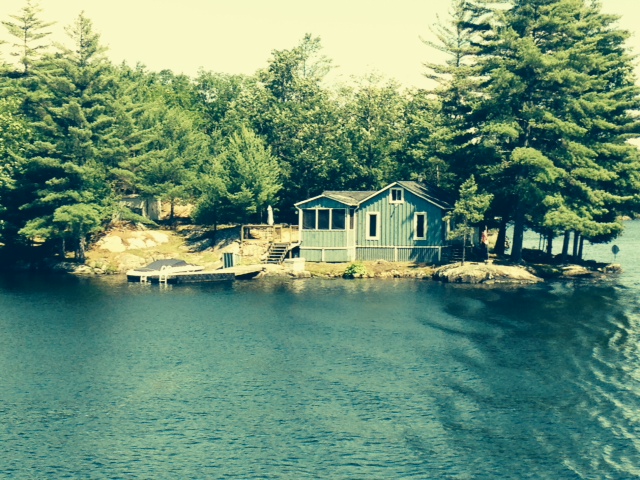
An interesting exhibit in the Blockhouse Museum – everyone had to pull his own weight in the old days, including Fido – this is a dog-powered butter churn. The dog was put in the cage on the left side of the wheel. As the dog walked forward (enticed by some food, perhaps?), the dog turned the wheel upon which it was standing, which in turn operated the churn on the left, connected by a pulley to the wheel. Where was the SPCA?
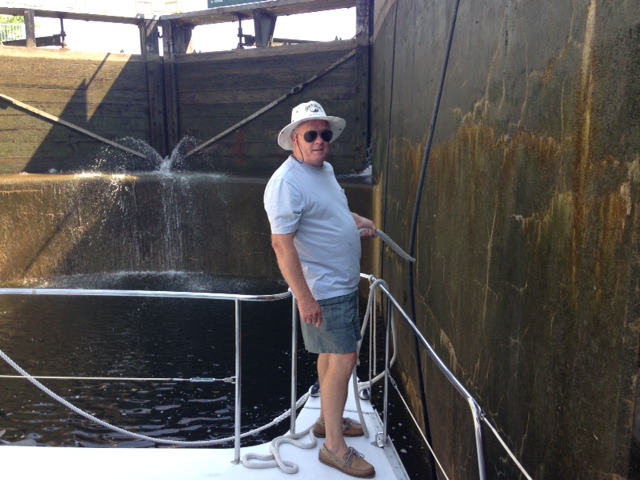
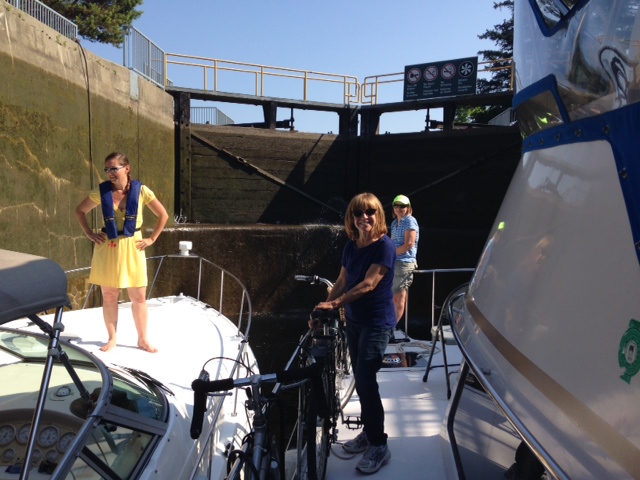
 

Paul doing what Paul does best - obviously worn out by his visit to the Blockhouse Museum and imagining how that dog must have felt

Paul doing what Paul does best – obviously worn out by his visit to the Blockhouse Museum and imagining how that dog must have felt

The rapids at Merrickville next to where we were docked - we thought about running them, but decided to use the locks instead....

The rapids at Merrickville next to where we were docked – we thought about running them, but decided to use the locks instead….

Canada is serious about its hockey - this beer tap in one of the pubs leaves no doubt about the Owner's loyalties (we didn't mention the Bruins)

Canada is serious about its hockey – this beer tap in one of the pubs leaves no doubt about the Owner’s loyalties (we didn’t mention the Bruins)

A wonderful system of bike paths parallels much of the Rideau Canal and connects to other bike paths. One of the great experiences of a trip like this is the people one meets.  This is John, a biker doing a week-long trip who was camping in the park area adjacent to the lock in Merricksville.  One can camp at many of the locks, many of which have park areas, picnic tables, and rest rooms

A wonderful system of bike paths parallels much of the Rideau Canal and connects to other bike paths. One of the great experiences of a trip like this is the people one meets. This is John, a biker doing a week-long trip who was camping in the park area adjacent to the lock in Merrickville. One can camp at many of the locks, many of which have park areas, picnic tables, and rest rooms

Our next stop was Smith Falls, a larger and more commercial town than Merrickville.  There are three museums in town – the Railway Museum, the Heritage Museum, and a History Museum.  Again, we tied up to the seawall in the middle of downtown and walked or biked everywhere, including a pub in town where we watched the Russia/Korea World Cup game.  A few pictures from Smith Falls:

This is the Dentist Car at the Railway Museum.  It would go from town to town in northern Canada bringing dental care to remote villages where none existed in the 20's and 30's.  The dentist and his family lived in the car, which was moved from town to town by freight trains when needed

This is the Dentist Car at the Railway Museum. It would go from town to town in northern Canada bringing dental care to remote villages where none existed in the 20’s and 30’s. The dentist and his family lived in the car for several years at a time, which was moved from town to town by freight trains when needed

This is the dentists office within the Dentist Car - no anesthesia except laughing gas was used - he must have been a popular guy -

This is the dentists office within the Dentist Car – no anesthesia except laughing gas was used – he must have been a popular guy –

Shucks - and we brought all our fishing gear....

Shucks – and we brought all our fishing gear….

This old RR bridge as we exited the locks at Smith Falls has been in the open position since 1973.  It was an engineering feat when built, perfectly balanced throughout the entire opening sequence so it required only a 1/4 HP motor to open or close it.  It is now privately owned by a contractor who excavated all the fill leading up to the bridge and has no further use for it, so the bridge can be bought for $1

This old RR bridge as we exited the locks at Smith Falls has been in the open position since 1973. It was an engineering feat when built, perfectly balanced throughout the entire opening sequence so it required only a 1/4 HP motor to open or close it. It is now privately owned by a contractor who excavated all the fill leading up to the bridge and has no further use for it, so the bridge can be bought for $1

We are now in Westport, a small resort village on the northeast tip of Upper Rideau Lake, a side trip of about 5 miles. It is a remote area, and the town is small but quite pleasant with many shops that must be busy at the height of the tourist season. We went to the “rack & tunes” night at the local restaurant/pub, featuring ribs and fries for $10 with live music.

The footbridge in Westport Harbor connecting the island where we're docked to the mainland

The footbridge in Westport Harbor connecting the island where we’re docked to the mainland

On to Kingston, which we expect to reach over the weekend and spend several days sightseeing. Trish & Pat will join us by mid-week, then we’ll head west on Lake Ontario to the entrance to the Trent Severn Waterway.


Standard

WOMEN ARE PERSONS….

Women are Persons… – Post #11, Day 44  – June 14 (my birthday!)

The week started on an exciting note last Saturday, as we left the Hull Marina, crossed the Ottawa River and entered the set of 8 flight locks that are the entrance to the Rideau Canal. In the early days of canal construction, the technology did not allow for high lifts (such as the 7 story lift in the Carillon Lock on the Ottawa River, which was constructed much later). The need to lift boats significant heights was accomplished with flight locks, which are a series of locks in a row in which you enter the chamber of the next lock directly upon leaving the previous lock. Since the land rises sharply from the banks of the Ottawa River in Ottawa (which is built on a hill), it was necessary to build a series of 8 flight locks just to get to the elevation of the city.  The average lift for each lock is less than 10 feet.
Completed in 1832, the 140-mile long Rideau Canal connects a series of lakes and rivers via a series of canals and 44 locks, following a route between the Ottawa River and Lake Ontario that was used for centuries by native Americans (or in this case Native Canadians) well before Samuel de Champlain traced the route in 1615. The other canals we’ve transited so far were all built for economic reasons – to provide a cheaper and faster way to move people and goods via water before railroads came along and provided an even cheaper and faster method. The Rideau Canal, however, was built not for economic reasons but for military reasons. Britain was still smarting over losing two wars to the upstart Americans – the Revolutionary War and the War of 1812 – and were fearful that another war would break out which would jeapordise Britain’s ownership of Canada. At the time, Britain used Lake Ontario and the St. Lawrence River to move supplies and troops to Quebec, but were fearful that the Americans could close that route in the event of a war, isolating Quebec. Therefore, they decided to construct an alternate water route from Lake Ontario to the Ottawa River, thus enabling them to bypass the St. Lawrence to supply Quebec. Ironically, it was never used for military purposes but immediately became an economic success from the movement of goods. Today, the Rideau Canal is a World Heritage Site (along with such places as the Pyramids, Stonehenge, etc.). In the winter, it freezes and becomes the world’s longest skating rink – 9 kilometers long.
In any case, we had a fascinating run up the flight locks that are now over 180 years old and still hand operated. Since the locks go right through downtown, sometimes thousands of people gather to watch boats transit the 8 locks, which takes about 2 hours to do. Here are a few pictures:

The eight historic flight locks in downtown Ottawa built in 1832 which mark the beginning of the Rideau Canal and our trip south to Lake Ontario

The eight historic flight locks in downtown Ottawa built in 1832 which mark the beginning of the Rideau Canal and our trip south to Lake Ontario

The crew for the trip from Montreal to Ottawa waiting for the last lock to open as we enter Ottawa - from left to right, Tom, Mary M, Ted, Kathleen, Mary R, and Jim K

The crew for the trip from Montreal to Ottawa waiting for the last lock to open as we enter Ottawa – from left to right, Tom, Mary M, Ted, Kathleen, Mary R, and Jim K

The week has been spent in Ottawa enjoying this wonderful city and seeing the sights.  English is clearly dominant here, although many people are bilingual.  A two minute ride across one of the bridges reverses the culture, where French is clearly dominant.  In 1857, Queen Victoria was required to choose the city which would be the capital of Canada.  Kingston, Toronto, Montreal, and Quebec City were the front-runners – Ottawa was thought not even to be under consideration, since at that time it was a ramshackle lumber town in the middle of nowhere.  However, with amazing foresight, Queen Victoria chose Ottawa because it was on the confluence of the French and English cultures, which would have to work together if Canada was to survive.  Ottawa was so remote at the time that, upon hearing of Victoria’s decision, the Governor General of Canada wrote glumly of his “exile to the wilderness”.  Today, I’m told there are two seasons in Ottawa – construction season and hockey season.

The magnificent Parliament Building is a highlight of the City.  Here are some pictures:

The magnificent Parliament Building high on the hill overlooking the Ottawa River in downtown Ottawa

The magnificent Parliament Building high on the hill overlooking the Ottawa River in downtown Ottawa

View of the Ottawa River from the observation deck in the Parliament Building. The French-speaking city of Hull, Quebec, is on the far side of the river (on the left in the photograph)

View of the Ottawa River from the observation deck in the Parliament Building. The French-speaking city of Hull, Quebec, is on the far side of the river (on the left in the photograph)

The House of Lords chamber in the Parliament Building.  The color green is dominant. The Senate has a similar chamber, where the color red is dominant

The House of Lords chamber in the Parliament Building. The color green is dominant. The Senate has a similar chamber, where the color red is dominant

Incidentally, in Canada, Senators are not elected – they are appointed by the Prime Minister and serve until they choose to resign or they turn age 75, whichever comes first.  What would the US Congress look like if the President appointed Senators essentially for life instead of the people of each state electing them?

Another highlight in Ottawa is the marketplace district, which includes extensive open air markets that sell a wide variety of products including fresh produce, pedestrian malls closed to traffic, restaurants galore with outdoor seating that spills onto the streets, street performers, watering holes, etc., etc.  It is alive with people every day and night of the week – perhaps it is best described as a combination of Boston’s Haymarket Square and Fanuiel Hall Marketplace times four.

A few pictures taken in Ottawa:

Restaurants spill onto the streets in the Marketplace District - I'm told that you could eat 3 meals a day in the Marketplace for three months and not eat at the same restaurant twice

Restaurants spill onto the streets in the Marketplace District – I’m told that you could eat 3 meals a day in the Marketplace for three months and not eat at the same restaurant twice

One of the more interesting street performers in the Marketplace District

One of the more interesting street performers in the Marketplace District

The Joint Adventure tied to the canal wall in downtown Ottawa, next to the Westin Hotel.  The dockage is free with electricity available for $10/day.

The Joint Adventure tied to the canal wall in downtown Ottawa, next to the Westin Hotel. The dockage is free with electricity available for $10/day.

The Canadian capital has protests as well - this is a large march through the city by the Egyptian community objecting to the military rule in Egypt

The Canadian capital has protests as well – this is a large march through the city by the Egyptian community objecting to the military rule in Egypt

This will freak you out if you are afraid of spiders - a two story high spider in the plaza of the National Gallery of Canada.  The magnificent building is in the background - the building itself is worth the $10 admission.  I'm not an expert in art by any means, but found it extraordinary

This will freak you out if you are afraid of spiders – a two story high spider in the plaza of the National Gallery of Canada. The magnificent building is in the background – the building itself is worth the $10 admission. I’m not an expert in art by any means, but found it extraordinary

The atrium of the Gallery of Canada in downtown Ottawa

The atrium of the Gallery of Canada in downtown Ottawa


In case of a mutiny, this is my back-up crew - at least they won't talk back

In case of a mutiny, this is my back-up crew – at least they won’t talk back


For you bikers, Ottawa is a very bike-friendly place with bikes everywhere. Here is the best design for an urban bike lane - parked cars are moved away from the sidewalk and a second curb is put in to delineate a fully-protected bike lane and keep parked cars out of the bike lane

For you bikers, Ottawa is a very bike-friendly place with bikes everywhere. Here is the best design for an urban bike lane – parked cars are moved away from the sidewalk and a second curb is put in to delineate a fully-protected bike lane and keep parked cars out of the bike lane

My lifeboat crew - practicing their rowing...

My lifeboat crew – practicing their rowing…

Celebrating the defeat of the NY Rangers in the Stanley Cup final with my new buddy at a Marketplace bar near the end of the second overtime at 12:30 AM - WAY past my bedtime

Celebrating the defeat of the NY Rangers in the Stanley Cup final with my new buddy at a Marketplace bar near the end of the second overtime at 12:30 AM – WAY past my bedtime

So you may recall the contest we had to come up with a creative caption for the bent boat hook picture.  We received many great suggestions, most of which are listed in a previous blog post.  Below is the picture along with the winner and the runner-up:

The winner:  Seriously, Jim, this is exactly how you gave it to me The runner-up:  That's for using the hook around a corner

The winner: Seriously, Jim, this is exactly how you gave it to me
The runner-up: That’s for using the hook around a corner

So – what does the title “Women Are Persons….” have to do with anything?  Well, when Canada was formed in 1867, the Act that created Parliament stipulated that only “qualified persons” were eligible to serve in the Senate.  Five governments in a row determined that women were not “persons”, and therefore not eligible to serve in the Senate. In 1927, a group of women activists challenged the determination in court. In 1928, the Supreme Court ruled that women were not eligible because they were not “persons”.  The women activists appealed the Supreme Court decision, and in 1929, the highest court in Canada ruled that women, in fact, are persons after all.  I’m not sure what kind of research they might have done.  The court went on to say   “the exclusion of women from all public offices is a relic of days more barbarous than ours, but it must be remembered that the necessity of the times often forced on man customs which in later years were not necessary.” I’m not commenting.

Here are some pictures of a sculpture on Parliament Hill marking the occasion of this ground-breaking revelation:

Two of the women in the sculpture commemorating the court ruling - one holding up the front page of a newspaper to three other women in the sculpture

Two of the women in the sculpture commemorating the court ruling – one holding up the front page of a newspaper to three other women in the sculpture

The plaque that the woman in the sculpture is holding up, which is the front page of a newspaper when the ruling was announced

The plaque that the woman in the sculpture is holding up, which is the front page of a newspaper when the ruling was announced

The other two women in the sculpture

The other two women in the sculpture

So – are women persons in the United States?  Canada cleared up this question in 1929, but I’m not aware of any similar determination by a court in the U.S.  Does anyone have any thoughts on this subject that they could share?

Tomorrow morning we head south on the Rideau Canal towards Lake Ontario.


Standard