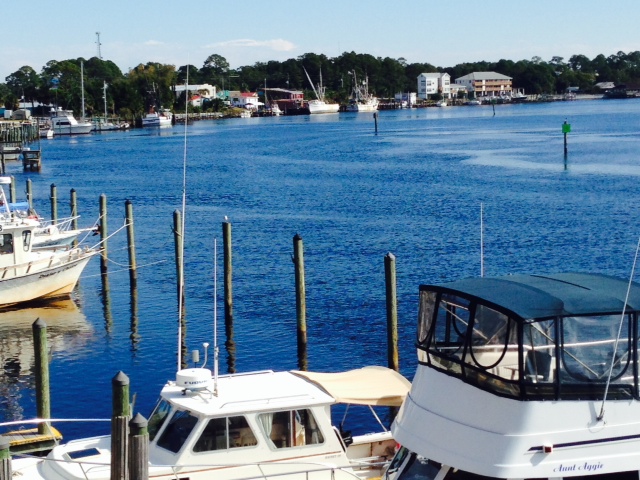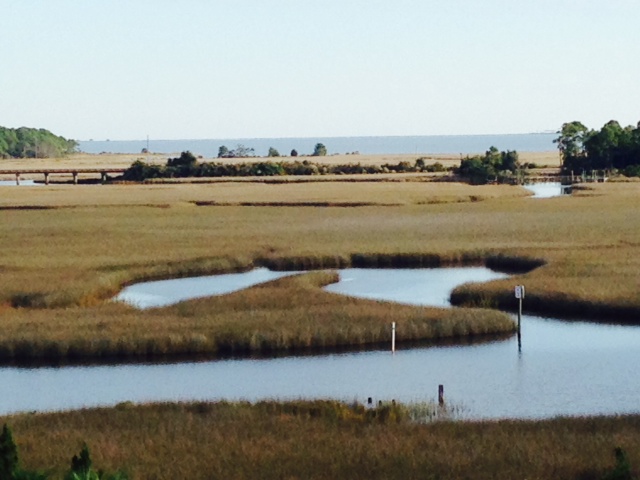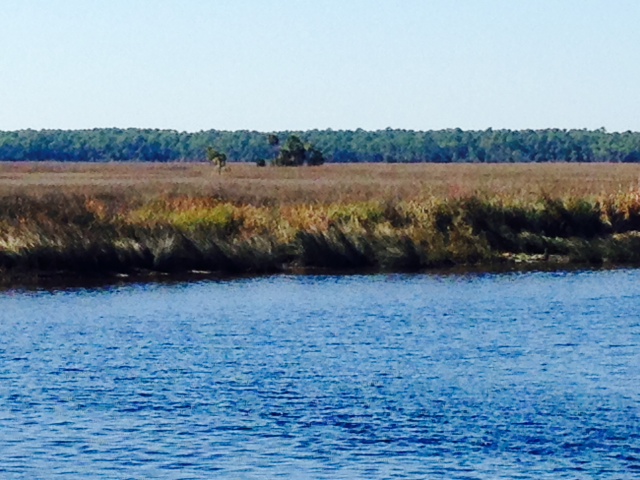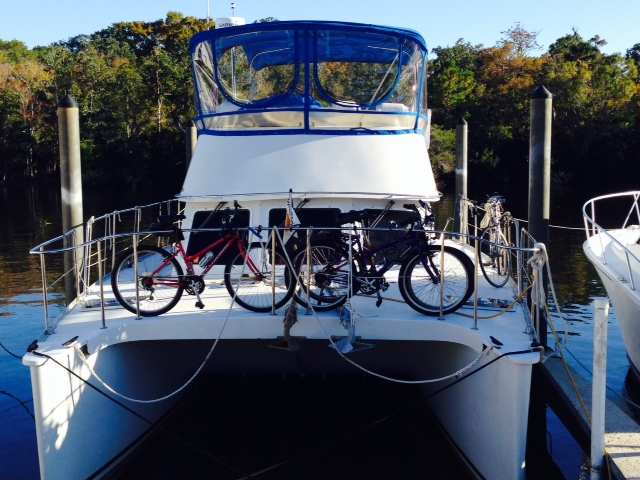
CROSSING OUR WAKE AND A GOLD FLAG

Post # 40: CROSSING OUR WAKE AND A GOLD FLAG  – Day 223 , December 13, 2014.  On Board:  Paul Coates, Jim K.

It seems a long time since my last post, probably because it has been – a week at home for the Thanksgiving holiday, followed by a week running from St. Petersburg to Fort Meyers Beach, followed by more tardiness on my part.

St. Pete proved to be a beautiful, interesting city. Most business activity in the area takes place across the bay in Tampa, so St. Pete is primarily a residential city. A number of high rise condominium buildings have been constructed near the waterfront over the past couple of decades, which dominate the St. Petersburg skyline. This has led to active streetscapes with outdoor seating along the sidewalks, an abundance of retail shops, and some interesting museums.

At the St Petersburg Museum of History, in addition to a great deal of Florida history, I learned that the first commercial airline in the world was started in St. Pete in 1914. The entrepreneurs who started the airline first approached the City Council in Tampa, who rejected the plan – they were worried that fast transportation to St. Pete would take business away from Tampa and transfer it its competitor-city across the Bay.  The City Council in St. Petersburg, however, embraced the idea, so the airline was chartered and based there. The plan was to fly passengers in an airboat 21 miles across Tampa Bay between the two cities, a flight that took 23 minutes if all went well.  The fare was $5, but the first ticket was auctioned off and purchased by the former mayor of St. Petersburg for $400. However, halfway through the first flight, a chain came off its sprocket on the airboat, so they had to perform an emergency landing in Tampa Bay and wait while the pilot put the chain back on before they could resume the flight. Despite the problems, however, the new airline was successful and is recognized today as the first step in legitimizing commercial air travel.

Here are some images from our time in St. Pete:
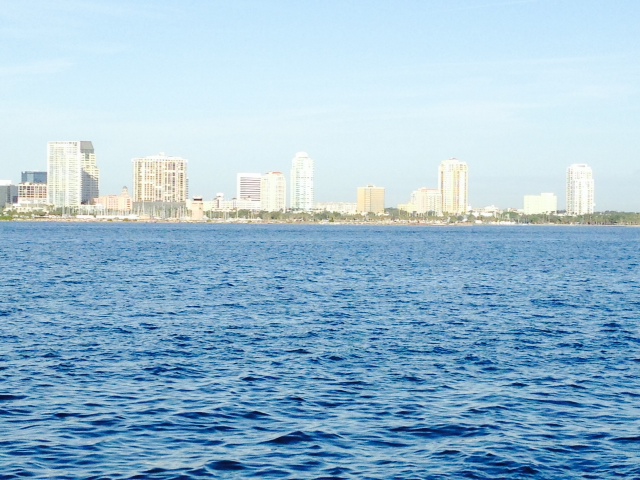
The new high rises forming the St. Petersburg skyline are virtually all residential buildings, most built in the last 2 or 3 decades.
The new high rises forming the St. Petersburg skyline are virtually all residential buildings, most built in the last 2 or 3 decades.

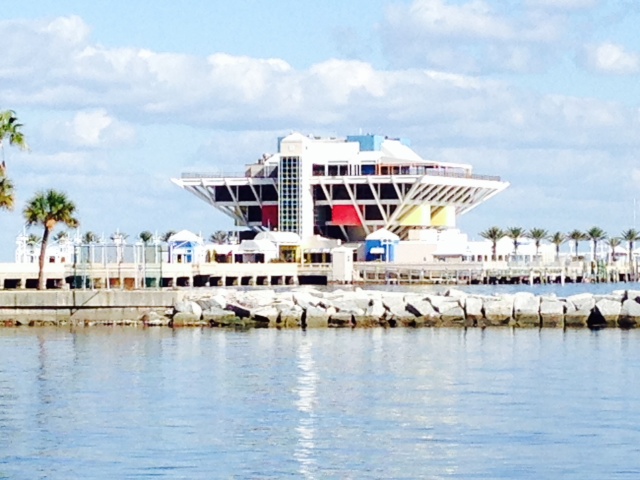
Constructed in 1973, The Pier, or unofficially called the Pyramid, is an iconic image for St. Petersburg;  it used to contain the city's Aquarium, retail shops, two restaurants, and administrative offices.  However, it was vacated and closed in 2013 due to structural deterioration of the connecting causeway.  It was scheduled to be demolished and replaced with a new structure called The Lens, which was approved by the City Council. However, a subsequent voter referendum rejected the plan, so the future plans are now in turmoil

Constructed in 1973, The Pier, or unofficially called the Pyramid, is an iconic image of St. Petersburg; it used to contain the city’s Aquarium, retail shops, two restaurants, and administrative offices. However, it was vacated and closed in 2013 due to structural deterioration of the connecting causeway. It was scheduled to be demolished and replaced with a new structure called The Lens, which was approved by the City Council. However, a subsequent voter referendum rejected the design, so the future plans are now in turmoil.
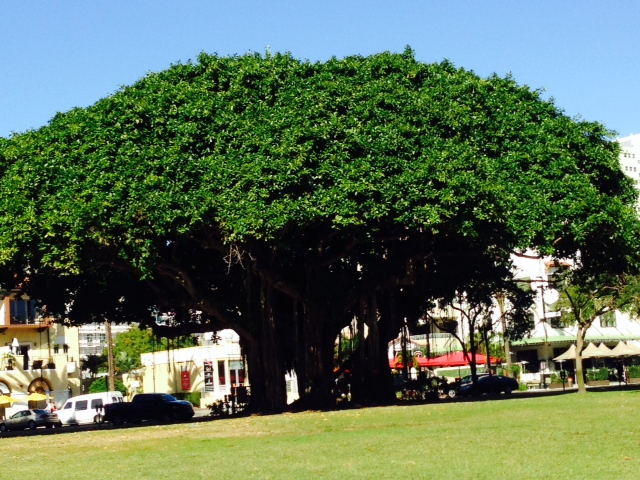
OK, so maybe I'm a bit obsessed with trees.  This is a magnificent one in the waterfront area that I couldn't resist.

OK, so maybe I’m a bit obsessed with trees. This is a magnificent one in the waterfront area that I couldn’t resist. This is all one tree!

The famous Dali Museum, exhibiting the works of Salvatore Dali, a Spanish artist whose career spanned a series of different styles as his works evolved. The museum building is stunning and the artwork fascinating, even to an art neophyte like me
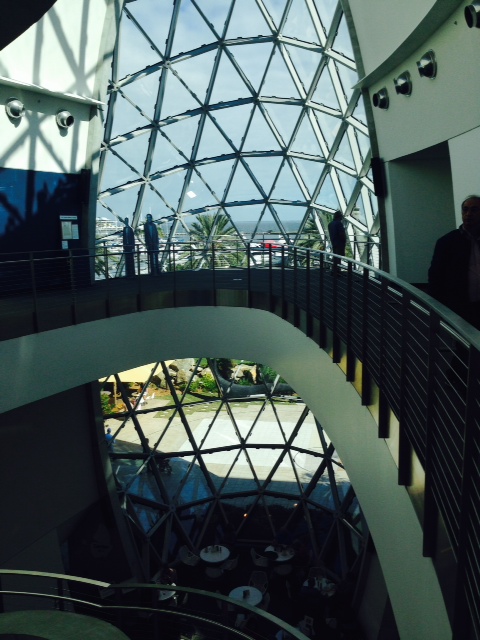
The famous Dali Museum exhibits the works of Salvatore Dali, a Spanish artist and friend of Picasso whose career spanned a series of different styles as his works evolved. The museum building is stunning and the artwork fascinating, even to an art neophyte like me

The atrium of the Dali Museum
The atrium of the Dali Museum

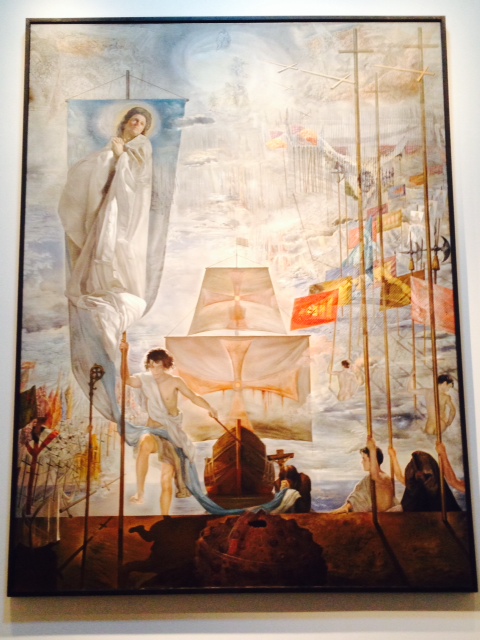
One of several enormous works that nearly covers the entire wall in the museum

One of several enormous works that nearly covers the entire wall in the museum. This is from Dali’s “spiritual” period.

Another enormous painting in the museum

Another enormous painting in the museum; the more you look at it, the more new images appear that you didn’t notice before.
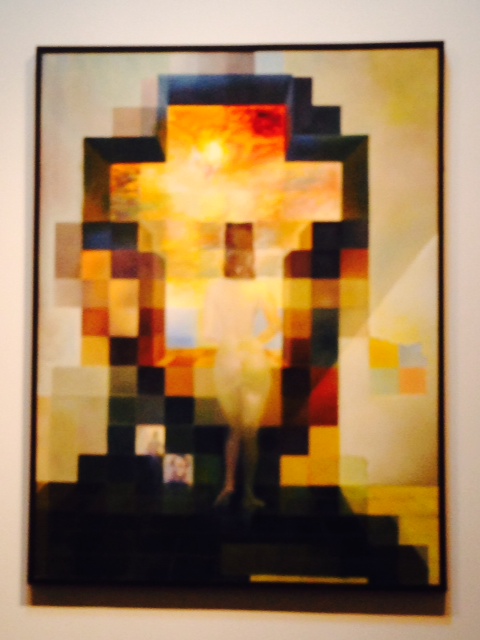
This painting changes images a one views it from different distances. From afar, the image of Lincoln appears, which is indistinguishable from closer distances
This painting changes images as one views it from different distances. From afar, the image of Lincoln appears, which is indistinguishable from closer distances

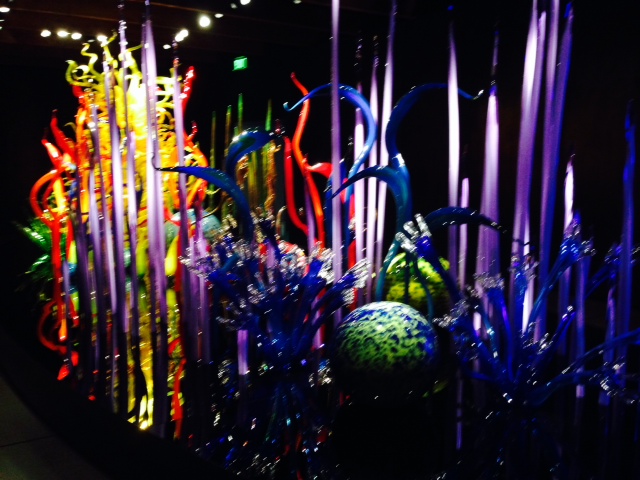
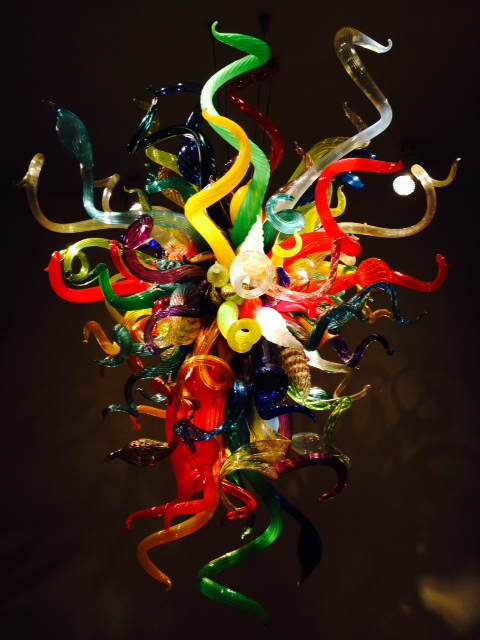
Another stunning display of art is the Chihuly Collection by Dale Chihuly, a glass sculpture who uses glass and light to create amazing images. Following are a few of his works seen at the Chihuly Collection in St. Pete

Another stunning display of art is the Chihuly Collection by Dale Chihuly, a glass sculpturer who uses glass and light to create amazing images. Following are a few of his works seen at the Chihuly Collection in St. Pete. These are all made of glass.

StPete-Chihuly2

StPete-Chihuly3

StPete-Chihuly4

Supposedly, one appears to be underwater when a picture is taken underneath this glass sculpture due to the lighting and the surroundings. You be the judge...

Supposedly, one appears to be underwater when a picture is taken underneath this glass sculpture due to the lighting and the surroundings. You be the judge…

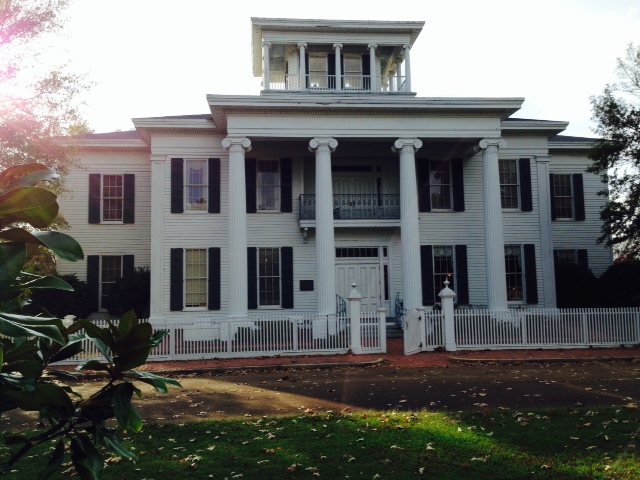
The historic neighborhood in St. Pete contains hundreds of beautifully preserved historic homes.
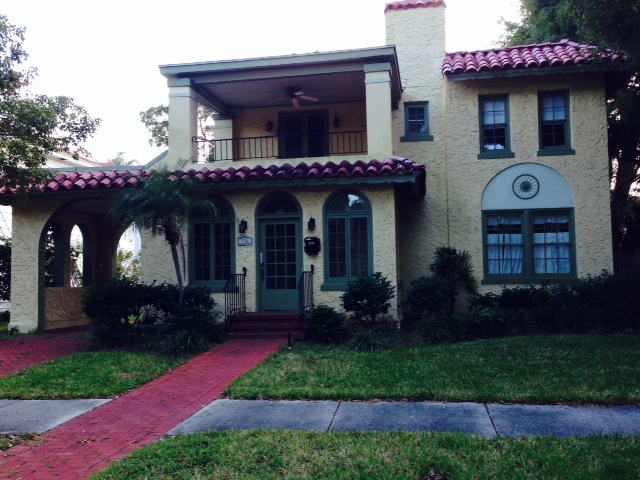
The historic neighborhood in St. Pete contains hundreds of beautifully preserved historic homes.

Another beautiful historic home

Another beautiful historic home

I could think of a number of captions for this picture, but am wise enough to not use any of them.  Any suggestions?

I could think of a number of captions for this picture, but have become wise enough to not use any of them. Any suggestions?

Paul's brother Steve and his wife Sue live in St. Pete, and we had the pleasure of spending some time together, in addition to a wonderful dinner with the Coates family, including Bill Coates, the Patriarch. Steve took us to this pub with a deck overlooking an inlet to the Gulf, where we enjoyed dinner, a couple of beers, the sunset, and the pleasure of Steve's company.

Paul’s brother Steve and his wife Sue live in St. Pete, and we had the pleasure of spending some time together;  I also had the honor of  attending a wonderful dinner with extended members of the Coates family, including Bill Coates, the Patriarch. Steve took us to this pub with a deck overlooking an inlet to the Gulf, where we enjoyed dinner, a couple of beers, the sunset, and the pleasure of Steve’s company.
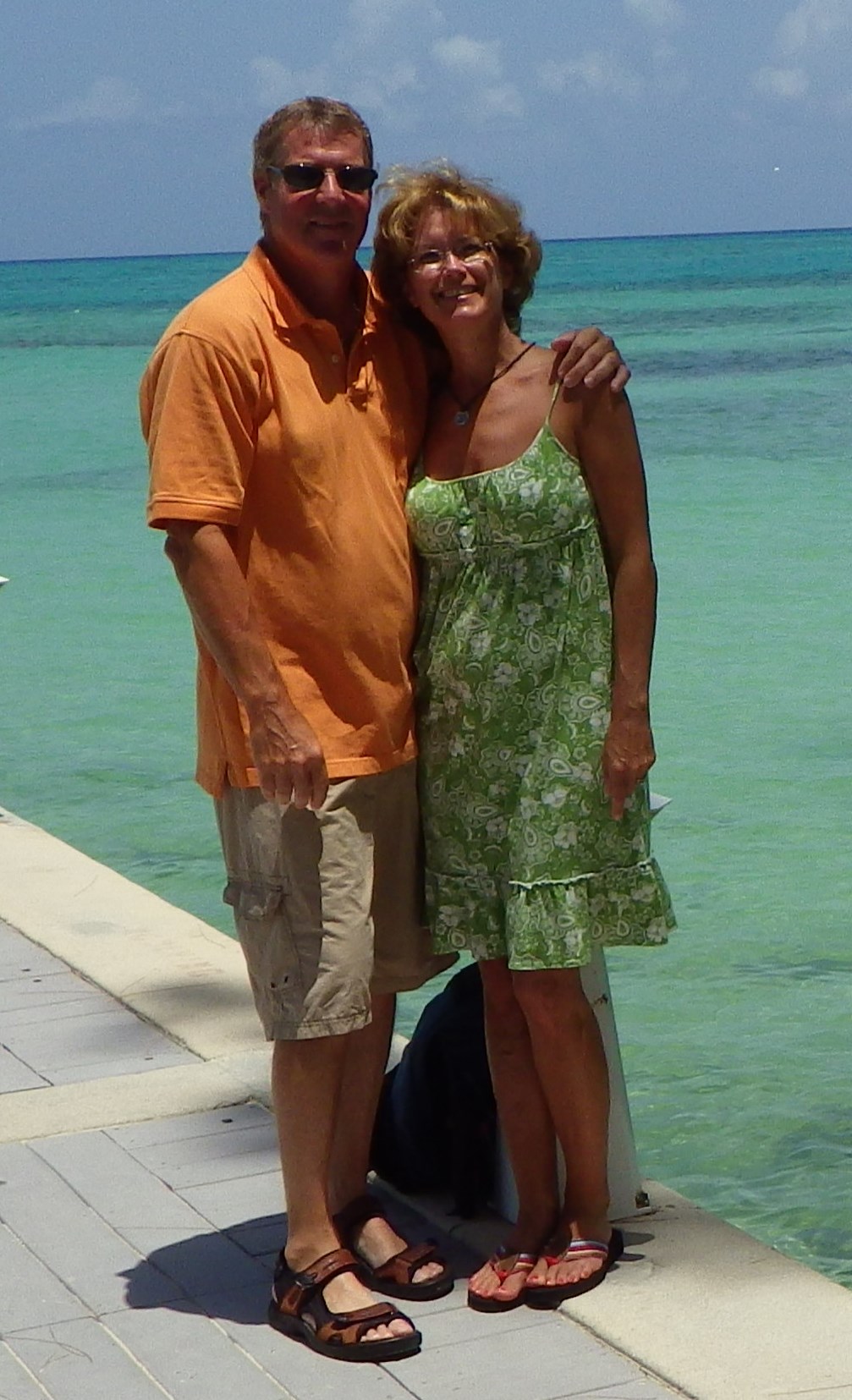
Steve and his wonderful bride, Sue. Ten years ago, when my daughter Jenny and I rode our bicycles cross country to raise money for breast cancer research, we ended our journey in St. Augustine, Florida.  We didn't know anyone there, so Steve & Sue drove 3 hours across the state to congratulate us on the completion of our journey - an incredible gesture that we have never forgotten, but a commonplace act of kindness for Steve & Sue.

Steve and his wonderful bride, Sue. Ten years ago, when my daughter Jenny and I rode our bicycles cross country to raise money for breast cancer research, we ended our journey in St. Augustine, Florida. We didn’t know anyone there, so Steve & Sue drove 3 hours each way across the state to meet and congratulate us on the completion of our journey – an incredible gesture that we have never forgotten, but a commonplace act of kindness for Steve & Sue.

OH, NO. Not another bridge!  I couldn't resist - this is the suspension bridge span of the bridge/causeway across Tampa Bay, which we passed under on our way south from St. Petersburg.

OH, NO. Not another bridge! I couldn’t resist – this is the Sunshine Skyway Bridge across Tampa Bay, which we passed under on our way south from St. Petersburg. The original bridge was constructed in 1954, but collapsed in 1980 when a supporting pier was struck by the freighter SUMMIT VENTURE during a blinding thunderstorm;  the collision caused 1200 feet of the bridge to plummet into Tampa Bay, taking 6 cars, a truck, and a greyhound bus with it. One person miraculously survived when his pick-up truck landed on the deck of the freighter before falling into the Bay, but 35 people were killed. This current bridge, spanning 4.1 miles across the Bay, replaced the collapsed one in 1987.

Our next stop was Sarasota, a 30 mile run south from St. Petersburg. Sarasota is a very upscale city with a beautiful beachfront area on the barrier islands and a thriving residential downtown area across the bridge on the mainland. We were fortunate enough to stay at the opulent Sarasota Yacht Club on the beach side for free.

Sarasota is home to the Ringling Brothers Circus Museum and Art Gallery. It’s clear that the Ringling Brothers legacy continues to have a significant presence in Sarasota. The Ringling Brothers Circus was founded in 1884 by five of the seven Ringling Brothers. Although each brother had a different job with a different level of effort and responsibility, the five brothers always divided the proceeds equally among them. In 1887, they went to Philadelphia and acquired several railroad cars, which enabled them to travel greater distances to larger towns, thus playing to larger audiences each night and grow their reputation and following exponentially. The image of the railroad cars also became an icon of the Ringling Brothers Circus. In 1907, they acquired the Barnum & Bailey’s Circus and merged them in 1919 to become “The Greatest Show On Earth”. In 1929, they bought 7 other circus shows, including Buffalo Bill’s Wild West Show, after which they owned every traveling circus show in America.

In 1927, they moved their winter headquarters to Saraota, where John and wife Mable Ringling had been wintering since 1909. John was instrumental in the development of modern-day Sarasota, and became one of the richest men on earth. He and Mable acquired an enormous collection of art, and first established the art museum in Sarasota in 1927. Upon his death in 1936, John Ringling willed the art collection plus a $1.2 million endowment (a huge sum back then) to the State of Florida, despite the fact that he was nearly bankrupt at that time (after all, this is America). Creditors contested the donation, but the state eventually won after years of court battles.  However, the state allowed the property to fall into disrepair until 2002, when it finally appropriated $43 million in construction funds, provided that the private sector kicked in $50 million within 5 years. By the time the deadline arrived, $55 million had been raised, and in 2007, a $79 million expansion and renovation project was finished. Designated as the official Florida State Art Museum, it contains over 10,000 pieces of art and over 150,000 square feet of new space, including the Art Museum, the Circus Museum, the Ringlings’ mansion, and the historic Asolo Theater.

Here are some images from our stay in Sarasota:
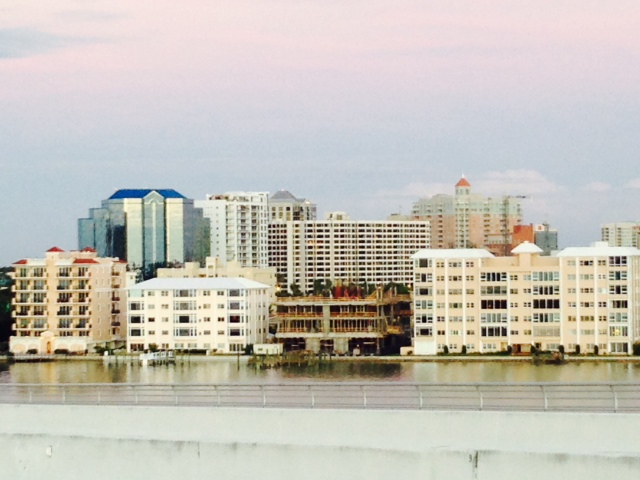
The skyline of the mainland-side os Sarasota consists mostly of residential buildings

Similar to St. Petersburg, the skyline of the mainland-side of Sarasota consists mostly of residential buildings

To give you an idea of how upscale the City is - this is Marina Jack, the main marina serving the City of Sarasota

To give you an idea of how upscale Sarasota is – this is Marina Jack’s, the main marina serving the City of Sarasota….a bit different from the marinas along the inland routes on the Great Loop.
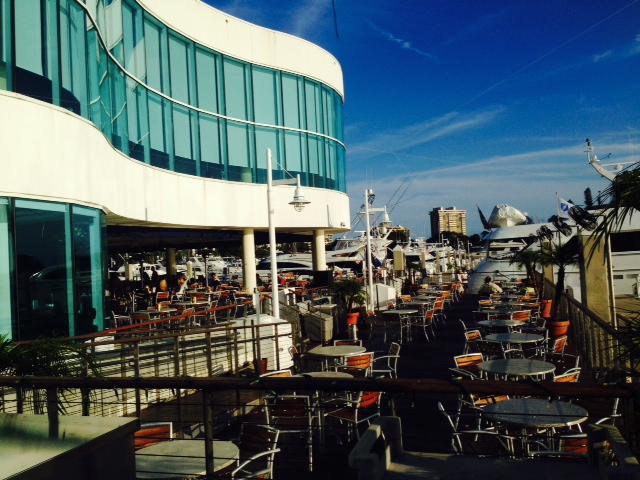
The waterfront dining overlooking the Intracoastal Waterway at Marina Jack's

The waterfront dining overlooking the Intracoastal Waterway at Marina Jack’s

The wide beach at Sarasota is spectacular, with fine white sugar-like sand
The wide beach at Sarasota is spectacular, with fine white sugar-like sand

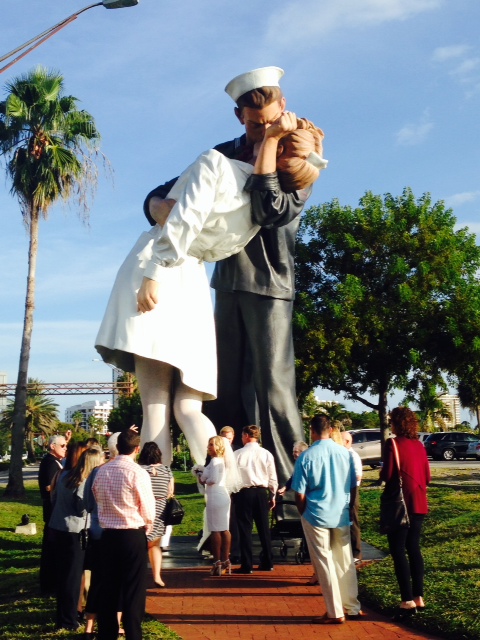
On the mainland-side of Sarasota, there is this enormous statue of the famous photograph taken of a sailor kissing a nurse in the streets moments after the surrender of Japan ending World War II was announced. There happened to be a wedding just getting underway beneath the statue as I rode up on my bike and snapped this picture.
On the mainland-side of Sarasota stands this enormous statue of the famous photograph taken of a sailor kissing a nurse in a street in Europe moments after the announcement of the surrender of Japan ending World War II. There happened to be a wedding just getting underway beneath the statue as I rode up on my bike and snapped this picture.

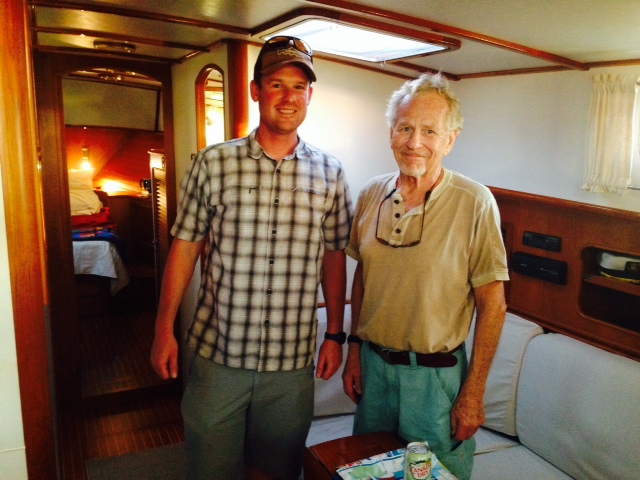
It had been over a month, since we were together at Fairhope, Alabama, since we had seen our good friends Tom & Tim, the grandfather/grandson team aboard the vessel IF. Thus, I was thrilled to find them in Sarasota at Marina Jack's and to spend some time with them aboard IF.

It had been over a month since we were together at Fairhope, Alabama with our good friends Tom & Tim, the grandfather/grandson team aboard the vessel IF. Thus, I was thrilled to find them in Sarasota at Marina Jack’s and to spend some time with them aboard IF.

Cruising south along the Gulf Intracoastal Waterway continued to provide some interesting scenery:

Both the house and the setting - on a long peninsula sticking out into the GICW, struck me as we came upon this house

Both the house and the setting – on a long peninsula sticking out into the GICW  – captured my attention as we cruised by it.

Here is a closer shot of the house

Here is a closer shot of the house

We haven't seen a swing bridge since the historic, manually-operated wooden swing bridges on the Trent-Severn Waterway, so I couldn't resist capturing this one

We haven’t seen a swing bridge since the historic, manually-operated wooden swing bridges on the Trent-Severn Waterway, so I couldn’t resist taking a picture of this one

We then ran just 15 miles south to Venice, Florida, a smaller version of Sarasota with a European twist. Here are some images:
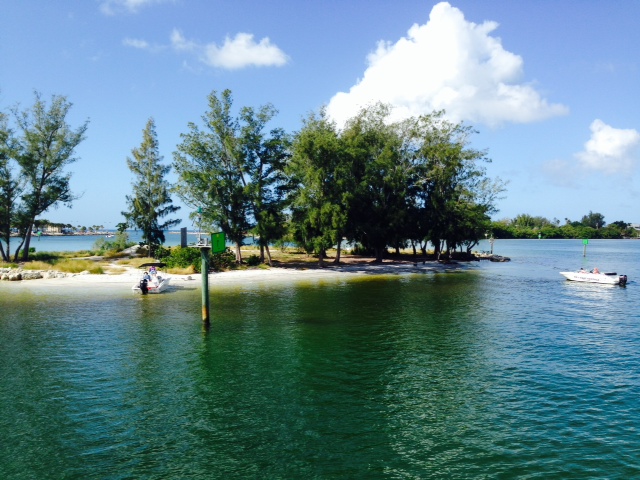
This picturesque islands greets boaters as they approach Venice on the GICW from the north.

This picturesque islands greets boaters as they approach Venice on the GICW from the north.

The marina where we stayed in Venice is directly on the Gulf Intracoastal Waterway

The marina where we stayed in Venice is directly on the Gulf Intracoastal Waterway – the day was sunny and calm.
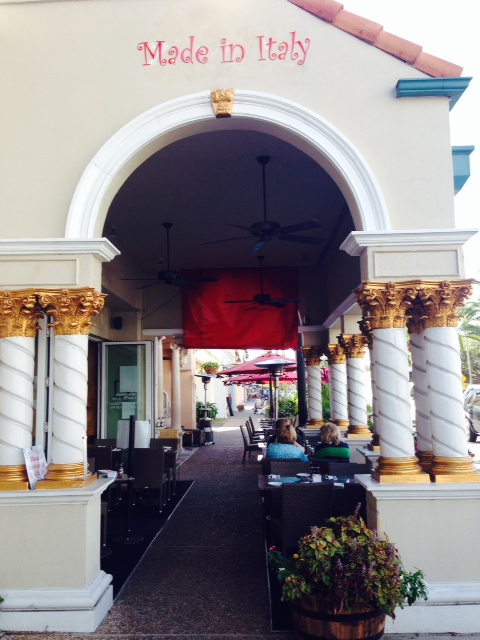
The "Italy" theme is quite prevalent throughout the city, as its namesake would suggest

The “Italy” theme is quite prevalent throughout the city, as its namesake would suggest

An image from the main street in downtown Venice

An image from the main street in downtown Venice

Notice the balcony, reminiscent of buildings throughout Italy

Notice the balcony, reminiscent of buildings throughout Italy

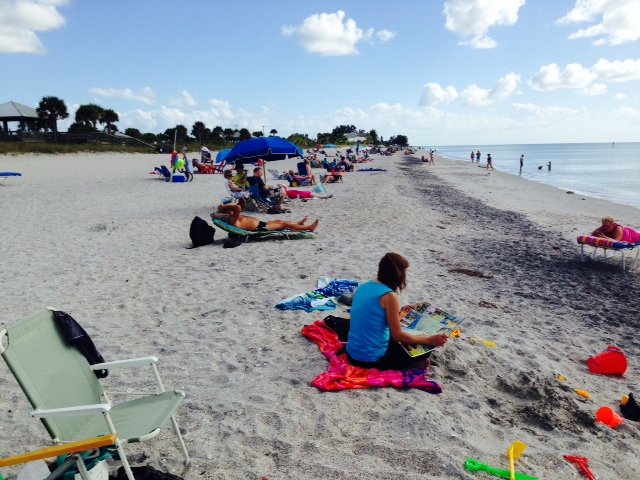
Another spectacular beach along the Gulf coast of Florida - this one in Venice

Another spectacular beach along the Gulf coast of Florida – this one in Venice

Our next stop was Englewood Beach on Manasota Key, one of our favorite places. It is about 25 miles south of Venice, but very different from both Venice and Sarasota.  Instead of high-rises and resorts, Englewood Beach is lined primarily with more modest older cottages and two-story homes. The commercial area is small and a bit funky. There is only one small marina tucked in a corner of the harbor on the bay side of the island, with some commercial fishing boats docked in the harbor as well and a fish market where you can buy fresh fish just brought in off the boats. There are two fun and funky restaurant/pubs overlooking the harbor, both of which feature outdoor and indoor seating and live music every night and often during the afternoon as well. Here are some images:

Another picture of the cozy marina at Englewood

The Joint Adventure tucked in the corner of the cozy marina at Englewood, which is surrounded by mangroves right to the edge of the docks

Another picture of the marina and the Joint Adventure
Another picture of the marina and the Joint Adventure

Notice the lack of high-rises along the beach. However, the sand is a bit coarser that the sugar-fine sand on the beaches further north.

Notice the lack of high-rises along the beach
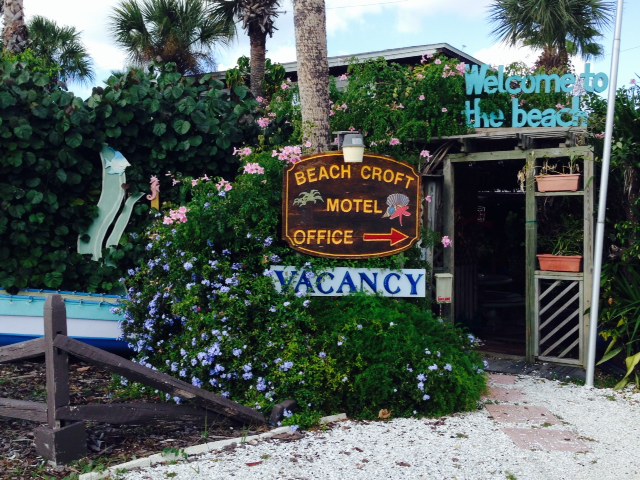
The entrance to a funky hotel on Englewood Beach
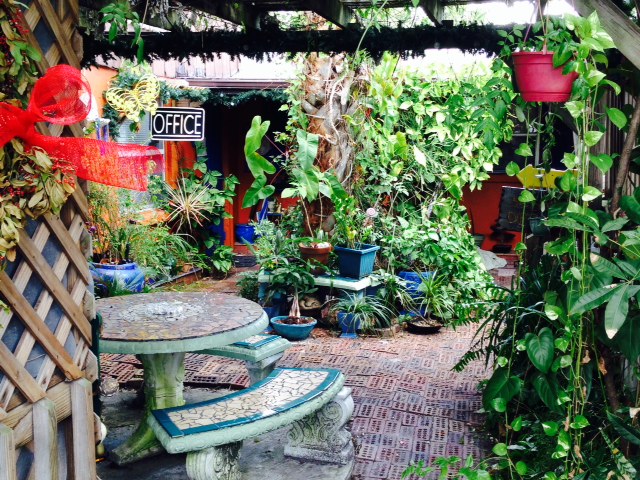
The entrance to a funky hotel on Englewood Beach

This is the entrance to a funky hotel located along Englewood Beach

A view of the entrance courtyard of the hotel once you pass through the vegetated archway
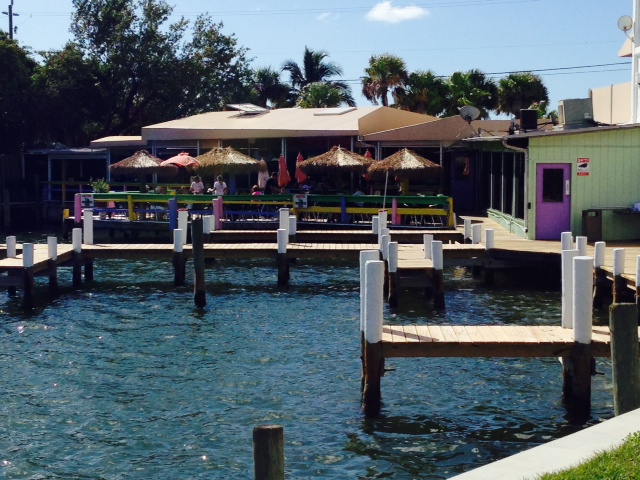
One of the two fun restaurant/pubs overlooking the waterfront on the bay side

One of the two fun restaurant/pubs overlooking the waterfront on the bay side

The three-piece band playing outside on the deck in the afternoon - we couldn't resist an early happy-hour visit...

The three-piece band playing outside on the deck in the afternoon – we couldn’t resist an early happy-hour visit…

You may have seen one of these before, but I never had and I was fascinated - it is an electronic drum set, in which striking each of the eight panels produces the sound if a different drum - base, snare, cymbals, etc.  What will they think of next?

You may have seen one of these before, but I never had and I was fascinated – it is an electronic drum set, in which striking each of the eight panels produces the sound if a different drum – base, snare, cymbals, etc. What will they think of next?

We next visited Boca Grande on Gasparilla Island, another barrier island with an interesting history. Boca Grande is Spanish for “Big Mouth”, so named due to the width and depth of the pass at the southern tip of the island, which, at 80 feet deep, is one of the deepest natural inlets in Florida. The first settlers came to Gasparilla Island to fish, but the discovery of phosphate rock on the nearby banks of the Peace River in 1885 brought prosperity to the island. Due to the deep water pass, a railroad was built to carry phosphate onto and down the length of the island where a 1/5 mile long pier and deep water facilities were built to load the phosphate directly onto ocean-going freighters for shipment throughout the world. As a result, at its peak in 1969, Port Boca Grande was the 4th busiest port in Florida. However, use of the port ceased 10 years later as it became cheaper to ship through Tampa Bay.  Today, the abandoned railroad bed is an active bike trail that goes through the center of the upscale town.

Fishing is the other activity that put Boca Grande on the map – the area is renowned as the world’s premier tarpon fishing location which yields more tarpon than any other place in the entire world. Today, Boca Grande is an upscale tourist destination with many restored buildings from its past, upscale shops, and fine homes.  Here are some images:

The old train depot brought wealthy visitors to the island until a roadway was built.  It now houses a restaurant in the center of town, as well as numerous shops.

The old train depot brought wealthy visitors to the island until a roadway was built. It now houses a restaurant in the center of town, as well as numerous shops.


Golf carts are the primary means of transportation on the island, and are available for rent at numerous locations.

Golf carts are the primary means of transportation on the island, and are available for rent at numerous locations.

How true this is....

How true this is….

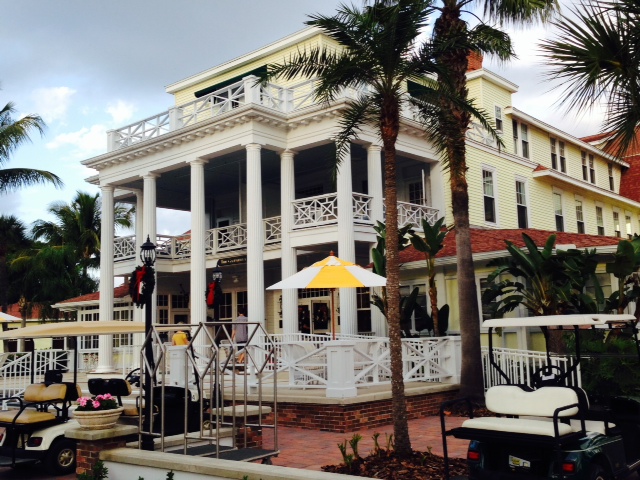
The enormous Gasparilla Inn & Club was built in 1911 and has been beautifully restored to its original opulence when it was built to cater to wealthy visitors from the north who came to Boca Grande for the world-class fishing and the warm winter climate.

The enormous Gasparilla Inn & Club was built in 1911 and has been beautifully restored to its original opulence when it was built to cater to wealthy visitors from the north who came to Boca Grande for the world-class fishing and the warm winter climate.

Inside the Gasparilla Inn -

Inside the Gasparilla Inn –

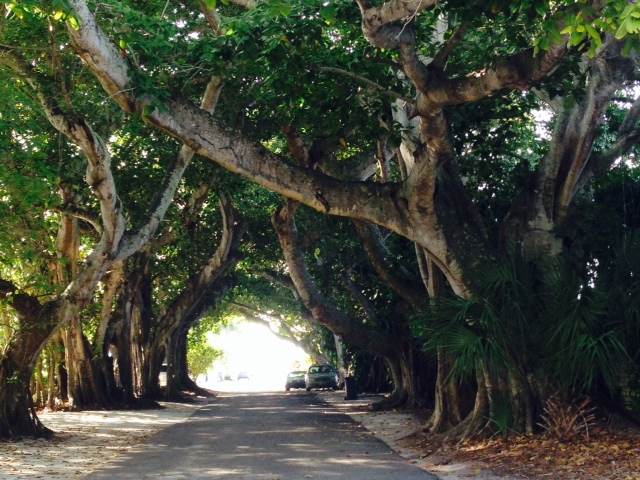
The banyan trees literally create a tunnel through which aptly-named Banyan Road passes.

The banyan trees literally create a tunnel through which aptly-named Banyan Road passes.

This is all one banyan tree in downtown Boca Grade!

This is all one interconnected banyan tree in downtown Boca Grande!

We left Boca Grande and headed for Fort Myers as our next stop on our Great Loop Adventure. Believe it or not, there is actually a non-profit organization that was formed in 1999 which is focused on people who are interested in traveling the Great Loop.  Called “America’s Great Loop Cruisers Association”, it provides moral and informational support to those who are traveling or thinking of traveling the Great Loop. They also have available two different types of flags to those who travel the Loop.  The first is a white flag that looks like this:
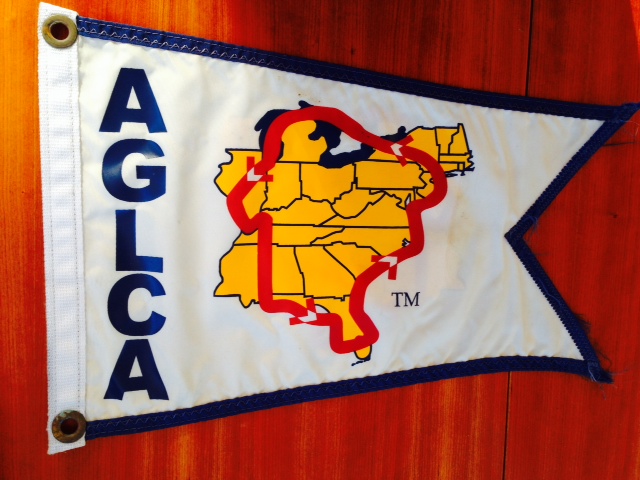
The white Looper flag identifies the vessel as underway on the Great Loop

The white Looper flag identifies the vessel as underway on the Great Loop

Virtually all Loopers fly this flag so that we can identify each other, which virtually always leads to an exchange of information, camaraderie, “docktails” (shared cocktails on the dock), and new friendships. However, when one finally completes the entire Loop, referred to as “crossing your wake”, you are entitled to fly a new, gold flag that identifies you as having completed the entire Loop.

Although we started our current voyage on May 2 of this year, we bought the Joint Adventure in December of 2012 in Port Charlotte, Florida, a few miles from Boca Grande. We then brought her to Boston the following spring, crossing central Florida on the Okeechobee Waterway to the East coast, then transiting the Atlantic Intracoastal Waterway north from Florida to Boston, thus transiting the portion of the Great Loop from Port Charlotte to Boston. Therefore, at 7:55 AM on Saturday, December 6, when we passed the mouth of Charlotte Harbor where we had passed through two years ago nearly to the day, we “crossed our wake” and officially completed our circumnavigation of the Eastern half of the U.S. – the Great Loop. We would have popped open a bottle of Champaign, but we still had to operate the vessel safely for the next 4 hours on our way to Fort Myers. However, we did put it in neutral, exchanged high fives, danced around the deck, and took a few pictures:
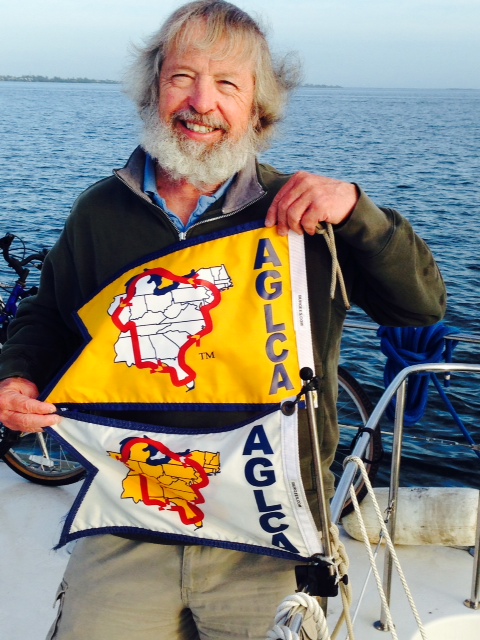
 

Crossing Or Wake - we took down the white flag and put up the gold one!
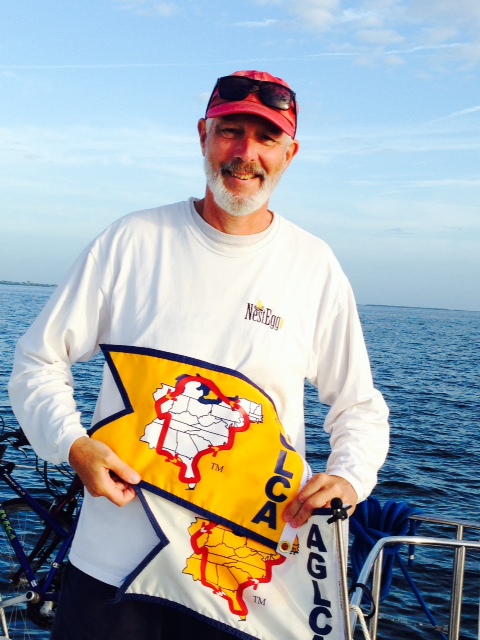
Crossing Or Wake – we took down the white flag and put up the gold one!

GICW-gold flag2

While we have officially completed the Great Loop, our current trip has always been Boston to Boston, so on we go!

Our next destination was downtown Fort Myers, about 45 miles away and 15 miles up the Caloosahatchee River. Fort Myers literally started out as a fort along the Caloosahatchee River, built as a base of operations to support the series of wars with the Seminole Indians. Afterwards, during the Civil War, the fort was used as a base for Confederate blockade runners and cattle ranchers, then was abandoned. There was still no permanent settlement at Fort Myers until the first settlers arrived in 1866. Just 20 years later, in 1886 when Fort Myers was still no more than a rustic outpost, Thomas Edison visited and fell in love with the beauty of the place and built his winter estate on the bank of the Caloosahatchee River. However, the settlement hardly grew until a winter resort called the Royal Palm Hotel was built around the turn of the century and a railroad link was established in 1904. In 1914, Edison famously declared “There is only one Fort Myers, and 90 million people are going to find it out”.  Shortly thereafter, in 1915, Edison’s close friend and confidante, Henry Ford, built his winter estate next door to Edison’s;  the two inventers, along with mutual friend and frequent visitor Harvey Firestone, maker of tires, traded ideas and conducted experiments in Edison’s lab at his home. Today, the Edison and Ford estates are on the National Register of Historic places and are open to the public, along with the fascinating Edison Museum which displays many of his early successful and some unsuccessful inventions.

The City of Fort Myers has recently reinvented itself by restoring its downtown area and creating a hub of activity for both tourists and young people looking for night life. Many weekend evenings feature music festivals, art festivals, and other activities in which the streets downtown are closed to traffic and become outdoor pedestrian enclaves. There is a very active arts community, and there are no less than four venues for the performing arts.

Here are some images from our visit to Fort Myers:
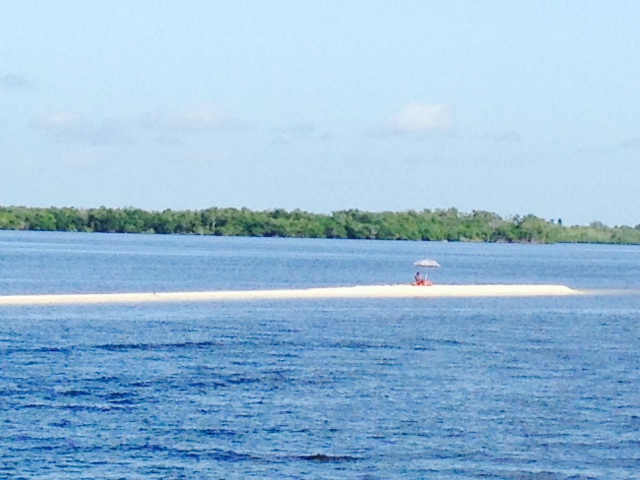
This guy knows how to live. He set up shop on one of the several beautiful, uninhabited islands in the Coloosahatchee River on the way to Fort Myers. The river was extremely busy with boat traffic on the warm, sunny Saturday when we steamed up the river, and he sat and watched the parade.

This guy knows how to live. He set up shop on one of the several beautiful, uninhabited islands in the Caloosahatchee River on the way to Fort Myers. The river was extremely busy with boat traffic on the warm, sunny Saturday when we steamed up the river, and he watched the parade go by while sipping his drink.

This floating bait shop on the Caloosahatchee River enables one to replenish the bait supply without having to go to shore

This floating bait shop on the Caloosahatchee River enables one to replenish the bait supply without having to waste valuable fishing time going to shore

The recent restoration of downtown Fort Myers includes brick streets, royal palms, and renovated historic buildings
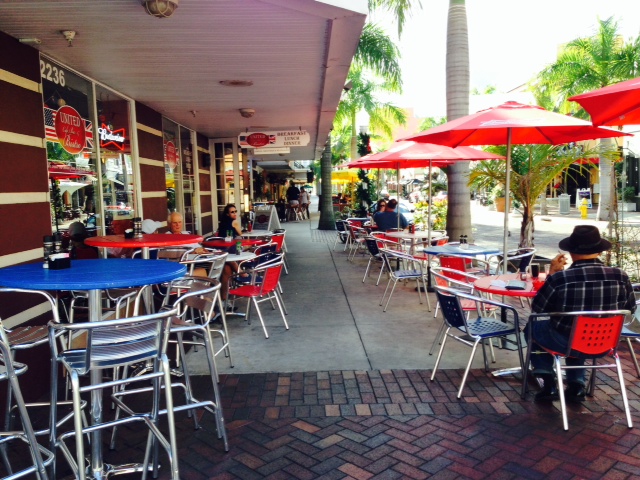
The recent restoration of downtown Fort Myers includes brick streets, royal palms, and renovated historic buildings

Sidewalk seating along the downtown streets activate the streets, which are alive with pedestrians

Sidewalk seating along the downtown streets creates a festive atmosphere, which is alive with pedestrians

The Sidney & Berne Davis Art Center in the heart of downtown is a magnificently restored building which hosts live theater, exhibits, and other activities throughout the year

The Sidney & Berne Davis Art Center in the heart of downtown is a magnificently restored historic building which hosts live theater, exhibits, and other activities throughout the year

A restaurant/pub called "Ford's Garage" features a full-sized replica of a model T hanging from the ceiling over the bar. The garage theme is carried into the rest rooms as shown with the unique sinks and faucets
A restaurant/pub called “Ford’s Garage” features a full-sized replica of a model T hanging from the ceiling over the bar. The garage theme is carried into the rest rooms as shown with the unique sinks and faucets

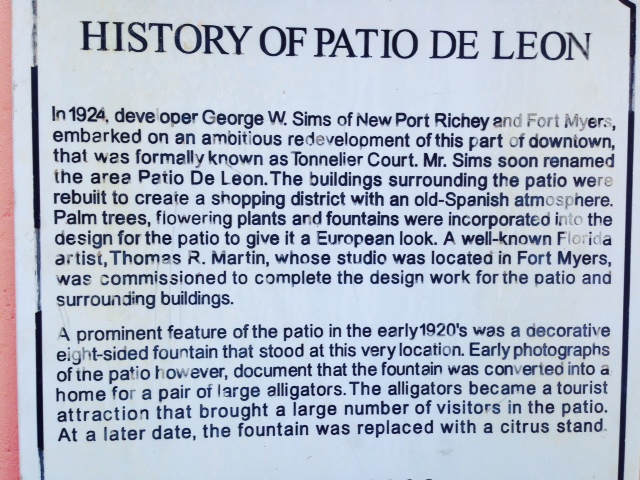
This sign on a downtown fountain explains the history of the fountain

This sign on a downtown fountain explains the interesting history of the fountain
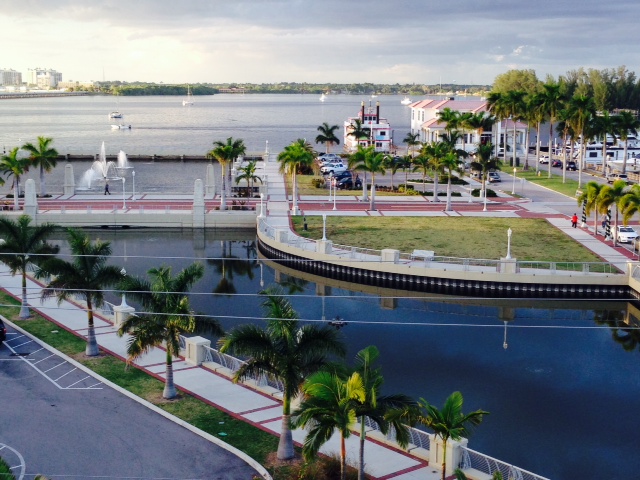
A view of the Caloosahatchee River and the waterfront taken from the 4th floor deck of a downtown restaurant/pub
A view of the Caloosahatchee River and the waterfront taken from the 4th floor deck of a downtown restaurant/pub

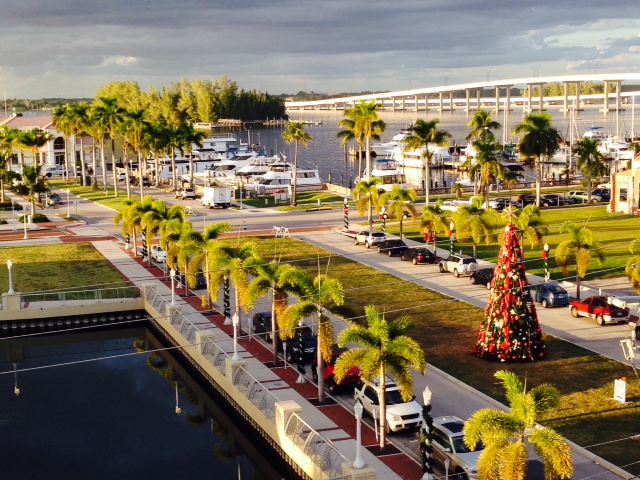
Another view from the 4th floor deck - the Joint Adventure is docked in the City Marina - the blue bimini cover can barely be seen on the right-hand side of the photo

Another view from the 4th floor deck – the Joint Adventure is docked in the City Marina – the blue bimini cover can barely be seen on the right-hand side of the photo

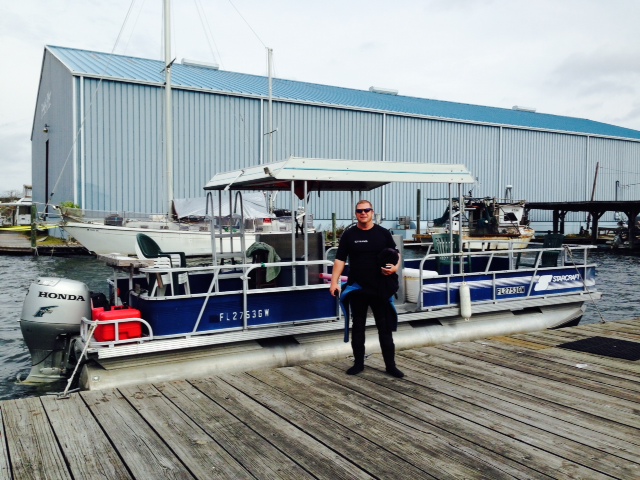
Our final run before docking the boat and returning home for the holidays was to the town of Fort Myers Beach, about 25 miles by water from Fort Myers. The Joint Adventure will stay here until we return from home on January 15 after spending the holiday season with family and friends. Our voyage at that time again changes dramatically, as we leave the protected waters of the Gulf Intracoastal Waterway, which turns eastward up the Caloosahatchee River and through Lake Okeechobee to the East coast of Florida.  Instead, we will head south along the open waters of the Gulf once again, headed for the Everglades and the Florida Keys

So the next blog update will likely be sometime in January.  In the meantime, please accept my wishes for a wonderful holiday season, and a happy, healthy, and prosperous new year!
 

Standard

SWIMMING WITH MANATEES IN THE WILD

Post #39, SWIMMING WITH MANATEES IN THE WILD, Day 203, November 23, 2014.  On board:  Paul, Jim K.

Did you know that the closest living relative to a manatee is the elephant? The two species share a number of similar and unique physical and biological functions which indicate that the two species are related, evolving quite differently from the same ancient ancestor.

Manatees are mammals, which means they breathe air and give live birth to their young (as opposed to eggs or larvae or some other multi-phase process). A baby manatee (calf) weighs about 60 pounds when born after a year-long gestation period in it’s mother’s womb. Adult manatees live up to 60 years, measuring up to 13 feet long and weighing up to 1300 pounds! They generally swim about 3-5 mph, but can accelerate up to 20 mph for short bursts – don’t get in the way of a 1300 pound manatee traveling at 20 mph!  They spend approximately 50% of their time sleeping submerged, surfacing for a breath of air every 20 minutes or so. They spend most of the rest of their time grazing on underwater plants in shallow water, in which they will usually eat 10-15% of their body weight EACH DAY, which translates to about 7 hours per day eating.  That’s a lot of salad!  They also perform their one other goal in life – mating. Eat, sleep, mate – it sounds like quite a good life – until you realize that they only mate about once every two years.

Manatees are generally solitary animals, and are also quite intelligent – similar to dolphins, they possess long term memory (like an elephant) and are capable of complex learning. They communicate via a wide range of sounds, mostly between mother and calf or during play or during the mating ritual (I can only imagine what they might be saying after waiting for two years to mate (“Remind me again – what do we do next” or  “Let’s try to make this LAST”).

Manatees are listed as an Endangered Species – their primary threat is collisions with powerboats or ships, and loss of habitat. All boaters in Florida are familiar with “idle speed only” manatee zones, designed to minimize collisions with manatees in areas where there they are known to hang out.

So much to our surprise, we learned that Crystal River is reportedly the only place in the world – certainly it is the only place in the U.S. – where it is legal to swim with manatees in the wild!  The town of Crystal River is located 8 miles up the river itself, which originates from a cluster of 50 natural springs that feed King’s Bay at the head of the river.  Because it is spring-fed, King’s Bay, resembling a small lake at the terminus of the river, maintains a constant temperature of 72 degrees year round. Manatees do not like cold water – they therefore seek areas of relatively warm water to hang out in the wintertime. Thus, King’s Bay and Crystal River are home to over 400 manatees during the winter. So, of course, since we’re in Crystal River, we had to experience swimming with the manatees firsthand. Here are some images:

While it is permitted to take your dinghy and go into the area of the springs where the manatee hang out on your own, there are guides who know the best place to go at any given time and who provide wet suits, snorkel equipment, etc., so it is a far better experience for a first-timer to go with a guide. Our guide was Jeff from Double J Adventures and this is his boat.  He and his wife, also a guide, started the business two years ago and provide vey personal service - we were the only two on the boat.

While it is permitted to take your dinghy and go on your own into the area of the springs where the manatees hang out, there are guides who know the best place to go at any given time and who provide wet suits, snorkel equipment, etc., so it is a far better experience for a first-timer to go with a guide. Our guide was Jeff from Double J Adventures and this is his boat. He and his wife, also a guide, started the business two years ago and provide vey personal service – we were the only two on the boat and Jeff took these pictures with his underwater camera, then put them on a CD for us.

Jeff guiding the boat to the springs in search of manatee

Jeff guiding the boat to the springs in search of manatees

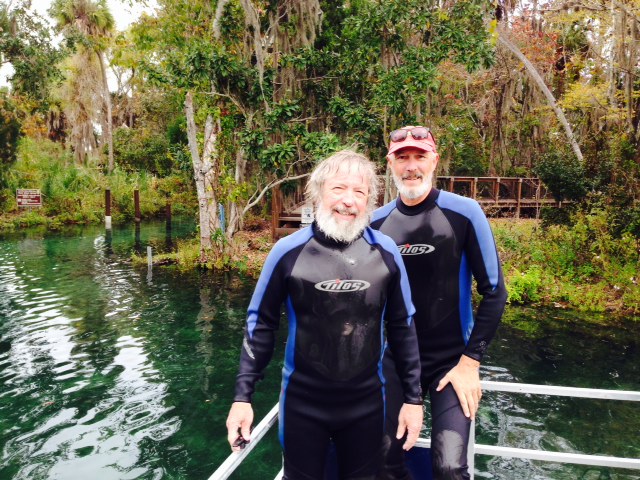
Paul & I in our wetsuits, preparing for the swim

Paul & I in our wetsuits, preparing for the swim

If this won't scare away a manatee, nothing will....

If this won’t scare away a manatee, nothing will….

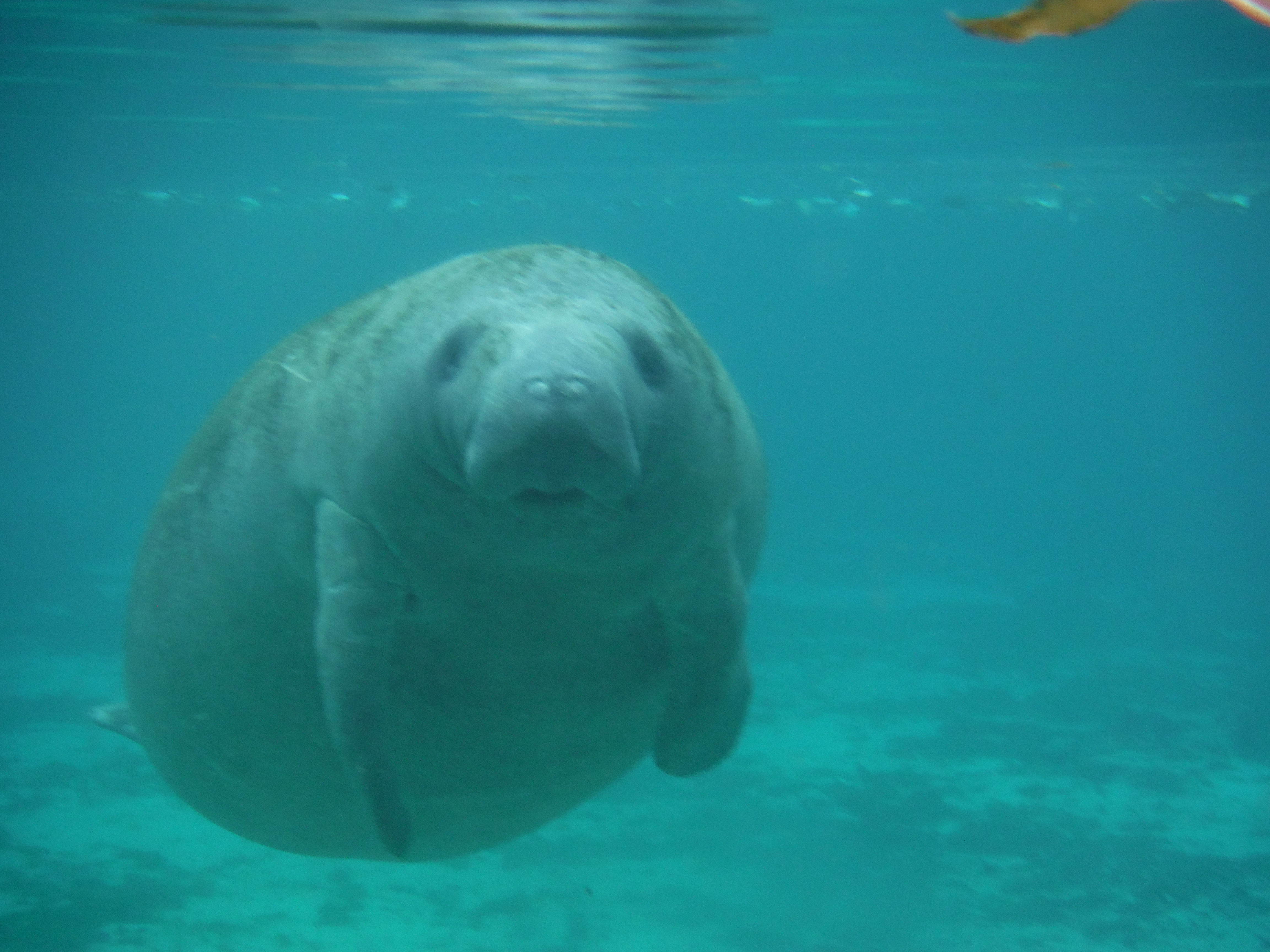
It's a staring contest - who will look away first?  Ok, you win...

It’s a staring contest – who will look away first? Ok, you win…

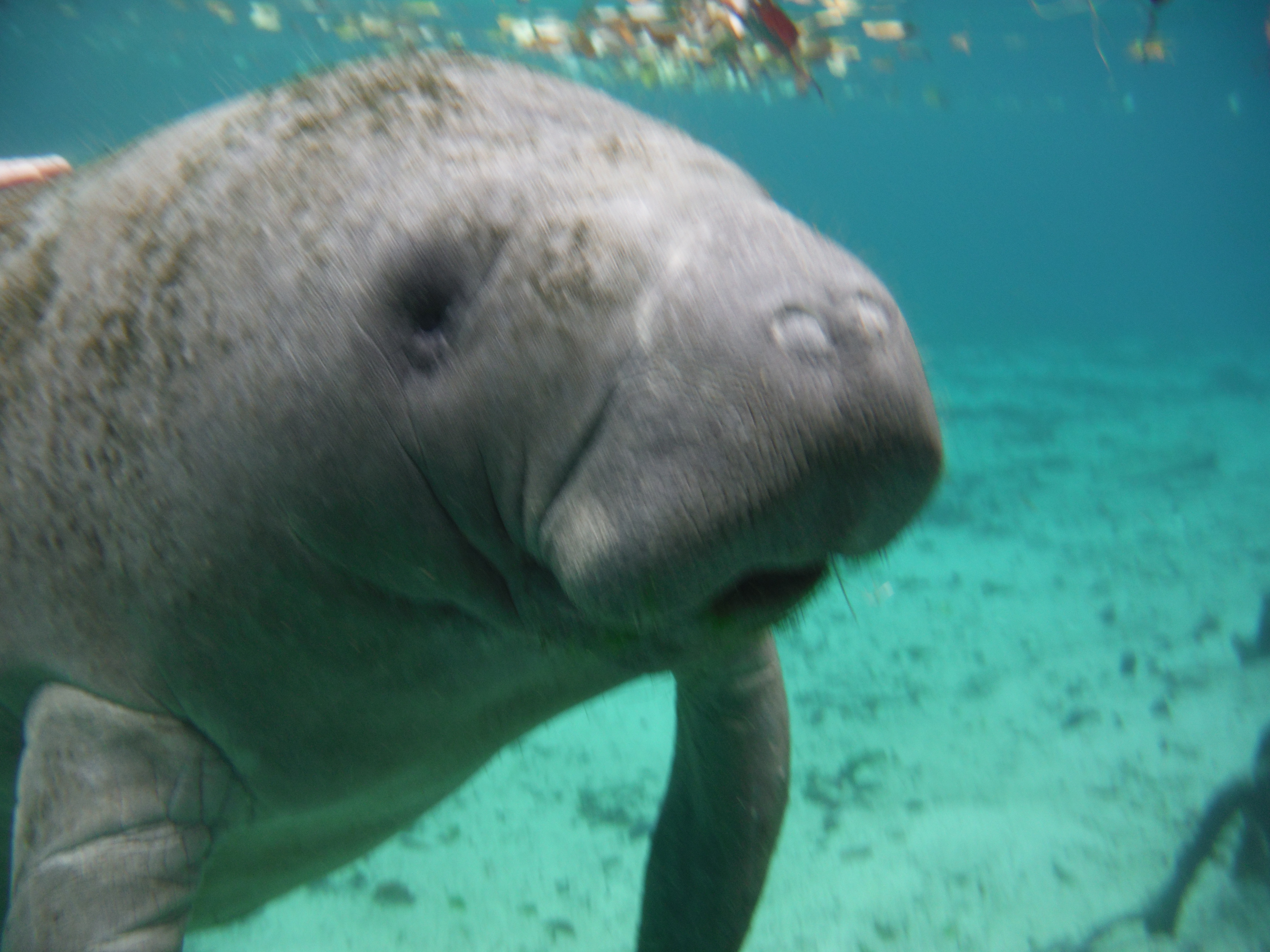
A face only a mother could love...

A face only a mother could love…

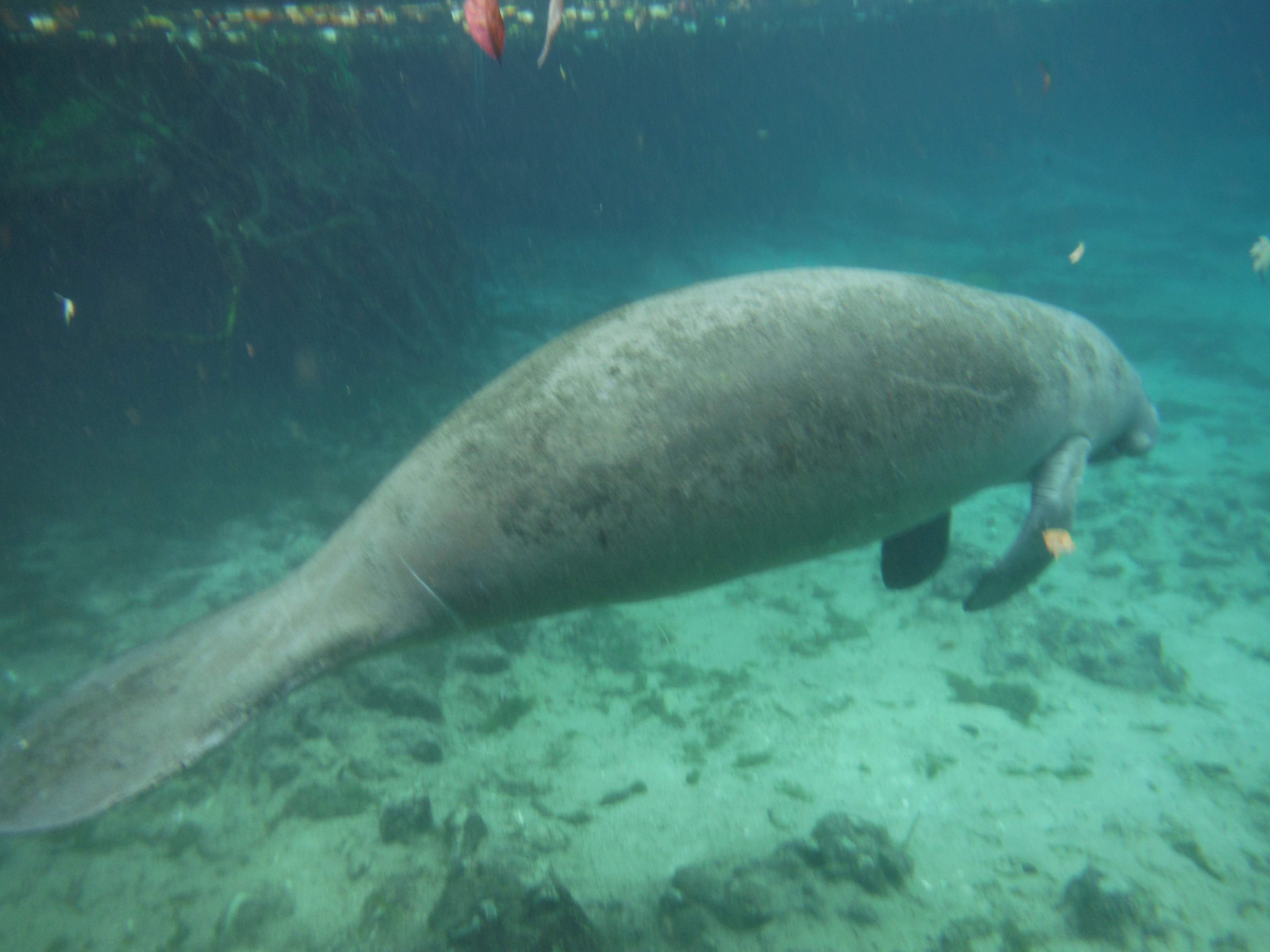
Manatees propel themselves with their tail, then steer with their two front flippers

Manatees propel themselves with their tail, then steer with their two front flippers

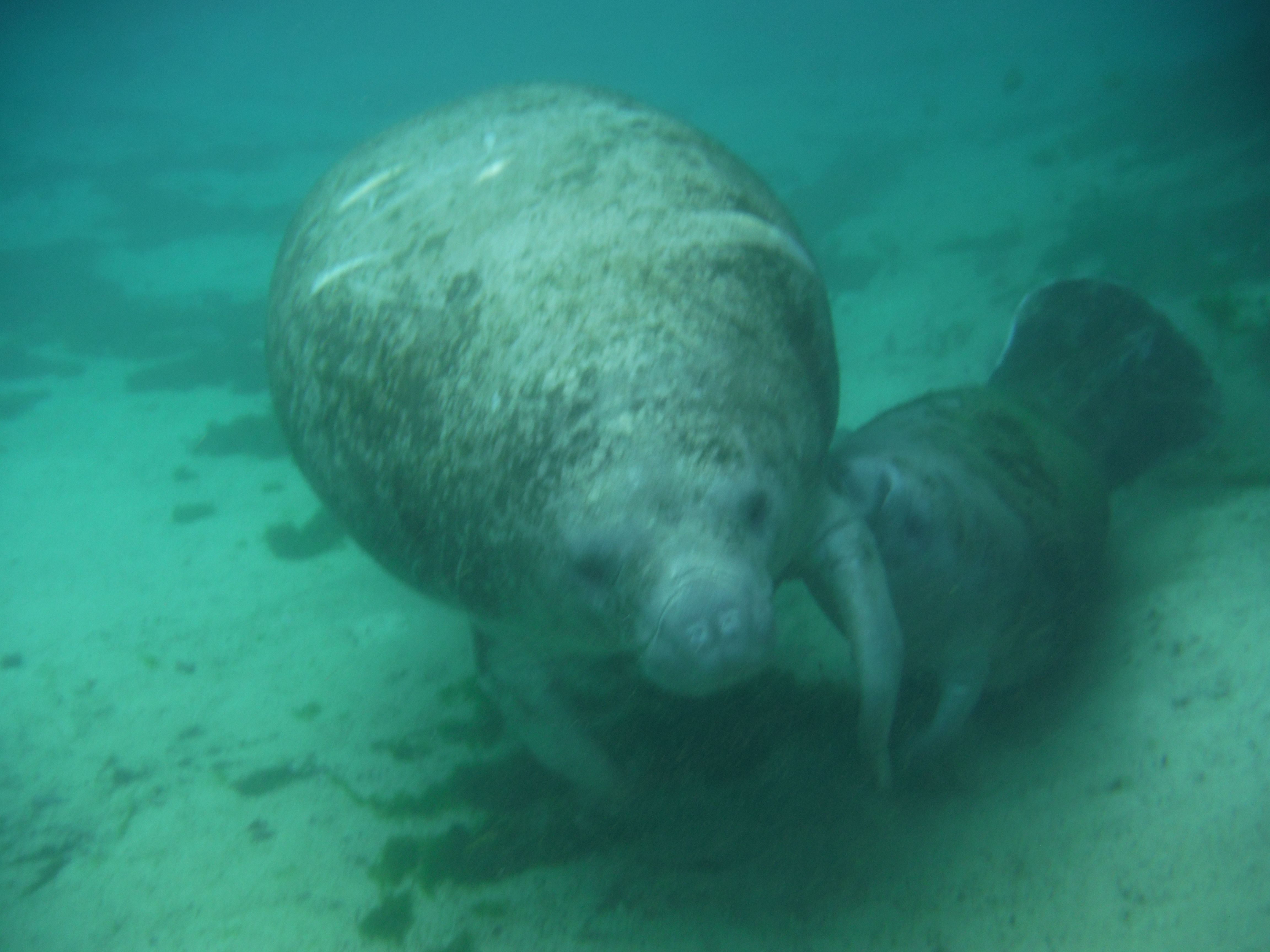
A mother with her calf, who stays with the mother and nurses for 12-18 months

A mother with her calf, who stays with the mother and nurses for 12-18 months


The mother nursing the calf - the nipple is located beneath the mother's flipper

A mother nursing her calf – the mother’s breast is located beneath the her flipper

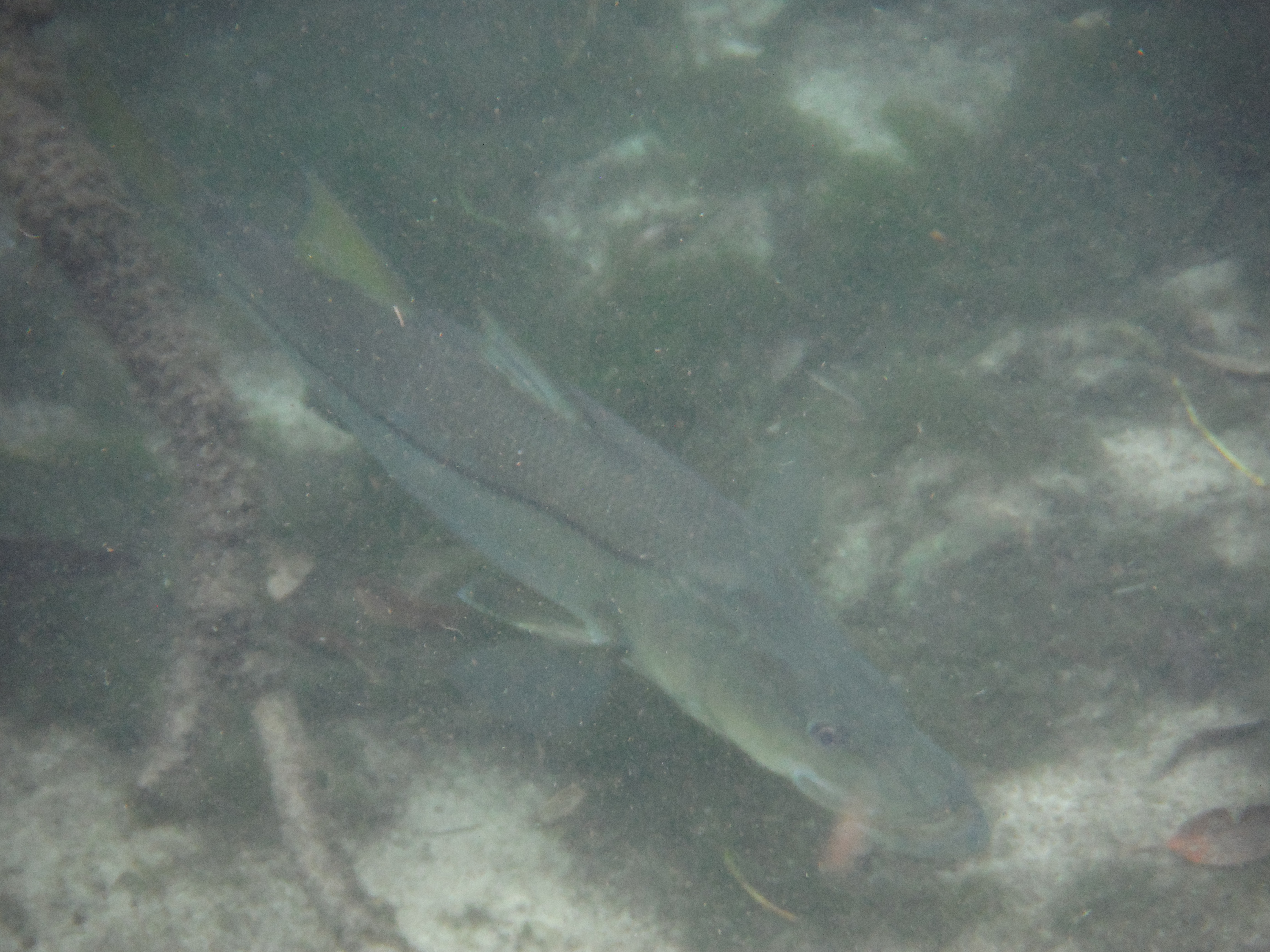
In addition to the manatees, we saw many fish - this is a good-sized snook that swam beneath us. Where is my fishing rod when I need it?

In addition to the manatees, we saw many fish – this is a good-sized snook that swam beneath us. Where is my fishing rod when I need it?

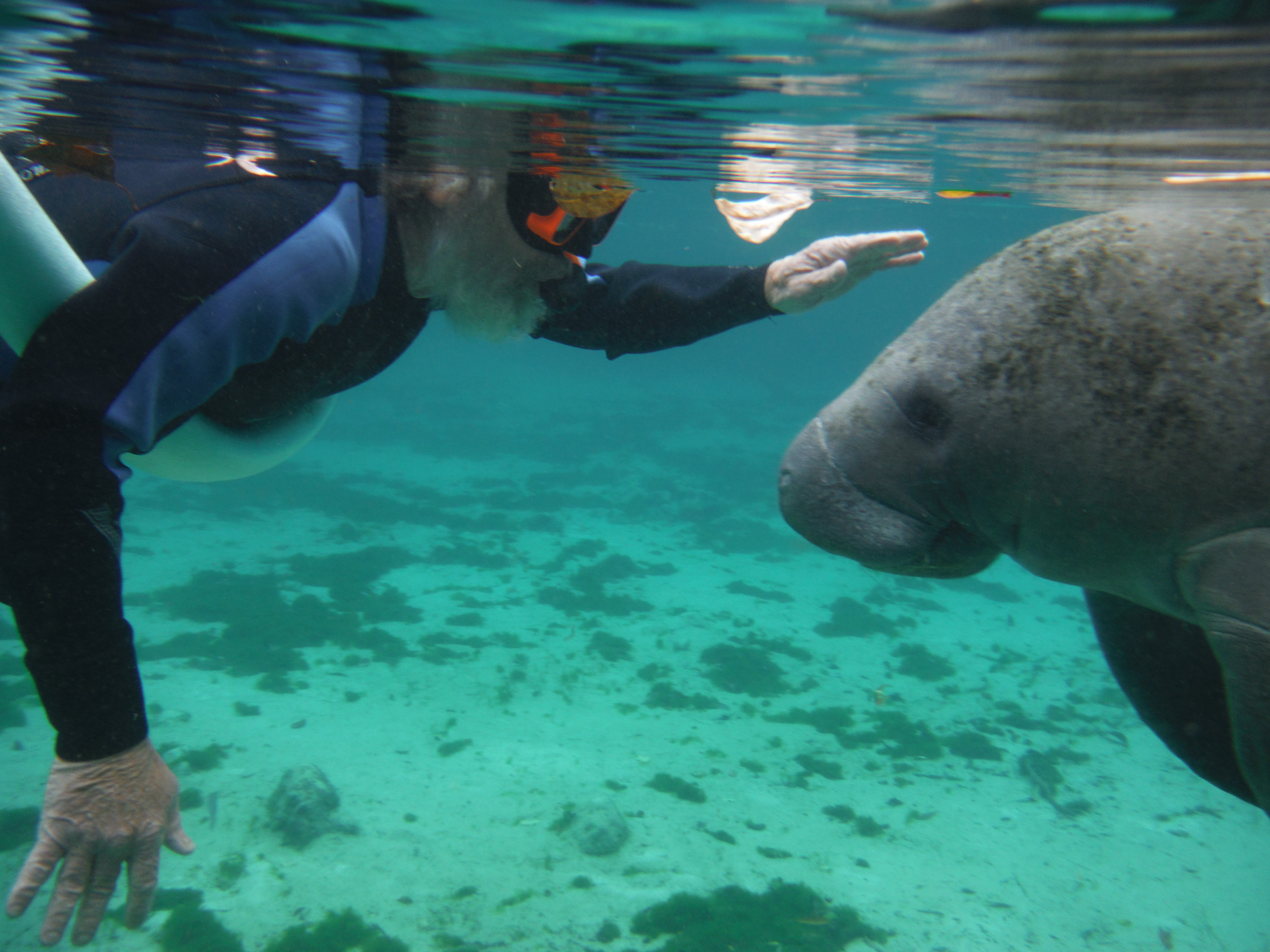
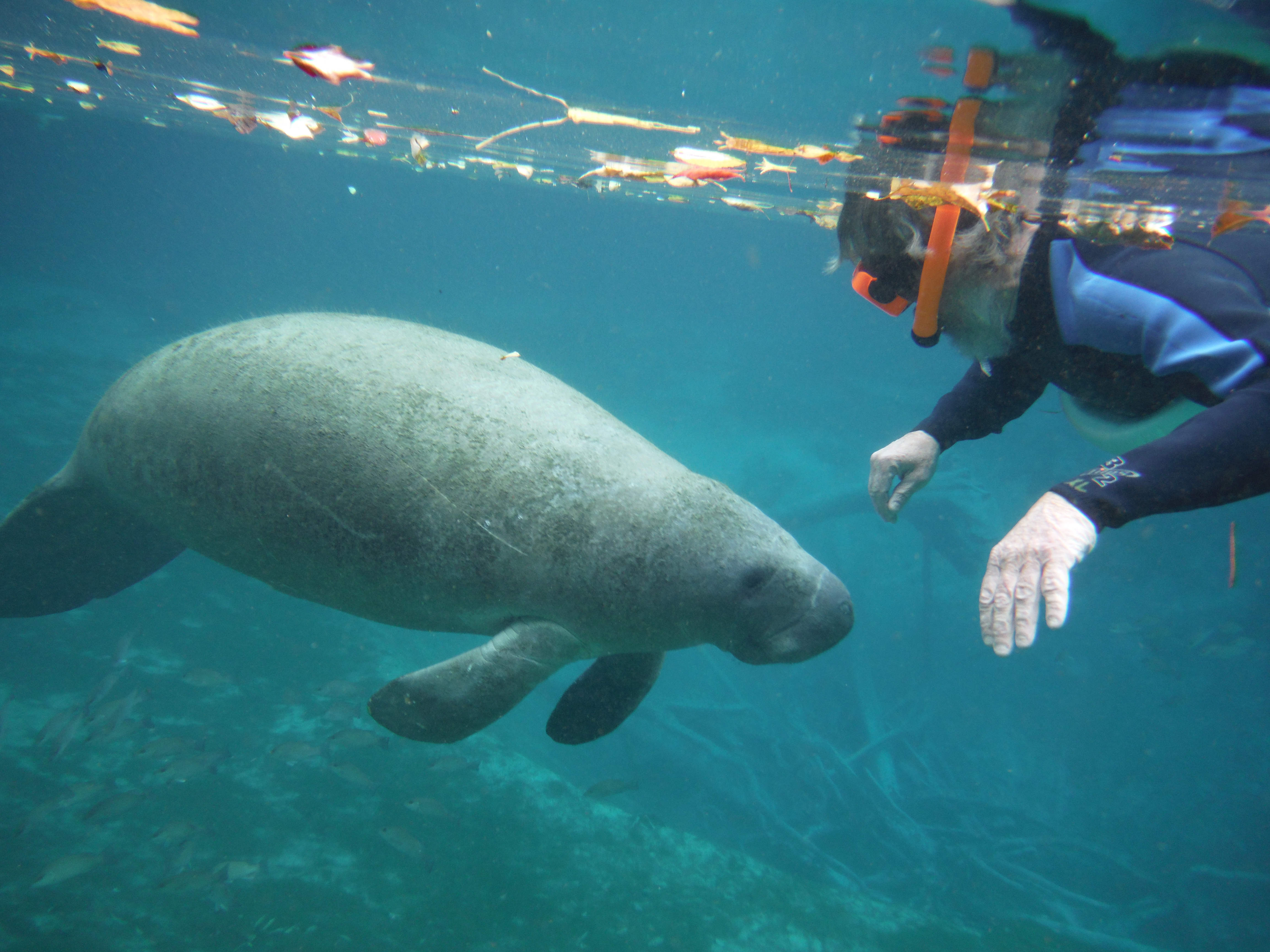
There are very strict rules regarding behavior while swimming with the manatees – the swimmer is to be a passive observer unless the manatee initiates interaction, in which case touching the manatee is allowed. As it was explained to me, some manatees have no interest in interacting, similar to how some cats tend to shy away from close interaction with people. Other manatees are curious and will, at times, initiate and seem to enjoy interaction. I was fortunate in that a large manatee swam up to me while I was hovering, and she clearly wanted to interact:

This manatee approached me with focused curiosity - maybe it was the beard...

This manatee approached me with focused curiosity – maybe it was the beard…our first interaction was the stare-down.

She hung around, seemingly waiting to be pet, so I did - she seemed to like it

She hung around, seemingly waiting to be petted, so I did – she seemed to like it!

Congratulating her on winning the stare-down...

Congratulating her on winning the stare-down…


This manatee swam directly under me - for a minute I thought I was going to get a ride...

She then started to swim directly under me – for a minute I thought I was going to get a ride…

She hovered seemingly waiting to be petted

She hovered seemingly waiting to be petted

Her skin is surprisingly rough

Her skin is surprisingly rough


The enormous manatee turned sideways to me, as if waiting to be pet. I did so, and she stayedstill for about a minute while I pet her like a dag, which she seemed to enjoy

She then turned sideways to me so I could pet her back – she stayed still for about two minutes while I pet her like a dog, which she clearly seemed to enjoy

By the way, I keep referring to these behemoths as “she” – I have no idea whether any of them (except the mother with the baby) is a he or she.  However, I wasn’t about to try to put myself in a position to find out…

If you want to swim with the manatees, Crystal River is only about a 1 1/2 hour drive from Tampa/St. Pete. You can do so year-round, although I imagine it is much better in the winter since the manatees come up the river at that time to escape the colder water of the Gulf. Call Jeff or Joanne at Double J Adventures, 352 445 2483.

So Crystal River was our first stop after we left Suwannee, and our last stop along the Big Bend. We left Suwannee at first light last Sunday about 2 hours before high tide, with a goal of reaching the mouth of Crystal River a couple of hours before low tide there, since there had been shoaling reported in the channel and in the 8 mile run up the river. Conversations with the local Boat US/Tow Boat operator provided some additional “local knowledge”, and we had no difficulties. The town of Crystal River is notably larger than our previous stops on the Big Bend, with  a population of about 3,000 (still a small town).  It’s economy is focused on tourism, supported by the manatees and by water sports and boating centered on King’s Bay.  There is some fishing, but it does not dominate the culture as it did in the other Big Bend towns of St. Marks, Steinhatchee, or Suwannee. Here are some images:

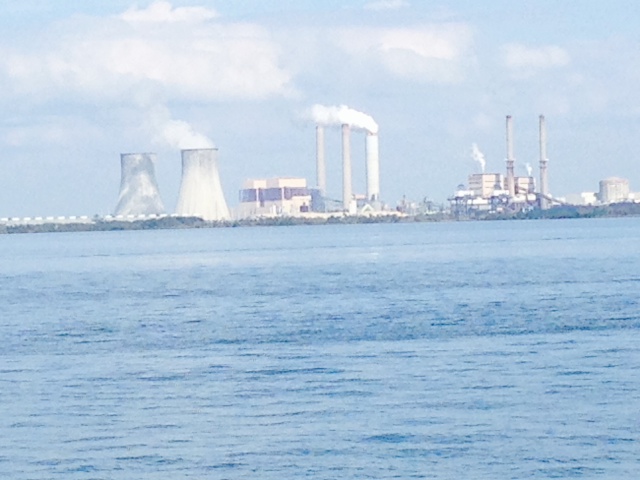
The Crystal River power plant located on the Gulf at the mouth of Crystal River. The nuclear reactor was permanently shut down in 2013 after a gap in the concrete containment building was discovered during a routine maintenance and upgrade. The gap was apparently caused earlier when workers cut the concrete containment to  replace a generator. The four coal-fired plants on the site continue to operate.

The Crystal River power plant located on the Gulf at the mouth of Crystal River. The nuclear reactor was permanently shut down in 2013 after a gap in the concrete containment building was discovered during a routine maintenance and upgrade. The gap was apparently caused earlier when workers cut the concrete containment to replace a generator. The four coal-fired plants on the site continue to operate. As you can see, the image of the power plant dominates the view as you approach the mouth of Crystal River from the Gulf.

Pete's Pier, the marina where we stayed at King's Bay, at the end of Crystal River.

Pete’s Pier, the marina where we stayed at King’s Bay, at the headwaters of the Crystal River 8 miles by water from the Gulf. Double J Adventures operates from Pete’s Pier as well.

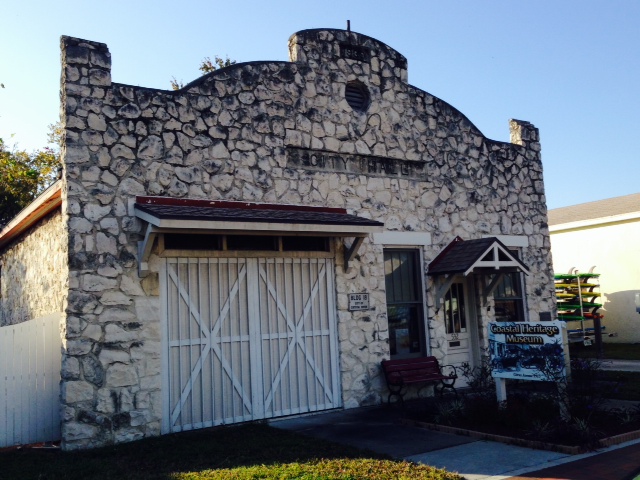
The original City Hall building in Crystal River now houses a small museum

The original City Hall building in Crystal River, built around 1939, now houses a small, interesting museum focused on the history of Crystal River.

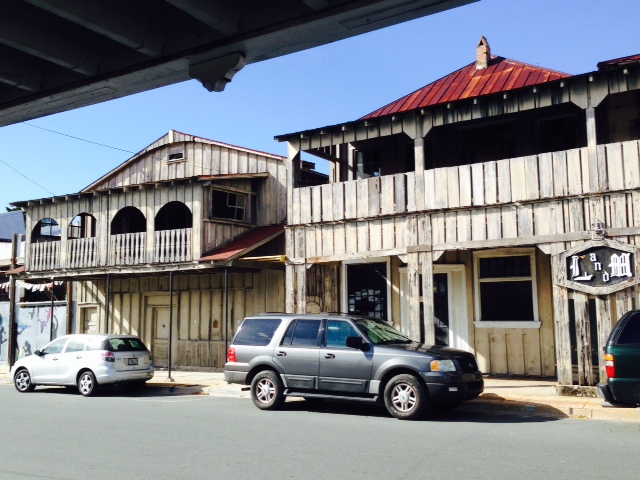
There is an interesting street in the village that contains many historic buildings from the turn of the century, which now contain a few shops and some small businesses and offices

There is an interesting street in the village that contains many historic buildings from the turn of the century, which now contain a few shops and some small businesses and offices

This is the historic train depot, also built in the early 1900's after the first depot burned down.  There are also some historic train cars on display at the depot.

This is the historic train depot, also built in the early 1900’s after the first depot burned down. There are also some historic train cars on display at the depot as well.

I've been trying for some time to get a representative picture of the many magnificent Live Oaks draped with Spanish Moss that are prevalent in Florida and other places in the south. While no picture I have taken do these stately trees justice, here is an example

I’ve been trying for some time to get a representative picture of the many magnificent Live Oaks draped with Spanish Moss that are prevalent in Florida and other places in the southeast. While no picture I have taken do these stately trees justice, here is an example

Florida cracker refers to English or American pioneer settlers from colonial times and their descendants. They started to arrive after Spain ceded Florida to Britain following the end of the French & Indian War in 1763. Since the influx of Northerners after World War II and widespread use of air conditioning, some whose family has been here much longer describe themselves proudly as "crackers". Others view the term as offensive and insulting since it usually describes poor southern whites. The owner of this pick-up seems to be in the former group.

“Florida Cracker” refers to English or American pioneer settlers from colonial times and their descendants. They started to arrive after Spain ceded Florida to Britain following the end of the French & Indian War in 1763. Since the influx of Northerners after World War II following the widespread use of air conditioning, some whose family has been here much longer describe themselves proudly as “crackers”. Others view the term as offensive and insulting since it usually describes poor southern whites. The owner of this pick-up seems to be in the former group.

As we have moved through various parts of the country, it’s fascinating to see the different attitudes regarding alcohol. In some areas, there is tight regulatory control over the sale and use of alcohol (such as in Massachusetts). In other areas, you can walk into a gas station and buy a can of beer from a tub of ice next to the cash register when you pay for your gas. In many parts of the south however, particularly in Alabama and Mississippi, you cannot buy alcohol at all – many towns and/or counties are completely dry. But I had a unique experience in Crystal River, now that I’m in Florida – I went into a large liquor store and asked the clerk where I could find a bottle of Bailey’s Irish Cream. “Have you ever had Michael’s Irish Cream – it’s better and $2 cheaper”, he said. “No, I think I’ll stick with the Baileys”, I replied. “It really is better – would you like to try a sample?” he asked. “What?” “Would you like a sample?”  “Uhh – sure”.  So he took a bottle of Michael’s Irish Cream off the shelf, opened it, poured some in a glass and handed it to me to drink.  He then poured samples and handed them to several other customers in the store who happened to walk by. I knew I was surely in Florida.  I bought the Michael’s.

So we stayed an extra two days in Crystal River due to windy weather (not to mention cold – it was 27 degrees in the morning!). We therefore rented a car and drove to Yankeetown then Cedar Key, the only two Big Bend stops that we had bypassed.  Yankeetown proved to be no more than a wide spot in the road a few miles from the river, and the marina where we would have stayed was remote and in very poor condition:

The marina in Yankeetown had some boats in some of the slips, but was in general disrepair and was locked up when we stopped by - fortunately we had decided to bypass this stop with the boat even though it has deep water access without having to worry about the tides

The marina in Yankeetown had some boats in some of the slips, but was in general disrepair and was locked up when we stopped by – fortunately we had decided to bypass this stop with the boat even though it has deep water access without having to worry about the tides

We then drove to Cedar Key (accessible by bridge), which proved to be a fun, funky, artsy island community with shops, restaurants, pubs, and interesting old buildings.  We had lunch and, of course, ice cream as we walked around and took in the sights of the town. Here are some images:

The architecture is varied, with many of the buildings dating back to the early 1900's

The architecture is varied, with many of the buildings dating back to the early 1900’s

AACK-bldg3

These restaurants and shops overlook the water with spectacular views of a nearby island and the Gulf

These restaurants and shops overlook the water with spectacular views of a nearby island and the Gulf

This building also overlooks the Gulf

This building also overlooks the Gulf

For some reason, this guy didn't seem to be catching much...

For some reason, this guy didn’t seem to be catching much…however, I can relate to the look on his face from my fishing experiences…

This large sign was on a big grey wall along the main street in town.  See if you can read the message - start at the bottom -

This large sign was on a big grey wall along the main street in town. The sign next to it says “Spin to Read”.  See if you can read the message – start at the bottom –

The forecast was finally for lighter winds Thursday morning – however, the tide schedule was challenging.  Low tide occurs 2 1/2 hours LATER at the upper end of the Crystal River than it does at the mouth, 8 miles downriver. There is a shoal a short ways from the end of the river where we were docked, and another one at Shell Island, at the mouth of the river.  We therefore left at first light to get past the first shoal before the tide got too low, but then had to dawdle for a couple of hours to wait for the tide to fill in at Shell Island at the mouth of the river. On top of that, when we cast off at first light, the temperature was 29 degrees and there was ICE on the decks – we had to hold onto the railings to keep from falling on the ice as we collected the docklines and cast off.  I thought we were in Florida!  The net result was a long, 11 hour day, for we had a 60 mile run to Tarpon Springs after we finally cleared the channel – we left at first light and pulled into the dock at Tarpon Springs at sunset.

Tarpon Springs marks the official end of Florida’s “Big Bend”, and marks the resumption of the protected waters of the Gulf Intracoastal Waterway. You may recall from previous posts that southbound trawler-type boats have a choice of crossing the Big Bend via a 20-hour overnight passage of about 175 miles or taking the “hopscotch” route and stopping at various harbors along the way, as we did, which adds about 100 miles to the trip. The overnight trip requires a 2-day weather window of light winds and favorable weather. A flotilla of boats left Carabelle on the same day that we left on the “hopscotch route” two weeks ago, and had a pleasant passage.  Unfortunately for those boats that arrived at the start of the Big Bend a day or two later, the favorable weather window slammed shut – there are now about 25 boats that have been waiting for another weather window for two weeks now, and are expected to have to wait at least until the coming weekend before they can cross, and will spend Thanksgiving wherever they are. Welcome to boating!

Tarpon Springs is a sizable tourist town with two dominant themes, which are related to each other.  First, it has the highest percentage of Greek Americans of any city in the United States. As a result, it is known for it’s many Greek restaurants which are reputed to be some of the best Greek restaurants in the nation. Second, it is known for the harvesting of sponges, in which early Greek immigrants played a critical role.

Tarpon Springs was first settles in 1876 by both white and black fishermen and farmers. They named the new settlement “Tarpon Springs” when they observed many tarpon jumping out of the water. In the 1880’s, the harvesting of sponges began and grew – sponges grew naturally in the shallow waters of the Gulf adjacent to the settlement. The harvesting of sponges was a significant industry in Greece at the time, so a number of Greek immigrants were attracted to Tarpon Springs to work in the sponge industry. In 1905, a Greek entrepreneur introduced sponge diving as a more efficient method of harvesting sponges, and he recruited divers and their crews from Greece to come to Tarpon Springs to harvest sponges. As a result, the Greek population increased dramatically. Thus, the two dominant themes in the city today – Greek culture and sponges – stem from the origins of Tarpon Springs and the relationship between those two forces that was forged over 100 years ago.

Here are some images from our stay in Tarpon Springs:

You have your pick of literally dozens of Greek restaurants, all reputed to serve great and authentic Greek food

You have your pick of literally dozens of Greek restaurants, all reputed to serve great, authentic Greek food

In addition to Greek restaurants, sponges are everywhere - in every gift shop, in dedicated sponge stores, in the "Sponge and Soap Museum, etc.  You can even go on sponge tours in which harvesters take you on their boat and you observe the harvesting of sponges in the Gulf waters

In addition to Greek restaurants, sponges are everywhere – in every gift shop, in dedicated sponge stores, in the “Sponge and Soap Museum”, etc. You can even go on sponge tours in which harvesters take you on their boat and you observe the harvesting of sponges in the Gulf waters

Spongeorama???

Spongeorama???

Sponges of every size and shape are available in the many gif shops along the waterfront, from utilitarian sponges which are said to be superior in their characteristics to the manufactured sponges that most of us use to sponges intended for ornamentation to sponges made into items intended to be used such as waste baskets for your bathroom

Sponges of every size and shape are available in the many gift shops along the waterfront, from utilitarian sponges which are said to be superior in their characteristics to the manufactured sponges that most of us use, to sponges intended for ornamentation, to sponges made into useful items, such as waste baskets for your bathroom

One of the many sponge harvesting boats on its way int the harbor - notice the bundles of sponges tied to the roof.  Sponge boats come in all shapes and sizes

One of the many sponge harvesting boats on its way into the harbor – notice the bundles of sponges tied to the roof. Sponge boats come in all shapes and sizes

The city of Tarpon Springs is located about 3 miles up Anclote River.  The harbor is fairly narrow and is lined with boats of every description, many rafted 5 and 6 boats deep due to limited space within the harbor

The city of Tarpon Springs is located about 3 miles up Anclote River. The harbor is fairly narrow and is lined with boats of every description, many rafted 5 and 6 boats deep due to limited space within the harbor

This statue of a diver on the waterfront commemorates the importance of sponge diving to both the history of Tarpon Springs and its current economy

This statue of a diver on the waterfront commemorates the importance of sponge diving to both the history of Tarpon Springs and its current economy

In addition to the waterfront along the harbor that is lined with Greek restaurants and sponge & gift shops, there is a historic downtown in Tarpon Springs that is quite interesting with architecture dating back to the late 1800's and early 1900's

In addition to the waterfront along the harbor that is lined with Greek restaurants and sponge & gift shops, there is a historic downtown in Tarpon Springs that is quite interesting with architecture dating back to the late 1800’s and early 1900’s

This Mediterranean-style building in downtown Tarpon Springs was built in the 1920's as the Howard Hotel.  It has now been restored and converted into commercial space, and is on the National Register of Historic Places

This Mediterranean-style building in downtown Tarpon Springs was built in the 1920’s as the Howard Hotel. It has now been restored and converted into commercial space, and is on the National Register of Historic Places

The city has several residential neighborhoods surrounding the downtown area in which the architecture of the houses clearly reflect their Greek heritage

The city has several residential neighborhoods surrounding the downtown area in which the architecture of the houses clearly reflect their Greek heritage

Another house reflecting its Greek heritage

Another house reflecting its Greek heritage

No Greek community would be complete without an iconic Greek Orthodox church

No Greek community would be complete without an iconic Greek Orthodox church

WOW!  Do you really think he lived here???

WOW! Do you really think he lived here?

So we went fishing while we were in Tarpon Springs and finally caught The Big One....(OK, just kidding...)

So we went fishing while we were in Tarpon Springs and finally caught The Big One….(OK, so we didn’t…)

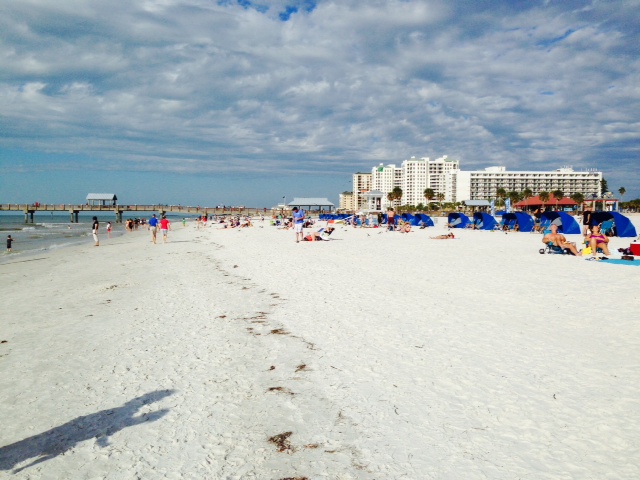
Our next stop was Clearwater Beach, about 15 miles south of Tarpon Springs. Talk about culture change from our experiences along the Big Bend over the past week and a half! Clearwater Beach is a sprawling, new, modern, resort area with high rise condominiums, street performers, restaurant chains, and resort-type activities. The wide beach is truly spectacular with fine, white sand. Here are some images:

The beach and pier at Clearwater Beach. It was breezy and a bit cool the day we were there, so the beach wasn't crowded

The beach and pier at Clearwater Beach. It was breezy and a bit cool the day we were there, so the beach wasn’t crowded

The beach as the sun was setting, taken from the pier

The beach as the sun was setting, taken from the pier

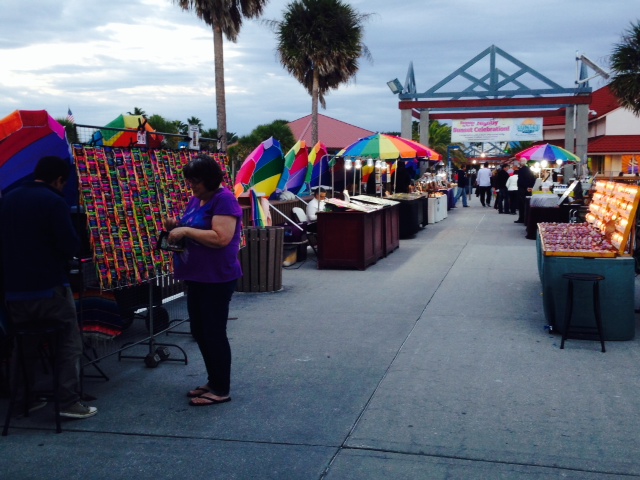
Street vendors lining the long pier known as "Pier 60"

Street vendors lining the long pier known as “Pier 60”

The colorful umbrellas are ordinarily used by the street vendors on the pier to shade them from the sun - however, it was breezy and mostly cloudy the day we were there, so the vendors used the umbrellas instead to block the wind, creating a colorful scene

The colorful umbrellas are ordinarily used by the street vendors on the pier to shade them from the sun – however, it was breezy and mostly cloudy the day we were there, so the vendors used the umbrellas instead to block the wind, creating a colorful scene

One of the many tourist-type activities is this "Surf Machine" - water is jetted up the surface of the fiberglass "wave" so you can surf on it, moving up or down or being stationary.  I don't think I would want to be their insurance carrier...

One of the many tourist-type activities is this “Surf Machine” – water is jetted up the surface of the fiberglass “wave” so you can surf on it, moving up or down or being stationary. I don’t think I would want to be their insurance carrier…

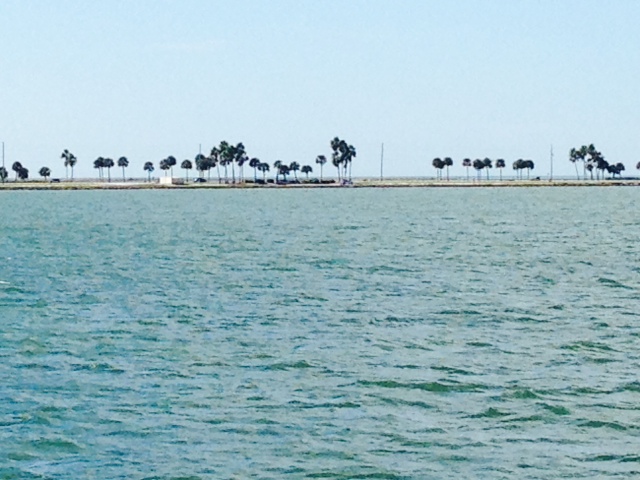
The section of the Gulf Intracoastal Waterway from Tarpon Springs to St. Petersburg for the most part runs directly behind the barrier islands with the Gulf beaches just on the other side of the islands. Here are some images:

The Intracoastal in this location iseparated from the Gulf only by a narrow spit of beach with some palm trees on it.  This picture reminded me of the Korona commercials "find your beach" theme

The Intracoastal in this location is separated from the Gulf only by a narrow spit of beach with some palm trees on it. This picture reminded me of the Corona commercials “find your beach” theme

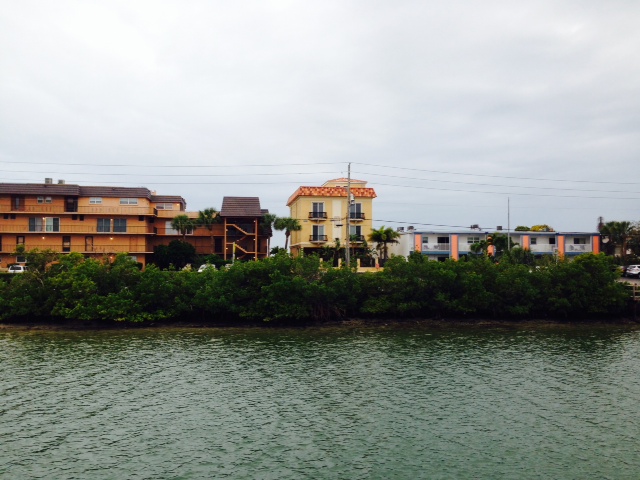
Running along the Intracoastal, you can identify the areas that are newly developed, characterized by glitzy high rise condominiums such as those in Clearwater Beach, and areas that were developed in the 50's or 60's or perhaps the early 70's, characterized by utilitarian three or four story buildings that might have originally been built as apartments or motels, now mostly converted to condominiums - basic housing but still million-dollar views and beaches

Running along the Intracoastal, you can identify the areas that are newly developed, characterized by glitzy high rise condominiums such as those in Clearwater Beach, and areas that were developed in the 50’s or 60’s or perhaps the early 70’s, characterized by utilitarian three or four story buildings that might have originally been built as apartments or motels, now mostly converted to condominiums – basic housing but still million-dollar views and beaches

An unwelcome sight on the Intracoastal - this is not a derelict boat that was abandoned or neglected and eventually sunk, but a fairly new cruiser that recently took on water until it sunk and is sitting on the bottom - I have no idea why

An unwelcome sight on the Intracoastal – this is not a derelict boat that was abandoned or neglected and eventually sunk, but a fairly new cruiser that recently took on water until it sunk and is sitting on the bottom – I have no idea why

On Saturday, our run of about 40 miles from Clearwater Beach to Saint Petersburg was marked by cloudy weather but no rain, and 15 knot winds with gusts to 20. Though not a problem on the protected areas of the Intracoastal Waterway, we were confronted with 3′-5′ waves once we entered the wide and open waters of Tampa Bay. We picked our way slowly up the bay to St. Pete, carefully managing the angle of the boat to the waves (catamarans don’t like waves on the beam). However, we reached the marina in downtown St. Pete without incident, where we are leaving the Joint Adventure for a week over the Thanksgiving holiday.  As I write this on Sunday morning, I’m preparing to leave for the airport and a flight home.

Happy Thanksgiving to you and yours!


Standard

WAY DOWN UPON THE SUWANNEE RIVER…

Post #38 – WAY DOWN UPON THE SUWANNEE RIVER – Day 195;  November 15, 2014.  On board:  Paul Coates, Jim K

Sing with me:  “Wayyy down upon the Suwan-nee River…far, far away…”.  Most everyone, I think, learned this song, or parts of it, as schoolchildren. The song was written in 1851 by Stephen Foster, a white man. But are you aware of the controversy it has caused over the years, and continues to cause? The song was written in the first person from the perspective of a black slave at a time when slavery was legal in half the country. The narrator sings “…longing for de old plantation…”, which has long drawn criticism as romanticizing slavery. Worse, the lyrics of the chorus includes “Oh, darkies, how my heart grows weary…”  – the word “darkies”, of course, has long been considered a racial slur. I was therefore amazed to learn when I arrived here that the song is the official state song of Florida. In order to make the song more palatable, when it was sung at the dedication of the new Florida capitol building in 1978, the word “brothers” was substituted for the word “darkies”. However, as the lyrics became more and more objectionable over time, an effort to change the state song gained traction. A contest to select a new state song was undertaken in 2007, and the song “”Florida (Where the Sawgrass Meets the Sky)” was selected as the winner in early 2008.  However, when faced with a decision, the politicians did what politicians do best – they tried to please everyone – so they adopted the new song as the state ANTHEM and kept “Suwannee River” as the state SONG. In doing so, they also officially changed some of the objectionable lyrics.  Predictably, the “two song solution” appears to have satisfied no one.

So as I write this, we are docked about three miles up the fabled Suwannee River in the town of Suwannee, Florida. The heart and soul of the town are focused on the river, and like many of the towns along the Big Bend, it is a fishing town – the locals grew up fishing since they were old enough to walk, and it has recently become a fishing destination for weekenders, vacationers, and others who have a condo or second home here on the river or who come here to rent a boat and fish or go out on a fishing charter. The boats are not offshore boats that are the hallmark of New England charters, but are small skiffs or 25′ center consoles with outboard motors.  The shallow water of the Gulf and the desire to poke into shallow places on the river or side creeks keep the boats and the fishing parties small. The year-round population of the town is only 350, and the summer population is only about 750, so it is not a big place. There is one restaurant that serves only breakfast and lunch and another that serves only dinner, and there is a very small general store that has some groceries. There are some condos that were built just before the Great Recession, and there are homes along a network of canals that were built in the 60’s. Most of the homes are modest – it is a fishing destination, not a resort-type place at all. Many of the homes and the few businesses that are here could benefit from some sprucing-up.

Here are some images from Suwannee:

It's always good to have a roadside sign to point you in the right direction -

It’s always good to have a roadside sign to point you in the right direction –

The bank of the Suwannee River, entering the mouth

The bank of the Suwannee River, entering the mouth

The banks of the Suwannee River are lined with cypress trees and beautiful, natural scenery

The banks of the Suwannee River are lined with cypress trees and beautiful, natural scenery

One of the many creels and side channels off the main river, which is in the background

One of the many creeks and side channels off the main Suwannee River, which is in the background

A creek-side house in Suwannee - there were at least 30 enormous turkey vultures roosting on the dock, deck, and roof

A creek-side house in Suwannee – there were at least 30 enormous turkey vultures roosting on the dock, deck, and roof of the house

A "typical" house on a canal in Suwannee

A “typical” house on a canal in Suwannee

Notice the sling for the boat lift under the house - a modest house, but a great place to store your boat under cover with instant access to it -

Notice the sling as part of the boat lift under the house – a modest house, but a great place to store your boat under cover with instant access to it!

The only breakfast restaurant in town is a gathering place in the morning, especially for people who are going fishing - the restaurant is part of a small marina.  We went by dinghy

The only breakfast restaurant in town is a gathering place in the morning, especially for those going fishing – the restaurant is part of a small marina. We went by dinghy

Florida has no car inspection requirement....they may want to re-think that...

Florida has no car inspection requirement….they may want to re-think that.   Notice the convertible top, which can be removed by simply untying a couple of knots holding the tarp in place.  Notice also the rope holding up the bumper…

Suwannee is literally the "end of the road"....

Suwannee is literally the “end of the road”….

We agonized a bit over whether to come here at all, as almost no loopers do, and the guidebooks all warn of shallow water and the need to ride the tides just so. We had visions of catastrophe – running aground in the narrow, shallow channel or inadvertently wandering off the channel into a shoal with waves crashing down upon us. However, remembering Eleanor Roosevelt’s inspirational words of encouragement: “My life was full of catastrophes, most of which never happened”, we were enticed to ignore our visions of worst-case scenarios and go forward.  We waited until nearly noon to leave Steinhatchee for the 42 mile run so we would arrive at about 4:30 PM, an hour and a half or so before high tide in the channel. Eleanor Roosevelt was right – we poked our way slowly through the 2-mile long channel then 3 miles up the river and had no trouble.

We had planned to stay in Suwannee an extra day or so, but the weather gods decided we should stay longer – the winds on the Gulf have kicked up seas that we don’t like, so we’re waiting for more benign weather. We therefore decided to go fishing:   When in Rome….  We found a guide that was willing to take us out for half a day.  Here are some images:

Captain Jackie, our guide, who has forgotten more about fishing than I'll ever know

Captain Jackie, our guide, who has forgotten more about fishing than I’ll ever know

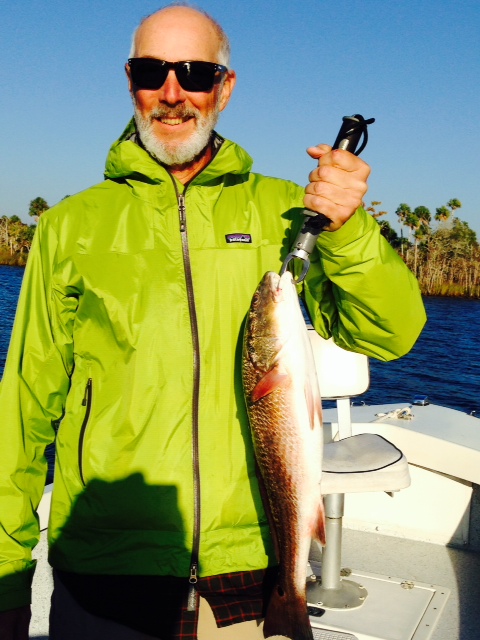
A "keeper" redfish that Paul caught - Captain Jackie cleaned the fish for us, and we took them to the local restaurant where they cooked them for us for dinner-

A “keeper” redfish that Paul caught – Captain Jackie cleaned the fish for us, and we took them to the local restaurant where they cooked them for us for dinner-talk about fresh fish!

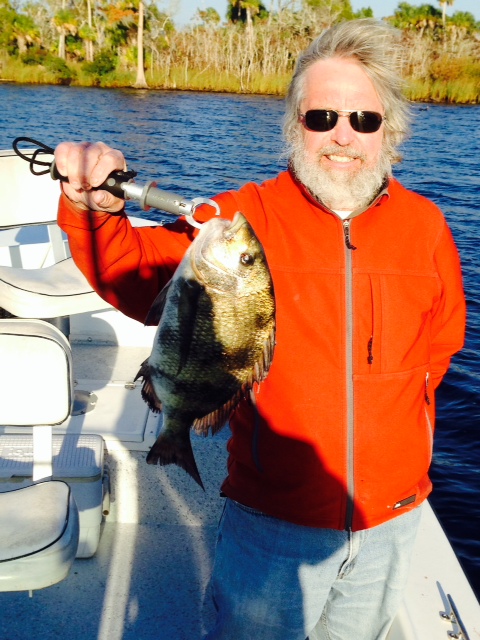
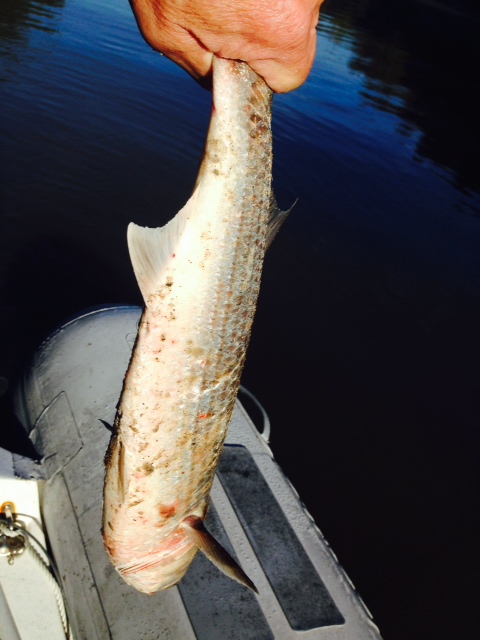
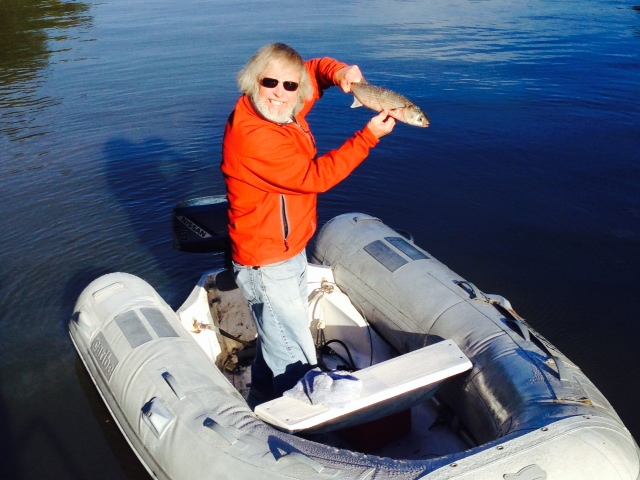
One of the Sheep's head that I caught -

This fish is called a “sheep’s head” – I don’t know why.  In addition to the two “keeper” redfish, we caught about half a dozen “keeper” sheep’s head.

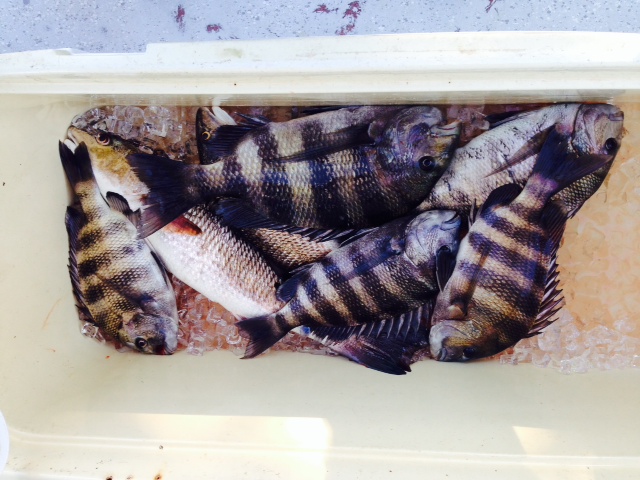
A respectable catch for a day of fishing -

A respectable catch for a half a day of fishing –

Look closely and you'll see a wild boar that we saw along the shore.  There is a baby boar there as well, but it is behind the mother in this picture.  While out fishing, we also saw three large alligators, several large turtles, and a bald eagle

Look closely and you’ll see a wild boar that we saw along the shore of the Suwannee River. There is a baby boar there as well, but it is behind the mother in this picture. While out fishing, we also saw three large alligators, several large turtles, and a bald eagle which circled directly overhead.

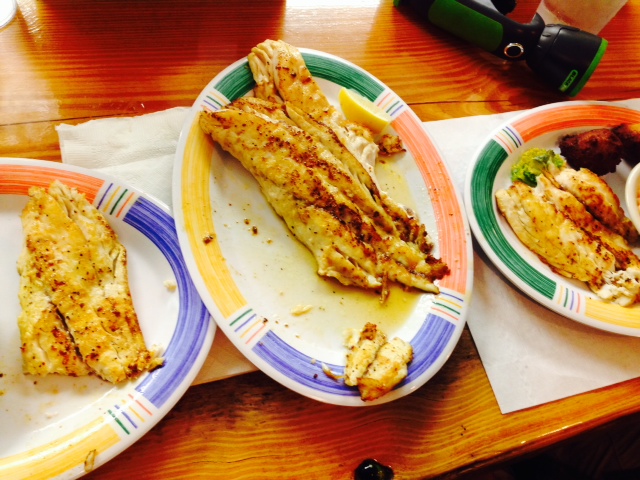
Our fresh redfish dinner, cooked for us by the local restaurant -

Our fresh redfish dinner, cooked for us by the local restaurant –

No, we really did catch these fish!  However, my friend Doug has been known to stop at a fish market on the way home from a fishing trip when he got skunked and insist on buying the whole fish to bring home....

No, we really did catch these fish! However, my friend Doug has been known to stop at a fish market on the way home from a fishing trip when he got skunked and insist on buying the whole fish to bring home….

So I jumped ahead to Suwannee after describing our stay at Apalachicola in the last post – please allow me to back up and fill in the gap between those two places. Our first day on the Big Bend last Sunday from Apalachicola to Carrabelle was pleasantly uneventful. Carrabelle has a beautiful, well-protected harbor with plenty of space for boats.  However, the town is too small to have a real “downtown”, but instead has a few pockets of commercial establishments along a mile-long stretch of road. The town appears to have overreached in the mid 2000’s, and has several vacant, dilapidated buildings.  In addition, there are countless vacant docks, many of which appear abandoned, and a large waterfront “bank owned” housing development in which infrastructure was installed but only a few buildings built. It seems like the natural environment is attractive enough to make this a destination, but it has not happened yet. Here are a few images:

Carrabelle has a large, deep natural harbor

Carrabelle has a large, deep, very beautiful natural harbor

Entering Carrabelle Harbor at low tide -

Entering Carrabelle Harbor at low tide –

A salt water marsh adjacent to Carrabelle Harbor

A salt water marsh adjacent to Carrabelle Harbor

There were about 15 – 18  loopers at the marina in Carabelle last Sunday, so an impromptu “Happy Hour” was convened in the lounge at the marina. We learned that, of the group, we were the ONLY boat that would be taking the “hopscotch” route across the Big Bend. A favorable weather window for an overnight crossing was being forecast for Monday and Tuesday nights, so most of the other loopers were preparing to leave the following afternoon for an overnight passage, with one or two fast boats planning to leave early in the morning for a daylight passage.  However, we pressed on, planning to make four stops and run five separate days on our way to Tarpon Springs, where the Intracoastal Waterway resumes. Our first “hopscotch stop” was a small, out of the way place that almost no cruisers visit called St. Marks – it is off-route by about 40 miles, meaning you travel about 55 miles but end up only 15 miles further along the Great Loop route.  However, though no one could understand why we were going here, we LOVE out of the way places where no one goes, and St. Marks did not let us down.  The town lays 10 miles north up the winding St. Marks River, with gorgeous views of salt water marshes along the way. It is primarily a fishing town, boasting one of the oldest fishing camps in Florida.  It is another town that is literally located at “the end of the road”. Here are some images:

A salt water marsh lined the riverbank for much of the ride up the St. Marks River

A salt water marsh lined the riverbank for much of the ride up the St. Marks River

We thought that finding dockage for the Joint Adventure might be a problem on this trip due to her wide 17' beam, but it has not been a problem at all.  However, in St. Marks, we had to put her into a slip with steel posts on both sides that was om;y inches wider than her beam. Fortunately, there was no wind and a light current as the tide was changing.

We thought that finding dockage for the Joint Adventure might be a problem on this trip due to her wide 17′ beam, but it has not been a problem at all. However, in St. Marks, we had to put her into a slip with steel posts on both sides that were only inches wider than her beam. Fortunately, there was no wind and a light current as the tide was changing, so we wedged her in tight..

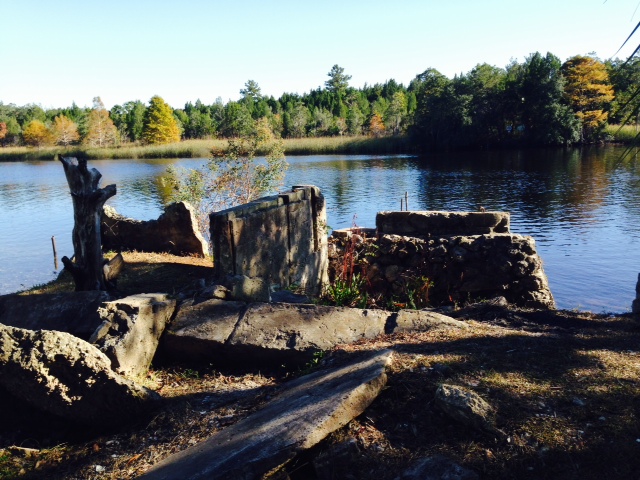
This is the remnant of an old bridge abutment of a railroad bridge that went to a ghost town that has disappeared called Port Leon.  The bridge was built in 1838 to extend the railroad 2 miles south of St. Marks so cotton could be transported directly to ships waiting offshore. An entire town called Port Leon was built at the terminus, including a saw mill, a grist mill, a hotel, two taverns, a post office, and a newspaper. However, just 5 years later, in 1843, a hurricane destroyed both the town and the bridge, both of which were abandoned and have since disappeared.

This is the remnant of an abutment from an old railroad bridge that went to a ghost town that disappeared long ago called Port Leon. The bridge was built in 1838 to extend the railroad 2 miles south of St. Marks so cotton could be transported directly to ships waiting offshore. An entire town called Port Leon was quickly built at the terminus, including a saw mill, a grist mill, a hotel, two taverns, a post office, and a newspaper. However, just 5 years later, in 1843, a hurricane destroyed the town and the bridge, both of which were abandoned and have since disappeared.

There is now a 16 mile long bike path where the railroad used to run in 1843

There is now a 16 mile long bike path where the railroad used to run in 1843

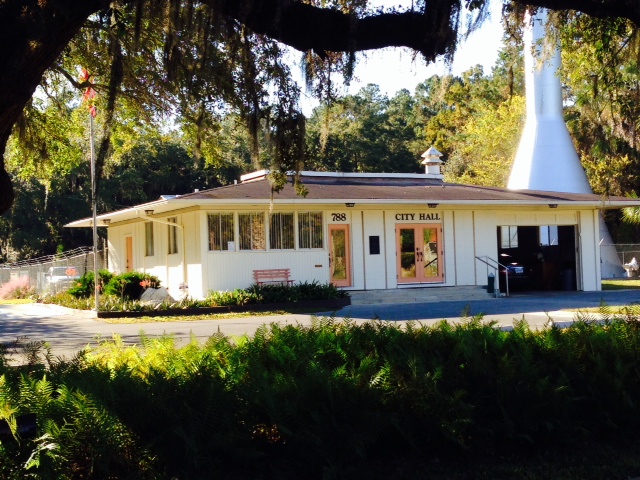
City Hal in St. Marks - not exactly an urban setting....

City Hall in St. Marks – not exactly an urban setting….

The one and only grocery store in town

The one and only grocery store in town

Yes, it is a fishing town...

Yes, it is a fishing town…

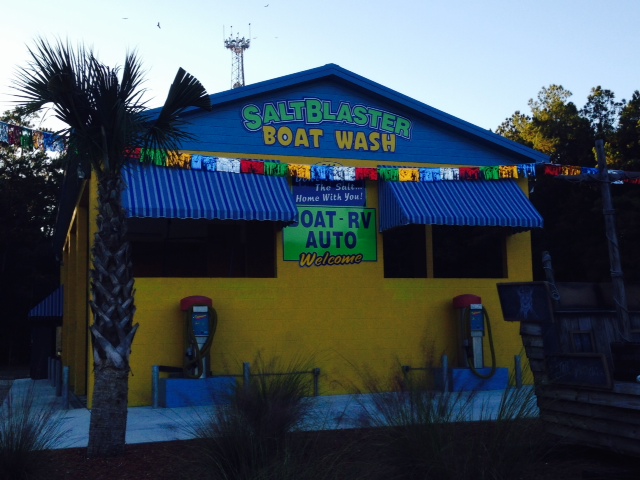
There is no car wash in town - but wait, this is a fishing town, and they have their priorities straight...

There is no car wash in town – but wait, this is a fishing town, and they have their priorities straight…

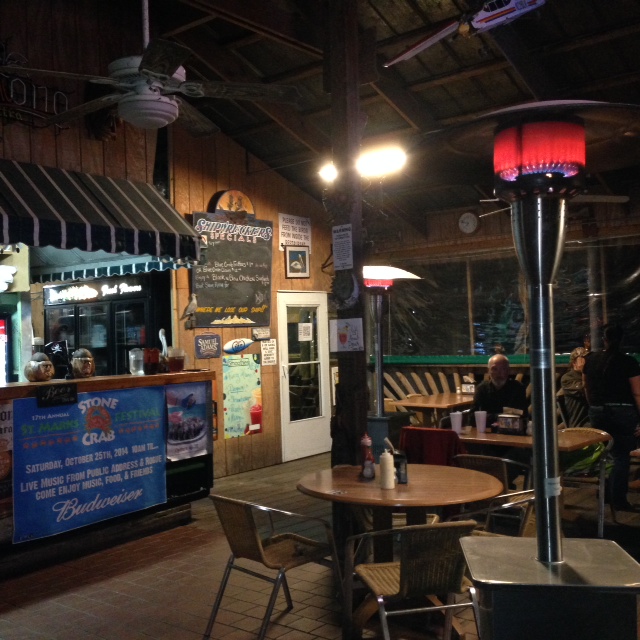
You may recall from the last post the "rustic" restaurant with great, fresh seafood in Panama City called Bayou Joe's.  We found another one in St. Marks - overlooking the water, just as rustic, catering to the local fisherman - and fresh fish caught earlier that day - red fish, mullet, grouper - but don't expect a white tablecloth -

You may recall from the last post the “rustic” restaurant with great, fresh seafood in Panama City called Bayou Joe’s. We found another one in St. Marks – overlooking the water, just as rustic, catering to the local fisherman, with fresh fish caught earlier that day – red fish, mullet, grouper – just don’t expect a white tablecloth –

One more story from St. Marks. In 1850, a wood-fired, sidewheeler steamship named Spray started picking up passengers, mail, and cargo in St. Marks and bringing them downriver to ships anchored in deeper water offshore, then returning to St. Marks with arriving passengers, mail, and cargo. However, in 1864, the ship was commandeered by the Confederate Navy and outfitted with two guns – its mission was to guard the mouth of the river, which was seen as an entry point for Union forces to attack Tallahassee.  The Spray was involved in several skirmishes, and is credited with a critical role in preventing Tallahassee from ever falling to the Union forces – the only Confederate capital not to fall. Near the end of the war, the Spray was eventually surrendered to the Union and taken to Key West.  After the war, the Union Navy returner her to her owner, who then resumed service ferrying passengers, mail, and cargo to and from St. Marks. After he died about a decade later, the Spray was left idle and eventually sank. She has recently been found, and possible salvage plans are now being discussed.

With a long way to go to our next stop, a small town called Steinhatchee, we left as the sun was rising:

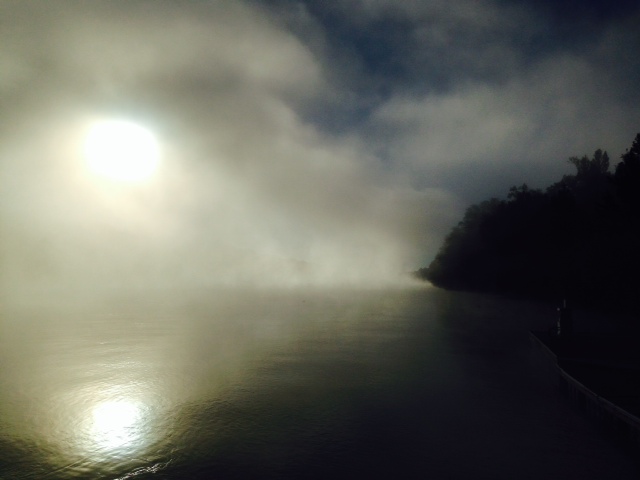
It was cold!  Forty degrees, and there was fog on the river.  I thought this was Florida?

It was cold! Forty degrees, and there was fog on the river. I thought this was Florida!

The early morning sun on the grasses of the salt water marsh was spectacular -

The early morning sun on the grasses of the salt water marsh was spectacular –

The 65 mile run in the open Gulf was more eventful that we like. A short ways out of St. Marks, we started to encounter crab pots, marked by floats on the surface of the water. Unfortunately, we were headed directly into the rising sun, so it was very difficult to see the floats with the sun’s reflection on the water in our eyes.  Sure enough, despite both Paul and I watching for floats, we snagged one that we never saw on the rudder/propeller.  We couldn’t get it free, so we had no choice but to cut the line (it was part of a string, so the trap could still be retrieved).  Fortunately, it did not get wrapped around the prop or do any damage, so we were able to continue. The rest of the day required focus and concentration to avoid getting snagged again.

Steinhatchee is little more than a wide spot in the road, but like many of these coastal/river towns that cater to fishing, it had a local restaurant where all of the seafood was caught fresh that day. It was time for an oil change for the Joint Adventure, so part of the afternoon was spent working with the mechanic from the marina changing the oil and doing some other minor maintenance chores.

So tomorrow (Sunday) we expect to get a one day weather window, in which we plan to head to our fourth stop on the Big Bend, called Crystal River. Shallow water and timing the tides at both ends of the run continue to be a challenge, so we plan to cast off at first light so we leave Suwannee on an incoming tide and reach the mouth of Crystal River before the tide is too low.  We then have an 8 mile run up the river as the tide continues to drop. We always try to obtain some local knowledge when conditions are uncertain, so we’ve been calling the local Sea Tow or Boat US/Tow Boat operator and getting information about shoaling, shallow spots, missing markers, etc.  They have been very helpful and always willing to share what they know.

Stay tuned!


Standard

INCREDIBLY AWESOME

Post #37 -INCREDIBLY AWESOME – Day 189, November 9, 2014.  On board:  Jake Mycofsky, Paul Coates, Jim K.

Panama City, where we arrived on Tuesday after a 50 mile run, was a complete surprise – I expected a significant-sized city, but in reality it is no bigger than a medium-sized town.  Buildings along the main downtown street are virtually all only two and three stories high, and the downtown area is not very large. The city also felt a bit like a time-warp, like it was still the 50’s or 60’s.  On the other hand, there were only scattered vacant storefronts on the main drag, so the downtown area seems to be surviving.  Here are some images from our visit to Panama City:

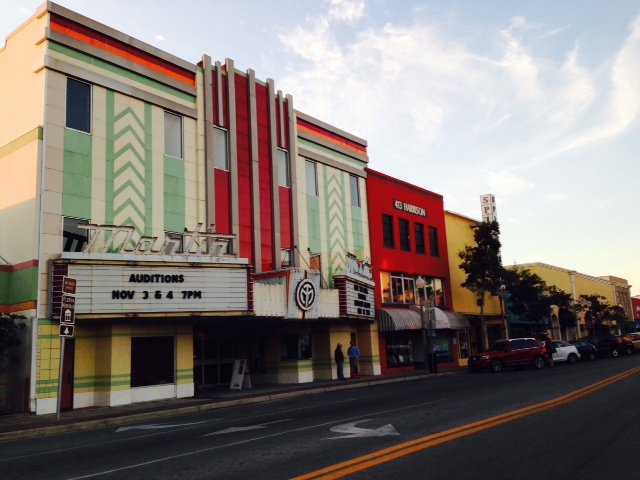
This is a picture looking down the main street in the downtown area, which seemed stuck in the 50's or 60's - even the movie theater was showing a Humphrey Bogart movie!

This is a picture looking down the main street in the downtown area, which seemed stuck in the 50’s or 60’s – even the movie theater was showing a Humphrey Bogart movie!

We did find a great, funky restaurant in an out-of-the-way part of downtown Panama City - accessed through a series of dilapidated, covered docks, the restaurant is behind the docks, built on piers and overlooking a lagoon. The only seating on a covered/screened porch area. The restaurant is rustic, and the seafood was southern and right off the boats - everything was homemade.

We did find a great, funky restaurant called Bayou Joe’s in an out-of-the-way part of downtown Panama City – accessed through a series of dilapidated, covered docks, the restaurant is behind the docks, built on piers and overlooking a lagoon. The only seating is on a covered/screened porch area. The restaurant is rustic, and the seafood was southern and right off the boats – everything was homemade.

Looking inward toward the kitchen at Bayou Joe's

Looking inward toward the kitchen at Bayou Joe’s

Actually, everyone was quite friendly -

Actually, everyone was quite friendly –

The marina on the waterfront at panama City was quite nice with great views

The marina on the waterfront at panama City was quite nice with great views

Our next stop was Port St. Joe, Florida – and we re-entered the Eastern time zone! Port St. Joe is a tourist town that seemed to have an unusually large number of antique shops, along with some other tourist shops. A couple of pictures:

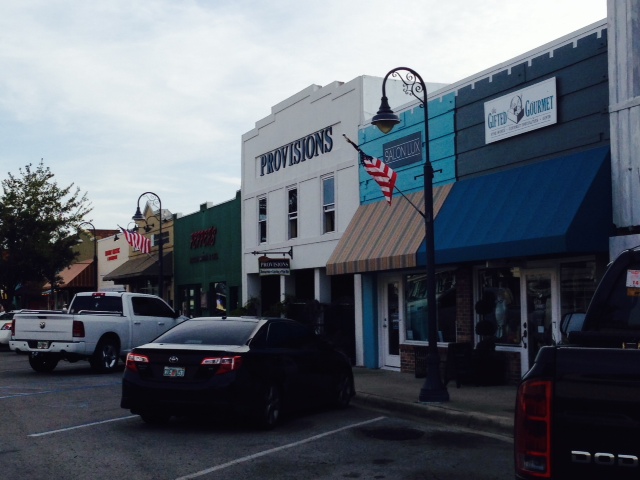
The main street in downtown Port St. Joe

The main street in downtown Port St. Joe

Part of the commercial shrimp and oyster fleet at Port St. Joe

Part of the commercial shrimp and oyster fleet at Port St. Joe

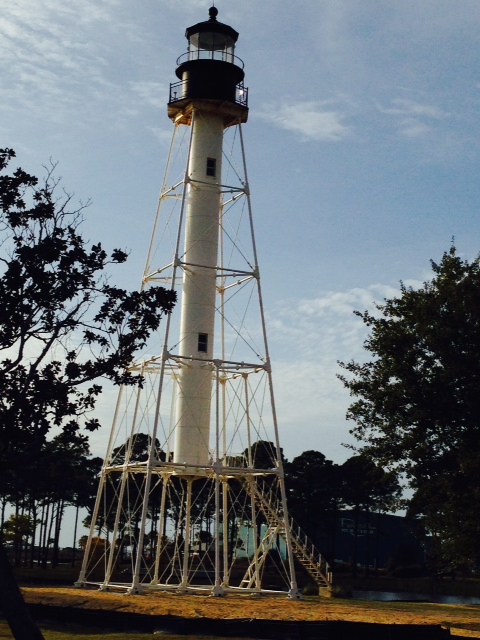
Port St. Joe is located on a very large bay that is also open at one end to the Gulf, Therefore, this large lighthouse was built to guide maritime traffic

Port St. Joe is located on a very large bay that is also open at one end to the Gulf, Therefore, this large lighthouse was built to guide maritime traffic

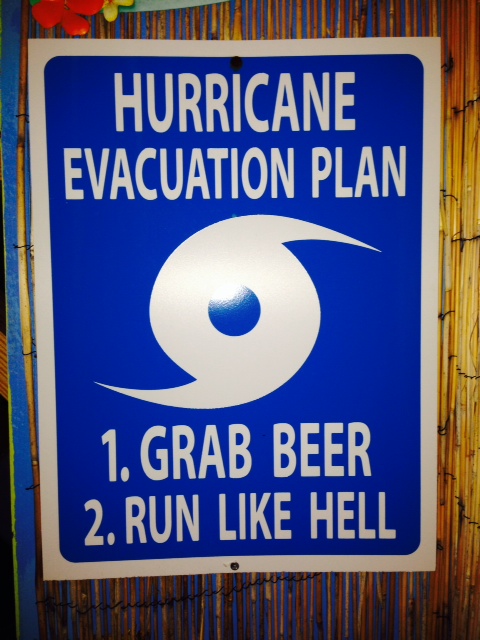
It's important to always have a plan -

It’s important to always have a plan –

In the first section of the Gulf Intracoastal Waterway heading east from Mobile – between Mobile Bay and Panama City – the Intracoastal runs directly behind barrier islands and the scenery is dominated by dunes, sand, and beaches. After Panama City, the waterway turns inland a bit and large sections follow rivers and dug canals – the scenery in these sections is dominated by lowland forest along the banks of the Waterway.  Here are some images along the Gulf Intracoastal Waterway:

We have not yet gone aground on this trip, but it can happen in a flash - this large freighter is agound in the bay off Panama City. Two tugs are attempting to free it

We have not yet gone aground on this trip (knock on wood), but it can happen even to large, commercial, professionally-operated vessels – this large freighter is agound in the bay off Panama City. Two tugs are attempting to free it

:

A sand cliff along the Gulf Intracoastal Waterway

A sand cliff along the Gulf Intracoastal Waterway

In some areas, the steep sides of the Waterway are susceptible to erosion, with sand constantly washing into the Waterway

In some areas, the steep sides of the Waterway are susceptible to erosion, with sand constantly washing into the Waterway

A dredge working to clear erosion that has washed into the Waterway

A dredge working to clear erosion that has washed into the Waterway

Portions of the Waterway consist of canals dug through the sand to connect bays, inlets, rivers, and estuaries to form a continuous waterway that is protected from the sometimes-rough waters of the Gulf

Portions of the Waterway consist of canals dug through the sand to connect bays, inlets, rivers, and estuaries to form a continuous waterway that is protected from the sometimes-rough waters of the Gulf

I think these boats can still be salvaged -

There are a surprising number of sunken boats along this section of the Gulf Intracoastal

It's not clear to me whether these boats sank from neglect or were sunk by a hurricane or major storm and then abandoned

It’s not clear to me whether these boats sank from neglect or were sunk by a hurricane or major storm and then abandoned

This is the largest sunken vessel that we saw

This is the largest sunken vessel that we saw

A waterside house along the way

A floating house along the way

The reflection in the water in this picture and the next two show how smooth and peaceful the water was as we passed through parts of the rivers/canal section of the Waterway

The reflection in the water in this picture and the next two show how smooth and peaceful the water was as we passed through parts of the rivers/canal section of the Waterway

More reflections -

More reflections –

And one more - the character of the scenery is constantly changing

And one more – the character of the scenery is constantly changing

I include this picture with a very sad note - as we passed by the vicinity of Tyndall Air Force Base, we watched in awe as pilots performed training flights in F-16 fighter jets.  However, about mid-morning, we heard a Coast Guard announcement on the VHF radio regarding a report of a plane that had crashed into the water, and to be on the lookout.  We didn't see anything, but the reports went on most of the day. It was later confirmed that the plane crashed about 50 miles south of Panama City.  The pilot was killed.

I include this picture with a very sad note – as we passed by the vicinity of Tyndall Air Force Base, we watched in awe as pilots performed training flights in F-16 fighter jets. However, about mid-morning, we heard a Coast Guard announcement on the VHF radio regarding a report of a plane that had crashed into the water, and to be on the lookout. We didn’t see anything, but the reports went on most of the day. It was later confirmed that the plane crashed into the water about 50 miles south of Panama City, and that the pilot was killed.

Our next stop was Apalachicola – what an interesting town!  My first reaction biking around town was that it looked like it was built 15o years ago and then time stood still – nothing changed.  A closer exploration, however, reveals a town with a storied waterfront/port town history which has managed to evolve with changing times but also holds on steadfastly to its roots and its authenticity.  While it accommodates tourists, the fabric of the town and its people is fishing, seafood, the river, and the Gulf.

The town is located where the Apalachicola River empties into the Gulf of Mexico, which is one of only three navigable southern rivers that flow to the Gulf. The town grew quickly based on the shipment of cotton from Alabama and Georgia – in fact, the town was first named Cottonton before it was renamed West Point, and then Apalachicola. The cotton was loaded onto shallow-draft boats to be taken to ocean vessels anchored offshore, then onto ports in the North and in Europe. The first cotton shipment left town in 1822, and by 1840, up to 160,000 bales each year were being shipped and Apalachicola was the third largest cotton port in the US.   As a result, Apalachicola was the first Gulf port that the Union Navy blockaded at the outbreak of the Civil War. While some shipments made it out by blockade runners, the shipment of cotton diminished drastically and never really recovered after the war, partly because alternate routes had been established and partly because of inefficiencies due to the shallow water in the river and the nearby Gulf which prohibited the use of larger ships. The railroads then ended the cotton-shipping business in Apalachicola, since they provided a faster and cheaper method of shipment.  The town then reinvented itself by turning to the lumber industry. With an ample supply of cypress and pine trees from Georgia and Alabama, lumber mills were constructed in Apalachicola and prosperity returned.  In addition, the sponge industry grew to be a lucrative business in town. Sponge harvesting boats would set out from town for a month at a time, carrying 12-15 foot dinghies, each of which were manned by two people – one slowly moved the boat forward with a paddle while the other scouted the sea floor for sponges using a wooden box or bucket with a glass bottom to peer into the water. Sponges were brought to the surface with a long-handle, 3-pronged iron hook. By 1895, there were 16 sponge-harvesting boats operating from Apalachicola along with processing plants on shore.  Early in the 20th century, Greek businessmen came into town and introduced the harvesting of sponges by divers attached to umbilical cords for air.  This method was more efficient. and was adopted over time by the local people as well.

However, as the 20th century unfolded, the sponge industry declined due to foreign competition and the growing use of artificial sponges, which were much cheaper. Worse for the town, by around 1930, the lumber supply had been depleted, so the lumber industry declined rapidly as well.  Once again, however, Apalachicola reinvented itself again via the seafood and fishing industry. Apalachicola oysters are renowned as some of the best-tasting oysters in the world, and are featured in restaurants and fish markets throughout the south – in fact, Apalachicola supplies 90% of the oysters consumed in Florida and 10% of those consumed in the entire US. The harvesting of Gulf shrimp is also a thriving industry in town.

Today, Apalachicola has many great restaurants featuring fresh fish, shrimp, and oysters offloaded from the boats daily, as well as an assortment of antique shops, galleries and gift shops. However, the shops do not dominate the town as they often do in other places, and the town retains some of its grittiness and authenticity. It appears that an artists community is starting to take hold as well, which adds diversity to the town.

Here are some images from our stay in Apalachicola:

The buildings downtown retain their character from the thriving days of cotton

The buildings downtown retain their character from earlier times. This building was built in 1901 as a restaurant and rooming house. It was known at that time for the chef’s specialty, a “Whole Loaf” – the chef would hollow out a whole loaf of bread, then stuff it with oysters and sauces, then bake it. It sold for 20 cents. The restaurant also had a soda fountain where they made ice cream with a kerosene-driven freezer

One of the downtown streets -

One of the downtown streets –

Another historic downtown building -

Another historic downtown building –


There is a performing theater in downtown, but performances are help only during the winter months

There is a performing theater in downtown, but performances are held only during the winter months

Some of the antique stores in town are truly unique, with many unusual nautical items from the town's rich maritime history

Some of the antique stores in town are truly unique, with many unusual nautical items from the town’s rich maritime history

There is even a sponge shop in town, as commercial harvesting of sponges has reopened in recent years and locally-harvested sponges are available. Sponges today are still harvested by divers, much as they were 100 years ago after the Greeks introduced that method to Apalachicola early in the 20th century

There is even a sponge shop in town, as commercial harvesting of sponges has reopened in recent years and locally-harvested sponges are available. Sponges today are still harvested by divers, much as they were 100 years ago after the Greeks introduced that method to Apalachicola early in the 20th century

A thriving art community seems to be taking hold in Apalachicola

A thriving art community seems to be taking hold in Apalachicola

The Joint Adventure at the dock along the river in Apalachicola - even the waterfront is somewhat rustic and authentic, as seen in the next two pictures as well

The Joint Adventure at the dock along the river in Apalachicola – even the waterfront is somewhat rustic and authentic, as seen in the next two pictures as well

A small boat coming into the dock next to the Joint Adventure

A small boat coming into the dock next to the Joint Adventure

riverfront houses next to the dock, as seen from the bridge of the Joint Adventure

Riverfront houses next to the dock, as seen from the bridge of the Joint Adventure

Houseboats along a long boardwalk that goes out to a gazebo overlooking the bay - a spectacular place to watch the sunset

Houseboats along a long boardwalk that goes out to a gazebo overlooking the bay – a spectacular place to watch the sunset

We ate dinner on the upper deck of a restaurant called Up The Creek - located, appropriate, up a creek in Apalachicola. This picture is taken from the upper deck with the rays of the setting sun on the grasses as the sun was setting behind us

We ate dinner on the upper deck of a restaurant called Up The Creek – located, appropriately, up a creek in Apalachicola. This picture is taken from the upper deck with the rays of the setting sun on the grasses behind us

This picture was taken from the same spot, a couple of hours later after the rise of a full moon over the creek

This picture was taken from the same spot, a couple of hours later after the rise of a full moon over the creek and river. Notice the sky!

Come on, Dad, how long does it take to drink a beer?  We've been waiting here FOREVER!!

Come on, Dad, how long does it take to drink a beer? We’ve been waiting here FOREVER!!

By the way, we have really become ice cream snobs. One of us (the guilty shall remain unnamed…) was looking in town for an ice cream parlor, but instead came upon a place that only served gelato. This person bought some gelato, and started to enjoy it as he walked down the street. Three stores later, he came upon a real ice cream parlor. What would you do?  This unnamed person discarded the gelato and bought an ice cream.  A true ice cream snob…

So – our trip has been incredibly awesome for us so far, but that’s not what the title of this post refers to. When we visited the National Navy Museum last weekend, we learned that the 2014 Homecoming Show in which the Blue Angels officially return to their home base in Pensacola would be this weekend. We were only 4 hours away by car, so I rented a car Friday evening and set the alarm for 5:00 AM on Saturday morning. As luck would have it, Jake needed to get the airport in Panama City on Saturday morning, which was on the way to Pensacola. I therefore dropped him off and arrived at the air show by 9:30. If you’ve never been to a Blue Angels show, I suggest you put it on your bucket list. They tour the country, so will likely perform somewhere within driving distance of wherever you are within the next year or two.  In any case, I found the show to be Incredibly Awesome:

This was the sunrise, taken on the way to Pensacola on Saturday morning

This was the sunrise, taken on the way to Pensacola on Saturday morning

The show started with acrobatic biplanes from the early "barnstorming" days - these planes did dives, spirals, loops - you name it

The show started with acrobatic biplanes from the early “barnstorming” days – these planes did dives, spirals, loops – you name it

I was a hair slow on the trigger, but you can see the tailspin that the pilot put this plane into, pulling out just before he and the ground met

I was a hair slow on the trigger, but you can see the tailspin that the pilot put this plane into, pulling out just before he and the ground met

A loop, flying straight up, then stalling and falling backwards -

A loop, flying straight up, then stalling and falling backwards – in unison!

All the military personnel on the grounds stood at attention and they played the National Anthem as this paratrooper descended with this American flag

All the military personnel on the grounds stood at attention and they played the National Anthem as this paratrooper descended with this American flag

What airshow would be complete without the Budweiser Clydesdales marching by?

What airshow would be complete without the Budweiser Clydesdales marching by?

Awesome animals!

Awesome animals!

Yes, all the cases of beer on the wagon are full of beer - so says the announcer, in any case

Yes, all the cases of beer on the wagon are full of beer – so says the announcer, in any case

If you look closely, you'll see that there is a "wingwalker" standing on top of the airplane.  It is a 50 year old woman named Theresa Stokes who is an internationally acclaimed aviation and space artist - her portfolio includes works of art for several major rock bands, such as the artwork on the inside of Aerosmith's "Rocks" album. She wingwalks as a hobby, and is recognized as the top stuntwoman wingwalker in the world. She does so without a parachute or safety line. At the show yesterday, she did flyovers on the wing, on the top of the airplane, and one standing on her head!  Not only that, she lives on a boat!

If you look closely, you’ll see that there is a “wingwalker” standing on top of the airplane. She is a 50 year old woman named Theresa Stokes who is an internationally acclaimed aviation and space artist – her portfolio includes works of art for several major rock bands, such as the artwork on the inside of Aerosmith’s “Rocks” album. She wingwalks as a hobby, and is recognized as the top stuntwoman wingwalker in the world. She does so without a parachute or safety line. At the show yesterday, she did flyovers on the wing, on the top of the airplane, and one standing on her head! Not only that, she lives on a boat!

Part of the show featured ten planes flying in unison and doing acrobatics

Part of the show featured ten planes flying in unison and doing acrobatics

Amazing -

Amazing –

Truly amazing -

Truly amazing –

This is the Blue Angels supply plane known as "Fat Albert" that accompanies them on all of their trips throughout the country bringing thev support crew, spare parts, etc.  I believe it is a C-10 Transport, the type that carries tanks into war zones - does anyone know for sure?

This is the Blue Angels supply plane known as “Fat Albert” that accompanies them on all of their trips throughout the country, bringing support crew, spare parts, etc. I believe it is a C-10 Transport, the type that carries tanks into war zones.

The Blue Angels fly F/A-18's. Nothing I can add to the next series of pictures -

The Blue Angels fly F/A-18’s. Nothing I can add to the next series of pictures –

AABA-jets2

AABA-Jets10AABA-Jets9

AABA-Jets4

AABA-Jets3

AABA-Jets5

AABA-Jets6

AABA-Jets8

AABA-Jets7

This picture was taken at an earlier time by my daughter Jessie - she's serving in the Navy JAG Corp, and is working on several legal issues involving the Blue Angels - as a result, she comes to Pensacola from her home base in San Diego regularly and gets to see the Blue Angels fly

This picture was taken at an earlier time by my daughter Jessie – she’s serving in the Navy JAG Corp, and is working on several legal issues involving the Blue Angels – as a result, she comes to Pensacola from her home base in San Diego regularly and gets to see the Blue Angels fly

Incredibly Awesome!!

The next leg of the trip will be one of the more challenging segments. The Gulf Intracoastal, call the Big Bend, is interrupted by about 175 miles of open water where the coastline of Florida bends in a southeasterly direction as it transitions from the panhandle to peninsular Florida. There are two possible approaches to this section – one is to “cut the corner” and go straight across, usually from Carabelle to Tarpon Springs. Fast boats can complete this crossing in daylight and do it in one day.  Slower boats must undertake an overnight passage of up to 20 hours, leaving in the morning or early afternoon and arriving in daylight the next day.  The alternative is to hopscotch along the coast, going into various harbors along the way.  However, there are challenges with this route: First, the harbors along the way are located up rivers, some as much as 22 miles off course or up a river. Therefore, the hopscotch route adds over 100 miles to the Big Bend crossing. Second, the water is very shallow throughout the area – channels are narrow, and some have only 3 1/2 feet at mean low tide – and that’s IN the channel, with shallower depths if you wander outside the narrow channels. Therefore, trips have to be planned to enter harbors on a rising tide, after mid-tide has been reached.  This is problematic, since the runs tend to be fairly long and there is only one rising tide cycle during daylight hours per day.

So – all that being said, there are some interesting places to see along the Big Bend route and we really don’t want to stay up all night and do an overnight passage, so we are opting for the “hopscotch” route. Depending on weather and tides, it will likely take 5-10 days, but it should be quite interesting. We’re on our way to Carabelle this morning.

Stay tuned!


Standard

TURN LEFT AGAIN

Post #36:  TURN LEFT AGAIN – Day 183, November 3, 2015  – on board:  Paul Coates, Jake Mycofsky, Jim K.

You may recall from earlier posts that my friend Bill Burke explained that navigating the Great Loop was simple – looking at the diagram of the route, it’s like a big rectangle – just head up the Hudson River, he said, then take four left turns at the appropriate time and you’ll be back in Boston.  So we just made our third left when we left Mobile, Alabama, and are now heading East – another major milestone! Depending on where we go in Florida, we are now about half way through our journey.

Everything has changed, once again. Instead of river banks and river currents, we have sand dunes, beaches, and tides:

Much of the Gulf Intracoastal Waterway is just a few hundred feet from the beaches of the Gulf, separated by barrier islands which consist mainly of sand dunes

Much of the Gulf Intracoastal Waterway is just a few hundred feet from the beaches of the Gulf, separated by barrier islands which consist mainly of sand dunes

We experienced a very special treat as we ran down Mobile Bay on a perfectly calm, sunny day. A pod of about 8-10 dolphins descended upon us and proceeded to play in our bow wave for about 15 minutes:

The dolphins would dart back and forth from one hull to the other, breaking the surface periodically as they played. The white form on the right-hand side of each of these pictures is the starboard hull of the Joint Adventure

The dolphins would dart back and forth from one hull to the other, breaking the surface periodically as they played. The white form on the right-hand side of each of these pictures is the starboard hull of the Joint Adventure

AADolphins5

Notice the dolphin under water just to the left of the hull while the other one jumps through the surface

Notice the dolphin under water just to the left of the hull while the other one jumps through the surface

Another duo -

Another duo –

Actually, this is the port-side hull where I'm standing, so the dolphin is immediately below me by about 4 feet

Actually, this is the port-side hull where I’m standing, so the dolphin is immediately below me by about 4 feet


So our first stop was for lunch at Lulu’s Restaurant on the Gulf Intracoastal Waterway in Orange Beach, Alabama. Lulu’s claim to fame is that it is owned and run by Jimmy Buffet’s sister, and supposedly he stops by from time to time (we didn’t see him). The ambiance is exactly what you would expect for such a place – open-air, laid back, friendly. It’s a large place with several separate pavilions where different bands can be playing at the same time.  Here are a couple of images:

Lulus from the water - we arrived at the same time as 4 other loopers, but there is plenty of dock space for visiting boaters

Lulus from the water – we arrived at the same time as 4 other loopers, but there is plenty of dock space for visiting boaters

Wide open on the waterside, the Intracoastal Waterway can be seen in the background.  There was no live music when we were there for lunch on a Tuesday, but you can tell that it's a hoppin' place at night, especially on weekends

Wide open on the waterside, the Intracoastal Waterway can be seen in the background. There was no live music when we were there for lunch on a Tuesday, but you can tell that it’s a hoppin’ place at night, especially on weekends

I think I'll pass on this one....

I think I’ll pass on this one….

We stayed at a village/marina resort in Orange Beach that night called The Wharf.  It is the off-season here, so there was not a great deal of activity, but the beach was beautiful.  Some pictures:

Jake enjoying a walk on the beach on the Gulf Coast at Orange Beach, Alabama

Jake enjoying a walk on the beach on the Gulf Coast at Orange Beach, Alabama

I couldn't resist a swim in the still-warm waters of the Gulf

I couldn’t resist a swim in the still-warm waters of the Gulf

So Paul & I watched a Thursday night football game while we had dinner at the bar in a waterside restaurant at the Wharf. A big guy came along and started to talk to us, eventually sitting down next to us to chat. It turns out he owned three restaurants at the Wharf, and at the end of the conversation we learned that he was Bob Baumhower, a former Pro-bowl nose tackle for the Miami Dolphins for 10 years, playing under Coach Don Shula and along with Bob Greise and Dan Marino.  For those who really know their football, he was a member of the "Killer B's" defense in which the names of all of the defensive linemen started with the letter "B". He then spent a half hour taking us around telling us stories and showing us autographed pictures on the wall of him with various other celebrities, like Joe Namath, Bum Phillips, Cheryl Tiegs, and many others. He then ordered a desert for each of us, on him. Another chance encounter!

So Paul & I watched a Thursday night football game while we had dinner at the bar in a waterside restaurant at the Wharf. A big guy came along and started to talk to us, eventually sitting down next to us to chat. It turns out he owned three restaurants at the Wharf, and at the end of the conversation we learned that he was Bob Baumhower, former Pro-bowl nose tackle for the Miami Dolphins for 10 years, playing under Coach Don Shula and along with Bob Greise and Dan Marino. For those who really know their football, he was a member of the “Killer B’s” defense in which the names of all of the defensive linemen started with the letter “B”. He then spent a half hour taking us around telling us stories and showing us autographed pictures on the wall of him with various other celebrities, like Joe Namath, Bum Phillips, Cheryl Tiegs, and many others. He then ordered a desert for each of us, on him. Another chance encounter! By the way, Paul is 6′- 3″ tall – that will give you an idea of the size of this guy. (I almost come up to his shoulder…)

Our next stop was Pensacola – Florida! Our 12th state! We planned to spend two days in Pensacola, but gale force winds were predicted for Saturday, so we stayed an extra day (only one boat left that we know of). Pensacola is home to the US Naval Air Station, and is home to the National Naval Aviation Museum and the Blue Angels. The city is smaller than I expected, with the downtown area comprised almost exclusively of three and four story buildings.  However, it is one of the most vibrant cities we have visited – a city of young people, undoubtedly driven by the presence of the large naval aviation base about 8 miles from downtown. Here are some images from our visit:

The Navy, not surprisingly, has a major presence in Pensacola, although we saw few people in uniform in the downtown area

The Navy, not surprisingly, has a major presence in Pensacola, although we saw few people in uniform in the downtown area

We were here for Halloween weekend, so they closed about 8 blocks of the main downtown area to vehicles in the late afternoon/early evening on the day before Halloween and catered to small children trick-or-treating.  The restaurants and commercial establishments all accommodated the trick-or-treaters, and there were games and music for the kids. It was packed!  I was told that, on the third Friday of every month, they close the same area to vehicles and from early evening to midnight, the entire area becomes an entertainment district in which alcohol is allowed to be carried and consumed in the entire area, so you can wander from establishment to establishment or just hang out and party in the street.

We were here for Halloween weekend, so they closed about 8 blocks of the main downtown area to vehicles in the late afternoon/early evening on the day before Halloween and catered to small children trick-or-treating. The restaurants and commercial establishments all accommodated the trick-or-treaters, and there were games and music for the kids. It was packed! I was told that, on the third Friday of every month, they close the same area to vehicles and from early evening to midnight, the entire area becomes an entertainment district in which alcohol is allowed to be carried and consumed in the entire area, so you can wander from establishment to establishment or just hang out and party in the street.

Located downtown is the Historic Pensacola Village - an area where many small, original 1800's wood frame houses have been preserved and restored, and several museums have been added to tell the story of earlier times in Pensacola

Located downtown is the Historic Pensacola Village – an area where many small, original 1800’s wood frame houses have been preserved and restored, and several museums have been added to tell the story of earlier times in Pensacola

One of the historic streets in the Historic Pensacola Village

One of the historic streets in the Historic Pensacola Village

Did you ever feel like you have the weight of the world on your shoulders?  This gal is holding up an enormous tree branch, and apparently has been doing so for quite a long time.

Did you ever feel like you have the weight of the world on your shoulders? This gal is holding up an enormous tree branch, and apparently has been doing so for quite a long time. By the way, I’ve been trying to get a good picture of a Live Oak, a magnificent species of tree that is quite prevalent in the south.  Some have trucks which are 4 or 5 feet in diameter and are several hundred years old. You often see them in classic pictures from the south with Spanish moss hanging from the branches

A restaurant/tavern/entertainment center called the Seville Quarters seems to be ground zero for the younger generation, although several other places were overflowing as well on Halloween Weekend. Entertainment over the weekend included a Michael Jackson show (every Friday & Saturday throughout the year), a dance club, a karaoke bar, a sports bar, a costume contest, a separate sexy witch costume contest, and dualing pianos in the piano bar (featured every night all year). On Halloween night they closed the street in front and the party and dancing spilled onto the street as well

A restaurant/tavern/entertainment center called the Seville Quarters seems to be ground zero for the younger generation, although several other places were overflowing as well on Halloween Weekend. Entertainment over the weekend included a Michael Jackson show (every Friday & Saturday throughout the year), a dance club, a karaoke bar, a sports bar, a costume contest, a separate sexy witch costume contest, and dualing pianos in the piano bar (featured every night all year). On Halloween night they closed the street in front and the party and dancing spilled onto the street as well

The inside of the dance club portion of the Seville Quarters in the afternoon before people arrived for the evening

The inside of the dance club portion of the Seville Quarters in the afternoon before people arrived for the evening

Dueling pianos - they take turns playing and singing requests from the audience, so the music is virtually non-stop - they claim that there isn't a song that they cant play, and the requests ranged from Frank Sinatra to current top 40.

Dueling pianos – they take turns playing and singing requests from the audience, so the music is virtually non-stop – they claim that there isn’t a song that they cant play, and the requests ranged from Frank Sinatra to current top 40.

Every Thursday, Friday, & Saturday, they put on a Michael Jackson "Thriller" show in which they flood the stage with haze from a haze machine and the dancers, made up as zombies, slink along the floor barely visible, the slowly emerge from the haze and perform a half hour dance routine - very well done and very cool - obviously professional dancers

Every Thursday, Friday, & Saturday, they put on a Michael Jackson “Thriller” show in which they flood the stage with haze from a haze machine and the dancers, made up as zombies, slink along the floor barely visible, then slowly emerge from the haze and perform a half hour dance routine – very well done and very cool – obviously professional dancers

The full dance routine after the haze has mostly cleared -

The full dance routine after the haze has mostly cleared –

In addition to all the entertainment options at the Seville Quarters, another Club downtown featured a unique band called the “MarchFourth Marching Band”. They have about 15 members and they don’t actually march (except marching in place at times during the performance). They are dressed sort of like a marching band and they incorporate a great deal of dancing and some acrobatics into their performance. I had never heard of them before, but apparently they are quite well known and tour nationally. It was a truly unique performance – here are a few images:

The Marchfourth Marching Band -

The MarchFourth Marching Band –

Each performer was quite a showman....

Each performer was quite a showman….


A unique acrobatic portion of the performance -

A unique acrobatic portion of the performance –

These two guys on enormous stilts danced better on the stilts than most people I've seen dance with their feet on the ground.  After the obligatory encore, everyone thought they were done - instead, they came from backstage, instruments in hand, and sang, played, and danced (including the two guys on stilts) with and among the audience

These two guys on enormous stilts danced better on the stilts than most people I’ve seen dance with their feet on the ground. After the obligatory encore, everyone thought they were done – instead, they came from backstage, instruments in hand, and sang, played, and danced (including the two guys on stilts) with and among the audience

Of course, the crown jewel of Pensacola is the National Naval Museum located at the Naval Air Station. It would be easy to spend two entire days just in the museum, which includes various simulators where you can experience flight, including a Blue Angels simulator which actually turns you upside down, forwards, backwards, sideways, etc. as if you were in the jet (no G-forces, however). Here are some images from the museum:

Called an NC-4, this is an early Navy "flying boat" - Jake is standing in front of it so you can gauge the massive size of it.  Three of them departed to try to fly from New York to Portugal (this was well before Lindbergh did it non-stop). Two didn't make it due to mechanical failures, but this one made it, taking 19 days (most of it on the ground on islands, including the Azores). There were no seats for the crew of three, and its cruising speed was about 80 mph

Called an NC-4, this is an early Navy “flying boat” – Jake is standing in front of it so you can gauge the massive size of it. Three of them departed to try to fly from New York to Portugal (this was well before Lindbergh did it non-stop). Two didn’t make it due to mechanical failures, but this one made it, taking 19 days (most of it on the ground on islands, including the Azores). There were no seats for the crew of three, and its cruising speed was about 80 mph

This is an early seaplane developed by the Navy - the large pontoons were made of plywood and had to be drained of water after every flight

This is an early seaplane developed by the Navy – the large pontoons were made of plywood and had to be drained of water after every flight

Another Navy "flying boat" - in the early days, the Navy did not view these things as aircraft that could take off and land on water, but rather as boats that could fly

Another Navy “flying boat” – in the early days, the Navy did not view these things as aircraft that could take off and land on water, but rather as boats that could fly

An interesting recruiting Navy poster from World War I

An interesting recruiting Navy poster from World War I

So we had heard of a famous bar located on the Florida/Alabama state line called Flora-Bama, and decided we couldn’t be this close and not go. It was lunchtime on a weekday in the off-season, so there was not a lot going on, but it was clear to see that it would be a wild place when it gets hoppin’. Here are some pictures:

Jake and our friend Tim from the vessel "If" in one of the many bars in FlorBama

Jake and our friend Tim from the vessel “If” in one of the many bars in Flora-Bama

The floors and walls are finished with plywood and patrons carve their initials in the walls and wood railings - obviously there are some wild nights here -

The floors and walls are finished with plywood and patrons carve their initials in the walls and wood railings – obviously there are some wild nights here –

As seen in the picture, above one of the dance floors are clothes lines upon which patron apparently deposit their bras when their no longer needed - I'm just the reporter here, reporting the facts....

As seen in the picture, above one of the dance floors are clothes lines upon which patrons apparently deposit their bras when their no longer needed – I’m just the reporter here, reporting the facts….

A view of the same dance floor from above

A view of the same dance floor from above

We continued east about 50 miles to Destin, Florida, an upscale resort town with an incredible white, sugar-sand beach. Here are some images from the Gulf Intracoastal Waterway and from Destin:

The scenery along the Gulf Intracoastal is sand dunes and palm trees -

The scenery along the Gulf Intracoastal is sand dunes and palm trees –

More GICW scenery -

More GICW scenery –

The harbor front as you turn off the Intracoastal into the narrow mouth of Destin Harbor - it is clearly a destination resort harbor with waterfront restaurants, bars, shops, etc. lining the waterfront, and a beautiful Gulf-front dune beach across the harbor

The harbor front as you turn off the Intracoastal into the narrow mouth of Destin Harbor – it is clearly a destination resort harbor with waterfront boardwalk featuring restaurants, bars, shops, etc. lining the waterfront, and a beautiful Gulf-front dune beach across the harbor

The white sand dune beach directly across from the boardwalk

The white sand dune beach directly across from the boardwalk

One of the Jimmy Buffet "Margaritaville" restaurants is on the waterfront in Destin

One of the Jimmy Buffet “Margaritaville” restaurants is on the waterfront in Destin

The sunset from the boardwalk in Destin Harbor

The sunset from the boardwalk in Destin Harbor

We tied to the boardwalk then launched the dinghy and took it to the beautiful beach directly across the harbor - Paul, enjoying the beach!

We tied to the boardwalk then launched the dinghy and took it to the beautiful beach directly across the harbor – Paul, enjoying the beach!

The dinghy pulled up on the beach across from the boardwalk

The dinghy pulled up on the beach across from the boardwalk

The Joint Adventure tied to the boardwalk, as seen through the dune grass on the beach across the harbor

The Joint Adventure tied to the boardwalk, as seen through the dune grass on the beach across the harbor

The birds on guard...

The birds enjoying the scenery as well

A lesson for us all....

A lesson for us all….

We moved on to another gulf-side resort marina in Sandestine, Florida. It seems they have gotten themselves into the Guinness Book of World Records. Some pictures of our stay in Sandestine:

The world's largest fishing lure

The world’s largest fishing lure

So as we walked through the resort village, Jake & I came upon a zip line - in a weak moment....this picture is taken from the top of one of the towers, looking across the pond to the other tower

So as we walked through the resort village, Jake & I came upon a zip line – in a weak moment….this picture is taken from the top of one of the towers, looking across the pond to the other tower. YIKES!!!

Jake, making his zip line debut -

Jake, making his zip line debut – does he look scared?

A picture of grace, holding on for dear life...

A picture of grace, holding on for dear life…

Tomorrow we continue our journey east, with our next destination being Panama City, 70 miles away.


Standard

TIME OUT #3

Post #35:  Time Out #3 – Day 176, October 27, 2014

This post is dedicated to my Dad.  Known to others as Hank, my Dad officially turned 90 on October 25, 2014 – he was born on that day in 1924.  A member of “The Greatest Generation”, he grew up during the Great Depression, then served in General Patton’s 3rd Army as it liberated France and Germany in 1944-1945. Like so many other returning soldiers, he married shortly after he returned stateside, and he and my Mom started a family. Four children – two boys, two girls. Nothing remarkable about the story, but everything remarkable about the man, the father, the human being.

Not a lot of money, but a lot of love.  Although he grew up in downtown Buffalo, he wanted to live in farm country. So he scratched and saved to buy a plot of land on a rural, country road. He and my uncle then built my uncle’s house, then our house themselves, since they couldn’t afford to hire someone to do so – every night after work except Fridays, and every weekend. More than just a house, it was a happy home. He worked hard, but always made time for his family. So much more I could say, but you get the sense. How fortunate I was to have my Dad as my father!

So we four kids planned this small birthday celebration for my Dad in Buffalo where he lives. He was insistent that he did NOT want a party, so we kept it small. However, a number of close friends of Trish and I have also become friends with my Dad through our annual bicycle trips – for the past three summers, my Dad and I have organized a week-long bike trip for about 15 of our friends in which we biked each day, then stayed either in a campground or a B&B each night. My Dad drove a 30 foot RV along the route, ferrying stragglers, bringing us lunch, and otherwise supporting us in every way. Yes, my Dad was 87, 88, and 89 while supporting us in a 30′ RV (he would have again this past summer if it weren’t for the Great Loop trip). So a number of the “bikers” wanted to come to Buffalo to see Hank and help celebrate his 90th. We therefore rented an RV in Boston and drove together to Buffalo for the celebration. Here are a few pictures from the weekend:

On the way from Boston to Buffalo in the RV on Friday afternoon -

On the way from Boston to Buffalo in the RV on Friday afternoon – Happy Hour!

On Saturday, we all piled into the RV and went to Niagara Falls, about an hour from my Dad's house

On Saturday, we all piled into the RV and went to Niagara Falls, about an hour from my Dad’s house

All piled into the trolley for a ride around the grounds at the Falls

A trolley ride to get around the grounds at the Falls


We went on the "Maid of the Mist", a boat that takes you right up to the base of the Falls - be prepared to get very wet!

We went on the “Maid of the Mist”, a boat that takes you right up to the base of the Falls, seen here on its way to the base of the Canadian Falls – be prepared to get very wet!

Donning the raincoats (I use the term lightly...) on the Maid of the Mist. Between the wind and the spray next to the Falls, I'm not sure the raincoats did much good...

Donning the raincoats (I use the term lightly…) on the Maid of the Mist. Between the wind and the spray next to the Falls, I’m not sure the raincoats did much good…but we sure looked the part –

The rapids at the top of the Falls - the current is over 30 knots - nothing compared to the Mississippi!

The rapids at the top of the American Falls – the current is over 30 knots – reminds me of the Mississippi –

Saturday night we had a dinner party in a reception room at a local restaurant, after Happy Hour at my Dad's house

Saturday night we had Happy Hour at my Dad’s house, then we had a dinner party in a reception room at a local restaurant.

My Dad with our four kids - from left to right, Chrissie, Hank, Jenny, Jessie, and Danny

My Dad with our four kids – from left to right, Chrissie, Hank, Jenny, Jessie, and Danny


Our daughter Jessie, who is currently serving in the Navy JAG Corp and my Dad - both wearing their military hat - my Dad's from his service in World War II

Granddaughter Jessie, who is currently serving in the Navy JAG Corp and my Dad – both wearing their military hat, known as a “garrison cover” – my Dad’s from his service in World War II

My Dad dancing with granddaughter Jenny -

My Dad dancing with granddaughter Jenny Saturday after dinner-

OK, OK - just one more family picture. Sorry, I couldn't resist. To my Dad's right is Mary Alice, my Dad's wonderful sister.

OK, OK – just one more family picture. Sorry, I couldn’t resist. To my Dad’s right is Mary Alice, my Dad’s wonderful sister.

So a week or so ago, Jenny asked my Dad what her favorite cake is, to which he replied "I don't know". Jenny thought that by the time someone turns 90, they should know what their favorite cake is. So she made six cakes, all a different flavor, and had him taste each one to decide, once and for all, what his favorite cake is. He chose chocolate.

So a week or so ago, Jenny asked my Dad what her favorite cake is, to which he replied “I don’t know”. Jenny thought that by the time someone turns 90, they should know what their favorite cake is. So she made six cakes, all a different flavor, and had him taste each one to decide, once and for all, what his favorite cake is. Chocolate. Now he knows.

As the party progressed into the evening, some of the dancing moved outside under the lights. Not sure exactly what this is....

As the party progressed into the evening, some of the dancing moved outside under the lights. Not sure exactly what this is….also not sure how many drinks they had…

One final group picture as we piled back into the RV on Sunday morning and headed back to Boston

One final group picture as we piled back into the RV on Sunday morning and headed back to Boston

Happy Birthday, Dad!  You’re the best!

So back to the Great Loop trip. Before leaving for Buffalo, we spent a few days in Fairhope, Alabama, a city about 10 miles south of Mobile on the eastern shore of Mobile Bay where the Joint Adventure is docked. Fairhope was first settled in 1894 when a group of idealists, reformers, and free thinkers left Des Moines, Iowa to start a model community. They found what they felt was a good location and declared that they had a “fair hope” of success – they therefore named their new settlement “Fairhope”. Today, Fairhope is a small, upscale, fairly prosperous tourist city with many restaurants, shops, and boutiques in a charming historic downtown district which is on the National Register of Historic Places – very different from the poor, struggling towns we visited through rural Alabama along the rivers. Here are some images from Fairhope:

A cool house along the Fly River in Fairhope

A cool house along the Fly River in Fairhope

Another cool house along the river

Another cool house along the river

Small but cozy...

Small but cozy…

Another option for living along the Fly River in Fairhope -

Another option for living along the Fly River in Fairhope –

A graphic illustration on the side of a building along the Fly River in Fairhope, showing the water levels of recent hurricanes and floods

A graphic illustration on the side of a building along the Fly River, showing the water levels of recent hurricanes and floods

This Great Blue Heron was perched on the railing of he long pier in Fairhope that extends out into Mobile Bay. There is a nice, casual restaurant on stilts over the Bay about halfway out on the pier

This Great Blue Heron was perched on the railing of the long pier in Fairhope that extends out into Mobile Bay. There is a nice casual restaurant on stilts over the Bay about halfway out on the pier

This is the third alligator we've seen so far - the other two were live along the Black Warrior-Tombigbee Waterway, and were enormous - they looked to be about 12-14 feet long. They quietly slinked from the riverbank into the water as we passed by

This is the third alligator we’ve seen so far – the other two were live along the Black Warrior-Tombigbee Waterway, and were enormous – they looked to be about 12-14 feet long. They quietly slinked from the riverbank into the water as we passed by. This one stayed put.

Unfortunately, I was the only one who showed up....

Unfortunately, I was the only one who showed up….

I also spent a day in Mobile, exploring the city. The French founded Mobile in 1702 as the first capital of their new colony, La Louisiane – the original settlers were Acadians who were forced to leave Nova Scotia by the British. The original location of the settlement was 20 miles up the Mobile River, where they built a wooden fort. There was a dramatic need for women, however, so in 1704, twenty three women who were taken from orphanages and nunneries were sent on a ship called the Pelican to become wives of the soldiers and pioneers – they became known as the Pelican Women.

The original location of the settlement proved to be poor due to flooding and frequent outbreaks of Yellow Fever, so in 1711 the settlement was moved to its present location at the head of Mobile Bay. When the French lost the French and Indian War in 1763, they ceded Mobile and the surrounding territory (along with Quebec) to the British, and Mobile became part of British West Florida. In 1780, when the British were preoccupied with fighting the American Revolution, the Spanish took their turn – they attacked and captured Mobile. The Spanish then ceded the fort to the Americans in 1813, at which time Mobile became part of the Mississippi Territory until Alabama obtained statehood in 1819. Mobile’s growth was fueled by cotton, which was shipped down the rivers from Alabama, Mississippi, and Tennessee, where it was loaded onto ocean-going vessels bound for the Atlantic coast and ports in Europe. Mobile became the second leading cotton export city in the country.

Today, Mobile is a smaller cousin to New Orleans (which, by the way, wasn’t founded until 17 years after the first settlers arrived in Mobile). The city remains a major international seaport, which is the lifeblood of the city. The architecture, music, and culture are quite similar to New Orleans, although the Mobile retains its own identity.

Here are some images from my visit:

A replica of a portion of the 1723 fort is located in the center of the city, and depicts much of the early history of Mobile

A replica of a portion of Fort Conde is located in the center of the city, and depicts much of the early history of Mobile

There are several walking tours that pass by a multitude of historic homes in the city

There are several walking tours that pass by a multitude of stately historic homes in the city

The entertainment district is known as Daphne Street, which is lined with restaurants and pubs, many of which feature live music.  The architecture is very reminiscent of New Orleans, since the history of their development is quite similar

The entertainment district is known as Daphne Street, which is lined with restaurants and pubs, many of which feature live music. The architecture is very reminiscent of New Orleans, since the history of their development is quite similar

Another picture of Daphne Street

Another picture on Daphne Street

Wintzell's Oyster House, a famous oyster bar and restaurant on Daphne Street

Wintzell’s Oyster House, a famous oyster bar and restaurant on Daphne Street – it was a great stop for lunch!

There is an excellent museum near Fort Conde called the History Museum of Mobile.  In addition to a superb presentation of the history of the city and the surrounding area, the Museum addresses in a forthright manner  the tragedy of slavery and its important role in the economy of Mobile prior to the Civil War. This famous statue of a slave at auction is presented in the Museum next to the chart below

There is an excellent museum near Fort Conde called the History Museum of Mobile. In addition to a superb presentation of the history of the city and the surrounding area, the Museum addresses in a forthright manner the tragedy of slavery and its important role in the economy of Mobile prior to the Civil War. This famous and gut-wrenching statue of a slave at auction is presented in the Museum next to the chart below

Although it may be difficult to read in this picture, this chart shows the market value of various types of slaves as they were sold in the public auctions in downtown Mobile prior to the Civil War

Although it may be difficult to read in this picture, this chart shows the market value of various types of slaves as they were sold in the public auctions in downtown Mobile prior to the Civil War

As seen in some of the photos in my last post taken from the water as we motored through Mobile Harbor, dramatic, modern architecture used in the design of several of the new buildings highlight the skyline of the city.  This one, however, hasn't panned out as envisioned - it is a new cruise ship terminal, designed to entice cruise ships to stop in Mobile.  However, with New Orleans a short distance away, the cruise ships continue to bypass Mobile.  It is now being converted into a Maritime Museum, but its opening continues to be delayed

Dramatic, modern architecture marks the design of several of the new buildings on the skyline of the city. This one, however, hasn’t panned out as envisioned – it is a new cruise ship terminal, designed to entice cruise ships to stop here. However, with New Orleans a short distance away, the cruise ships continue to bypass Mobile. It is now being converted into a Maritime Museum, scheduled to open next year.

No visit to Mobile would be complete without a visit to the battleship museum and USS Alabama, a retired WW II battleship.  One can't help but be awed by the size of the ship and the enormity of its guns.

No visit to Mobile would be complete without a visit to the battleship museum and USS Alabama, a retired WW II battleship. One can’t help but be awed by the size of the ship and the enormity of its guns.

This picture is taken from the bow of the ship, looking backwards

This picture is taken from the bow of the ship, looking backwards

This is a replica of the Hunley, the first submarine ever to sink an enemy ship.  It was built in secrecy by the Confederacy in 1863-1864, and several crews drowned during attempts to deploy it. However, on February 17, 1864, it successfully planted an underwater charge on a union ship. The Hunley surfaced and sent a coded message of success to shore.  However, it then silently sank beneath the waves for reasons that have never been determined, drowning its 8 man crew. The Hunley was located and raised in recent years, and is on display in Charleston, South Carolina

This is a replica of the Hunley, the first submarine ever to sink an enemy ship. It was built in secrecy by the Confederacy in 1863-1864, and several crews drowned during attempts to test and deploy it. However, on February 17, 1864, it successfully planted an underwater charge on a Union ship. The Hunley surfaced and sent a coded message of success to shore. However, it then silently sank beneath the waves for reasons that have never been determined, drowning its 8 man crew. The original Hunley was located and raised in recent years, and is on display in Charleston, South Carolina

This super-secret spy plane used in reconnaissance missions over North Korea in search of the USS Pueblo, captured by North Korea in 1968

This super-secret spy plane was used in reconnaissance missions over North Korea in search of the USS Pueblo, captured by North Korea in 1968

Tomorrow (Tuesday) we fly back to Mobile, then start heading east along the coast of Alabama in the Gulf Intracoastal Waterway, heading towards the Florida panhandle. The rivers are behind us, and a new set of challenges await us along the Gulf coast.


Standard

SALTWATER!

Post #34 – SALTWATER!  – Day 167 , October 18, 2014.  On board: Paul, Jim K

On Friday afternoon (October 10), as we continued south on the Tenn-Tom Waterway, we crossed the border into our last “western” state – Alabama! The marina is in the town of Pickensville, and 10 miles away is Aliceville.  Pickensville is little more than a wide spot in the road, but Aliceville is a sizable town of about 2500 people. Unfortunately, it is a very depressing town which the economy has left behind. More than half the storefronts in the downtown area are boarded up, and many of the houses are in disrepair. Like many towns we have encountered throughout the trip both in Canada and in the US, the development of strip malls, big box stores, and other retail outlets along the highways have starved the downtown areas for business.  Aliceville, however, suffers even more from a loss of population and from having few well-paying jobs. This is the soft underbelly of the rural south. Here is a sad picture of Main Street in Aliceville:

At least half of the storefronts in downtown Aliceville are boarded up and vacant

At least half of the storefronts in downtown Aliceville are boarded up and vacant

That being said, there are two truly interesting places in Aliceville, which I stumbled upon while out exploring. The first is the Aliceville Museum in downtown Aliceville. During World War II, nearly 400,000 German soldiers were imprisoned in 511 POW camps in the United States. One of the largest of these was in Aliceville, Alabama, which housed over 6,000 prisoners and employed over 1,000 American soldiers and civilians. The camp was built in just 3 months, and in June of 1943, prisoners from General Rommel’s Africa Corp arrived in Aliceville, followed by prisoners from the European theater. The museum tells the story of the camp, and it is an encouraging one: in deep contrast to the treatment which Allied prisoners endured in German and Japanese prison camps, the prisoners at Aliceville were well treated, as evidenced by the many former POW’s who have returned to Aliceville and to the museum, and by the many displays at the museum which were actually donated by former German POW’s. It is a fascinating museum with a film in which several former German POW’s are interviewed.

Pictures were not allowed inside the museum, but here are a couple of images from an area outside the museum where pictures were allowed:

In order to pass the time, prisoners were allowed to put on plays, create paintings, and build statues. Several of the statues created by the prisoners were donated to the museum. Here is one of them (it was just coincidental that I happened to take a picture of the statue of a naked lady...)

In order to pass the time, prisoners were allowed to put on plays, create paintings, and build statues. Several of the statues created by the prisoners were donated to the museum.

Here is one of the statues donated to the museum - it was just coincidental that I happened to take a picture of the statue of the naked lady -

Here is one of the statues donated to the museum – it was just coincidental that I happened to take a picture of the statue of the naked lady –

The other interesting place in Aliceville was the US Montgomery, a 178 foot sternwheeler powered by steam that was built in 1925.  It was built as a “snagboat” – a specially-designed boat used to hoist from the rivers trees, logs, and other obstructions that impeded navigation- known as “snags”. This steam powered sternwheeler – a relic from earlier times – was actually used to remove snags from the rivers until 1982, when it was finally retired; at the time it was retired, it was the last sternwheeler still in operation in the south, and one of only two steam-powered work boats still in operation in the US. It is now on display and can be boarded in Aliceville, and is on the National Register of Historic Places:

The Snagboat, US Montgomery - 178 feet long sternwheeler, powered by steam

The snagboat US Montgomery – a 178 feet long sternwheeler, powered by steam

The massive sternwheel, which was the only source of propulsion on the Montgomery.  It's hard to imagine maneuvering this ship in wind and river currents to position it to hoist snags from the river

The massive sternwheel, which was the only source of propulsion on the Montgomery. It’s hard to imagine maneuvering this ship in wind and river currents to position it to hoist snags from the river

The massive crane on the front of the Montgomery, used to hoist snags from the river

The massive crane on the front of the Montgomery, used to hoist snags from the river

The very impressive Visitor Center building at the US Montgomery

The very impressive Visitor Center building at the US Montgomery

One sees some unusual sights cruising along the inland rivers. Here are a couple of interesting ones, the first of which is one of the more perplexing:

Suddenly in the middle of nowhere, there was a clearing in the trees along the shore and this appeared - phone call, anyone?

Suddenly in the middle of nowhere, there was a clearing in the trees along the shore and this appeared – phone call, anyone?

A nice place to swing while you enjoy the view of the water - don't swing out too far!

A nice place to swing while you enjoy the view of the water – don’t swing out too far!

Even though there was a threat of rain and scattered thunderstorms, Saturday night we opted to anchor out rather than run over 90 miles with a lock in the middle.  We anchored in a cove immediately next to the waterway – the weather stayed sunny and calm, and the night was clear and windless. Here are some images:

The Joint Adventure at anchor in the cove - the Tenn-Tom Waterway passes by in the background

The Joint Adventure at anchor in the cove – the Tenn-Tom Waterway passes by in the background

Part of the Tenn-Tom Waterway was formed by water building up behind dams. In most places, these flooded areas were not cleared of trees and debris prior  to flooding. As a result, there are fallen trees, logs, stumps, and other debris lurking below the surface in many locations. Therefore, we always attach a line to the end to the anchor with a float on the other end of the line - called a trip line -to help pull it up if it gets snagged on something or if it becomes set hard in the bottom. Paul is shortening the trip line after the anchor was set so we could better identify the location of the anchor as we swung

Part of the Tenn-Tom Waterway was formed by water building up behind dams. In most places, these flooded areas were not cleared of trees and debris prior to flooding. As a result, there are fallen trees, logs, stumps, and other debris lurking below the surface in many locations. Therefore, we always attach a line to the end to the anchor with a float on the other end of the line – called a “trip line” -to help pull it up if it gets snagged on something or if it becomes set hard in the bottom. Paul is shortening the trip line after the anchor was set so we could better identify the location of the anchor as we swung

Out for a joy-ride in the dinghy, exploring the cove

Out for a joy-ride in the dinghy, exploring the cove

A north-bound tow passing by, just as the sun was setting

A north-bound tow passing by the cove where we were anchored, just as the sun was setting

On our last day on the Tenn-Tom, we passed through one of the most beautiful land forms on the inland rivers, called the White Cliffs at Epes. I couldn’t resist taking many pictures, so here are several (I had trouble eliminating pictures…):

The White Cliffs at Epes -

The White Cliffs at Epes –

AATT-white cliff 2

AATT-white cliff 3

AATT-white cliff 4

AATT-white cliff 5

AATT-white cliff 6

Late Saturday, we entered the last stretch of the inland route to the Gulf, called the Black River-Tombigbee Waterway.  A total of 217 miles long, it consists of the lower Tombigbee River below the junction with the Black Warrior River, which then empties into the Mobile River, which takes us to Mobile Bay. The town of Demopolis, Alabama is at the start of this stretch, then it is VERY remote until Mobile Bay – there are no towns and only one “fish camp” with dockage until Mobile.  Therefore, we provisioned for 4-5 days and planned to anchor out for at least three nights.

Here are a few images from Demopolis, another town whose downtown has been decimated by strip centers and other retail development along the highway corridor:

I couldn't figure out what a "Vine & Hoof" shop would be - Paul guessed it would be a wine and beef store. It turned out to be a wine and beer store -

I couldn’t figure out what a “Vine & Hoof” shop would be – Paul guessed it would be a wine and beef store. It turned out to be a wine and beer store –

Yes, we're still in the deep south....

Yes, we’re still in the deep south….

Evidence of the Confederacy abound - here is a statue honoring the Confederate Dead, located in Confederate Park in Demopolis

Evidence of the Confederacy abounds – here is a statue honoring the Confederate Dead, located in Confederate Park in Demopolis

Different places that we have visited as we pass through the rural South have dealt with the legacy of slavery in different ways.  This historical sign summarizing the history of the City in downtown Demopolis is one example

Different places that we have visited as we pass through the rural South have dealt with the legacy of slavery in different ways. This historical sign in downtown Demopolis summarizing the history of the city is one example

Now there are gift shops when you visit for some spiritual healing?

A gift shop when you visit for some spiritual healing?

This is the fuel dock at Demopolis Marina. Given its strategic lacation at the start of the Black Warrior- Tombigbee Waterway, the marina provides fuel to the tug boats that push the barges up and down the river. The tugs rest against the tall yellow steel posts when fueling

This is the fuel dock at Demopolis Marina. Given its strategic location at the start of the Black Warrior- Tombigbee Waterway in an otherwise remote area, the marina serves as a fuel stop to the tug boats that push the barges up and down the river. The tugs rest against the tall yellow steel posts when fueling

Here's the fuel dock with a tug taking on fuel - they take on as much as 30,000 gallons of diesel fuel!  At $3.50/gallon - I ran out of fingers & toes...Notice how the tug dwarfs the building on the dock - they are all engines at the lower level, but must be high enough for the pilot to see over the barges, which stretch out up to 600 feet (two fll football fields, end to end) in front of him!
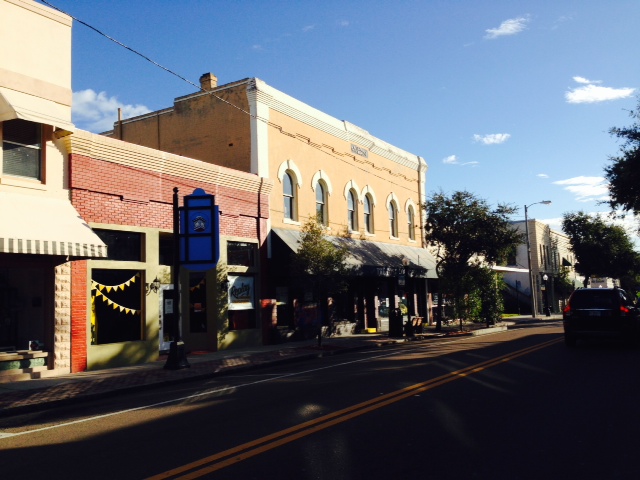
Here’s the fuel dock with a tug taking on fuel – they take on as much as 30,000 gallons of diesel fuel! At  $3.50/gallon – I ran out of fingers & toes…Notice how the tug dwarfs the building on the dock – the tugs are all engine at the lower level, but the helm must be high enough for the pilot to see over the barges, which stretch out up to 600 feet (two fll football fields, end to end) in front of him!

So as you probably know, a massive storm system passed through the midsection of the country, and especially the south, on Monday and Tuesday, bringing huge rainfalls, near-hurricane force winds, lightning, and tornadoes in some places. Knowing that it was coming, we planned our schedule to be in Demopolis, which ended up to be under a tornado watch for about 12 hours. The storm that hit us was very nasty, but fortunately for us, the worst of the storm passed slightly north of us. However, the high rainfall throughout the watersheds that drain into the Tenn-Tom and Black Warrior-Tombigbee Waterway, caused the water level to rise over 15 feet above normal. The result was swift currents and a resurgence of floating debris, though nothing like we experienced on the Mississippi. Here are a few images:

A flooded dock along the Black Warrior-Tombigbee Waterway

A flooded dock along the Black Warrior-Tombigbee Waterway

High water and swift currents

High water and swift currents

We stayed in Demopolis for two days due to the storm, then continued south, where we tied up at Bobby’s Fish Camp – it is quite rustic with a single dock parallel to the river, but it served us just fine.  Here are a few images:

Bobby's Fish Camp - notice the Spanish Moss hanging from the trees - quite beautiful

Bobby’s Fish Camp – notice the Spanish Moss hanging from the trees – we are in the deep south!

The main building at Bobby's, which also has a small restaurant that is open just three evenings per week - unfortunately, we were not there on one of them, and no one was around

The main building at Bobby’s, which also has a small restaurant that is open just three evenings per week – unfortunately, we were not there on one of them, so we cooked on board

Is this the same guy whose hand got caught in the rear hatch of the minivan?  This guy really gets around - he ought to be more careful!

Is this the same guy whose hand got caught in the rear hatch of the minivan? This guy really gets around – he ought to be more careful!

Prior to the storm, the weather has been very hot - mid to high 80's during the day, mid to high 60's at night. The water is incredibly warm - like bath water,  However, the storm pulled in cold air, so it's been in the 40's at night - as a result, we've had morning fog on the water every day since the storm went through.  This is a picture of the fog at Bobby's as we prepared to cast off.

Prior to the storm, the weather has been very hot – mid to high 80’s during the day, mid to high 60’s at night. The water is incredibly warm – like bath water, However, the storm pulled in cold air, so it’s recently been in the 40’s at night – as a result, we’ve had morning fog on the water every day since the storm went through. This is a picture of the fog at Bobby’s as we prepared to cast off.

As we continued, we arrived at our 140th lock since we left Boston – however, this was a very special lock:  it is our LAST lock until we reach the lock on the Charles River, back in Boston.  Here it is:

I just had to take a picture of it as we exited our last lock until we reach Boston

I just had to take a picture of it as we exited our last lock – the 140th that we have transited -until we reach the lock at the entrance to the Charles River where we keep the Joint Adventure in Boston

We stayed at two more anchorages on our final push south. Both of these were in fairly narrow creeks, so we needed a stern anchor to keep us from swinging into the banks. However, we couldn’t get the stern anchor to hold (a large aluminum Danforth anchor which proved inadequate), so we ended up with a bow anchor out, then tying the stern to a tree along the shore to hold us in place both nights.  Here are some images:

The Joint Adventure at anchor in the narrow creek, with the stern tied to shore

The Joint Adventure at anchor in the narrow creek, with the stern tied to shore

The anchorage in the morning - notice the fog even though the sun has risen quite a bit.  The anchorages were very beautiful and quiet

The anchorage in the morning – notice the fog even though the sun has risen quite a bit. The anchorages were very beautiful and quiet

Remember the Asian Carp?  We haven't seen any since the Illinois River. Imagine our surprise in the morning when I got into the dinghy to retrieve our line tied to shore to find this Asian Carp that had jumped into the boat at some time in the morning!

Remember the Asian Carp? We haven’t seen any since the Illinois River. Imagine our surprise in the morning when I got into the dinghy to retrieve our line tied to shore to find this Asian Carp that had jumped into the boat overnight!  We say several more jump during our stay at the anchorage.

We could have had dinner for two!

Dinner for two!

The anchorage on our last night before Mobile, in a creek off the Mobile River, about 15 miles north on Mobile

The anchorage on our last night before Mobile, in a creek off the Mobile River, about 15 miles north on Mobile

Our stern line tied to an overhanging tree on shore - small bass fishing boats plied this creek, so we tied floats onto the line to make sure any boaters saw the line and passed around the other side of us

Paul starting to retrieve our stern line, which we tied to an overhanging tree on shore – small fishing boats plied this creek, some at night, so we tied floats onto the line to make sure any boaters saw the line and passed around the other side of us

So for the first time since early May – nearly 5 1/2 months ago – we are again in salt water!  We arrived in Mobile Bay this morning – another major milestone on the Great Loop route. We have completed the inland rivers, nearly 1400 miles of waterway that is a unique experience and is the most variable section of the trip. Weather conditions, of course, affect every day on the water. However, on other segments of the trip, a weather system passes and conditions return to normal. On the inland rivers, it can be very different – the effects of a weather system can and sometimes do affect the rivers for weeks. In addition, weather systems from hundreds of miles away that you may not even know about can have a huge effect on you – such was the case when major storms dumped near-record rainfalls on Kansas City and the Upper Missouri River, causing extreme conditions for weeks on the Mississippi – just at the time that most of the Loopers (including us!) were starting to pass through, damaging many of the boats and delaying virtually everyone.  The inland rivers also include the most remote and rural sections of the trip, with long stretches (up to 250 miles) with no fuel, water, provisions, or other services, necessitating anchoring for several nights.  However, it is also one of the most rewarding sections of the trip, with unique challenges, beautiful scenery, an opportunity to see rural towns and meet wonderful and interesting people in a way that you wouldn’t any other way, and a chance to see and understand the unique role that these vital waterways have played and continue to play in the movement of goods in our economy.
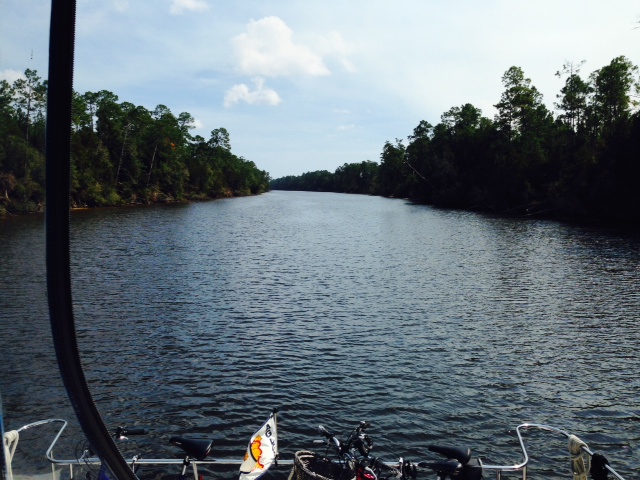
So this morning, we pulled up the anchor and ran the last 15 miles through the city of Mobile and into Mobile Bay.  Here are some images:

The last 10 miles or so of the Mobile River run through an enormous cypress swamp

The last 10 miles or so of the Mobile River run through an enormous cypress swamp

A shanty along the bank of the Black Warrior - Tombigbee Waterway

A shanty at the entrance to a creek along the bank of the Mobile River

Our first glimpse of Mobile, coming downriver from the North

Our first glimpse of Mobile, coming downriver from the North

M

Most of Mobile Harbor is lined with industrial uses on both sides, with a great deal of activity – ships and barges being loaded and unloaded up and down the harbor, dry docks, freighters, barges, tugs, Navy ships – you name it.  We saw very few recreational vessels, and they were virtually all small boats out fishing.

Several Navy "stealth" boats were in the harbor - I'm not sure what they are, but they looked intimidating

Several Navy “stealth” boats were in the harbor – I’m not sure what they are, but they sure looked intimidating

Downtown Mobile from Mobile Harbor - the harbor is very busy and is extremely industrial for most of the way on both sides - there is a great deal of activity, with ships and barges being loaded and unloaded up and down the harbor, dry docks, Navy ships, freighters, tugs, barges - you name it.  We saw very few recreational vessels, and virtually all of those were small fishing boats

Downtown Mobile from Mobile Harbor – this picture is taken slightly from the south, and shows the one area of the downtown waterfront that isn’t industrial

Some interesting architecture from the water

Some interesting architecture from the water

Entering Mobile Bay - the city of Mobile is in the background.

Entering Mobile Bay – the city of Mobile is in the background.

We’ll be in Mobile for a few days to do some exploring, then we leave the boat here for a week while I go to Buffalo to help celebrate my Dad’s 90th birthday!!!
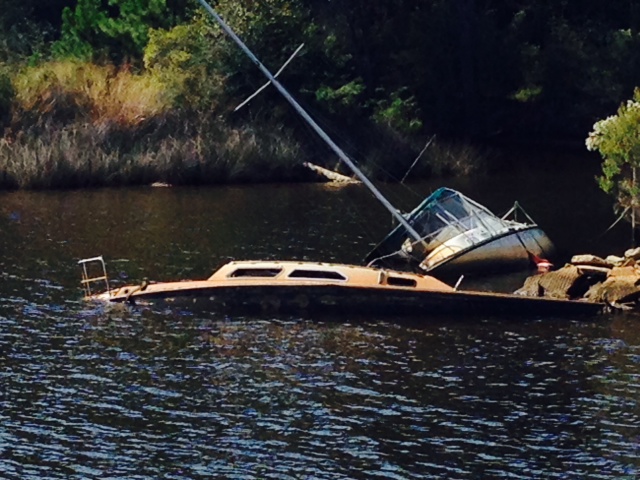


Standard

CATFISH, GRITS, BISCUITS AND GRAVY, FRIED CHICKEN, AND TORNADOES

Post #33:  CATFISH, GRITS, BISCUITS & GRAVY, FRIED CHICKEN, AND TORNADOES – Day 158, October 9, 2014

We are in the deep south – if I didn’t know it any other way, I would know it every time I look at a restaurant menu – it is signature-south. Most of the menu items are fried. Everything can be ordered smothered in gravy. Every restaurant features catfish for dinner. Grits for breakfast. A side of biscuits covered with gravy at any meal. Big portions.

Paul requested an order of sausage biscuits with gravy for breakfast:

They say it's good to eat a hearty breakfast....

They say it’s good to eat a hearty breakfast….

Everything tastes irresistibly good.  We up North turn up our noses at catfish, presumably because catfish are bottom-feeders and somewhat ugly-looking fish – but it is a light, flakey white fish, much like flounder, which are also bottom feeders and somewhat ugly-looking fish. Catfish is really good, especially when it is grilled or baked with lemon-pepper as they sometimes do it down here. However, most of the catfish is served deep-fried. In addition, the health benefits of catfish in the southern diet are often overwhelmed by the health detriments of most of the other signature-south items in the southern diet, as well as the large size of the portions. The unfortunate result is that Mississippi has the highest obesity rate in the country, and the southern states as a group have a disproportionately high level of obesity. But the food sure is good.

After weeks without rain, we finally had a major storm last Thursday night, starting around midnight. Wind, rain, near-continuous lightning flashes.  Around 2:00 AM, anyone who was asleep was awoken by a loud and prolonged siren – a tornado warning. Thinking it’s no big deal and with no real understanding of the implications, we rolled over and went back to sleep when the siren finally stopped. However, the threat became real to us the next day shortly after we arrived at a small marina in the small town of Smithville, Mississippi, just 18 miles away. We learned that, just three years ago, the owner of the marina along with 15 other residents of Smithville were killed in a tornado that virtually wiped out the town. The son of the deceased owner now runs the marina – the empty foundation of his father’s house adjacent to the marina is a sober reminder of the power of nature. The EF5 tornado (the most powerful category) passed within 100 yards of the marina, leaving only foundations in its path; miraculously, the marina was unharmed. Later in the day, we visited a hardware store in town and learned more – the store was new, as the building that had stood since the turn of the century had been leveled. Stories abounded. As the tornado approached, the owner and employees of the store took refuge in an old bank vault adjacent to the store which they used for storage. All survived. That night, we went to the local diner (the only one in town). More harrowing stories.  From a written story on the menu of the diner:

“Bobby and Melanie Edwards [owners of the diner] had been home for an afternoon break from work when the weather turned ominous. When alerts showed Smithville in the tornado’s path, the Edwards went into the basement of their church a couple of miles from their home. Bobby called the diner on the phone. ‘Shut off the gas and get into the cooler’ Bobby recalls urging waitress Brandy Holloway over the phone minutes before the EF-5 rumbled through.  The waitress said ‘You don’t understand. We have customers here’. Bobby said ‘You don’t understand. It’s going to be here in 10 minutes’. Holloway did as she was told. That made 12 more survivors.”

The diner was gone. The cooler with its mix of 12 employees and customers still stood. Bobby and Melanie rebuilt. Others weren’t so lucky. A drive through the small town revealed empty foundation after empty foundation where homes and businesses once stood.

Here are a couple of images:

This is a photo of the actual tornado, taken by a resident moments before ducking into a tornado shelter. The clerk at the hardware store showed us this and many other pictures she had

This is a photo of the actual tornado, taken by a resident moments before ducking into a tornado shelter. The clerk at the hardware store showed us this and many other pictures she had of the devastation.

The new Mel's Diner, rebuilt after being leveled by the tornado. The only restaurant in town, it serves as a de facto community center/gathering place as well

The new Mel’s Diner, rebuilt after being leveled by the tornado. The only restaurant in town, it serves as an informal community center/gathering place for residence of the small town.

From now on, if we hear a tornado siren, you can be sure we will pay attention.

Of course, much of the story of our trip is the story of the people that we meet. Everyone has their own story to tell.  I’ve told the story of some of the boaters and fellow loopers whom we’ve met.  Here are some pictures of some local people we’ve met recently in Mississippi:

This is Dave and his homemade houseboat. Dave is the guy who drove us to Tupelo to visit Elvis's birthplace & museum.  Dave and his wife are from Wisconsin - he built the boat, then decided to take it down the inland rivers to Mobile. He had never piloted a boat like that before and had never been in a lock. Down the Mississippi, up the Ohio, down the Tennessee, then down the Tenn-Tom they went. They stopped overnight in Fulton, Mississippi a year and a half ago and never left. They live on the boat, she works at the local Community College, and he drives a long-haul tractor trailer

This is Dave and his homemade houseboat. Dave is the guy who drove us to Tupelo to visit Elvis’s birthplace & museum. He and his wife are from Wisconsin – they built this boat together to live on, then decided to take it down the inland rivers and move to Mobile for a change in lifestyle. He had never piloted a large boat before and had never been in a lock. Down the Mississippi, up the Ohio, down the Tennessee, then down the Tenn-Tom Waterway they went. Fortunately, the weather and water levels were favorable for them. They stopped overnight in Fulton, Mississippi a year and a half ago and never left. They live on the boat;  she works at the local Community College, and he drives a long-haul tractor trailer. Very nice people.

This is Patty and her home, docked at the Smithville Marina.  Patty got divorced, then became sick of maintaining her single family house,  "especially mowing the grass - I don't ever want to mow grass again". So her friend Scott, who owns the marina, told her "I have just the place for you". So she has lived on this boat since April, and intends to stay there indefinitely. She has set up her lawn patio furniture on the dock next to the shore, where it serves as a gathering place each evening for the few people who also live in the small marina and friends who occasionally stop by.

This is Patty and her home, docked at the Smithville Marina. Patty got divorced, then became sick of maintaining her single family house, “especially mowing the grass – I don’t ever want to mow grass again”. So her friend Scott, who now owns the marina since his father was killed in the tornado, told her “I have just the place for you”. So she has lived on this boat since April, and intends to stay there indefinitely. She has set up her patio furniture on the dock next to the shore, where it serves as a gathering place each evening for the few people who also live in the small marina and friends who occasionally stop by.


This is John, standing next to his boat in Smithville.  John has lived on the boat at the marina for 15 years. "I seldom take the boat out", said John. "Maybe once a year, if that".  It looked like it had been much longer than that since the boat had moved....

This is John, standing next to his boat in Smithville. John has lived on the boat at the marina for 15 years. “I seldom take the boat out”, said John. “Maybe once a year, if that”. It looked like it had been much longer than that since this boat had moved….

These are two local fisherman who come down to the marina whenever they can to fish off the dock where the Joint Adventure was tied up. The pressure was on - their church was having a fundraiser later that day and was selling fish dinners for $10/plate - they had to catch the fish for the dinners, many of which had already been sold. I'm not sure if they were up to the task or not, but they sure were fun to talk with -

This is Ned and Al, two local fisherman who come down to the marina whenever they can to fish off the dock where the Joint Adventure was tied up. The pressure was on – their church was having a fundraiser later that day and was selling fish dinners for $10/plate – they had volunteered to provide the fish for the dinners, many of which had already been pre-sold. I’m not sure if they were up to the task or not, but they sure were fun to talk with –


Emily, the clerk at the hardware store and the daughter of Bobby and Melanie Edwards (owners of the store) and her Mom Melanie told us many stories about the tornado, which struck when she was 22. After hearing about our trip, she very much wanted to see our boat, so we took her on a tour of the Joint Adventure

This is Emily, the clerk at the hardware store and the daughter of the owners of the store.  She and her Mom told us many stories about the tornado, which struck when Emily was 22, and shared many pictures of the tornado with us.  After hearing about our trip, Emily very much wanted to see our boat, so we took her on a tour of the Joint Adventure. Her southern accent was so thick we had to strain to understand her, but she was just a peach of a kid and a joy to talk with.


This is Keith and Debby and the houseboat that they plan to live on. Keith was a trucker for years but was forced to retire for health reasons. He sold this boat a year ago, but had to repossess it due to lack of payment. So we met them on the Tenn-Tom as they were bringing it to Mobile, then on to New Orleans where they live. Keith intends to earn a living buying older boats, fixing them up, then selling them.

This is Keith and Debby and the houseboat that they plan to live on. Keith was a trucker for years but was forced to retire for health reasons. He sold this boat a year ago, but had to repossess it due to lack of payment. So we met them on the Tenn-Tom as they were bringing it to Mobile, then on to New Orleans where they live. Keith intends to earn a living buying older boats, fixing them up, then selling them. Judging from the condition of this boat, he has his work cut out for himself.

While much of the Tenn-Tom Waterway is a wide, man-made canal, the dams at each of the locks create small lakes and wetland areas that are very beautiful. Often the channels entering the occasional marina wind through areas that are scattered with trees growing through the water or stumps from trees that have long since fallen. We planned to anchor out on Saturday night, but the wind was howling in the afternoon and we didn’t like any of the possible anchorages that we saw, particularly with the gusty winds. We therefore opted to go into the Aberdeen Marina, with a winding channel that required some focus. Here are some images from Aberdeen, Mississippi:

A beautiful wetland area, created when the Tenn-Tom was built.

A beautiful wetland area, created when the Tenn-Tom was built.

The narrow channel winds through this  tree and stump-filled wetland - better stay focused!

The narrow channel winds through this tree and stump-filled wetland – better stay focused!

I couldn't resist this sunset picture, taken from the bridge of the Joint Adventure at Aberdeen Marina

I couldn’t resist this sunset picture, taken from the bridge of the Joint Adventure at Aberdeen Marina

A few nights ago, I inadvertently left the VHF radio on and was awakened in the night by someone talking on the radio. I turned it off and went back to sleep.  However, it reminded me of the last time I left the radio on and went to bed.  We were bringing the Joint Adventure to Boston from Florida where we had purchased her, and were tied to a dock at a marina about a mile up a river from the Intracoastal Waterway in the low country of Georgia. Around 2:00 in the morning, the radio started to squawk. I was in a deep sleep, out cold;  I thought it was my alarm clock and I groped around in the dark, pushing every button I could find to turn it off. I finally woke up enough to realize it was the VHF radio, so I stumbled to the breaker panel and shut it off, then went back to bed.  Now half awake, I started to connect the dots as I lay in bed.  Could I have pressed the “DISTRESS” button on the radio?  Did I just call the Coast Guard? I sat up wondering what to do, slowly deciding I’d better turn my radio back on when suddenly my cell phone rang (remember, it was 2:00 AM). “Is this Mr. Koningisor?” Yes, it is. “This is the United States Coast Guard.  We received a distress signal from your radio and are preparing to send out a Search and Rescue mission.  Are you OK?” I sheepishly explained what had happened. Fortunately, he pretended to be somewhat understanding and just scolded me mildly. As I lay back in bed, I had visions of helicopters descending upon me next to the dock where I was safely tied, then receiving a bill from the Coast Guard for $25,000. I’m surprised I ever used the radio again.

So we spent a day in Aberdeen, Mississippi, and are now in Columbus, on the Tenn-Tom waterway 335 miles by water from Mobile, Alabama and the Gulf of Mexico.  Here are some images from our stays in Aberdeen and Columbus:

Aberdeen, Mississippi is an interesting town with many historic homes and buildings. Main Street has a covered sidewalk along its entire length on both sides, and the town boasts a historic architectural tour of over 50 homes from various periods and displaying various styles of architecture.

Aberdeen, Mississippi is an interesting town with many historic homes and buildings. Main Street has a covered sidewalk along its entire length on both sides, and the town boasts a historic architectural tour of over 50 homes from various periods and displaying various styles of architecture.

One of the nearly 50 historic architectural tour in Aberdeen

One of the nearly 50 historic architectural tour in Aberdeen

Aberdeen has a rich history with music, particularly the blues, as captured in this large mural on Main Street

Aberdeen has a rich history with music, particularly the blues, as captured in this large mural on Main Street

My Dad making sure our lines on the dock are ship shape - if only we kept the inside of the boat so neat and organized...

My Dad making sure our lines on the dock are ship shape – if only we kept the inside of the boat so neat and organized…

So I tried to come up with a clever caption for this picture but drew a blank - can anyone help me out?  I'll put the best ones in a subsequent post

So I tried to come up with a clever caption for this picture but drew a blank – can anyone help me out? I’ll put the best ones in a subsequent post


An impromptu Happy Hour/Dock Party at the marina in Columbus, organized by our friends Scott & Angela on the boat "Lucky Lucky", whom we first met on our first day out of Chicago on the Illinois River when we both had to wait several hours for a lock, tied to a barge and then to a seawall.  Scott & Angela are doing the Great Loop with their two daughters, age 10 and 7 (or thereabouts - I have trouble remembering the ages of my own kids...). Angela is home-schooling them during their year on the boat - an interesting and challenging task, I'm sure!

An impromptu Happy Hour/Dock Party at the marina in Columbus, organized by our friends Scott & Angela on the boat “Lucky Lucky”, whom we met on our first day out of Chicago on the Illinois River when we both had to wait several hours for a lock, tied to a barge and then to a seawall. Scott & Angela are doing the Great Loop with their two daughters, age 10 and 7 (or thereabouts – I have trouble remembering the ages of my own kids…).  Angela is home-schooling their daughters during their year on the boat – an interesting and challenging task, I’m sure!

Sadly, my Dad and Tom left the boat yesterday to go back to the real world. I will miss them!  So Paul and I are on our own for a couple of weeks until our friend Jake joins us later in the month.  Tomorrow, we continue our march south.

Standard

THE MAN-SIZED TOILET STRIKES AGAIN

Post #32 – THE MAN-SIZED TOILET STRIKES AGAIN –   Day 152, October  2, 2014.  On Board:  Tom, Paul, my Dad (Hank), Jim K

Here it is again....

Here it is again….does this look familiar?

You may recall that, early in our trip, in Albany, New York, our toilet became clogged to the extent that we had to remove it completely to try to unclog it. Many boats, including this one, are built with a “compact” toilet.  Not very convenient.  So we decided that if we had to perform the somewhat unpleasant task of removing the toilet in its entirety, we would “upgrade” with a brand new, “man-sized” toilet.  Which, with the help of Dave Luciano, we did.  YYAAYY!  A brand new toilet!  No more toilet woes!  Not to be.  Earlier this week, we successfully managed to clog the new one, or so we thought. It turned out that we instead clogged the discharge hose that goes to the holding tank.  Then in the process of trying to make it work (i. e. forcing it when we really knew better), we seem to have damaged the pump on the toilet.  !#@#%&!!.  We were in southwest Tennessee – otherwise known as “The Middle of Nowhere”.  No place to buy parts.  Of course it was Friday afternoon, so parts couldn’t be shipped out until Monday, for overnight delivery on Tuesday. I’ll spare the details, but we kept moving and had the parts shipped ahead to where we would be on Tuesday.  The parts arrived, and our big-boy toilet is again functional. Among other things, we learned that you really need a toilet on a boat…

So – knowing that we had a 60 mile run and a large lock to go through on Sunday, we left early. The lock was only 9 miles from our destination, so when we arrived at the lock by 3:00 PM, we thought we were in good shape.  Not to be – a tow had just started locking up, and he was too large to fit in the lock all at once;  therefore, they had to separate the barges into two sections, lock them up separately, then re-assemble them at the top.  Four hours later – at 7:00 PM and in virtual darkness, we finally were locked through and emerged at the top. For the next hour, we picked our way 9 miles up the river in the dark, including turning the corner from the Tennessee River onto the Tenn Tom Waterway. Getting into the marina in the dark where we had never been and finding our slip was another challenge;  however, by 8:30 PM we were tied up. We were happy to be greeted by our new friends Harvey & Mary Helen on the boat “Lollygagger” (also doing the Great Loop), who quickly invited us onto their boat for a much-appreciated cocktail. We finally had a dinner of beans and applesauce at 9:30 PM.  Just another day on the water!

As are most “loopers” whom we meet, Harvey & Mary Helen are fun and interesting people. Harvey was a Virginia State Legislator for 32 years, and mesmerized us with stories from Virginia politics. We exchanged political views and all complained about one thing or another.

So we have now finished our run down the Tennessee River – a very beautiful river through mostly remote countryside. Here are some images from our final days on the Tennessee:

There are many creeks that empty into the Tennessee, including this one entering from the right of the rock formation.  Most of the marinas along the Tennessee are located up these creeks, sometimes a couple of miles up a winding channel

There are many creeks that empty into the Tennessee, including this one entering from the right of the rock formation. Most of the marinas along the Tennessee are located up these creeks, sometimes a couple of miles up a narrow, winding, but beautiful channel

Notice the hot tub in the rock enclosure overlooking the edge of the cliff.  I could live here....

Another interesting home along the river – notice the hot tub in the rock enclosure overlooking the edge of the cliff. I could live here….

Due to flooding, even mobile homes are now put on stilts -

Due to flooding, even mobile homes are now put on stilts –

An interesting place to put a house -

An interesting place to put a house –

We'd like to spend some time with the folks on this boat...

We’d like to spend some time with the folks on this boat…

So we entered the Tenn-Tom Waterway, another significant milestone on our journey. The Tenn-Tom connects the Tennessee River with the Tombigbee River, cutting as much as 720 miles off the trip between various ports and creating the path we are following to the Gulf. The waterway was originally proposed by the French in the late 1700’s, followed by lobbying in 1810 by citizens of Knoxville who urged Congress to construct the waterway. However, the first engineering study wasn’t performed until 1875, when it was determined that the 43 locks needed for a 4 foot deep channel was uneconomic. Another study was done in 1913, in which it was determined that 65 locks would be required for a 6 foot deep channel – again determined to be uneconomic. Further studies were done in 1923, 1935, 1938, and 1945 (as we know, our government likes to study things…).  In 1946, Congress finally approved construction of the waterway. However, continued opposition delayed the project until President Nixon included $1 million for the project in his 1971 budget to build the waterway, and construction began. In 1977, with construction well underway, President Carter tried to stop construction;  nevertheless, Congress continued to fund the project. After spending nearly $2 billion, the Tenn-Tom was finally opened in 1985. Yes, Nixon approved $1 million for construction, and the final cost was just shy of $2 billion. Though the Tenn-Tom Waterway is relatively unknown, the enormous 243 mile project is the largest ever performed by the US Army Corp of Engineers – more earth was moved than in the construction of the entire Panama Canal!  Of course, despite all the studies, the Tenn-Tom will never be “economic”, but we’re glad it’s here – otherwise, we would be fighting the Mississippi River all the way to New Orleans!  Some images:

The junction of the Tennessee River and the Tenn-Tom Waterway.  It looks much different in the daytime, as we turned the corner and entered the Tenn-Tom Sunday night in the dark!

The junction of the Tennessee River and the Tenn-Tom Waterway. It looks much different in the daytime, as we turned the corner and entered the Tenn-Tom Sunday night in the dark

Heading south on the Tenn-Tom, the river narrows, and eventually transitions into a 25 mile man-made canal

Heading south on the Tenn-Tom, the river narrows, and eventually transitions into a 25 mile man-made canal

Although the weather remains hot as we continue south, generally in the 80's, the leaves are beginning to show some fall colors along the river

Although the weather remains hot as we continue south, generally in the 80’s, the leaves are beginning to show some fall colors along the river

We used the courtesy car at the marina in Cource, Mississippi to drive to Shiloh to visit the museum and battlefield at one of the bloodiest battles of the Civil War. The two day battle resulted in over 23,000 casualties on both sides, finally resulting in a critical victory for the Union forces commanded by General Grant. The memorial park is enormous, as the battle raged over a large area adjacent to the Tennessee River. Here are some images:

The church at Shiloh, a critical place in the see-saw battle which was alternately held by the Confederate and Union forces

The church at Shiloh, a critical place in the see-saw battle which was alternately held by the Confederate and Union forces over the two day period.

The inside of the church -

The inside of the church –

Pittsburg Landing on the Tennessee River, where the Union forces landed their troops to try to penetrate deep into the south. In the Shiloh battle, the Confederate forces tried to capture the Landing to prevent reinforcements for the Union forces from crossing the river, but failed to reach the river

Pittsburg Landing on the Tennessee River, where General Grant landed his troops to try to penetrate deep into the South. In the Shiloh battle, the Confederate forces launched a surprise attack to cripple the Union army, then tried to capture the Landing to prevent Union General Buell from crossing the river with 13,000 Union reinforcements which were expected within days. Though the Confederate forces were clearly victorious on the first day of the battle, they did not capture Pittsburg Landing. General Buell and his army arrived and were ferried across the river that night, and the Union army forced the Confederate army to retreat with heavy losses the next day.

One of many memorials marking key locations in the battle of Shiloh

One of many memorials marking key locations in the battle of Shiloh

At Shiloh, we learned more about the battle of Johnsonville and Confederate General Nathan Forrest, who, you may recall from the last blog post, successfully destroyed the entire heavily-fortified supply depot at Johnsonville with a small group of men and some artillery. It seems that, as a result of  the strategic artillery barrage by Forrest, the Union commander of the supply depot became convinced that the Confederate forces were much, much larger than they were. As a result, he ordered his own men to set fire to the supply depot and intentionally burned the $6 million worth of supplies, the remaining ships, etc. to keep them from being captured by the Confederates.  We also learned that, although we up North generally know nothing about General Forrest, he is a major hero in the South and was a huge figure during the war in the South. Below is a picture of a historical plaque at Shiloh which says it all:

Apparently Confederate General Forrest was quite a soldier

Apparently Confederate General Forrest was quite a soldier

Back to our trip – we reached another major milestone on Sunday as we left Tennessee and entered our 11th state – Mississippi. We are now about 450 miles from the Gulf of Mexico. There are reminders everywhere that we are well into the Bible Belt:

Driving along the highway on our way to Shiloh, we came upon this enormous cross - there was no church or other building around, just tis cross.  Notice that it matches the height of the adjacent full-grown trees!

Driving along the highway on our way to Shiloh, we came upon this enormous cross – there was no church or other building around, just this cross. Notice that it matches the height of the adjacent full-grown trees!

Even on the waterway, there are reminders that we are squarely in the Bible Belt...

Even on the waterway, there are reminders that we are squarely in the Bible Belt…

We arrived in the Mississippi town of Fulton, just 17 miles from the town of Tupelo, birthplace on Elvis Presley. How could we not go? The marina wouldn’t let the courtesy car go outside the Fulton town limits, so we found a local guy who agreed to take us there and back for a small “donation”. Fearing a tourist trap, my expectations for the Elvis Presley birthplace museum weren’t very high;  however, it was actually quite well done and I learned some things about Elvis that I didn’t know (which was easy, since I didn’t know anything).  Anyway, did you know that: (1) Elvis had an identical twin, who was stillborn (2) Elvis’s family lived in the poorest section of a very poor, Mississippi town during the Depression, and (3) Elvis’s father was a sharecropper and sold a pig to pay his rent. The buyer would only pay $4, but Elvis’s father was desperate.  Knowing that the pig was worth much more than $4, however, he took a pen and wrote in a “1” in front of the “4” on the check, making it $14 instead of $4. He was arrested for forgery and sentenced to 3 years in jail. He was released after 8 months, but lost his job and his house as a result. As a result, he moved the family to Memphis in pursuit of a better life, and the rest is history.

Here are some images:

This is the house where Elvis was born and his Dad lost as a result of his stint in prison

This is the two-room house where Elvis was born and that his Dad built as a sharecropper. It had no electricity and no plumbing. His Dad lost the house as a result of his time in prison

The kitchen/dining room of the Elvis house

The kitchen/dining room of the Elvis house

When I saw this outhouse on the grounds of the Elvis birthplace museum, I thought it was a bit over the top.  However, the museum used the replica outhouse to show one aspect of life growing up very poor in a very poor neighborhood, explaining that often multiple families shared a single outhouse like this one. Also, in keeping with the theme of this post, I'm guessing that they didn't have to deal with a clogged toilet...

When I saw this outhouse on the grounds of the Elvis birthplace museum, I thought it was a bit over the top. However, the museum used the replica outhouse to show one aspect of life growing up very poor in a very poor southern neighborhood, explaining that often multiple families shared a single outhouse like this one. Also, in keeping with the theme of this post, I’m guessing that they didn’t have to deal with a clogged toilet like we do…

One last thing from the Elvis museum – the plaque shown in the picture below was on the wall at the museum – I have no idea why. However, you may recall from an earlier post the story of Tom and Tim, the grandfather/grandson team that we met early in the trip and with whom we’ve become good friends. The name of their boat is “IF”. When I asked Tom why, he explained that he loved the poem “IF” by Rudyard Kipling. I don’t know much about poetry, but I happened to know this poem well and recited a verse by heart at the time. In any case, if you are not familiar with the poem, here it is as shown on the plaque at the Elvis museum:

If, by Rudyard Kipling

If, by Rudyard Kipling

Having completed our day of sightseeing, tomorrow (Friday) we continue heading south on the Tenn-Tom.


Standard

“IT’S MIGHTY EXPENSIVE TO LOOK THIS CHEAP”

Post #31 – IT’S MIGHTY EXPENSIVE TO LOOK THIS CHEAP” – Day 147 , September 27, 2014.  On board: Tom, Paul, my Dad, Jim K

After our experience with floodwaters on the Mississippi, who would ever have thought that we would soon be facing issues with low water? But that’s the case on the Tennessee River. The watershed feeding the Missouri River caused the Mississippi River flooding, but the Tennessee watershed has experienced a drought – we’ve seen only one short rainfall in the past three weeks. Thus, the water level on the Tennessee River is 4-5 feet below normal, and we’ve already been turned away by one marina due to low water in their entrance channel, despite our shallow draft of under three feet. Welcome to the vagaries of the Inland Rivers!

Regarding the Tennessee River – In 1931, a legislative bill which would create and fund a federal agency to build a hydroelectric dam on the Tennessee River to generate electricity was passed by Congress. President Herbert Hoover vetoed it, calling it a “socialist” program.  A year later, Franklin Roosevelt was in the White House pushing through the “New Deal”.  This time, a far more expansive bill became law – it created the Tennessee Valley Authority (TVA), which Roosevelt signed in 1933. It’s charter was to construct dams and other improvements to generate hydroelectric power, enhance navigation, provide flood control, and – perhaps even more important – provide jobs, economic development, and rural electrification to one of the poorest and hardest-hit areas of the country during the Great Depression. It was hugely controversial, as opponents went to court and argued that the federal government had no constitutional authority to undertake such a project – in particular, they argued that generating electricity and in essence becoming a public utility, which would compete unfairly against privately owned utility companies, was not allowed by the Constitution. As many New Deal programs did, the case worked its way all the way to the Supreme Court, which ruled in 1936 that the creation and operation of the Tennessee Valley Authority was constitutional. The floodgates (pun intended) were opened – the TVA has subsequently constructed a total of 29 dams and provides hydroelectricity to much of Tennessee, Kentucky, Alabama, and Mississippi, as well as portions of Georgia, North Carolina, and Virginia. The process of constructing the dams transformed the Tennessee and Cumberland river valleys and remained controversial, displacing 15,000 families as vast regions of the river valleys were intentionally flooded (think “Deliverance”). By 1950, the TVA became the largest provider of electricity in the United States, and today remains the largest regional planning agency in the federal government. However, it is very popular in Tennessee, as Barry Goldwater learned in 1964 when he proposed selling it to private owners during his campaign for the presidency. Some of you may also recall another turning-point Supreme Court decision involving the TVA in the 1970’s: the TVA proposed another huge hydroelectric project called the Tellico Dam. In a major test case of the new Endangered Species Act, the Supreme Court blocked the project due to the projected loss of habitat of a species of snail called the “snail darter”, listed as an endangered species.

In any case, two of the TVA dams significantly impact the Great Loop experience. The Barkley Dam across the Cumberland River created Lake Barkley, and the Kentucky Dam across the Tennessee River created the massive Kentucky Lake – nearly 200 miles long, it is the largest man-made lake east of the Mississippi River. The two lakes are roughly parallel to each other, and the land between them is aptly named “Land Between the Lakes”. Generally 5-10 miles wide, it is a well-known vacation destination in this region of the country, with water sports, spectacular scenery, hiking, and a great deal of history, much of it centered on the Civil War era.

Last week, we passed through the Barkley Lock, and entered Lake Barkley where we stayed Friday and Saturday nights. After passing through a 1.5 mile canal that connects Lake Barkley with Kentucky Lake, we passed by the top of the Kentucky Dam and headed south on Kentucky Lake, which is the flooded river valley of the Tennessee River. It is a beautiful lake with large state parks at intervals along the shore. We spent two more days heading south through Kentucky, then entered our 9th state – Tennessee!  Here are some images:

Kentucky Lake, which is a portion of the Tennessee River which was flooded by the construction of the Kentucky Dam by the TVA. Started in 1938, the lake began to fill with water when the dam was finally completed in 1944

Kentucky Lake, which is a portion of the Tennessee River which was flooded by the construction of the Kentucky Dam by the TVA. Construction of the dam started in 1938, and the lake began to fill with water when the dam was finally completed in 1944

The marina at Paris Landing State Park, Tennessee. Many of the slips are empty as we are well into the Fall

The marina at Paris Landing State Park, Tennessee. Many of the slips are empty as we are well into the Fall

I hope I can still do this at 90 - we figured that it was probably 30-40 years since my Dad rode a bicycle -

I hope I can still do this at 90 – we figured that it was probably 30-40 years since my Dad rode a bicycle –

The start of training for the Tour de France...

The start of training for the Tour de France…

On our third night on Kentucky Lake/Tennessee River, we stayed in a small town in Tennessee called New Johnsonville, with a rich history that is well-presented in a small but fascinating museum. Johnsonville (as it was called at that time, named after future-President Andrew Johnson, then-Governor of Tennessee) was little more than a river landing until early 1864 when the Union Army decided they needed a new, more secure supply route using the Tennessee River to support its advances into the south. Within six months, an enormous complex of wharfs, warehouses, fortifications, housing, and support facilities was constructed and Johnsonville became a crossroads for supplying the Union army, particularly Sherman’s army as it marched towards Atlanta. An innovative Confederate General named Nathan Forrest was given the task of interrupting the supply line to try to slow Sherman’s march. With a small group of men, he attacked using artillery from the other side of the river and managed to completely destroy the entire complex, including 33 Union supply ships and over $6 million dollars worth of supplies (an enormous supply depot in those days). In response, the Union army sent an entire brigade of 15,000 men to stop General Forrest, but he was long gone by the time they arrived. The complex at Johnsonville was never rebuilt, and by 1940 the town housed only 300 residents. Along came the TVA and the Kentucky Dam – all 300 residents were relocated to higher ground further up the river bank, and Johnsonville, along with the actual site of the battle, disappeared under the rising water. Hence, the new town became New Johnsonville, as it is called today.

Back to our trip. In New Johnsonville, we stopped at Birdsong Marina, home of the only fresh water pearl farm in North America and home to, of all things, a Pearl Museum. After testing many freshwater locations, the owners found the right temperature, water quality, acidity, etc. in the Tennessee River. After investing a reported $5 million, they began seeding mussels then hanging them from baskets in the water for an incubation period averaging 8 years. The Museum includes a short film shot by CBS News a few years ago. They grow pearls of varying shapes except round – the Chinese produce round pearls cheaper then they can, so they only produce specialty shapes.

Here are some images from our stay in New Johnsonville:

In the pearl farm, mussels are caught by divers on the bottom of the river, then sent to a local lab where they are "seeded" with an organic material of the shape desired for a pearl - contrary to popular belief, the "seed" is not a grain of sand. The mussel is then placed in a basket with about a dozen other mussels, which is then suspended from the wooden "floats" - basically pieces of lumber - then left submerged for about 8 years before they are raised again. The success rate for growing a pearl in each oyster is about 95%

In the pearl farm, mussels are caught by divers on the bottom of the river, then sent to a local lab where they are “seeded” with an organic material of the shape desired for a pearl – contrary to popular belief, the “seed” is organic and is not a grain of sand. The mussel is then placed in a wire mesh with about a dozen other mussels, which is then suspended from the wooden “floats” – basically pieces of lumber – then left submerged for about 8 years before they are raised again. The success rate for growing a pearl in each oyster is about 95%

Everyplace has a story - this sunken tour boat at the marina was docked and idle for several years on the waterfront in Memphis. The Mayor insisted that it be removed, so it was given to anyone who would take it - which turned out to be the owner of Birdsong Marina. It was then towed through the Mississippi, Ohio, then Tennessee Rivers by three separate barge companies. Shortly after it arrived and was tied to the dock, it sank as a result of a hole punched in the hull during transport. All three barge companies denied blamed the others, so it still sits on the bottom three years later while the courts decide

Every place has a story – this sunken tour boat at the Birdsong Marina was docked and idle for several years on the waterfront in Memphis. The Mayor insisted that it be removed, so it was given to anyone who would take it – which turned out to be the owner of Birdsong Marina. It was then towed through the Mississippi, Ohio, then Tennessee Rivers by three separate barge companies. Shortly after it arrived and was tied to the dock, it sank as a result of a hole punched in the hull during transport. All three barge companies denied responsibility and blamed the others, so it still sits on the bottom three years later while the courts decide

A view of the Tennessee River from the historical museum commemorating the successful raid on the Union supply depot by General Forrest

A view of the Tennessee River from the historical museum commemorating the successful raid on the Union supply depot by General Forrest

Don't shoot!! You can have the last Heinekin!!

Don’t shoot!! You can have the last Heinekin!!

The crew, from left to right - Jim K, Tom, Paul, my Dad (Hank)

The crew, from left to right – Jim K, Tom, Paul, my Dad (Hank)


Dinner in the gazebo at the end of the dock -

Dinner in the gazebo at the end of the dock –

Some really cool cloud patterns while running on the Tennessee -

Some really cool cloud patterns while running on the Tennessee –

Let's not forget - we ARE in Tennessee....

Let’s not forget – we ARE in Tennessee….

We wanted to visit Nashville – Birdsong Marina did not have a courtesy car, but one of the employees amazingly loaned us her personal vehicle so we could drive the 70 miles to Nashville where we spent the day sightseeing. Here are some images:

Tom, thinking he's Johnny Cash...

Tom, thinking he’s Johnny Cash…

OMG - Elvis IS alive!!!

OMG – Elvis IS alive!!!

Broadway and 2nd Avenue in the heart of Nashville are lined with pubs, all featuring fantastic Country & Western bands all day and into the wee hours. We randomly picked a place to have a couple of beers and were entertained by an extraordinary band =

Broadway and 2nd Avenue in the heart of Nashville are lined with pubs, all featuring fantastic Country & Western bands all day and into the wee hours. We randomly picked a place to have a couple of beers and were entertained by an extraordinary band

Enjoying the wonderful music at the pub on Broadway in Nashville

Enjoying the wonderful music at the pub on Broadway in Nashville

Now this is the kid of deal my son Danny needs....

Now this is the kind of deal my son Danny needs….for those not quite in touch, a “PBR” is a bottle of Pabst Blue Ribbon beer (I wouldn’t have known if Danny hadn’t told me…)

The Country Music Hall of Fame - a must see in Nashville -

The Country Music Hall of Fame – a must see in Nashville –

The famous Grand Ole Oprey -

The famous Grand Ole Oprey –

The stage at the Grand Ole Oprey, getting ready for a performance that evening

The stage at the Grand Ole Oprey, getting ready for a performance that evening

There are at least as many stores along Broadway and 2nd Avenue that sell cowboy boots for both men and women as there are that sell beer (at least it seems that way...)-

There are at least as many stores along Broadway and 2nd Avenue that sell cowboy boots for both men and women as there are that sell beer (at least it seems that way…)-

So we continued our journey south on the Tennessee River.  Here are some images from the river as well as our stops along the way:

the upper Tennessee River is marked by rock outcroppings as the river carved its way through the landscape

The upper Tennessee River is marked by rock outcroppings as the river carved its way through the landscape

One of many interesting homes along the Tennessee River

One of many interesting homes along the Tennessee River

Another interesting home -

Another interesting home –

Another sunset along the Tennessee River -

Another sunset along the Tennessee River –

So why did I take a picture of this spider? Well, on evenings that we eat cook aboard, we usually eat on the bridge about the time of sundown. This large spider took up residence at a corner of our canvass top, becoming active spinning his web around dusk.  We watched him with fascination for several nights, discussing his strategy and tactics for catching his dinner.  He's now become a member of our crew, providing entertainment and a topic for conversation at dinner on the bridge. So I thought I'd share him with you (her?)

So why did I take a picture of this spider? Well, on evenings that we eat cook aboard, we usually eat on the bridge about the time of sundown. This large spider took up residence at a corner of our canvass top, becoming active spinning his web around dusk. We watched him with fascination for several nights, discussing his strategy and tactics for catching his dinner. He’s now become a member of our crew, providing entertainment and a topic of conversation at dinner on the bridge. So I thought I’d share him (her?) with you

Finding an ice cream parlor is lways a high priority.  However, we're very disciplined - only on rare occasions do we hit two in one day -

Finding an ice cream parlor is always a high priority. However, we’re very disciplined – only on rare occasions do we hit two in one day –

Now, these are my kind of gas prices...

Now, these are my kind of gas prices…

A pleasant marina in Clifton, Tennessee - located in a small cove, everything floating with the fluctuating river level -

A pleasant marina in Clifton, Tennessee – located in a small cove, everything floating with the fluctuating river level –

So, you may recall from the beginning of our trip our saga with the toilet which resulted in Dave Luciano and I installing a brand new “man-sized” toilet in the boat. I thought my toilet woes were over forever.  Not to be. We managed to again clog the system, requiring us to spend the better part of a day trouble-shooting. Bottom line, we are having a new pump and discharge hose air-freighted to our next stop – however, since it is Saturday, we won’t get it until Tuesday, meaning we are without a toilet for 4 days. No questions, please.  Dave, help!!

So – back to the title of this post. When in Nashville, we went on a backstage tour of the Grand Ole Oprey. The tour guide told us how Dolly Parton was asked one day how long it took her make-up crew to make her hair look perfect. She replied: ” I don’t know – I’m never there when they do it”.  She went on to say: “It’s mighty expensive to look this cheap.”  The great Dolly Parton.

Standard