SEE YOU ON ONE WHISTLE

Post # 30 – SEE YOU ON ONE WHISTLE – Day 141, September 21, 2014 – On board: Tom, Paul, my Dad, Jim K

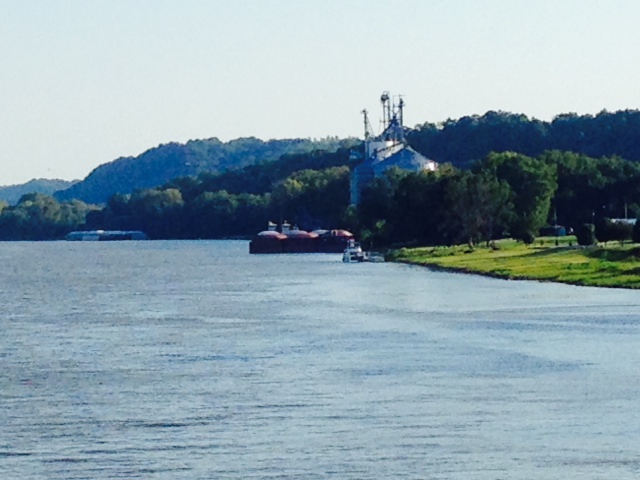
The Mississippi continued to flex her muscles and let us know who was boss the entire 218 miles of our time with her. In fact, another danger surfaced in addition to the debris, the strong currents, the turbulence, and the ubiquitous tows – we encountered a half dozen or so buoys that were pulled under the surface by the high water and the fast currents.  At one point, we were approaching a red buoy, looked away, then a moment later, it was completely gone. At first we couldn’t understand what had happened, then suddenly it popped back up in front of us.  Others were completely under water, the only evidence being extreme turbulence on the surface of the water, somewhat like the turbulence that a barely-submerged rock makes in the rapids of a swift-moving creek. Making matters more dangerous, the locations of floating buoys on the Mississippi are NOT marked on the charts because they need to be moved so frequently to mark the shifting channel, so there is no way to know where one might be other than extreme vigilance looking for signs of them underwater.  Further, many have been moved randomly out of position by the floodwaters. One of these, obviously, will ruin your whole day if you hit it, since they can tear the propeller out or punch a whole in the hull.

Some images from the Mississippi:

Hard to tell from the picture how fast the current is running, but this is the type of large steel buoy that were pulled completely under water by the high water and strong current, just waiting to punch a whole in someone's hull

Hard to tell from the picture how fast the current is running, but this is the type of large steel buoys that were pulled completely under water by the high water and strong current, just waiting to punch a whole in someone’s hull

Some of the debris from the river that has been pushed ashore - this shows the size of some of the stuff that we' dodged every day while on The Big Muddy

Some of the debris from the river that has been pushed ashore – this shows the size and magnitude of some of the stuff that we dodged every day while on The Big Muddy
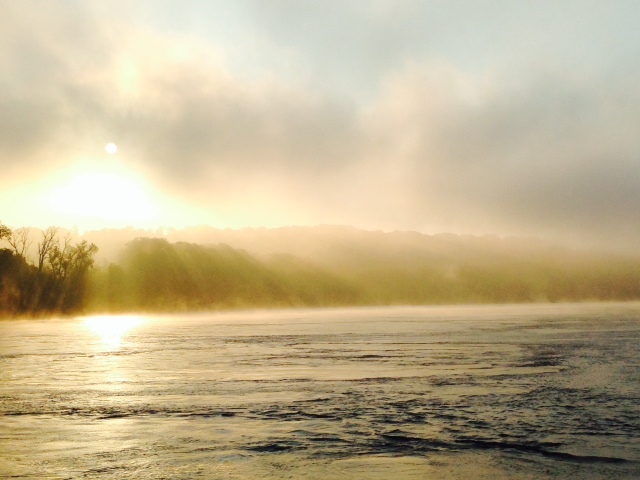
An added challenge one morning when we left at first light was morning fog on the river - we had to navigate by radar until the sun burned off the fog. It was that much more difficult to see the debris in time to avoid it, so poked along at a very slow speed

An added challenge one morning when we left at first light was morning fog on the Mississippi – we had to navigate by radar until the sun burned off the fog. It was that much more difficult to see the debris in time to avoid it, so we poked along at a very slow speed

A day after we passed a town called Chester, a tugboat sank at that location at about 1:00 in the afternoon. We spoke to one of our fellow loopers who passed through shortly after the boat sank. He monitored the radio as helicopters hovered overhead and as the Coast Guard discussed whether or not to close the river to traffic. He slipped past, and a short time later they closed the river to boat traffic since they could not locate the sunken tugboat in the muddy, fast-flowing water. A light oil slick from the tug’s 3500 gallon fuel tank then accompanied him the rest of the way down the Mississippi.

So our four-day run down Old Muddy was difficult and downright scary at times. Many boats that did the same 218 mile run damaged their propellers or worse during this stretch. One got a large branch wedged in his prop and had to limp along on one engine until he reached an anchorage off the river where he could dive below and remove the branch. Everyone’s opinion of the Mississippi River run was the same – the most difficult segment of the trip and glad to get off the river.  That being said, it’s important to note that the conditions were far from normal and were caused by very unusual flood conditions far upstream. I don’t know what the Mississippi would be like under normal conditions – obviously much more benign than we encountered, but likely still a challenge due to the volume of water from its huge drainage basin.

Contrast the experience running down the river with our overnight stays along the river. We spent our second night tied to the wall of a lock on the Kaskaskia river, about 100 yards from where it empties into the Mississippi. It was a quite, calm, secure place to stay, and was a welcome respite from the chaos of the Mississippi such a short distance away. Here are a few images:
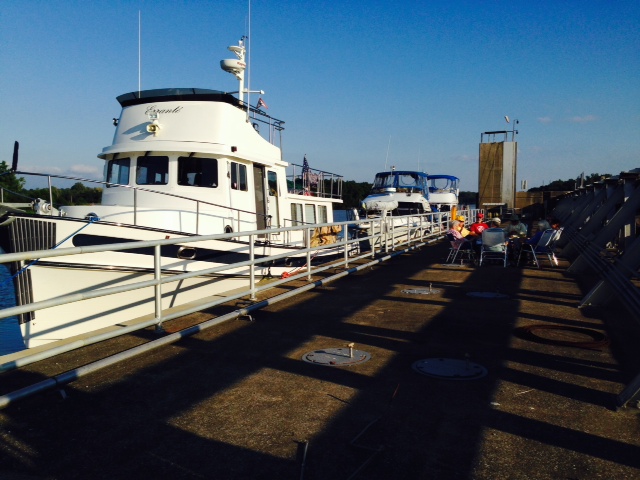
Tied to the lock wall on the Kaskaskia River, about 100 yards in from the Mississippi - three other boats were tied up with us

Tied to the lock wall on the Kaskaskia River, about 100 yards in from the Mississippi – three other boats were tied up with us
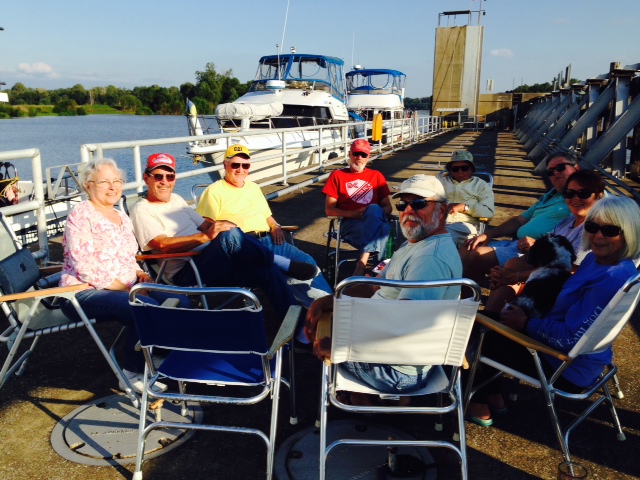
Out came the chairs, some snacks, and some spirits for an impromptu happy hour dock party with our new acquaintances from the other boats tied to the wall

Out came the chairs, some snacks, and some spirits for an impromptu happy hour dock party with our new acquaintances from the other boats tied to the wall. Interesting stories, as one guy was a former airline pilot and another was a helicopter pilot. The guy on a boat we met earlier along the trip was an F-4 Phantom fighter pilot in the Viet Nam war

Our third night on the Mississippi was spent anchored a short way up the mouth of a creek called Little Diversion Creek. It was a beautiful evening with warm temperatures and virtually no wind. Here are some images:

The Joint Adventure anchored in Little Diversion Creek. The Mississippi is in the background, through the opening in the trees

The Joint Adventure anchored in Little Diversion Creek. The Mississippi is in the background, through the opening in the trees

Two other boats entering Little Diversion Creek to anchor for the night as well

Two other boats entering Little Diversion Creek to anchor for the night as well

Tom and my Dad in the dinghy in Little Diversion Creek - we went exploring up the creek later in the afternoon

Tom and my Dad in the dinghy in Little Diversion Creek – we went exploring up the creek later in the afternoon

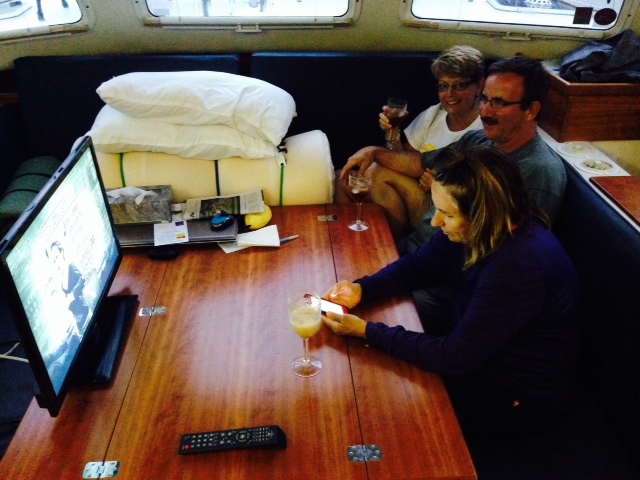
If we're not near a town, a restaurant, or other place to visit, we often watch a movie on board, either streamed from Netflix or one of the 50 or so DVD's we have on board. this evening, we played cards for a change of pace - I lost (as usual). Left to right, Paul, Hank (my Dad), and Tom

If we’re not near a town, a restaurant, or other place to visit, we often watch a movie on board, either streamed from Netflix if we have internet service or one of the 50 or so DVD’s we have on board. This evening, we played cards for a change of pace – I lost (as usual). Left to right, Paul, Hank (my Dad), and Tom

Another image of the Joint Adventure at anchor, taken from the dinghy.  Notice the tug pushing its barges in the background, heading up the Mississippi

Another image of the Joint Adventure at anchor, taken from the dinghy. Notice the tug pushing its barges in the background, heading up the Mississippi

Incidentally, these tows run 24/7. When we’re in a location along the river’s edge, such as tied to the barges at Hoppies as described in my last post, we’re sometimes startled by an enormously bright light illuminating the entire cabin.  It’s one of the two huge spotlights from a tow shining forward searching for buoys, the shoreline, and other landmarks as they navigate their way slowly up or down the river in the darkness.  It is surreal, and a sight to behold.

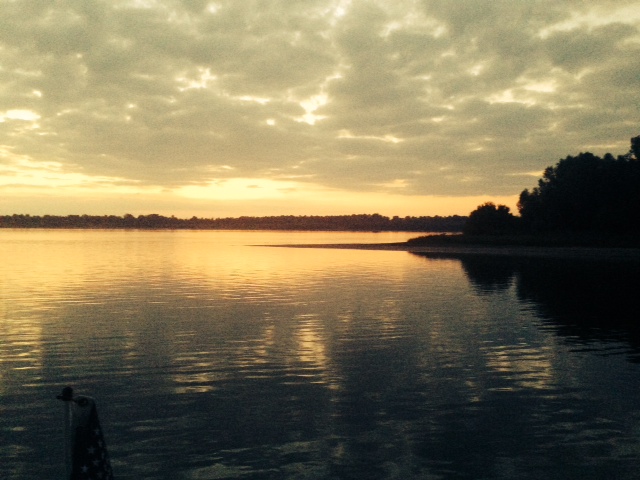
After we left Little Diversion Creek, we resumed our march south another 50 miles, where we finally completed our run down the Mississippi and turned eastward up the Ohio River. It was like a different planet. As soon as we turned the corner, the water was clear, there was no debris whatsoever, and the current was a comparatively calm 1-2 knots. We ran 60 miles up the Ohio to the mouth of the Cumberland River, where we anchored for the night in a small cove in Kentucky:
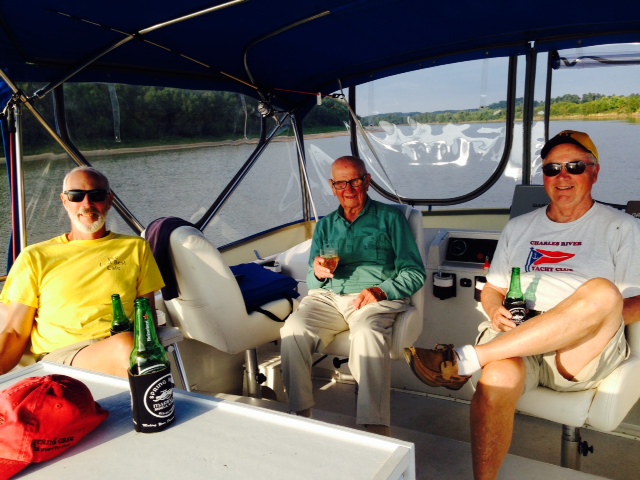
Happy hour on the bridge after the anchor was set, celebrating our completion of the Mississippi River run
Happy hour on the bridge after the anchor was set, celebrating our completion of the Mississippi River run

Sunset over the Ohio River - from our anchorage, looking west over the Ohio

Sunset over the Ohio River – from our anchorage in Kentucky, looking west over the Ohio

On Friday we left the Ohio and headed up the Cumberland River, our fourth inland river on our march toward the Gulf. When we reached the town of Grand Rivers, Kentucky, we finally re-joined civilization after our 250 mile, 5-day run with no shore-based services. We decided to stay a couple of days – the town is on Barkley Lake, a vacation/resort area formed by a monstrous dam on the Cumberland. We are definitely in Kentucky:
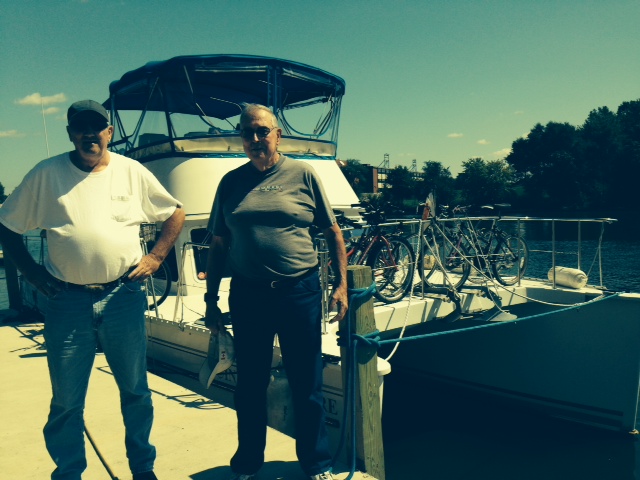
Tom & my Dad, pretending to fit in with the Good Ole Boys, who rode in on their motorcycles.

Tom & my Dad, pretending to fit in with the Good Ole Boys, who rode in on their motorcycles.

Yes, we are definitely in Kentucky -

Yes, we are definitely in Kentucky –

We rented a golf cart to get around – they can be operated on the public roads within a limited area, so we could get back and forth between the marina/resort and town:

The local news reported four escapees from the local nursing home on the loose and attempting a get-away....

The local news reported four escapees from the local nursing home on the loose and attempting a get-away….

Not sure how they found us - our cart blended in perfectly with other vehicles parked at the local ice cream parlor...we never thought they'd look for us there.

Not sure how they found us – our cart blended in perfectly with other vehicles parked at the local ice cream parlor…we never thought they’d look for us there.

On Saturday night, we bought tickets to a performance at the local Performing Arts Theater of a folk/county group from Nashville consisting of three sisters, called Carter’s Chord:

Two of the three sisters in Carter's Chord - the other was seated behind the piano, so isn't in the picture. The performance was excellent!

Two of the three sisters in Carter’s Chord – the other was seated behind the piano, so isn’t in the picture. The performance was excellent!

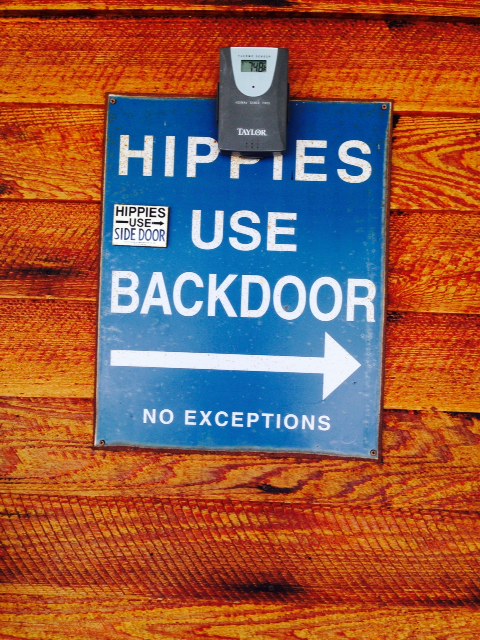
I never could quite figure out what to ask for - too bad I didn't see this sign years ago...

I never could quite figure out what to ask for – too bad I didn’t see this sign years ago…

So what’s this about “One Whistle”?  In the early days of river navigation, there were, of course, no radios.  So a set of conventions developed in which the captains of ships approaching or trying to pass one another could communicate their intentions to each other audibly using the whistles on their ships.  One whistle meant “I will pass you on my port side”, and two whistles meant “I will pass you on my starboard side”. The other vessel would respond in appropriate fashion to confirm the understanding. Old habits die hard.  When radios came into common use, the captains at that time were used to whistles – so instead of actually using their whistle, the captain would tell the other captain over the radio the number of whistles he would have sounded to convey his intention – thus, instead of saying “I’ll pass you on my starboard side”, he would simply say over the radio “One whistle”. The convention continues today – so when we are approaching or asking for instructions to pass a tow, the captain of the tow will say simply “One whistle” or more typically the convention has become “I’ll see you on one whistle” or simply “I’ll see you on the one”. The captain expects you to know what that means – and you’d better know!


Standard

THE BIG MUDDY

Post #29: THE BIG MUDDY – Day 135 , September 15, 2014:  On board:  Paul, Tom, Hank (my Dad), Jim K

Wow!  What a river!  The Illinois River was awe-inspiring, but it did not prepare us for this monster of a river – at least not for the Mississippi when she is flexing her muscles. As you undoubtedly have seen on the news, the Midwest has been pounded with enormous rainfalls. Kansas City reportedly received 9″ of rain in a short period of time, and many other areas have had similar monsoons. We experienced two massive, lengthy thunderstorms ourselves.  As a result, the Mississippi is today (Monday) cresting at a height of 26.5, just 3 1/2 feet shy of flood stage – it’s normal height is about 11 feet. The consequences are threefold: (1) the current is very fast – now running about 5-6 knots with a lot of turbulence, particularly in places where the river curves sharply (2) anchorages are unusually deep, requiring much more anchor line to be deployed and therefore requiring much more area to swing, and (3) most significantly, huge amounts of debris are being washed down the river – from small branches to entire trees, and including, so far, a stop sign and a huge truck tire & wheel. The debris is so thick at times that avoiding it is like driving a bumper car. The river also fully deserves its nickname The Big Muddy – the water is thick and brown, with zero visibility. Some pictures of the angry river:

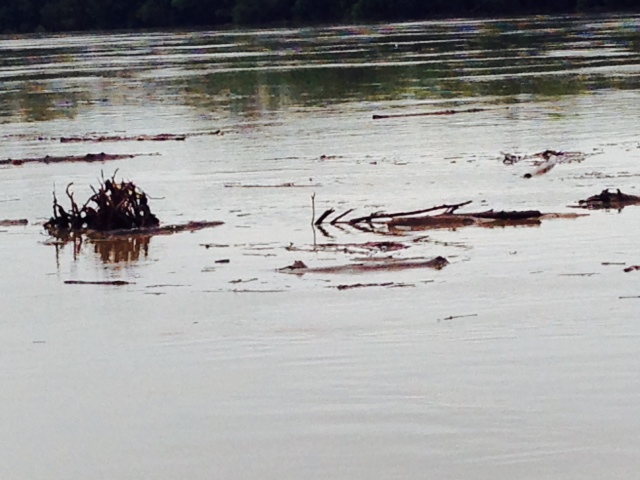
Debris flowing down the Big Muddy after being washed into the rising waters

Debris flowing down the Big Muddy after being washed into the rising waters

More debris in the river, picturs can't capture the enormous amount of debris flowing down the river, nor the enormous size of some of the trees and logs -

More debris in the river; pictures can’t capture the enormous amount of debris flowing down the river, nor the enormous size of some of the trees and logs –

Debris that has collected in the lock near St. Louis - we toured the Mississippi River Museum at the lock and took this picture from the top of the lock

Debris that has collected in the lock near St. Louis – we toured the Mississippi River Museum at the lock while in Alton and took this picture from the top of the lock


The Mississippi is the third largest watershed in the world, behind only the Nile in Africa and the Yangtze in Asia.  Forty percent of the land area of the U.S is drained through the Mississippi watershed. Because of its length and its reach, taming it to provide a navigable waterway and to control flooding has been a constant work in process for over two centuries. As a result, 77 million tons of goods valued at over $17 billion are shipped on the waterway each year. When shipping by truck, one gallon of fuel can move 1 ton of freight 59 miles; shipping by Mississippi barge, that same ton using that same gallon of fuel will move 514 miles.

However, the river is very different today than it was 200 years ago as a result of the Corp of Engineer’s attempts to tame it. And like most major projects, many of the efforts were controversial and involved significant politicking, and many caused unintended results. In particular, the Corp’s flood control efforts have, at times, increased flooding – dikes were built to protect adjacent lands.  The dikes confined the river within a narrow area, preventing it from spreading out. That caused the river to rise even higher, causing more damage when it overtopped the dike. So the dikes were built higher, which confined the river even more. And so on.

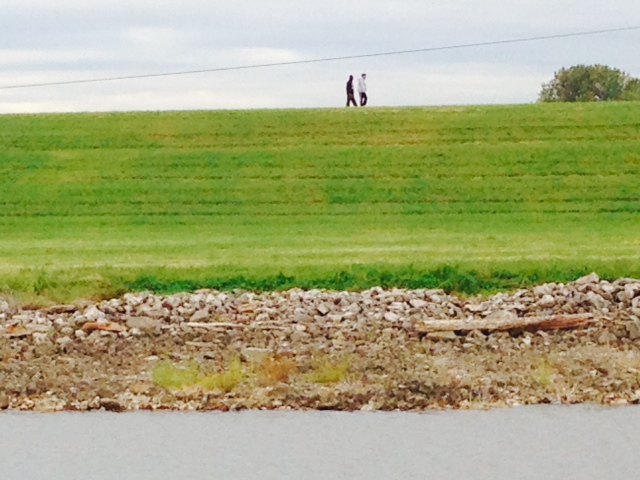
Here is a picture of the dike near St. Louis:

In order to control flooding, the Army Corp of Engineers has constructed massive levies along both banks of the Mississippi. The people walking on top of the levee provide some scale as to the height of the levees. One negative aspect of the levees is that it completely cuts off the river visually from the surrounding landscape, whether you're on the land looking towards the river or you're on the river looking towards the land

In order to control flooding, the Army Corp of Engineers has constructed massive dikes along both banks of the Mississippi. The people walking on top of the dike provide some scale as to the height of the dikes. One negative aspect of the dikes is that they completely cut off the river visually from the surrounding landscape, whether you’re on the land looking towards the river or you’re on the river looking towards the land

In recent years, efforts have been focused more on adding flood plain space for the river to spread out rather than trying to contain it.

Although there have been scores of floods along the Big Muddy, two stand out. The Great Flood of 1927 swept across an area roughly equal in size to Massachusetts, Connecticut, New Hampshire, and Vermont combined – imagine that entire area under water!  Immense human drama and political debates resulted – in order to save New Orleans, a huge breach in the dike would need to be opened with explosives – wiping out entire villages, thousands of homes, farmlands, etc.  Who, if anyone, has the legal authority to order or approve such an action?  Who is liable for the resulting damage?  Who pays for what?  What are the moral issues – saving a city of mostly wealthy people by destroying the homes and livelihood of mostly poorer, rural folks?  There is a superb book that not only describes what happened but also the moral and legal debate and the political implications of what was done – “Rising Tide: The Great Mississippi Flood of 1927 and How It Changed America” by John Barry. As explained in the book, the aftermath propelled Herbert Hoover into the White House. It is fascinating and reads like a story – I highly recommend it.
The second flood was the Great Flood of 1993, at which time the Mississippi rose to the highest elevation ever recorded. The flood caused $15 billion in damage, but the Corp claimed that their flood-control measures prevented an additional $17 billion in damage from occurring. Others claimed that the river would not have risen to new record highs if the Corp hadn’t so constrained the river with enormous dikes.

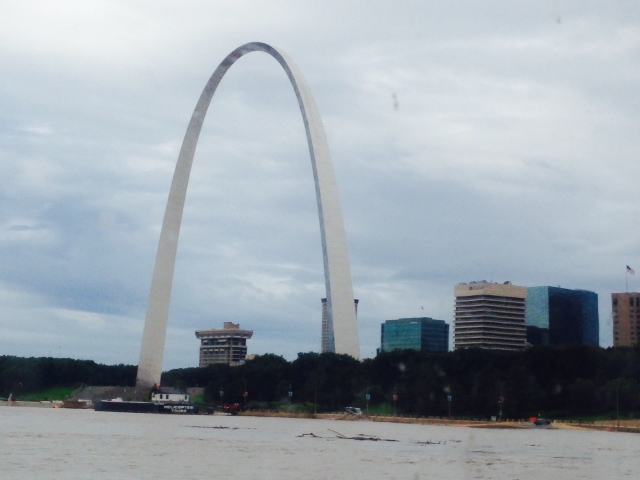
Back to our trip.  There appears to be somewhere in the vicinity of 50 – 75 boats on the Inland Rivers doing the Great Loop. Like us, most first learned of the high waters when they first arrived on the Mississippi last week. Progress came to a halt, as everyone was advised not to continue on the river past the confluence of the Missouri River (just north of St. Louis) until the water started to recede. So we stopped in Alton, Illinois from last Wednesday till today (Monday), rented a car, and started to explore. The highlight, of course, was St. Louis and the famous arch.  Here are some pictures:

The Gateway Arch, completed in 1965, is 63 stories tall - taller than the John Hancock building in Boston. The museum at the base of the arch is terrific, with a movie about the Louis & Clark expedition, which embarked from St. Louis, and another about the construction of the arch. Each side was built separately, and leaned inward due to its own weight.  In order to join the two sides, they had to use hydraulic jacks to push them apart by four feet!

The Gateway Arch, completed in 1965, is 63 stories tall – taller than the John Hancock building in Boston. When you are next to it, the scale is enormous! The museum at the base of the arch is terrific, with a movie about the Louis & Clark expedition, which embarked from St. Louis in 1804, and another about the construction of the arch. Each side was built separately, and leaned inward due to its own weight. In order to join the two sides, they had to use hydraulic jacks to push them apart by four feet!

The gleaming stainless steel skin creates different images from different angles

The gleaming stainless steel skin creates different images from different angles

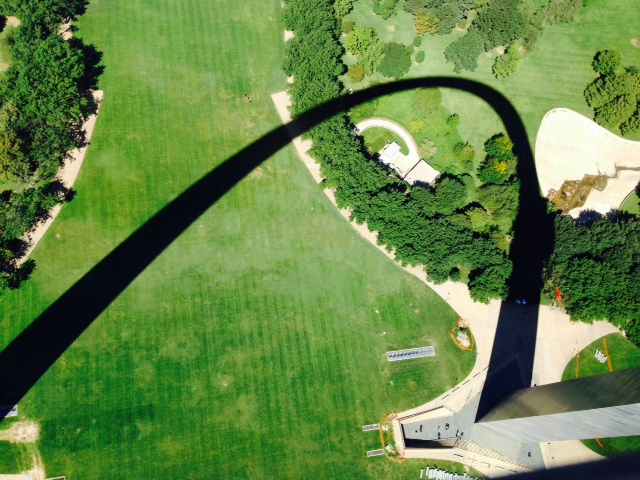
Looking down from the top of the arch, the shadow makes a sculpture of its own on the ground

Looking down from the top of the arch, the shadow makes a sculpture of its own on the ground


The Big Muddy as seen from the top of the Gateway Arch

The Big Muddy as seen from the top of the Gateway Arch, looking south

I couldn't resist another picture of the river from the top of the arch, looking in north

I couldn’t resist another picture of the river from the top of the arch, looking in north

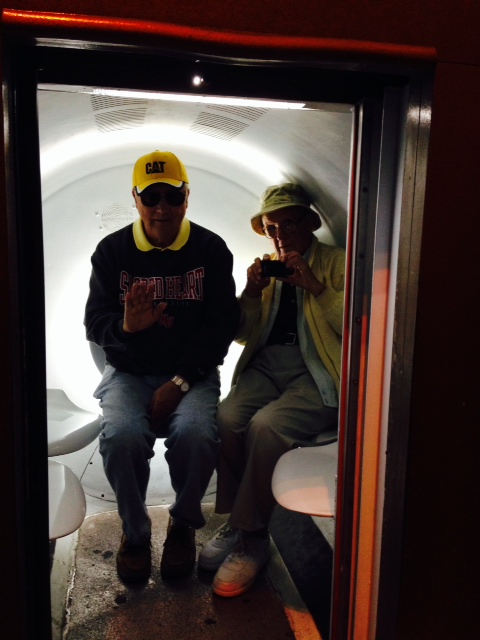
A capsule which is on a track takes you to the top of the arch - Tom and my Dad are in the capsule, ready for blast-off

A capsule which is on a track takes you to the top of the arch – Tom and my Dad are in the capsule, ready for blast-off

While in Alton, we went to a restaurant called “Fast Eddies”. At first, it was not my Dad’s kind of place – loud music, crowds of people, production food.  However, before long, he decided maybe we should hang around for awhile after all:

Good to know he's still got the touch...

Good to know he’s still got the touch…

Moving south from St. Louis, we’re now entering a stretch of about 250 miles with no marinas and no services – the last marina, about 20 miles south of St. Louis, is called Hoppies, and is run by Hoppie and his wife Fern. It was started in 1934 by Hoppie’s father, and is rustic and basic – it consists of 4 rusting, steel barges chained to the shore. Hoppies provides the last fuel, pump-out, and water for 250 miles, so virtually every boat heading south stops there. More importantly, they are experts regarding the river, its temperament, the best places to anchor going south in different conditions, etc.  So every boater going south sits with Fern and gets a lesson on how to navigate the next 250 miles.  Since we had time while waiting for the waters to recede a bit, we drove down in our rented car to get our lesson from Fern:

Fern in her ever-present golf cart that she uses to get around as she tends to everyone's needs at Hoppies

Fern in her ever-present golf cart that she uses to get around as she tends to everyone’s needs at Hoppies


Tom & I getting schooled by Fern about the river going south

Tom & I getting schooled by Fern about the river going south

The next decision – when do we continue south? There were many factors to consider – When will the river crest?  When will the amount of debris in the river diminish?  How difficult is the current and the turbulence?  With limited room in the limited anchorages for the next 250 miles, how to avoid a huge slug of boats all waiting to resume their voyage south at the same time?  Having to anchor for 3-4 nights in a row, what is the weather window during this period?  After weighing all these and other factors (and oscillating back and forth several times), we decided to go today (Monday). The downside is that the river is today cresting – thus the current is at its maximum, debris is at or near its maximum, and rain is predicted today. The upside is that heading downriver in subsequent days, the river will be receding, we will be ahead of the crowds at the anchorages, and it appears that a very favorable weather window through Saturday or Sunday is starting tomorrow. So we left this early this morning for Hoppies, arriving by early afternoon. We managed to avoid hitting anything, although entering the first lock was an adventure – the entrance was mostly blocked by debris and there was a strong current swirling at the mouth.  As a result, we nearly entered the canal going backwards – not your classic entry. But we got in without damaging our props in the debris, and we made it to Hoppies without a major incident. Here are some pictures:

The Joint Adventure tied to the dock (barge) at Hoppies

The Joint Adventure tied to the dock (barge) at Hoppies

Debris passing by the barge at Hoppies

Debris passing by the barge at Hoppies


Dad and Tom cooking dinner on board - pan-fried fish, rice, and broccoli - what a feast!

Dad and Tom cooking dinner on board – pan-fried fish, rice, and broccoli – what a feast! My turn to cook is next – YIKES!

The house next to Hoppies - another opportunity for Doug to renovate - this one comes with a car to refurbish - note the two extra engines for the car

The house next to Hoppies – another opportunity for Doug to renovate – this one comes with a car to refurbish – note the two extra engines for the car

So tomorrow (Tuesday) we continue south. The next 5 days or so constitute the most challenging part of our trip to date – another 160 miles south on the rain-swollen Mississippi, 60 miles up the Ohio River, then 30 miles up the Cumberland River before we return to civilization. Tuesday night, we will tie to a lock wall where we’re not permitted to leave the boat. The next three nights following that are at anchorages. We came for adventure, and we’re getting it!

Standard

YOU BOYS LOST?

Post # 28:  YOU BOYS LOST?  Day 132, September 12, 2014.  On board: Tom, Paul, Hank (my Dad), and Jim K

So we stopped at a very local diner in a very small, very rural, very Illinois town. In typical Midwest fashion, the waitress was friendly and to-the-point. When she asked where we were from, we replied “Boston”. Not understanding why anyone from Boston would ever find themselves in this very small, very rural, very Illinois town, her immediate reaction revealed the only explanation she could imagine:  “You boys lost?”  Well, we weren’t lost, thanks to the linear flow of the river, but it speaks volumes about the remoteness of some of the terrain on the Illinois River through which we have been passing.   Scenic, much of it pristine with herons, eagles, and other wildlife, and much of it very rural. We are constantly reminded of civilization, however, with the periodic encounters with barges and tows plying the river, and the occasional presence along the way of small villages on the waterfront or old industrial plants, most of which were shuttered and abandoned long ago. All in all, floating down the river is a treat. Here are some images since my last post:

We left early (around 6:30) because we decided to make a long run (100 miles) due to a weather system coming in the following day. Because of the chilly temperature, we ran into thick fog on the river a few miles downriver. It got so dense at times that we could see only one bank of the river and that one faded in and out of the fog - we had to navigate by radar until the sun rose and started to dissipate the fog

We left early (around 6:30 AM) because we decided to make a long run (100 miles) due to a weather system coming in the following day. Because of the chilly temperature, we ran into thick fog on the river a few miles downriver. It got so dense at times that we could see only one bank of the river and that one faded in and out of the fog – we had to navigate by radar until the sun rose and started to dissipate the fog

My Dad, concentrating on his chores as Navigator, with Tom in the background. This was taken early in the morning, so as you can see by the hat and gloves, it was chilly - actually, a welcome relief after a stretch of very hot weather most of the time since we reached Chicago

My Dad, concentrating on his chores as Navigator, with Tom in the background. This was taken early in the morning, so as you can see by the hat and gloves, it was chilly – actually, a welcome relief after a stretch of very hot weather most of the time since we reached Chicago

We came upon this tow that was perpendicular to the river, completely blocking passage.  Apparently he was having difficulty because his barges were grounding in the mud. When we contacted him by radio, his first instructions to us were "Stay away!". A short while later, another tow came upriver, so he had to unhook the tug from the barges and clear a path.  After the other tow went through, he let us pass as well.  The tows rule the river!

We came upon this tow that was perpendicular to the river, completely blocking passage. Apparently he was having difficulty because his barges were grounding in the mud. When we contacted him by radio, his first instructions to us were “Stay away!”. A short while later, another tow came upriver, so he had to unhook the tug from the barges and clear a path. After the other tow went through, he let us pass as well. The tows rule the river!

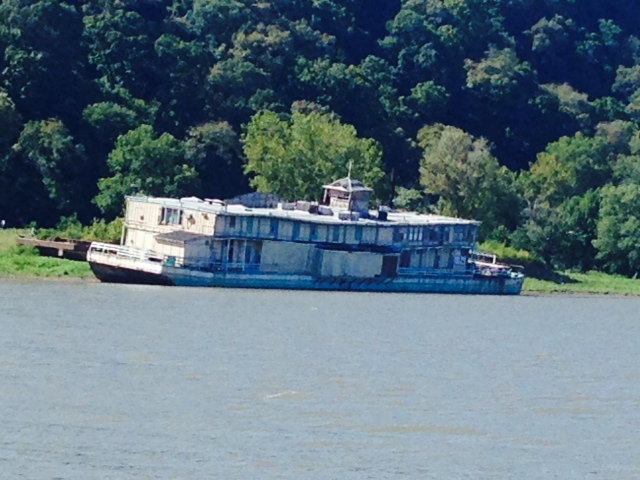
An old derelict replica paddlewheeler beached along the river.  Janet, this is Doug's next project - he told me you wouldn't mind moving in while he renovated it

An old derelict replica paddlewheeler beached along the river. Janet, this is Doug’s next project – he told me you wouldn’t mind moving in while he renovated it

Our first stop after Peoria was the Tall Timbers Marina in the town of Havana, Ill. Although the town was somewhat run-down and obviously experiencing difficult times, the people were friendly and resilient. A weekend-long Octoberfest was underway, in which the whole town seemed to be taking part. We went to a local tavern for lunch and watched the Patriots play a dismal second half and lose to the Dolphins. However, the small marina was a treat – nestled in a small dug-out basin surrounded by trees, the entire marina was built on floats – the docks, the marina office, the small restaurant (which unfortunately was closed), the screened-in lounge, etc – all floated.  The owner told us:  “When the river goes up, we all go up. When the river goes down, we all go down”:

The Joint Adventure tied to the dock next to the floating buildings. Four other "loopers" were at the marina with us as well, some to the left of us in the picture

The Joint Adventure tied to the dock next to the floating buildings. Four other “loopers” were at the marina with us as well, some to the left of us in the picture

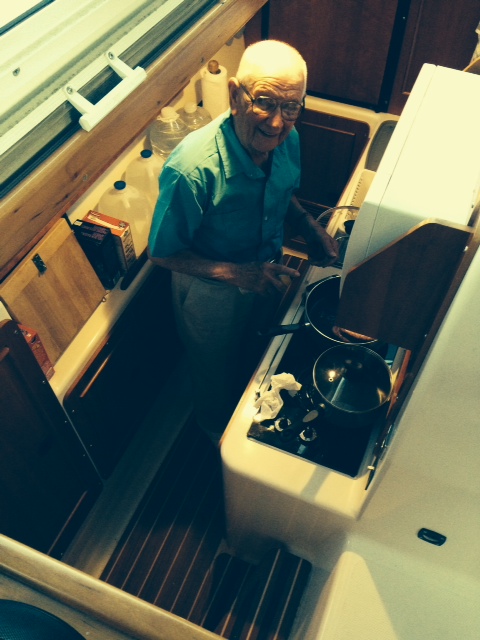
That evening, my Dad cooked dinner - we figured it was the first time he had ever cooked a complete dinner for four - a major milestone!

That evening, my Dad cooked dinner – we figured it was the first time he had ever cooked a complete dinner for four – a major milestone!

The next day, we did a 100 mile run due to forecasts of thunderstorms coming in the next day, and we wanted a secure and pleasant place to wait them out. We crossed a MAJOR milestone:

While not obvious in the picture, this bridge represents a major milestone on our journey - it is the western-most point on the Great Loop route - from here on, we gradually drift eastward as we continue south.  YYAAAYY!!

While not obvious in the picture, this bridge represents a major milestone on our journey – it is the western-most point on the Great Loop route – from here on, we gradually drift eastward as we continue south. YYAAAYY!!

Our next stop was in in the town of Hardin at a restaurant along the river with a dock where we could tie up for the night – places to tie up are becoming more and more scarce. Not everyplace we dock is beautiful – this was nothing more that a rusty steel dock with a precarious ramp, but it was a secure place to stay for the night along with quite good food in the adjacent restaurant. The town was small and very depressed.

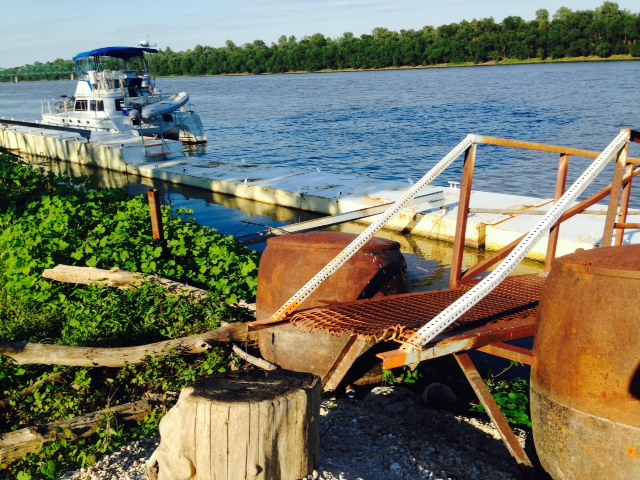
The Joint Adventure tied to the old steel dock. Notice the end of the ramp at the bottom of the picture - the stump is the stepping-stone to get off the ramp

The Joint Adventure tied to the old steel dock. Notice the end of the ramp at the bottom of the picture – the stump is the stepping-stone to get off the ramp

Taken from a bridge across the Illinois River, the Joint Adventure is tied to the dock in Hardin. Notice the barges tied to the shore just beyond the boat, and the industrial plant on shore near the barges

Taken from a bridge across the Illinois River, the Joint Adventure is tied to the dock in Hardin. Notice the barges tied to the shore just beyond the boat, and the industrial plant on shore near the barges

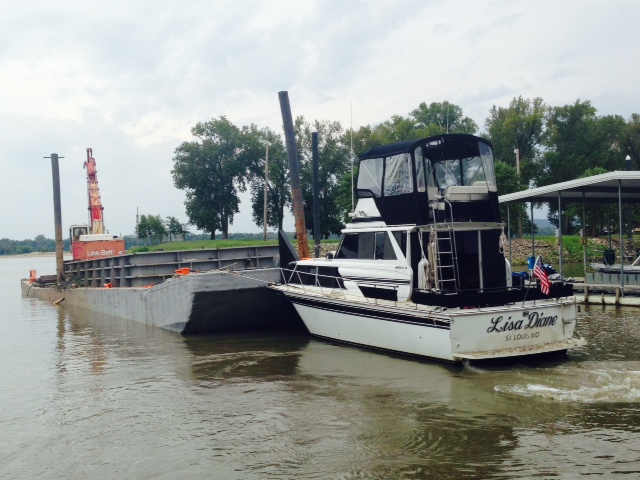
On Tuesday, another MAJOR milestone – we completed our run down the Illinois River, and merged onto our second Inland River on our journey south – the MISSISSIPPI!!  We stopped in Grafton, Missouri at the confluence of the Illinois and Mississippi Rivers – Missouri is our eighth state, in addition to two Canadian provinces.  The marina in Grafton, which had a novel approach for a work tug:

We've seen a wide variety of barges and tugboats along the way, but this was a novel combination of a working tug/barge - the marina in Grafton was using it to dredge their basin

We’ve seen a wide variety of barges and tugboats along the way, but this was a novel combination of a working tug/barge – the marina in Grafton was using it to dredge their basin

The current in the Mississippi is noticeably swifter than on the Illinois, and the river is wider. There is also more debris floating down the river, mostly sticks, small logs, and small branches. There was a massive thunderstorm Tuesday night, and we planned to stay in Grafton for another day due to more thunderstorms forecast for Wednesday. After monsoon rains in the morning, the weather cleared a bit. However, a more important issue arose – as you may have read, there have been huge rainstorms throughout the Midwest – Kansas City reportedly received 9″ of rain. Though many of these rainstorms are hundreds of miles away, the water all drains into the Missouri/Mississippi watershed, affecting the water levels and currents all the way to the Gulf. We’re in the process of trying to assess the impact on us. In the meantime, we decided to make a mad dash from Grafton, Missouri to Alton, Illinois (other side of the river, about 20 miles downstream) before the next wave of thunderstorms hit to be closer to St. Louis and be at a marina with better facilities. An hour after we arrived, a massive thunderstorm hit, with high winds, more monsoon rains, and lightning. However, we were safely tied up with our docklines doubled, sitting on the bridge having a beer.

We’re now in the process of determining the affect of the water levels on the next leg of our journey.


Standard

WE’RE NOT IN KANSAS ANYMORE

POST # 27 – WE’RE NOT IN KANSAS ANYMORE – Day 127, September 7, 2014.  On board:  Paul, Tom, Hank (my Dad), and Jim K

Remember Dorothy’s famous line when she first steps out of her house that has just landed unceremoniously in the Land of OZ – “Toto – I’ve got a feeling we’re not in Kansas anymore”?  That’s what it feels like having gone, in one day, from the first part of our trip – pristine lakes, scenic rivers, crystal clear water, resort-type communities, Chicago – to the first inland river, where, on the first day, the landscape was dominated by industry, and commercial tows are king while recreational boats are an afterthought. It was a fascinating but long and challenging first day – we cast off our lines at 7:30 AM but didn’t arrive at our destination 13 miles south of Joliet until it was almost dark, at a quarter to eight.

We first went through the harbor and into the lock that separates Lake Michigan from the Chicago River. Our two new crew members hard at work:

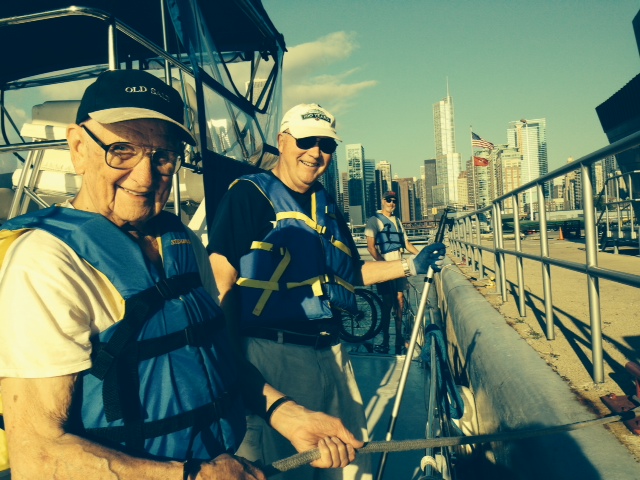
Manning the lines entering the Chicago River: left to right, my Dad (Hank), who turns 90 next month, and Tom, co-owner of the Joint Adventure. Paul is in the background, manning the bow line

Manning the lines entering the Chicago River: left to right, my Dad (Hank), who turns 90 next month, and Tom, co-owner of the Joint Adventure. Paul is in the background, manning the bow line

I posted pictures through the City in my last update, so I won’t repeat them here. The run through the City is truly remarkable. After passing through the City, one enters the Chicago Sanitary & Ship Canal (described in my last post), and the landscape turns quite industrial:

One of many industrial operations along the Sanitary & Ship Canal heading south out of Chicago

One of many industrial operations along the Sanitary & Ship Canal heading south out of Chicago

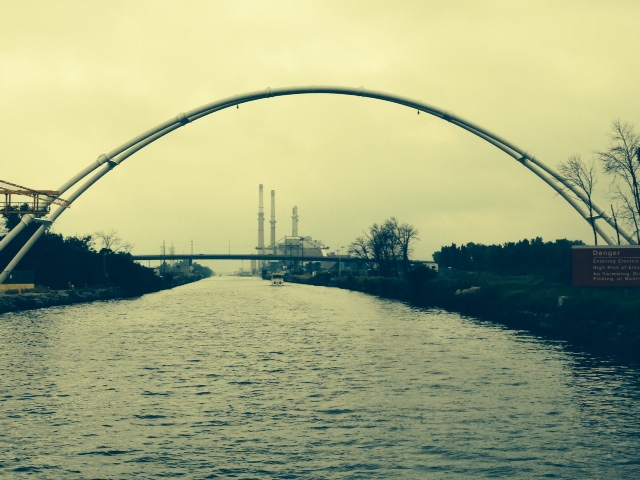
This is actually a pipeline crossing the Canal. A novel method;  I don't know why they didn't run the pipe under the canal

This is actually a pipeline crossing the Canal. A novel method; I don’t know why they didn’t run the pipe under the canal

Remember the discussion in a previous post about the Asian carp and other invasive species that people are trying desperately to keep from reaching Lake Michigan? The guidebook that we use has the following warning at a location about halfway down the Canal:  “A permanent electrical barrier designed to prevent and slow the spread of invasive fish species through the Chicago Sanitary and Ship Canal into Lake Michigan is operational 24 hours a day.  All vessels are prohibited from lingering or mooring in the area. Do not enter or put your hands or feet in the water under any circumstances.”  YIKES!. Sure enough, when we got there, we saw this sign:

We decided to stay on the boat....

We decided to stay on the boat….

The first “tow” that we encountered was a tug pushing a single barge. What’s the big deal?

Our first "tow" - a tug pushing a single barge.

Our first “tow” – a tug pushing a single barge.

So why did it take us over 12 hours to go 55 miles?  After we completed the transit of the Canal, we entered the Illinois River – the first of the Inland Rivers that will take us to the Gulf of Mexico. We quickly learned that when traveling the inland rivers, the dominant obstacles (so far, anyway) are the “tows” and the locks. Incidentally, they are called “tows”, but they are actually a bunch of barges chained together and pushed by a single tugboat from the rear. They range from one barge to a group of up to 42 barges, measuring in length over three football fields!! Forget the rules of navigation – these guys have the right-of-way by default.  Anyway, the second obstacle are the locks, the chambers of which are huge – two football fields long – and take up to a half hour to fill or to empty. However, despite the size of the chambers, the tows are still too long to fit in all at once, so they have to break them into two or three groups and lock each group one at a time. Therefore, it can take hours to get a tow through a lock – and, of course, the tows always have priority over us lowly recreational vessels. So we arrived at our first lock to find that the first half of a tow was being raised in the lock, and were told that we could go down when they emptied the lock in order to get the second half of the tow. Seemed reasonable. However, they parked the barges right in front of the entrance to the lock, leaving a narrow, winding path for us to enter the lock:

The barges that just exited the lock were parked immediately in front of the entrance to the lock. We had to pass between the concrete pier and the LaSalle, just a few feet wider than the Joint Adventure, then make a 90 degree turn to the right, then two more ninety degree turns in the narrow passage around the corner of the barge

The barges that just exited the lock were parked immediately in front of the entrance to the lock. We had to pass between the concrete pier and the LaSalle, just a few feet wider than the Joint Adventure, then make a 90 degree turn to the right, then two more ninety degree turns in the narrow passage around the corner of the barge

Another boat followed us through the maze into the lock - he scrapped the wall as he tried to pass through between the wall and the corner of the barge, on his port (left) side. Despite our wide beam, we were more fortunate and slipped through unscathed

Another boat followed us through the maze into the lock – he scrapped the wall as he tried to pass through between the wall and the corner of the barge, on his starboard (right) side. Despite our wide beam, we were more fortunate and barely fit through unscathed

A large tow heading down the Illinois River - this is just one quarter of the size of the larger tows we have yet to meet

A large tow heading down the Illinois River – this is just one quarter of the size of the larger tows we have yet to meet

The tug that is pushing the "tow" shown in the previous picture - basically it is  one enormous engine surrounded by a hull

The tug that is pushing the “tow” shown in the previous picture – basically it is one enormous engine surrounded by a hull

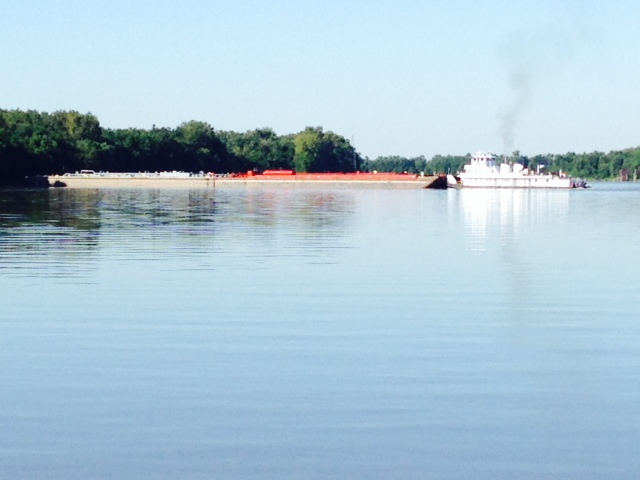
A tow that we just passed, taken from the stern of the Joint Adventure

A tow that we just passed, taken from the stern of the Joint Adventure


This is a tow that is three barges wide, just emerging from a lock. The barge at the center is empty, and therefore riding high in the water, while the barges on either side are full and riding low

This is a tow that is three barges wide, just emerging from a lock. The barge at the center is empty, and therefore riding high in the water, while the barges on either side are full and riding low

After transiting the first lock, we passed through the city of Joliet. There were half a dozen or so drawbridges across the river, and by radioing ahead, each bridge magically opened as we approached it, not even slowing down:

One of the drawbridges opening for us as we approached - the boat in the picture was traveling with us as well

One of the drawbridges opening for us as we approached – the boat in the picture was traveling with us as well

Major floods happen frequently on the inland rivers, including the Illinois River - newer houses are therefore built on stilts, similar to coastal homes in flood-prone areas of New England and elasewhere

Major floods happen frequently on the inland rivers, including the Illinois River – newer houses are therefore built on stilts, similar to coastal homes in flood-prone areas of New England and elasewhere

Despite the difficulty entering the first lock, we were fortunate in that the entire locking process took about an hour. Not so at our second lock. They were locking through some barges carrying chemicals of some sort so they would not allow anyone else in the lock with the barges. We waited 4 hours to get into the lock, then it took another hour to lock us through, along with the tug. While we waited, we first tied to a barge that was tied to shore awaiting lockage, until it was his turn to go:

Tied to a barge awaiting our turn...

Tied to a barge awaiting our turn…

We then tied to a wall next to a local bar (some of the crew felt obligated to patronize the place in return for their hospitality. Not saying who, but…):

Caught on film...

They even look guilty…

It was 30 minutes until sunset when we finally got through the lock, with about an hour to go to our destination –  just enough time to get in at dusk – we did NOT want to travel on the river in the dark, as the buoys are not lighted and it is impossible to see debris floating in the river, which can potentially punch a hole in the hull or damage a propeller. Halfway there, the high temperature alarm sounded – the port engine was overheating.  We had passed through a lot of seaweed and other debris over the course of the day, and the cooling system likely had become partially clogged. Rather than try to clean it while underway and end up running in the dark, we shut down the engine and ran mostly on one engine the rest of the way, arriving just as darkness was descending  – a dramatic ending to a long, exciting, challenging first day on the Inland Rivers.

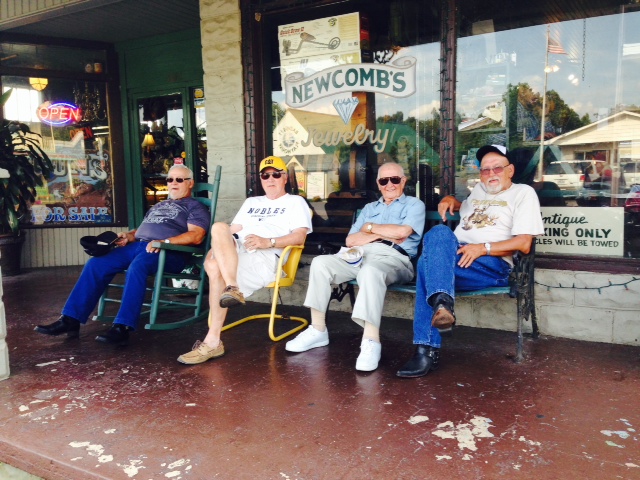
On Tuesday night, we stayed at Harborside Marina, about a mile from the small village of Seneca, Ill. The Marina loaned us their van, so we went to town for dinner, then went into town again to the local “greasy spoon” diner in the morning for breakfast. While we were there, four old retired guys came in and sat near us – classic rural Midwest, it could have been from a Norman Rockwell painting:

Tom (on the left) fits right in rather well...

Tom (on the left) fits right in rather well…

They were amazed to hear that we drove a boat to Seneca from Boston. We told them we planned to go through the next lock, then stay at the town dock in Ottawa 15 miles downstream. We arrived in the early afternoon and tied up – 15 minutes later, two of the four old guys showed up at the boat – “We didn’t have a lot on our schedule today, so we decided to watch you go through the lock. You were already through when we got there, so we drove down here.” So we gave them a tour, they drove us to the store, and we again enjoyed the “local color”:

Bob & Dana were full of stories of growing up along the river in rural Illinois

Bob & Dana were full of stories of growing up along the river in rural Illinois

A few more pictures from our stay in Ottawa:

The Joint Adventure at the free municipal dock in Ottawa - a short walk along the riverfront park brings you to Main Street

The Joint Adventure at the free municipal dock in Ottawa – a short walk along the riverfront park brings you to Main Street

The Illinois River, taken from the bridge in Ottawa

The Illinois River, taken from the bridge in Ottawa

Now here is a motto I can live by...

Now here is a motto I can live by…

I know tourists wanting an "authentic souvenier" can be gullible, but....how many of these do you think they actually sell???

I know tourists wanting an “authentic souvenier” can be gullible, but….how many of these do you think they actually sell???

An incredible mural on the side of a long building in downtown Ottawa

An incredible mural on the side of a long building in downtown Ottawa

Henry & Henry - my Dad Henry and fellow looper Henry from the boat Dee Dee, which Henry, whom we meet periodically at various stops along the way -

Henry & Henry – my Dad Henry and fellow looper Henry from the boat Dee Dee,  whom we meet periodically at various stops along the way –

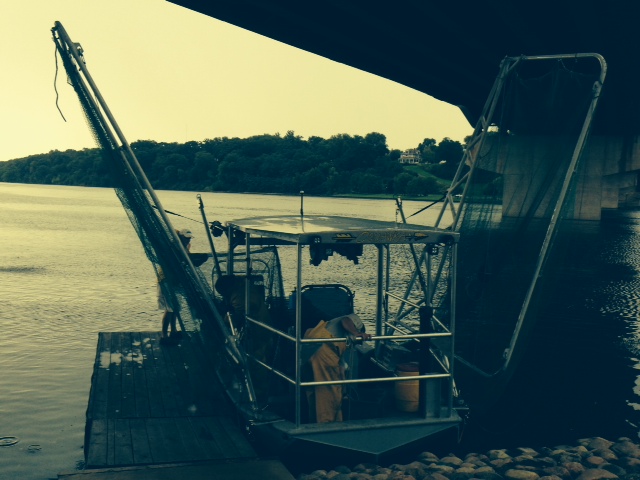
Back to the Asian Carp – in Ottawa, while enjoying the scenery, we were treated to the sight of several large (1-2 feet) Asian Carp literally jumping out of the water straight up three or four feet – I saw half a dozen and Paul saw 50-75 jump up all at once. Later, while waiting out a lightning storm, we happened upon a specially-built boat and crew from the US Fish & Wildlife Agency who were “fishing” for the Carp on an experimental basis.  They explained that the Carp jump when something startles or agitates them, and often when one jumps, it causes others to jump as well – hence a whole school of them jumping at the same time. The Asian Carp are now beginning to be fished commercially, the catch being sold to China where the Carp are eaten or used for fertilizer. Some fisherman literally drive around at high speeds, sometimes in circles, with nets sticking out in front of their boat, looking for schools of the carp. The boat agitates the fish, causing them to jump, hopefully into the nets. Others use gill nets to trap the fish.  The Fish & Wildlife guys had a specially built boat (picture below) with an electrical generator.  When they find a school of fish, they send an electrical shock into the water, which causes them to jump – they try to catch the fish in the nets as they jump. At times, they have caught up to 300-400 fish in minutes. The purpose of all this is two-old: (1) to thin the population of the carp in the northern section of the Illinois to reduce the chances that they get through the electric fish barrier, and (2) to try to develop an efficient method of catching the carp to create an ecconomical commercial fishery for the carp. Incidentally, they said that the fish is quite good to eat, but that the American public can’t get by the name “carp”. He suggested we look in local restaurants for “Mississippi silver fish” or other fancy names we haven’t heard of – it will likely be Asian Carp.

The custom-built experimental Asian Carp "fishing boat". The "wings" are the nets in an upright position - they are lowered on each side when the boat is underway

The custom-built experimental Asian Carp “fishing boat”. The “wings” are the nets in an upright position – they are lowered on each side when the boat is underway

I actually have a video that one of our fellow loopers took of the experimental boat shocking the Carp and causing them to jump.  I was unable to figure out how to add the video into the blog, however, so I’ll try to send it out separately.

Our next stop was Henry’s Marina, built next to an old abandoned lock.  A couple of pictures:

The "dockage" at Henry's Marina entailed simply tying to the rock wall of the old abandoned lock, built nearly 100 years ago, used for two years, then abandoned

The “dockage” at Henry’s Marina entailed simply tying to the rock wall of the old abandoned lock, built nearly 100 years ago, used for two years, then abandoned

Five "looper" boats all pulled into Henry's around the same time in the afternoon, so there was an impromptu "Happy Hour Dock Party" on the rocks of the old lock next to the boats

Five “looper” boats all pulled into Henry’s around the same time in the afternoon, so there was an impromptu “Happy Hour Dock Party” on the rocks of the old lock next to the boats

The next night, we stayed at the Peoria City docks, immediately adjacent to downtown. The city is perhaps twice the size of Springfield, Ma. and is clean, attractive, and has a vibrant waterfront:

The Joint Adventure tied to the city docks in downtown Peoria, Ill.

The Joint Adventure tied to the city docks in downtown Peoria, Ill.

It is the world headquarters of the Caterpillar Company, a worldwide supplier of construction equipment and diesel engines. A picture from our tour of the Caterpillar Museum:

This is a full-sized replica of the largest truck manufactured in the world, made by Caterpillar. The tires are 14 feet in diameter and it has to be shipped in pieces and assembled on site - it takes 6 rail cars to deliver all the pieces. Fully loaded, the combined weight of the vehicle and load is over 1 million pounds

This is a full-sized replica of the largest truck manufactured in the world, made by Caterpillar. The tires are 14 feet in diameter and it has to be shipped in pieces and assembled on site – it takes 6 rail cars to deliver all the pieces. Fully loaded, the combined weight of the vehicle and load is over 1 million pounds

We also went to the new Waterfront Museum which opened just a year ago, and focuses on the rich history of the Illinois River and of Peoria itself. Prior to Prohibition, the economy Peoria was centered on the production of whiskey, which was the city’s primary export.

Saturday evening, the waterfront was alive with no fewer than three free music concerts at various locations along the river. The last one that I visited was by a group called Too White Crew, which had a troupe of 12 male and female singers and dancers:

I happened to snap a picture of the female dancers...

I happened to snap a picture of the female dancers…

Peoria is about halfway down the Illinois River – halfway by water between Chicago and St. Louis. The lower half is more rural with fewer facilities as we continue south, so the next week or two will be quite interesting as we continue our journey south.


Standard

READY TO HEAD SOUTH!

Post #26 – READY TO HEAD SOUTH! – Day 117, August 28, 2014

One of my objectives on the Great Loop voyage is to learn to cook – being on a boat for a year and needing to eat several times each day seemed like ample incentive to do so. Thus far I have cooked the following meals ALL BY MYSELF:  (1) Baked beans in the microwave (2) pancakes (twice!) (3) vegetable sandwiches (OK, technically not cooking, but previously I was limited to peanut butter & jelly) (4) a fried egg sandwich (for dinner) (5) a tuna melt in the microwave (not a great idea…) (6) spaghetti (it didn’t seem like it would be enough for two of us so I ended up dumping in the whole box – we ate spaghetti for the next three weeks).   So it seems I need to pick up the pace a bit if I’m going to accomplish my goal of learning to cook.  Anyone have any suggestions on how I might branch out and what I might try to cook to reach the next level?

So this seems a good time for a few statistics of the trip, since we’ve reached a major milestone. So far, we’ve traveled 2,188 miles from Boston to Chicago. We’ve transited 115 locks, ranging from lifts of a foot or two to nearly 7 stories in one lift. We’ve used 641 gallons of diesel fuel for an average of 3.41 miles per gallon (not bad for a boat this size, since much of it was at cruising speed). In a few days, we will hit the 4 month mark from our departure from Boston on May 2.  We’ve had a total of 31 different people on board to share parts of the trip so far, several of whom have been on twice  – that has been the best part!

A bit more about the Chicago River. There is now a dead zone in the Gulf of Mexico covering as much as 8,000 square miles in which almost nothing can live – the water is depleted of oxygen as a result of pollution from the Mississippi River. In 2010, several environmental groups sued the City of Chicago for polluting the Gulf of Mexico, 1500 miles away.  How can that be?  In fact, the US Geological Survey identified Chicago as a “primary source” of the pollution, though not the only contributor. It all started with the reversing of the flow of the Chicago River and the connecting of the Great Lakes and Mississippi watersheds in 1900 as I as described in my last update – this was accomplished by constructing the Sanitary and Ship Canal at that time. It is so named because it accomplishes two purposes: it provides a waterway for ships to pass from one waterway system to the other, and it provides a convenient depository for waste disposal for the City of Chicago. The southern end of Lake Michigan does not have much flow, and Chicago gets its drinking water from the lake – so being able to send its waste south for 1500 miles ultimately reaching the Gulf of Mexico- out of sight, out of mind – was a major enticement for the City of Chicago to want this canal built. The City has made significant improvements in wastewater treatment over the years, but the possibility of losing the path south and diverting its wastewater into Lake Michigan has given pause to many. Meanwhile, the lawsuit against the City for polluting the Gulf continues.

In any case, our path to the Illinois River and south from there will be through the Chicago River and the Chicago Sanitary and Ship Canal.  We won’t go swimming, but it is plenty clean enough today for boating.

In the meantime, Chicago is a wonderful place to spend some time. Paul and I went to a Chicago Cubs game last Friday at Wrigley Field. The Cubs beat the Orioles (sorry, Jerry, but who can root against the Cubs, who haven’t won a World Series in over 100 years?).  A few pictures:

Wrigley Field - a great place to watch a ballgame, very reminiscent of Fenway Park

Wrigley Field – 100 years old this year, and a great place to watch a ballgame – very reminiscent of Fenway Park

Two unique features of Wrigley Field are the ivy-covered outfield wall and the bleachers erected on top of houses across from the park.  My understanding is that the Cubs threatened to sue to adjacent building owners or build wall to block the view unless the building owners shared the revenue with the Cubs. I'm told a revenue-sharing settlement was reached, but now the Cubs are talking about erecting a huge scoreboard that will indeed block the views from some buildings. Why can't they focus on winning a World Series?

Two unique features of Wrigley Field are the ivy-covered outfield wall and the bleachers erected on top of houses across from the park. My understanding is that the Cubs threatened to sue to adjacent building owners or build a wall to block the view unless the building owners shared the revenue with the Cubs. I’m told a revenue-sharing settlement was reached, but now the Cubs are talking about erecting a huge scoreboard that will indeed block the views from some buildings. Maybe they would be better off to just focus on winning a World Series.

My son Danny and his friend Leah drove from Ann Arbor to visit on Saturday & Sunday. His buddies Joey and Lauren were participating in a “Big Ten Pub Crawl” on Saturday, so off we went to meet them. Drinking a few beers and an Irish Car Bomb (a shot of Baileys Irish Cream dropped into a glass of Guinness, then chugged) reminded me that I’m somewhat more fragile than they are….

While walking around looking for a place that had real Chicago deep dish pizza, we came upon a series of statues built out of canned goods…

there are over 13,000 cans in this statue - don't these guys have a life?

there are over 13,000 cans in this statue – don’t these guys have a life?

That evening, we took the Joint Adventure out on the harbor for a swim and a moonlight cruise:

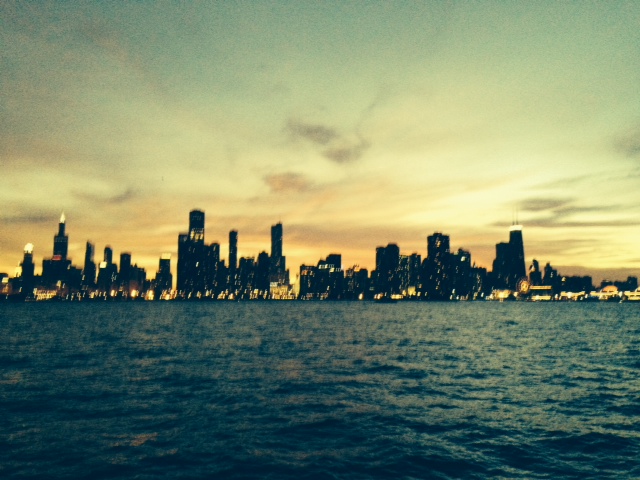
Chicago skyline from the Joint Adventure as the sun sets

Chicago skyline from the Joint Adventure as the sun sets

A glow over the City -

A glow over the City –

The skyline from the Joint Adventure as daylight disappeared

The skyline from the Joint Adventure as daylight disappeared

Sunday morning, Joey & Lauren joined us again, and we again went out into the harbor for a swim:

Danny, Leah, Joey, and Lauren enjoying the sights of the harbor on the "front porch" of the Joint Adventure

Danny, Leah, Joey, and Lauren enjoying the sights of the harbor on the “front porch” of the Joint Adventure

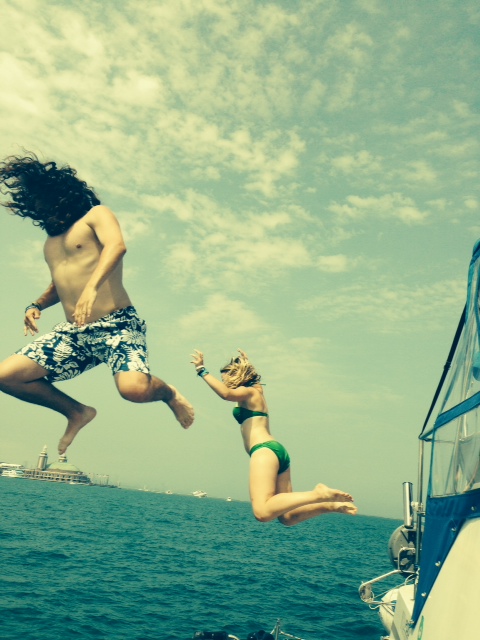
Danny & Leah practicing their dives for the Olympics - I think his head is somewhere under that hair....

Danny & Leah practicing their dives for the Olympics – I think his head is somewhere under that hair….

Another child left behind....

YIKES!

I got into the act, but not with the style of Danny & his friends -

I got into the act, but not with the style of Danny & his friends –

After our swim, we took the Joint Adventure through the lock from Lake Michigan and into the Chicago River. It was a hot and sunny Sunday afternoon, so the narrow river was jammed with boats. When there was a break in the action, I took a few pictures from the Joint Adventure:

This was actually taken from a bridge over the river - these enormously wide tour boats go up and down the river, sometimes taking up over half the width of the river, forcing all other traffic - other tour boats, small boats, cruisers, kayaks, and the like - to maneuver around them

This was actually taken from a bridge over the river – these enormously wide tour boats go up and down the river, sometimes taking up over half the width of the river, forcing all other traffic – other tour boats, small boats, cruisers, kayaks, and the like – to maneuver around them

The building dead ahead is the Chicago Trump tower

The building dead ahead is the Chicago Trump tower

The river is lined with skyscrapers right to the river's edge on both sides

The river is lined with skyscrapers right to the river’s edge on both sides

There are many more sights, museums, and things to do in Chicago that could be done in the time available, but here are some other sights in Chicago:

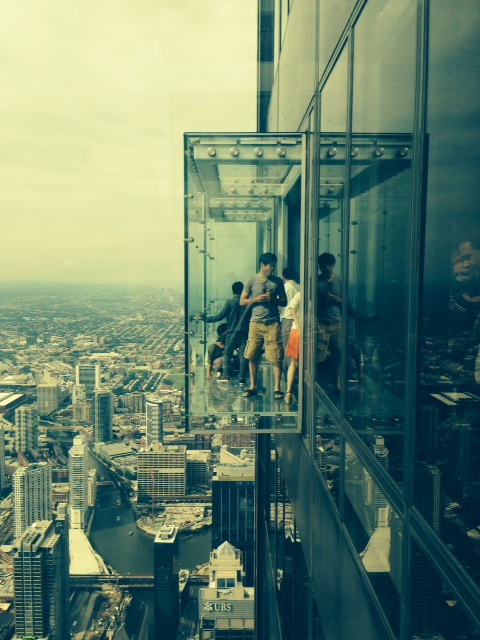
The Sears Tower (now actually the Willis Tower but still referred to as the Sears Tower) recently built two glass protrusions with glass floors that you walk out onto and look down to the ground over 100 stories below -

The Sears Tower (now actually the Willis Tower but still referred to as the Sears Tower) recently built two glass protrusions with glass floors that you walk out onto and look down to the ground over 100 stories below –

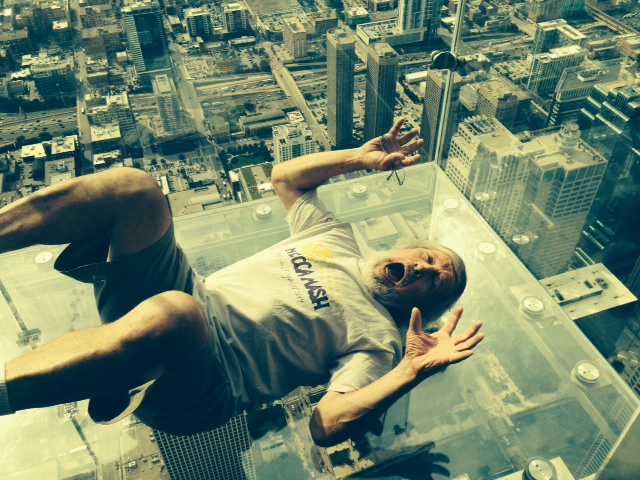
Standing on the glass floor looking down over 100 stories -

Standing on the glass floor looking down over 100 stories –

HELP _ I'M FALLINGGG!!!

HELP – I’M FALLINGGG!!!

View from the top of the Sears Tower, looking toward Lake Michigan and the harbor. The Joint Adventure is docked in the marina that you can see to the left of the boats that are at moorings

View from the top of the Sears Tower, looking toward Lake Michigan and the harbor. The Joint Adventure is docked in the marina of which you can see a small portion to the left of the boats that are at moorings

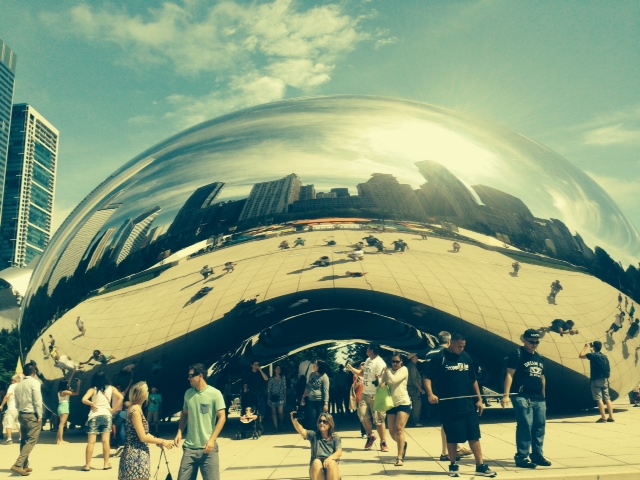
The famous Chicago "bean", built of reflective steel

The famous Chicago “bean”, built of reflective steel

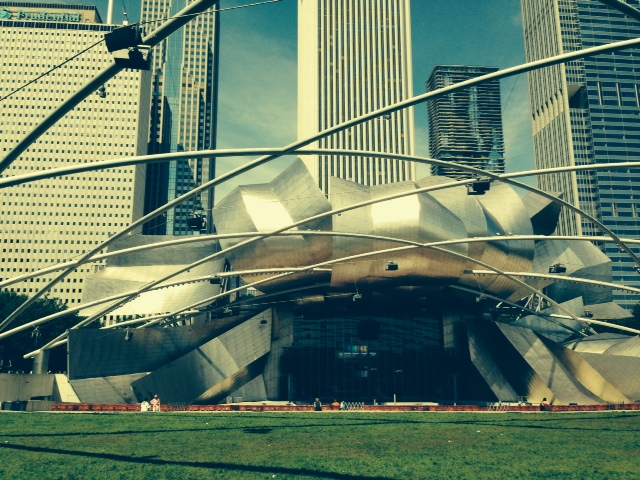
The concert pavilion - Chicago's version of the Boston's Hatch Shell

The concert pavilion – Chicago’s version of the Boston’s Hatch Shell

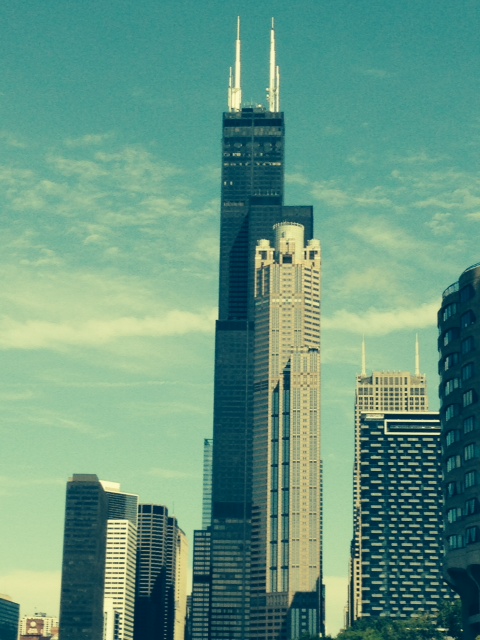
Chicago offers an "Architecture Tour" - a narrated boat tour that highlights and describes the architecture and history of many of the significant buildings in Chicago - this is the Sear Tower (now the Willis Tower) with another building in front of it

Chicago offers an “Architecture Tour” – a narrated boat tour that highlights and describes the architecture and history of many of the significant buildings in Chicago – this is the Sears Tower (now the Willis Tower) with another building in front of it

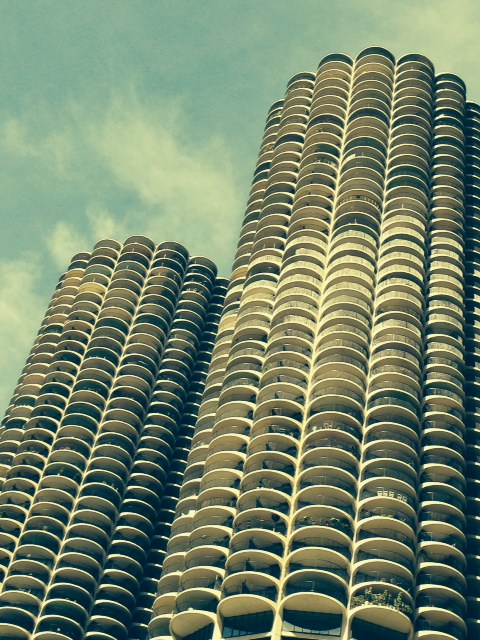
Sometimes referred to as the "corn cob building" - the lower levels are actually a parking garage in which the rear of the cars are visible when you're further away from the building.  Apparently one car did drive off and landed in the river - however, it was part of a movie shoot

Sometimes referred to as the “corn cob building” – the lower levels are actually a parking garage in which the rear of the cars are visible when you’re further away from the building. Apparently one car did drive off and landed in the river – however, it was part of a movie shoot

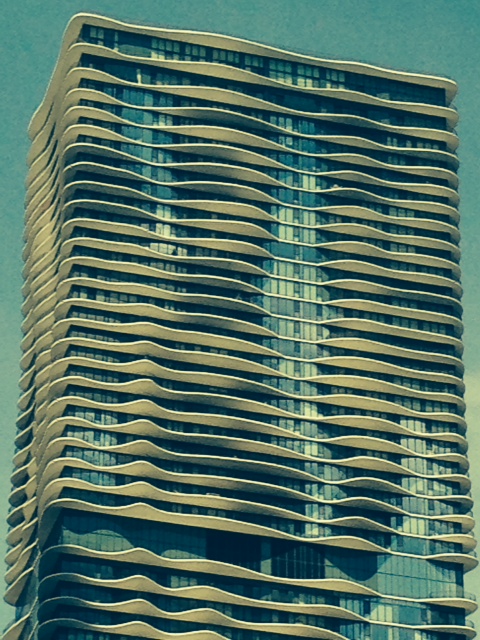
This is one of the most interesting buildings in Chicago - recently built, it is the tallest building in the world that was designed by a woman architect

This is one of the most interesting buildings in Chicago – recently built, it is the tallest building in the world that was designed by a woman architect

Tom and my Dad arrive tomorrow, and we plan to head south through the city and into the Illinois River this weekend, depending on when we get a weather window.  Think sun!

Standard

CHICAGO!!

Post #25: CHICAGO!! Day 112; August 23, 2014. On board: Paul, Jim K

“On a cold day in January 1900, a group of prominent Chicagoans gathered quietly at an earthen dam. The crowd, which started out as a few friends and trusted newspapermen, grew to about 100 as the men, trustees of the Chicago Sanitary and Ship Canal, broke through the ice and dirt separating the Mississippi and Great Lakes watersheds. They labored with dynamite, shovels, and a large dredge, keeping an eye out for the arrival of a threatened injunction from the Supreme Court. In the end, the water arrived before the litigation. They had reversed the flow of the Chicago River.”

Thus changed the course of geologic history. When the last of the glaciers retreated 10,000 years ago, the topography that they left behind had created two separate, enormous watersheds draining much of North America – the Great Lakes watershed, in which water from as far away as the Continental Divide would eventually find its way to the North Atlantic via the St. Lawrence River, and the Mississippi River Watershed, in which water from the vast midesection of America would eventually find its way to the Gulf of Mexico. By reversing the flow of the Chicago River, mankind had connected these two great watersheds which had been separate for 10,000 years. The feat was designated fifty years later by the American Society of Civil Engineers to be one of the seven modern wonders of the world. Freighters, barges, and recreational boaters could now enter the entire Great Lakes Watershed from New Orleans and vice versa – a connection which continues to move millions of tons of freight every year and is vital to the economy.  In fact, without this connection between the watersheds, the Great Loop voyage would be impossible.

However, the Law of Unintended Consequences has created a potential environmental disaster – the spread of invasive species from one watershed to the other. In 2002, an electrical barrier was constructed downstream from Chicago to stop an invasive fish, the round goby, from spreading from the Great Lakes into the Mississippi watershed. The electrical barrier was too late, however, as it was later discovered that the round goby had established itself in the Mississippi watershed three years earlier. Now a more serious threat faces the Great Lakes from the Mississippi – the Asian carp, which has been destroying aquatic ecosystems on the Mississippi for the past 10 years. The Army Corp of Engineers has undertaken a massive, years-long study (the “Great Lakes Mississippi River Interbasin Study”) to determine how to solve the problem. Potential permanent solutions range from cutting the link once and for all and thereby permanently restoring separate watersheds, to installing from one to five barriers, including a system to lift boats over the barriers. Lifting recreational boats is doable, as evidenced by the Big Chute Marine Railway on the Trent Severn Waterway, but the great challenge would be lifting large freighters and other commercial vessels. The cost has been estimated as high as $9.5 billion (we veterans of the Big Dig know how good these early estimates are….);   completion is unlikely before 2029 – by then, many people believe that temporary measures would be inadequate and the Asian Carp will have already made it into the Great Lakes with disastrous effects on boating, fishing, and recreation. Even if the waterways are separated or a barrier is constructed, there are other ways the Asian carp might get through – besides human activities, the Army Corp has identified 18 locations where floodwaters could allow carp to reach the lake. Several of those are identified as “medium risk”, meaning that an invasion is likely within 50 years.

In the meantime, we are grateful for the waterway connection or we wouldn’t now be in Chicago! Our final push started Monday morning with a short run to Grand Haven, Michigan, a medium-sized upscale tourist destination with many boutiques, galleries, gift shops, and restaurants. Like most of the cities and towns along the eastern shore of Michigan, Grand Haven was founded and grew from the fur trading and lumber harvesting businesses. However, Grand Haven had a distinct advantage – it is located at the mouth of the Grand River, at 260 miles the longest river in Michigan. Today it is navigable all the way to Grand Rapids, 40 miles upstream – the harbor therefore handles large commercial vessels heading upriver. In the 1800’s, Grand Haven became one of the largest manufacturers of furniture in the United States, being nicknamed “Furniture City.

In addition to the many shops, there are two interesting museums in town, and every evening during the summer, the town puts on a remarkable 20 minute fountain and light show on the opposite bank of the Grand River. Grand Haven is also home to a large Coast Guard station, and holds a town-wide celebration of its close relationship with the coast Guard every August.  Here are some pictures from Grand Haven:

The lighthouse marking the entrance to Grand Haven harbor

The lighthouse marking the entrance to Grand Haven harbor

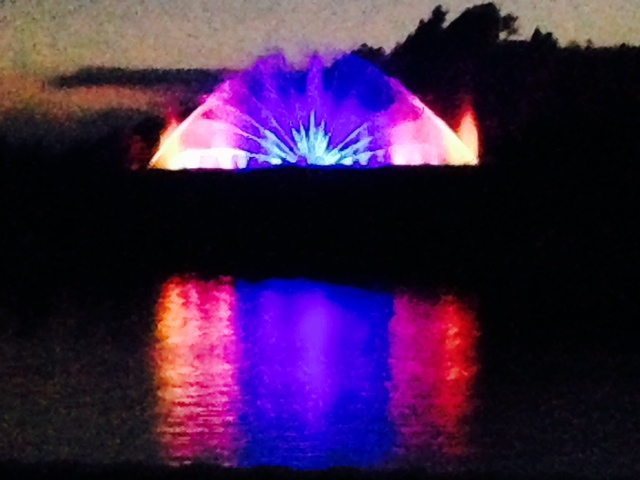
A view of the quite professional light & fountain show across the Grand River - we were docked at the Municipal Marina right next to downtown and across from the light show, which we could watch from the bridge of the boat. The show is so popular that the town erected a grandstand on the waterfront directly across from the show

A view of the very professional light & fountain show across the Grand River – we were docked at the Municipal Marina right next to downtown and across from the light show, which we could watch from the bridge of the boat. The show is so popular that the town erected a grandstand on the waterfront directly across from the show. The fountain is nearly a football field long and contains 1300 nozzles (many of which fluctuate creating motion), 1.5 miles of pipe, nearly 4 miles of electrical cable, and shoots water 15 stories into the air!

Another view of the show

Another view of the show

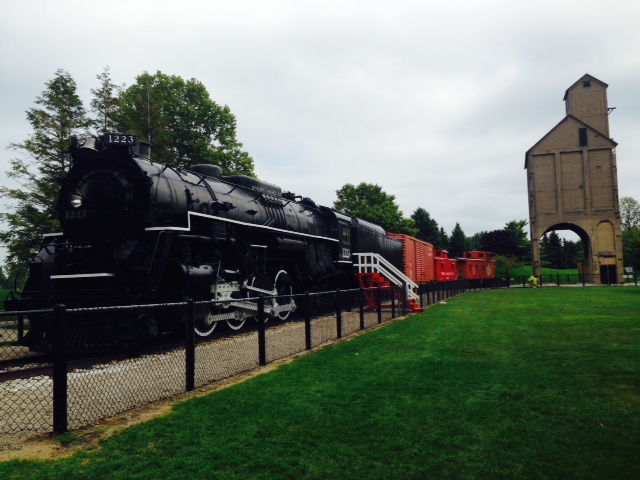
This coal-fired locomotive (with associated cars) is on display on the waterfront. It was built in 1941, then retired as obsolete just 10 years later. The building in the background is a coal elevator which was used to load coal onto the train

This coal-fired locomotive (with associated cars) is on display on the waterfront. It was built in 1941, then retired as obsolete just 10 years later. The building in the background is a coal elevator which was used to load coal onto the train

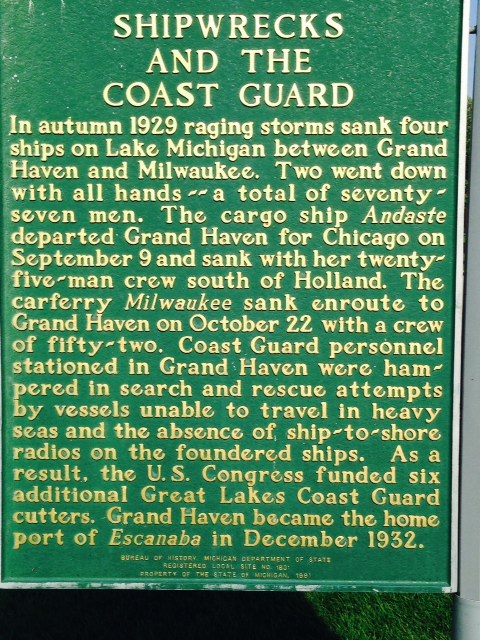
The Escanaba has a personal interest for Trish and her family - her uncle was stationed on the Escanaba in World War II and was lost at sea when she was sunk

The Escanaba has a personal interest for Trish and her family – her uncle was stationed on the Escanaba in World War II and was lost at sea when she was sunk. When boating in Boston Harbor, we frequently pass Escanaba III which is docked at the Boston Coast Guard Station downtown and think of her uncle

This historical marker shows how treacherous Lake Michigan and the Great Lakes can be in storms, especially in the fall and winter (which is one reason we'll be off by September 1). You may recall the song "The wreck of the Edmund Fitzgerald" by Gordon Lightfoot. The Edmund Fitzgerald hauled iron ore from the mines near Duluth, Minnesota to Detroit, Toledo, and other Great Lakes ports for 17 years - she set seasonal haul records 6 times, often breaking her own record. However, on November 9, 1975, carrying a full load of ore, she was caught on Lake Superior in a violent storm with hurricane-force winds and waves up to 35 feet. Shortly after 7:00 PM the next day, she suddenly sank without sending out a distress signal, leading many to believe she suffered sudden catastrophic structural damage.  All hands were lost and no bodies were ever recovered. The disaster lead to many safety requirements being implemented, including mandatory survival suits, depth finders, positioning systems, increased freeboard, and more frequent inspections

This historical marker shows how treacherous Lake Michigan and the Great Lakes can be in storms, especially in the fall and winter (which is one reason we’ll be off Lake Michigan by September 1). You may recall the song “The wreck of the Edmund Fitzgerald” by Gordon Lightfoot. The 729 foot Edmund Fitzgerald hauled iron ore from the mines near Duluth, Minnesota to Detroit, Toledo, and other Great Lakes ports for 17 years – she set seasonal haul records 6 times, often breaking her own record. However, on November 9, 1975, carrying a full load of ore, she was caught on Lake Superior in a violent storm with hurricane-force winds and waves up to 35 feet. Shortly after 7:00 PM the next day, she suddenly sank without sending out a distress signal, leading many to believe she suffered sudden catastrophic structural damage. All hands were lost and no bodies were ever recovered. The disaster lead to many safety requirements being implemented, including mandatory survival suits, depth finders, positioning systems, increased freeboard, and more frequent inspections

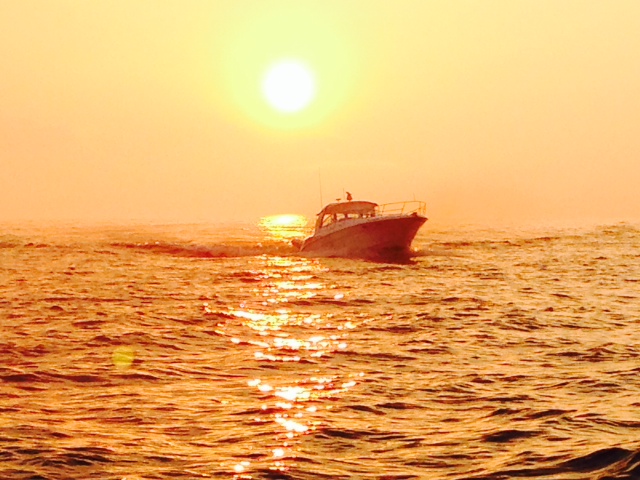
This is a boat coming into Grand Haven harbor at sunset

This is a boat coming into Grand Haven harbor at sunset

From Grand Haven, we ran about 35 miles to Saugatuck, another upscale resort-type village about a mile up the Kalamazoo River along the Michigan shore. It is an artsy community with many galleries and shops along several bustling streets crowded with pedestrians. The riverfront is gorgeous, with waterfront restaurants, dockages, and parks. The Saugatuck Center for the Arts is a performing arts theater, and we were lucky to learn that, due to a cancelation, there were two front row center seats available for the performance of “Beehive” that evening – a 60’s musical revue cast partly in New York. It was terrific – if you get a chance to see it somewhere, I highly recommend it!.

Here are a few pictures from Saugatuck:

A portion of the riverfront in Saugatuck

A portion of the riverfront in Saugatuck

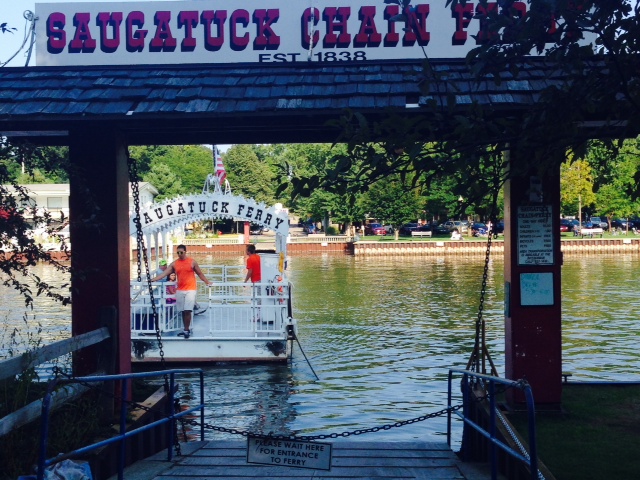
Saugutuck has a chain ferry that will take you across the river on demand - the ferry is literally connected to a chain that rests on the bottom and is attached to the ferry dock on each side. The operator (a college student) turns a crank on the ferry by hand, which pulls the ferry along the chain from one side to the other. It costs $1 - bikes are free!

Saugutuck has a chain ferry that will take you across the river on demand – the ferry is literally connected to a chain that rests on the bottom and is attached to the ferry dock on each side. The operator (a college student) turns a crank on the ferry by hand, which pulls the ferry along the chain from one side to the other. It costs $1 – bikes are free!

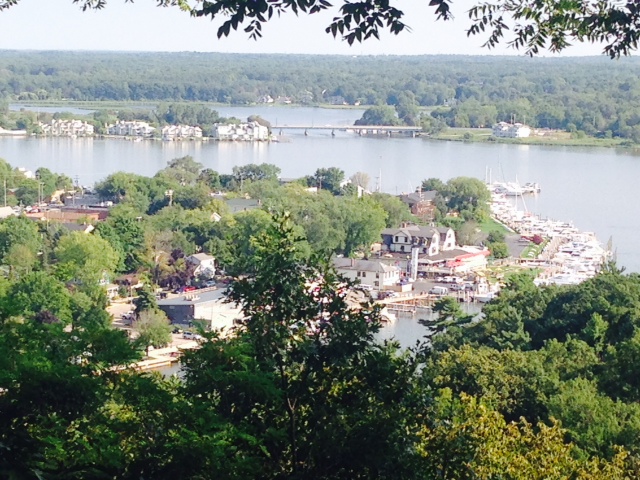
On the other side of the river, a 300-step climb up a set of stairs will get you to the top of Mt. Baldi, with an observation deck overlooking the village

On the other side of the river, a 300-step climb up a set of stairs will get you to the top of Mt. Baldi, with an observation deck overlooking the village. The Joint Adventure is among the boats docked along the riverfront on the right-hand side of the picture

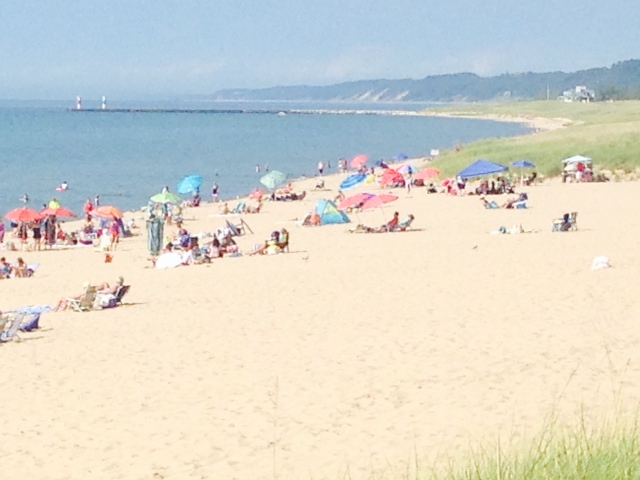
The beach at Saugatuck - typical of the beaches all along the shoreline of Michigan.  The water here was noticeably warmer than further north

The beach at Saugatuck – typical of the beaches all along the shoreline of Michigan. Notice the twin breakwaters marking the harbor entrance in the background. The water here was noticeably warmer than further north

We had two more days to get to Chicago by Friday – Paul had a flight to Tampa on Saturday morning to visit his Dad, and my son Danny, currently living in Ann Arbor, is coming to visit in Chicago over the weekend. Thunderstorms were predicted for both Thursday and Friday, so on Thursday morning we were up before daybreak analyzing various weather reports to determine our best and safest option. We therefore decided to leave at first light and head 95 miles directly across Lake Michigan to Chicago. It took us 7 hours, at one point being about 45 miles from the nearest landfall. The wind was 5-10 knots on our bow, and at one point we had to slow our speed for a ride which was more comfortable for us and the boat, though we were trying to arrive as early as possible to beat the predicted thunderstorms. Five minutes after we reached Chicago and tied up, it started to rain!

A few final thoughts about our time in Michigan. What a great place! The run along the Michigan shoreline, about 350 miles, far exceeded our expectations, with incredible scenery, enormous dunes, fabulous sand beaches at every stop, and beautiful, well-kept, interesting towns along the way, each with its own special history and character. For the most part, we had beautiful, warm weather, and one or more of us went swimming on average about 4-5 days out of each 7 that were in Michigan. I do have to say that the water was quite cold on the northern half, but moderated noticeably on the southern half. The people of Michigan are friendly, outgoing, and always willing to help. If someone is looking for an interesting place to vacation, whether by boat or on land, the Michigan shoreline would be a wonderful place to do so.

CHICAGO!  A MAJOR milestone on our Great Loop voyage. Here are some pictures as we approached Chicago:

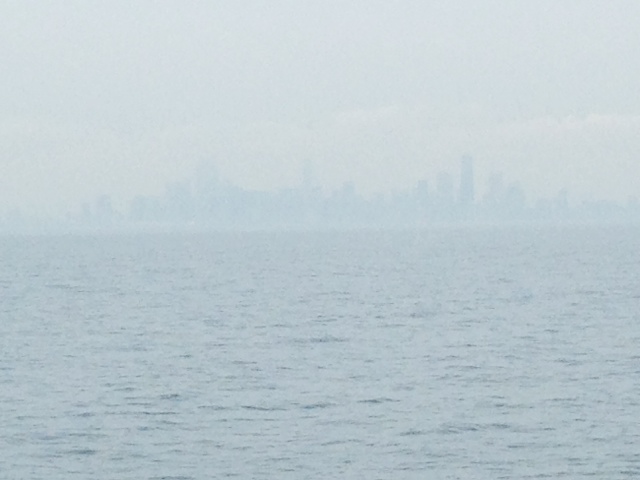
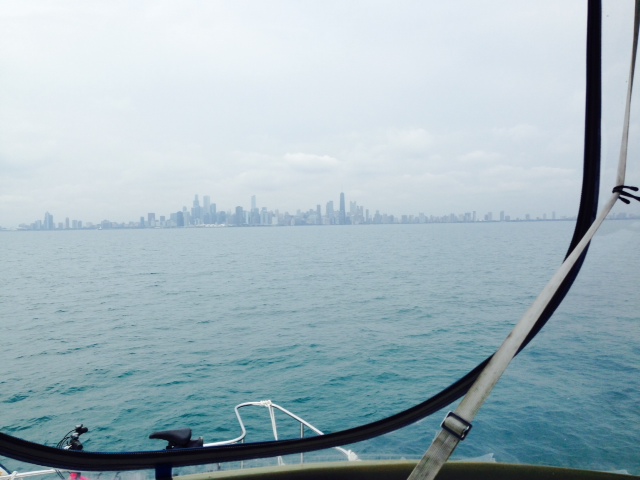
It was hazy, hot, and humid as we approached Chicago - this picture was taken from about 5 miles out -

It was hazy, hot, and humid as we approached Chicago – this picture was taken from about 5 miles out – if you look closely, you’ll see the Chicago skyline

This picture was taken from about 3 miles out -

This picture was taken from about 3 miles out –

We're now about a mile from the breakwater that serves as the entrance to Chicago's main harbor

We’re now about a mile from the breakwater that serves as the entrance to Chicago’s main harbor

Almost there!!!

Almost there!!!

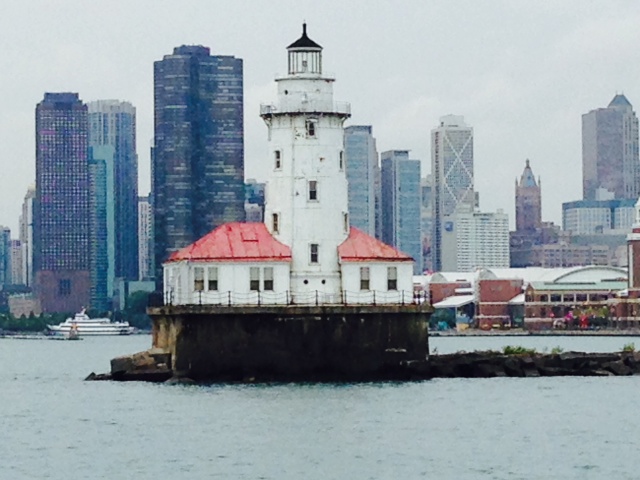
The iconic lighthouse marking the entrance to the harbor

The iconic lighthouse marking the entrance to the harbor – we made it!!

The rivers, quirky canals, and small lakes that brought us from New York to Lake Huron are behind us, as are transiting the last of the Great Lakes. The next 1300 miles or so to Mobile, Alabama will be very different, as we transit the great inland rivers which are marked by currents, fluctuating water levels based on rainfall hundreds of miles away, commercial traffic, isolated stretches, and fewer facilities for recreational vessels. We also anticipate beautiful scenery, fascinating river towns, heartland cities, and interesting people as we pass through Illinois, Missouri, Kentucky, Tennessee, Mississippi, and Alabama. An adventure indeed!


Standard

CHANGING OF THE GUARD

Post #24 – CHANGING OF THE GUARD: Day 106, August 17, 2014. On board: Trish until Thursday, Wendy & Knif, till Friday, Jim K

OK, I admit it – as a group, we’re laundry-challenged.  It started when I couldn’t tell the difference between a washing machine and a dryer, put my newly washed clothes into another washer instead of a dryer, and was forced to sit through the entire washing cycle of the clothes that had just been washed.  But Pat outdid me when she dumped her load of clothes into the washer, forgetting that she had put a bottle of shampoo in her laundry bag. The bottle opened during the wash cycle – making the clothes VERY sudsy, requiring at least one re-wash.  Not to be outdone – on Friday morning, Wendy & Knif offered to wash all the towels on board before they left. However, they were not quite dry when Wendy & Knif were about to be picked up, so rather than hang them on the boat to dry, I asked that they start the dryer for one more cycle and I would get them in 20 minutes. Earlier this evening (Sunday), I couldn’t figure out where all our towels went. Luckily, the marina was filled with people who didn’t need towels, and they were still there – in the dryer!

So – for the past 7 weeks, every Saturday has been a transition day in a pre-chosen location somewhere between Kingston, Ontario and Muskegon, Michigan – one set of friends joined us while another set of friends left us. We usually had 6 people on board, and for one special week, we had eight. Almost all cruisers whom we’ve met along the way have 2 people on board – usually a couple – and most have boats larger than the Joint Adventure. Most cruisers think we’re crazy. Maybe we are. But the camaraderie, the laughs, and the shared adventure have been more than worth any inconvenience caused by scheduled rendezvous points, limited space, or group decision-making. It has been truly a great experience.  However, now that the summer is winding down, we’re about to enter the next phase of our voyage. Paul & I are alone again for the next week and a half as we make our way south along the last third of Lake Michigan, then spend time exploring Chicago. Tom – friend, neighbor, and co-owner of the Joint Adventure – and my Dad then join us in Chicago as we head down the inland rivers towards Mobile, Alabama.

In the meantime, back to our trip – we spent our “weather day” in Ludington, Michigan (about halfway down the eastern coast of Lake Michigan) catching up on chores and going to a movie in the afternoon – Get On Up – the story of James Brown. Very good movie – I recommend it. Here are a couple of final pictures from Ludington:

We saw this otter climbing around the rocks foraging for food immediately adjacent to where the Joint Adventure was docked

We saw this otter climbing around the rocks foraging for food immediately adjacent to where the Joint Adventure was docked

A late evening sunset over Ludington Harbor and Lake Michigan

A late evening sunset over Ludington Harbor and Lake Michigan

Wednesday dawned cool, sunny, and calm, but we headed out early since the wind was predicted to increase as the day went on (it never did). Running along the coast in the early morning, we saw the most unusual formations of fog that I’ve ever seen – wisps of fog formed different patterns as they hung over the water intermittently.  It was hard to capture in pictures, but here’s one picture that did capture one of the fog formations:

This actually looks like a wave of water, but it is a fog formation a little ways from the shore

This actually looks like a wave of water, but it is a fog formation a little ways from the shore

We next docked in Whitehall, Michigan, about 4 miles down White Lake, a small lake that empties into Lake Michigan. However, the more interesting town (though smaller) was Montague, just across the river from Whitehall. It is a funky town, and boasts the largest weather vane in the world. Here are some pictures:

The largest weather vane in the world - who knew?

The largest weather vane in the world – who knew?

Montague also boasts the oldest continually-operated soda fountain in Michigan - selling milkshakes, etc. since 1878! Actually, it is a really cool place with a very friendly proprietor with great stories, who took over running it from her father who ran it since World War II. There are also historical displays of memorabilia, including the story and pictures of two local girls who were, for years, featured as the "Coke girls" in the old post-World War II signs and advertisements

Montague also boasts the oldest continually-operated soda fountain in Michigan – selling milkshakes, etc. since 1878! Actually, it is a really cool place with a very friendly proprietor with great stories, who took over running it from her father who ran it since World War II. There are also historical displays of memorabilia, including the story and pictures of two local girls who were, for years, featured as the “Coke girls” in the old post-World War II signs and advertisements

The room with the soda fountain also included a pharmacy in years past - the proprietor converted it to a restaurant, retaining the old pharmacy counter, seen at the rear, and the old merchandise shelving, seen on the left

The room with the soda fountain also included a pharmacy in years past – the proprietor converted it to a restaurant, retaining the old pharmacy counter, seen at the rear, and the old merchandise shelving, seen on the left

We came upon another funky place - a book store/café/bar/performing stage all in one. They had live music scheduled for the evening, so we decided to come back at 7:00, have dinner and drinks over live music while we celebrated Wendy's birthday. The live music turned out to be an opera singer - quite good, but not exactly our first choice of music-type. So we politely slipped out after one drink when she took a break -

We came upon another funky place – a book store/café/bar/performing stage all in one. They had live music scheduled for the evening, so we decided to come back at 7:00 and have dinner and drinks over live music while we celebrated Wendy’s birthday. The live music turned out to be an opera singer – quite good, but not exactly our first choice of music-type. So we politely slipped out after one drink when she took a break and had dinner and birthday cake elsewhere-

White Lake has had a troubled history - surrounded by industry in the early and mid 1900's, including lumber mills, tanneries, and a Hooker Chemical plant, the lake was one of 43 lakes designated in 1987 as an Area of Concern - meaning it was dangerously polluted. As a result of nearly 30 years of concerted clean-up effort, the EPA just announced that it will be de-listed this fall - a real success story. The picture below shows a remnant of the industrial era - these are enormous barrels that were used in the tanneries. Hides were put in the barrels, which were turned as part of the process for softening the hides

White Lake has had a troubled history – surrounded by industry in the early and mid 1900’s, including lumber mills, tanneries, and a Hooker Chemical plant, the lake was one of 43 lakes designated in 1987 as an Area of Concern – meaning it was dangerously polluted. As a result of nearly 30 years of concerted clean-up effort, the EPA just announced that it will be de-listed this fall – a real success story. The picture below shows a remnant of the industrial era – these are enormous barrels that were used in the tanneries. Hides were put in the barrels, which were then rotated as part of the process for softening the hides

Our next stop was Muskegon, Michigan, where I am now. Sadly, Trish, Wendy, and Knif all left the boat here. After spending the summer on the boat, Trish will be returning home and going back to work, since school starts in two weeks. I’ll miss her!

Muskegon is an interesting place. It is the largest city we’ve visited since Kingston, Ontario, and is obviously working hard to re-create itself after its old industrial base has been dismantled. A good portion of the downtown area was cleared via Urban Renewal in the 60’s, with nothing to replace it ( as sad story repeated in many cities across the country). Some old buildings were retained and some well-designed new ones have been built, but much of the land downtown remains vacant. The result is a downtown area with far too much open space between buildings and a glaring lack of people – even the relatively few restaurants and bars were nearly empty on Friday at lunch time and through the afternoon. However, it’s obvious that slow progress is being made, and there were a number of interesting museums, sights, and places to visit. Here are some pictures:

Muskegon is the birthplace of snowboarding - on Christmas Day, 1965, Sherman Poppen fastened two old wooden skis together and took his kids to slide down the snow-covered sand dunes - he called it snurfing. Just a year later, in 1966, Brunswick came out with the Snurfer - the first commercially-made snowboard, although the term "snowboard" didn't come into vogue until the 1980's. In the 1990's, Sherman Poppen was officially designated as the "Grandfather of Snowboarding", and Muskegon as the birthplace - the origin being sand dunes at the beach, not a ski mountain as one would expect

Muskegon is the birthplace of snowboarding – on Christmas Day, 1965, Sherman Poppen fastened two old wooden skis together and took his kids to slide down the snow-covered sand dunes – he called it snurfing. Just a year later, in 1966, Brunswick came out with the Snurfer – the first commercially-made snowboard, although the term “snowboard” didn’t come into vogue until the 1980’s. In the 1990’s, Sherman Poppen was officially designated as the “Grandfather of Snowboarding”, and Muskegon as the birthplace – the origin being sand dunes at the beach, not a ski mountain as one would expect

Muskegon has a large Performing Arts Center, and this sculpture is a tribute to film-making

Muskegon has a large Performing Arts Center, and this sculpture is a tribute to film-making

In addition to an impressive Museum of Art, Muskegon has several smaller museums with different themes.  This display in the Heritage Museum is a working model of a steam-powered factory from the 1800's. By the way, Lowell, Ma. has an amazing museum in which an entire textile factory, complete with weaving machines driven by an elaborate system of water-powered overhead belts shows what it was like to work in the incredibly noisy and cramped factories of the Industrial Revolution - well worth a visit

In addition to an impressive Museum of Art, Muskegon has several smaller museums with different themes. This display in the Heritage Museum is a working model of a steam-powered factory from the 1800’s. By the way, Lowell, Ma. has an amazing museum in which an entire textile factory, complete with weaving machines driven by an elaborate system of water-powered overhead belts shows what it was like to work in the incredibly noisy and cramped factories of the Industrial Revolution – well worth a visit

New industry trying to get a foothold - these are enormous windmill blades being loaded onto a freighter for shipment to a wind farm - not sure where.  I was amazed at the incredible size of each blade!

New industry trying to get a foothold – these are enormous windmill blades being loaded onto a freighter for shipment to a wind farm – not sure where. I was amazed at the incredible size of each blade!

What Paul & I will look like after a couple of weeks now that Pat & Trish have left the boat...

What Paul & I will look like after a couple of weeks now that Pat & Trish have left the boat…

How did they know I was coming?  Maybe I had better cut my hair....

How did they know I was coming? Maybe I had better cut my hair….

Muskegon has a truly beautiful beach - very wide and perhaps a mile long, the sand is soft and fine, like all of the beaches we've encountered so far along Lake Michigan. The mouth to the harbor is protected by two long breakwaters and is marked with a 70' high lighthouse

Muskegon has a truly beautiful beach – very wide and perhaps a mile long, the sand is soft and fine, like all of the beaches we’ve encountered so far along Lake Michigan. The mouth to the harbor is protected by two long breakwaters and is marked with a 70′ high lighthouse

Inside the Muskegon breakwater - this looks like fun, but what happens if you lose your balance and the jets don't turn off?

Inside the Muskegon breakwater – this looks like fun, but what happens if you lose your balance and the jets don’t turn off?


A sign attached to the base of the lighthouse - you have to be 4 feet from the lighthouse to read it - do they expect you to be a clairvoyant?

A sign attached to the base of the lighthouse – you have to be 4 feet from the lighthouse to read it – do they expect you to be a clairvoyant?

A view from the deck of a restaurant adjacent to the marina where the Joint Adventure is docked

A view from the deck of a restaurant adjacent to the marina where the Joint Adventure is docked

A dog's life - how do I get to be one?

A dog’s life – how do I get to be one?

We're having these bunks installed in the Joint Adventure so we can fit more people on board - actually, they're bunks on the LST 393, a World War II landing ship that delivered tanks to beaches.  It can hold 52 tanks, and delivered tanks to Italy, North Africa, and the beaches at Normandy

We’re having these bunks installed in the Joint Adventure so we can fit more people on board – actually, they’re bunks on the LST 393, a World War II landing ship that delivered tanks to beaches. It can hold 52 tanks, and delivered tanks to Italy, North Africa, and the beaches at Normandy

LST 393, which was a very interesting tour

LST 393, which was a very interesting tour

In addition to LST 393, there is a World War II submarine – the USS Silversides – docked at the Veterans Museum near the beach in the Muskegon Harbor channel. The museum focuses on the role of submarines in World War II. Only 1.6% of the Navy vessels in WW II were submarines, but they sank 55% of the total number of enemy ships sunk during the war. The Silversides sank more than all but two other US subs, out of over 200 that were deployed in the war. However, the cost was very high – the mortality rate among sailors on submarines during the war was 22%, highest of any group in the Navy. Here are a couple of pictures of the USS Silversides:

A World War II sub that is docked at the Veterans Museum adjacent to the beach and channel entering Muskegon. The Museum focuses on the role of submarines in World War II, and provides guided tours of the sub

The USS Silversides in Muskegon Harbor. The Museum focuses on the role of submarines in World War II, and provides guided tours of the sub


One of about 8 control panels inside the submarine

One of about 8 control panels inside the submarine

So tomorrow we continue our journey south towards Chicago.


Standard

UNPLANNED GEMS

Post #23 – UNPLANNED GEMS – August 12, 2014 – Day 101 – On board: Thru Saturday, August 9: Pat & Paul Coates, Jerry & Sheila Solomon, Jim & Trish Koningisor. August 9 – August 15: Wendy Barnes & Knif; Jim & Trish Koningisor

Charlevoix is the crown jewel of cruising northern Lake Michigan – it was recently named in a survey as the second best cruising harbor in the world (it is really, really nice, but that seems a bit of a stretch to me…).  The harbor and village are centered around Round Lake, a pond-sized body of water fronted by a park, docks, and homes at the waters edge. On the other side of Round Lake is Lake Charlevoix, a 26 mile long lake that is its own cruising ground. The village has a beautiful Main Street with boutiques, galleries, shops, and restaurants. The park along the vibrant waterfront is meticulously maintained with fountains, sculptured terraces, flowers, and beautiful landscaping.

Here are some pictures from our stay in Charlevoix:

This iconic and well-known lighthouse on the end of the jetty welcomes visitors entering the harbor

This iconic and well-known lighthouse on the end of the jetty welcomes visitors entering the harbor

Charlevoix Harbor as seen from the waterfront park

Charlevoix Harbor (Round Lake) as seen from the waterfront park

Homes right down to the waters edge line a portion of Charlevoix Harbor

Homes right down to the waters edge line a portion of Charlevoix Harbor

The noertheaster shore of Michigan has massive sand dunes - some rival the sand dunes of the Cape Cod National Seashore. We biked to a trailhead that leads into the sand dunes a few miles from the harbor

The northeastern shore of Michigan has massive sand dunes – some rival the sand dunes of the Cape Cod National Seashore. We biked to a trailhead that leads into the sand dunes a few miles from the harbor

The dunes a few miles from Charlevoix Harbor

The dunes a few miles from Charlevoix Harbor

We bought fresh fish from the fish market in Charlevoix and ate dinner on the bridge, listening to the concert in the park right next to the docks. Paul cooking on the grill attached to the rail at the bow of the boat

We bought fresh fish from the fish market in Charlevoix and ate dinner on the bridge, listening to the concert in the park right next to the docks. Paul cooking on the grill attached to the rail at the bow of the boat

Although I'd like to take credit for great planning, the concerts we've encountered have been by dumb luck. It was a Thursday night, but Charlevoix had an amazing all-brass band playing in the park adjacent to us.

Although I’d like to take credit for great planning, the concerts we’ve encountered have been by dumb luck. It was a Thursday night, but Charlevoix had an amazing all-brass band playing in the park adjacent to us.

A picture of the concert taken from the bridge of the Joint Adventure

A picture of the concert taken from the bridge of the Joint Adventure

While biking to the trailhead in Charlevoix, we came upon an overnight kids’ camp. It reminded me of the time we sent our oldest daughter Jessie to her first overnight camp. She was about 6 and 7, stubbornly independent, and insisted on packing her own suitcase – which we forgot to check before she left. When we picked her up on the last day, she came bounding out of the cabin wearing a T-shirt that our friend Louise had given me as a gag gift for my birthday – a yellow T-shirt, it had in huge purple letters across the front:  PARTY TILL YOU PUKE.  For some reason, Jessie wasn’t invited to any playgroups from that camp…

The need to make sure we have a safe place to stay each night and our planned crew changes each Saturday require us to do some basic planning each week as we move forward. However, we try to build in enough flexibility to take advantage of unplanned discoveries along the way – The Pool in the North Channel was one such unplanned gem. We experienced two more over the past several days – one of them thanks to Glenn & Linda, friends of Jerry who live in Charlevoix and visited us on the boat in the evening in Charlevoix. Glenn gave us local tips about cruising south on Lake Michigan, including a recommended stop on South Manitou Island, home to a portion of Sleeping Bear Dunes National Lakeshore.  Although it added 25 miles to our trip on Friday, the weather was sunny, warm, and calm, so we decided to go. The island is part of a chain that extends north to Mackinaw Straight, and consists of tilted layers of limestone buried under a blanket of glacial debris. The islands poke above the surface of Lake Michigan, and the glacier left piles of fine, ground-up rock – therefore, winds blowing on the high bluffs trapped sand, forming enormous dunes. In addition to the dunes on the island, there is an old-growth cedar forest, a shipwreck, and a tall lighthouse that you can tour on the island.  Here are some pictures:

Visitors to the island, which is served by a ferry from Leland as well as access by private boat, are greeted by this sign and ranger station

Visitors to the island, which is served by a ferry from Leland as well as access by private boat, are greeted by this sign and ranger station

The lighthouse on South Manitou Island near the ferry dock

The lighthouse on South Manitou Island near the ferry dock

An old-growth cedar tree, part of a beautiful hike through the forest on the island

An old-growth cedar tree, part of a beautiful hike through the forest on the island

A fallen cedar tree along the hiking trail

A fallen cedar tree along the hiking trail

The trail leads from the old-growth cedar forest to miles of sand dunes lining the west shore of the island. We were docked at the ferry dock and had to leave before the late afternoon ferry arrived, so we didn't have time to hike all the way to the beach ( the arrival of the ferry was our excuse, in any case...)

The trail leads from the old-growth cedar forest to miles of sand dunes lining the west shore of the island.

These dunes were truly amazing -

These dunes were truly amazing –

Gambling to make one last trip before winter, the Francisco Morazán left Chicago bound for Holland via the St. Lawrence Seaway on November 27, 1960 carrying nearly 1,000 tons of general cargo.  Blinded by fog and heavy snow in 40 MPH winds, she went aground 300 feet of South Manitou Island. All hands survived. However, the owners of the ship could never be found, so she still rests there today.

Gambling to make one last trip before winter, the Francisco Morazán left Chicago bound for Holland via the St. Lawrence Seaway on November 27, 1960 carrying nearly 1,000 tons of general cargo. Blinded by fog and heavy snow in 40 MPH winds, she went aground 300 feet off South Manitou Island. All hands survived. However, the owners of the ship could never be found, so she still rests there today.

On the boat on the way to Leland after an afternoon of hiking, Sheila needed to re-charge...

On the boat on the way to Leland after an afternoon of hiking, Sheila needed to re-charge…

We arrived in Leland Harbor around 5:30 Friday evening. Sadly, Jerry & Sheila leave us from here, and also sadly, Pat leaves after spending most of the summer on the boat. Paul leaves for a week but will return next Sunday. Happily, Wendy Barnes & Knif join us in Leland through next Friday.  Here is a group photo marking the changing of the crew: –

A "groupie" at our changing of the crew - from back row, left to right: Pat, Nif, Jim K, Jerry (Sol); front row, left to right: Paul, Wendy, Trish, Sheila

A “groupie” at our changing of the crew – back row, left to right: Pat, Knif, Jim K, Jerry (Sol); front row, left to right: Paul, Wendy, Trish, Sheila

Leland is a small, historic, well-kept village located where the LeLand River empties into Lake Michigan. The Ottawa Indians found it to be the perfect place to settle, and the village became the oldest and largest Indian village of its kind on the Leelanau Peninsula. Millennia later, European settlers found it just as enticing and built Leland on the site of the old Indian village. Leland was settled by fisherman 150 years ago, and the village has stubbornly held onto its fishing legacy while nearly all commercial fisheries on the Great Lakes have disappeared. The heart of historic Leland are the fishing shanties along the river adjacent to the harbor, called Fishtown. The shanties were built around the turn of the century, where a handful of fisherman set out from the mouth of the Leland River below a dam and abandoned sawmill – a legacy from the days when the lumber industry drove the local economy. As fishing declined later in the 20th century, many of the shanties were abandoned and fell into disrepair.  In the 1970’s, the US government banned gill nets on the Great Lakes. A final death sentence, nearly all commercial fisheries on the Great Lakes collapsed. However, a few fishing families in Leland adopted new methods and held on. The shanties were saved by a local fishing family (now into its fifth generation of fishermen) who bought many of them and found new uses for those no longer used to support fishing. Today the shanties provide an eclectic collection of uses from fish markets to specialty shops. Fishtown is a working harbor and active market – it is a rare working and historic example of a once-thriving way of life on the Great Lakes. Here are some pictures:

A historical market with a brief overview of Leland history

A historical market with a brief overview of Leland history

The shanties of Fishtown, looking up the Leland River

The shanties of Fishtown, looking up the Leland River

Wendy & Nif pausing in front of the fish market in Fishtown

Wendy & Nif pausing in front of the fish market in Fishtown

A Fishtown shanty -

A Fishtown shanty –

The shanties are weathered but serve their purpose well

The shanties are weathered but serve their purpose well

Fishtown looking down-river, towards Lake Michigan. The harbor in Leland outside of the narrow Leland River was created as a harbor-of-refuge - the rock breakwater can be seen in the background

Fishtown looking down-river, towards Lake Michigan. The harbor in Leland outside of the narrow Leland River was created as a harbor-of-refuge – the rock breakwater can be seen in the background

A sign in Fishtown to assist tourists in determining the weather at Sleeping Bear Park

A sign in Fishtown to assist tourists in determining the weather at Sleeping Bear Park

The beach at LeLand - all of the villages and towns along the northeastern shore of Lake Michigan have fabulous beaches due the abundance of beautiful, fine-grained sand built up since the glacier retreated. The weather has been sunny and warm for the past 10 days, so we go for a swim most afternoons. However, the water is quite - shall we say "refreshing" - colder than usual due to the very cold winter, the late break-up of the ice, and the unseasonably cool first half of the summer

The beach at LeLand – all of the villages and towns along the northeastern shore of Lake Michigan have fabulous beaches due to the abundance of beautiful, fine-grained sand built up since the glacier retreated. The weather has been sunny and warm for the past 10 days, so we go for a swim most afternoons. However, the water is quite – shall we say “refreshing” – colder than usual due to the very cold winter, the late break-up of the ice, and the unseasonably cool first half of the summer

This Mom's two boys talked her into jumping off the end of the jetty with them into the harbor - YIKES!

This Mom’s two boys talked her into jumping with them off the end of the jetty into the harbor – YIKES!

On our way to Frankfort on Monday morning, we encountered our second “unplanned gem”. The shoreline is lined with enormous dunes, many of which are 45 stories high!

A dune we passed along the way -

A dune we passed along the way –

Another dune we passed along the way -

Another dune we passed along the way –

After passing these incredible dunes for awhile, we couldn’t resist – we stopped the boat a few hundred feet offshore at what turned out to be a part of Sleeping Bear Dunes National Lakeshore – we later found out that, in 2011, Good Morning America named Sleeping Dunes National Lakeshore as “the most beautiful place in America”. We launched the dinghy, and I stayed with the boat while Trish, Wendy, and Nif took the dinghy to the beach. The dune where they landed is 45 stories tall, and has a path devoid of vegetation with an observation deck at the top. A number of people were on the dune, climbing up or down. It’s impossible to see the steepness of the slope in the pictures, but climbing was mostly done on all fours.  Here are some pictures:

People climbing up and down the dune

People climbing up and down the dune

Wendy & Nif starting their climb...

Wendy & Nif starting their climb…

Continuing the climb....

Continuing the climb….

Wendy, Nif, & Trish getting near the top after an hour of climbing...

Wendy, Nif, & Trish getting near the top after an hour of climbing…

Others still making the climb. Notice the two boats in the water below to get an idea of the height of this dune - the larger boat is a 100 foot that came by after we stopped.  The Joint Adventure is the small speck to the left of the yacht

Others still making the climb. Notice the two boats in the water below to get an idea of the height of this dune – the larger boat is a 100 foot yacht that came by after we stopped. The Joint Adventure is the small speck to the left of the yacht

A sign at the top of the dune near the observation platform.  Obviously, many people ignored the advice on the sign -

A sign at the top of the dune near the observation platform. Obviously, many people ignored the advice on the sign –

After several hours, we proceeded to Frankfort, arriving around 5:00 or so.  Like most harbors on this part of Lake Michigan, it has a long jetty marked with a tall lighthouse on the end of the jetty:

Wendy, Trish, and Nif on the jetty that goes out to the lighthouse

Wendy, Trish, and Knif on the jetty that goes out to the lighthouse

Frankfort is a pleasant town with a great harbor, numerous shops, and several restaurants overlooking the harbor, but it doesn’t quite have the charm of Leland.

The weather was predicted to deteriorate on Monday with thunderstorms likely in the afternoon, so we left early Monday morning for the 50 mile run to Ludington, where we expect to spend two nights due to nasty weather predicted for Tuesday. Like Leland and Frankfort, Ludington has a long breakwater with a lighthouse at the end – here is a picture of the jetty from the top of the lighthouse, which is open to the public:

A view from the top of the Ludington lighthouse of the 1/2 mile long jetty leading to the lighthouse

A view from the top of the Ludington lighthouse of the 1/2 mile long jetty leading to the lighthouse

Ludington is a good-sized town with some interesting attractions. A main attraction is the car ferry called the Badger, named after the Wisconsin University Badgers. She is 410′ long, and is the largest car ferry ever to ply the waters of Lake Michigan. Built in 1953 to ferry railroad cars across the lake from Ludington to Manitowac, WI., today she carries cars, trucks, and passengers along the same route.  She is still powered by coal-fired steam engines – the only one of her kind remaining. Coal, of course, is not an environmentally-friendly fuel, and there have been ongoing legal and bureaucratic battles over her continued operation – at times, environmentalists and preservationists, normally allies, are battling each other over the Badger. Of more concern than her smoke, the Badger apparently must dump significant quantities of coal ash that contain mercury into the lake each day. She is operating this year via a consent order while negotiations are underway to find a way to keep her operating beyond this fall. In any case, she is a sight to behold coming into Ludington Harbor, where she draws a crowd each evening upon her return from Wisconsin. An old ship that lacks modern maneuvering devices such as bow and stern thrusters, she employs a unique method to turn 180 degrees in the harbor to back in next to her dock – she drops her starboard-side anchor as she approaches he dock, then powers against it spin the boat around. The operation takes about a half hour to get her secured. A sight to behold for a 410′ ship!  Here is a picture of the Badger spinning on her anchor in the harbor:


The 410' coal/steam powered  Badger entering Ludington Harbor and spinning around her starboard-side anchor to back into her dock

The 410′ coal/steam powered Badger entering Ludington Harbor and spinning around her starboard-side anchor to back into her dock

Ludington also has an extraordinary sculpture park along the harbor. Here are pictures of some of the sculptures:

A sculpture dedicated to the fishing heritage of Ludington

A sculpture dedicated to the fishing heritage of Ludington

Car ferries (all of which started as ferries to carry railroad cars across the lake) were a major part of Ludington's economy. At its height, eight large car ferries carried railroad cars between Ludington and Wisconsin

Car ferries (all of which started as ferries to carry railroad cars across the lake) were a major part of Ludington’s economy, replacing the lumber industry as the main economic engine after the nearby lumber resources were depleted. At its height, eight large car ferries carried railroad cars between Ludington and Wisconsin

This sculpture is dedicated to the children, recognizing that the children are the future of Ludington

This sculpture is dedicated to the children, with a plaque noting that the children are the future of Ludington

This one has a plaque commemorating some very successful Ludington minor league baseball teams in recent years

This one has a plaque commemorating some very successful Ludington minor league baseball teams in recent years

In talking with some local sportfishermen that had just come in, Wendy managed to score some fresh lake trout – they explained to Wendy that it is against the law for sportfishermen to sell fish, but they could give it away – and so they did! After a great dinner of fresh fish on the boat, we had “Movie Night on the Joint Adventure:

Movie nigt on the Joint Adventure - complete with Amaretto on the rocks...

Movie nigt on the Joint Adventure – complete with Amaretto on the rocks…

After 12 glorious days of warm, sunny, perfectly calm days, the weather finally turned and we’re sitting out our first weather day in nearly three weeks. An all day soaking rain combined with winds gusting to 30 MPH have us using the day to catch up on chores, hang out, and generally relax. If the weather allows, tomorrow we hope to run to White Lake.


Standard

TURN LEFT!

Post #22 – TURN LEFT! – Day – August , 2014. On Board: Jerry & Sheila Solomon, Pat & Paul Coates, Jim & Trish Koningisor

In the last post, I stated that every once in a while one discovers a place that is truly special. Likewise, every once is a while, one also meets some people that are truly special.  Such was the case a month ago when we happened upon Tom & Tim in Trenton, Ontario – they also have very special story.

Tom is an octarian who has enjoyed a successful business career. He’s also been an adventurer, with a number of experiences as a mountain climber. In fact, he climbed the back side (not the tourist side, but the rock-cliff side that requires ropes and climbing gear) of Mount Kilimanjaro when he was 74 – at the time, he was the oldest person to do so (his record was broken a month later). Several months ago, after being informed of the actuarial lifespan of a person of his ilk, Tom decided it was time for a change – so he turned over his business to his management team and decided do something radically different. A month or so later, he had bought the first boat he looked at and was ready to depart from North Carolina on the Great Loop. However, Tom did not want to “drive the boat” – either figuratively or literally (“I’ve been driving the boat (figuratively) all my life – now I want someone else to drive the boat”).  And he needed a companion. So Tom called his twenty-something year old grandson, Tim, who was working in Colorado at the time and was ready to consider a change. During the call, Tim asked Tom if he could have 48 hours to think it over. Less than hour later, Tim called his grandfather – “I’m in”.  Neither had any significant boating experience, and they were about to set off on a year-long boating adventure on a 49′ boat, the likes of which neither of them had ever driven. Tim’s mother (Tom’s daughter) concluded that they both must be on a suicide mission. To help them get started, they hired an experienced captain to be on board for the first two weeks. By the time we met them in Trenton, they were both seasoned “old salts”. Tim handles the boat like a pro, and Tom jumps around the boat handling the lines, fenders, and other chores like a thirty year old.  More important, they are wonderful, fun, interesting people whom we have had the pleasure to cruise with, talk with, and be with.  They are both free spirits who embody the challenge of adventure – they were willing to step WAY outside their familiar sphere of activities and immerse themselves in something totally new. They are an inspiration to everyone they meet. TomTim (as we call them) are now a little bit ahead of our pace, but we hope to catch up with them again.

So I received a nice note from a very good friend of mine, who commented that she liked the pictures on the blog, but referring to my hair, she said “you, by the way, look like an aging hippie” – which, of course, is true.  I decided not to bother cutting my hair through the summer, just to try it out.  The problem is that my hair seems to grow out instead of down – sort of like Bozo the Clown. Maybe that sort of fits. Anyway, a day or two later, I came upon this sign next to the door of a shop:

How did they know I was coming?

How did they know I was coming?

After clearing customs on Friday, August 1, we spent the afternoon and evening at Drummond Island. The manual for our diesel engines recommends changing the oil every 250 hours of use, so it was about time to do so – the marina on Drummond Island pumped out the old oil and replaced it with new, along with new filters.

Here are some pictures from Drummond Island:

Paul again practicing his trade...

Paul again practicing his trade…

While the weather was spectacular - warm, sunny, no wind - the mosquitos were having a field day as the sun was getting ready to set, so we served our on-board dinner inside

While the weather was spectacular – warm, sunny, no wind – the mosquitos were having a field day as the sun was getting ready to set, so we served our on-board dinner inside

Sunset from the bridge of the Joint Adventure at Drummond Island

Sunset from the bridge of the Joint Adventure at Drummond Island

Sunrise the next morning, also from the bridge. Notice the reflection of the cloud in the water that looks like an eye - could that be the NSA watching us? After all, we just re-entered US waters...

Sunrise the next morning, also from the bridge. Notice the reflection of the cloud in the water that looks like an eye – could that be the NSA watching us? After all, we just re-entered US waters…

I couldn't resist putting in a second picture of the sunrise -

I couldn’t resist putting in a second picture of the sunrise –

On Saturday morning, we ran 15 miles to DeTour Village, which marks the western gateway to the North Channel. On land, DeTour is little more than a widening in the road, although it has a very good casual, reasonably-priced restaurant, a great boutique/gift shop, a small but interesting museum, and really friendly people. On the water, however, DeTour is a crossroads between the North Channel to the east, Mackinaw and Lake Michigan to the west, and Lake Superior via Sault St. Marie to the northwest. Here are some pictures from DeTour:

The DeTour Lighthouse marks the reef that must be cleared when approaching DeTour from the west. You can arrange to tour the lighthouse and even stay on it overnight for a unique night out

The DeTour Lighthouse marks the reef that must be cleared when approaching DeTour from the west. You can arrange to tour the lighthouse and even stay on it overnight for a unique night out

We haven't seen commercial freighters since we turned off the St. Lawrence River onto the Ottawa River in June. Freighters are a frequent site in DeTour, as the main shipping channel from Lake Superior to Lake Huron and on through Lakes Erie and Ontario then the St. Lawrence Seaway, passes through the channel, right by the docks in DeTour. These ships are not about to collide - the red one is actually anchored further back than the black one

We haven’t seen commercial freighters since we turned off the St. Lawrence River onto the Ottawa River in June. Freighters are a frequent site in DeTour, as the main shipping channel from Lake Superior to Lake Huron and on through Lakes Erie and Ontario then the St. Lawrence Seaway, passes through the channel, right by the docks in DeTour. These ships are not about to collide – the red one is actually anchored further back than the black one

A freighter passing through the channel at DeTour at sunrise

A freighter passing through the channel at DeTour at sunrise

This statue is actually a tree trunk that someone carved into this maritime figure

This statue is actually a tree trunk that someone carved into this maritime figure

DeTour hosted a concert in the park immediately adjacent to the marina on Saturday night. As opposed to the concert in Peterborough, this band was quite good and the music was at a reasonable volume

DeTour hosted a concert in the park immediately adjacent to the marina on Saturday night. As opposed to the concert in Peterborough, this band was quite good and the music was at a reasonable volume

A group photo as we changed crews on Saturday - from left to right - Chrissie, Sheila, Trish, Jerry (Sol), Jim Small, Jim K, Paul, Pat

A group photo as we changed crews on Saturday – from left to right – Chrissie, Sheila, Trish, Jerry (Sol), Jim Small, Jim K, Paul, Pat

So we learned an interesting story while exploring the museum in DeTour. In the early 1880’s, the Moiles Brothers built a sawmill in DeTour to take advantage of the vast timber resources of the area since there was a huge demand for lumber from a growing nation. However, they were not very good businessmen, and by the Spring of 1889 the bank in Buffalo that held their mortgage was about to seize the mill due to non-payment of their debt. So as soon as the ice started to break up in the channel, the Moiles Brothers brought in a tug and two large barges and disassembled the mill – machines, building, and all – and loaded them onto the barges. The next morning, they intended to take them to Canada. Some of the townspeople did not was the sawmill to go, so they tried to telegraph the sheriff to stop them.  However, the Moiles Brothers had cut the telegraph lines.  Not to be deterred, they sent a young man, Bill Jones, on horseback to Pickford where there was another telegraph station. Upon learning what was happening, the sheriff organized a posse of 20 men and set out by train to St. Ignac and Cherboygan, since the all-water route was still blocked by ice. In Cherboygan they boarded a steamer for DeTour. However, by the time they arrived, the Moiles Brothers and their sawmill were in Canadian waters and beyond the authority of the Americans.  Canadian Customs taxed the incoming mill and allowed it to enter the country. The Moiles Brothers then set up the sawmill on John Island, where it continued to operate for many years (no doubt debt-free). There is a museum on St John Island that contains artifacts from the old sawmill.

Sunday was a warm, sunny, and windless day, so we had a pleasant 40 mile passage to Cheboygan, MI, a good sized town for this area, with a movie theater. We couldn’t resist going to see “Jersey Boys” Sunday night – afterwards, we had drinks on the bridge while we downloaded and played Four Season’s songs – the songs “Sherry” and “Rag Doll”  are still running through our heads!

Monday dawned cool and cloudy, but we set out mid-morning for Mackinaw Island, 15 miles away. Shortly after we left the harbor, fog closed in.  We were crossing a major shipping lane, so we kept a close eye on the radar. By the time we reached Mackinaw, the sun had come out and the rest of the day was sunny and warm. Jerry took his turn at the helm:

Jerry (Sol) shows his versatility as a boater....

Jerry (Sol) shows his versatility as a boater…

Mackinaw Island was an important summer settlement for Native Americans for thousands of years before Europeans arrived, due its rich fishing grounds. After voyageurs arrived in the 1600’s, fur trading grew to dominate activities on the island. By the 1820’s, million of dollars in furs were being traded on Mackinaw every year. When fur trading declined in the 1830’s, fishing came to dominate the economy. After the Civil War, however, Mackinaw became a tourist destination for the wealthier upper class. In 1887, the Grand Hotel was built and Mackinaw became the most fashionable summer retreat for the rich and famous:

The Grand Hotel boasts the longest porch in the world - 600 feet long.  It was built in just 4 months in 1887 by over 300 carpenters. Bring your wallet - dinners start at $80/person and it costs $10 to tour the porch and the inside of the hotel. However, it is truly grand -

The Grand Hotel boasts the longest porch in the world – 600 feet long. It was built in just 4 months in 1887 by over 300 carpenters. Bring your wallet – dinners start at $80/person and it costs $10 to tour the porch and the inside of the hotel. However, it is truly grand –

The 600-foot long porch at the Grande Hotel

The 600-foot long porch at the Grand Hotel

In 1875, as development pressures grew, Mackinaw Island was designated by Congress as the nation’s second National Park, just 3 years after Yellowstone was designated as the first. However, in 1895, when US troops withdrew from Fort Mackinaw, the Park was transferred to the state and became Michigan’s first State Park. In 1898, the first automobile was brought onto the island. However, the loud noise, hissing, and backfiring scared several horses, so the carriage drivers got together and petitioned the Town Council to ban automobiles. In a decision that would have lasting impact on the island, the Town Council passed a bylaw on June 6, 1898:  “Resolved that the running of horseless carriages be prohibited within the limits on the village of Mackinaw”. To this day, no motorized vehicles are allowed on the island – all transportation is by foot, bicycle, or horse-drawn carriage.

The military history of Mackinaw Island is equally rich. Due to its strategic location at the narrow confluence of Lake Michigan and Lake Huron, a fort that had been built by the British on the highlands overlooking the strait was an important American position when the War of 1812 broke out. The British occupied a nearby fort just over the border in Canada. Word reached the Canadian fort that war had been declared, but that information had not yet reached the Americans at Fort Mackinaw.  The British acted quickly, surprising the Americans:

The surrender of Fort Mackinaw in 1812

The surrender of Fort Mackinaw in 1812

The Americans attempted to recapture the fort on August 4, 1814 – coincidentally, 200 years to the day when we visited the fort. The Americans suffered heavy casualties and were forced to withdraw and the fort remained in British hands until the Treaty of Ghent was signed ending the War of 1812. To commemorate the battle, a re-enactment was held while we were there:

In the reenactment, British troops squared off with American troops in a field, while Native Americans allied with the British massacred American soldiers when they tried to outflank the British in the woods

In the reenactment, British troops squared off with American troops in a field, while Native Americans allied with the British massacred American soldiers when they tried to outflank the British in the woods

Here are some pictures of the fort:

Fort Mackinaw as seen from the harbor

Fort Mackinaw as seen from the harbor

The barracks inside the fort. Verious re-enactments, including musket firing and cannon firing and a court-marshall take place throughout the day

The barracks inside the fort. Verious re-enactments, including musket firing and cannon firing and a court-marshall take place throughout the day

Mackinaw Island today is another world. The island is a tourist center, and I’ve never seen so many bicycles in one place. The Village is surprisingly large, with a quaint Main Street and many restaurants, shops, hotels, historic attractions, etc.  It has a Disneyesque quality to it, but there are rich, genuine historic sites mixed in as well, since the island was an important crossroads and settlement for Native Americans before European contact and became an important military post and fort as described above.  However, many people don’t realize that the vast majority of the island is a beautiful nature preserve, accessible with a network of bicycle and walking trails throughout the island. We spent two days here, but we couldn’t begin to see everything the Island and State Park have to offer in that time period; however, we did cover a lot of ground. Here are some pictures:

Main Street in the Village is active and vibrant. No worries about cars, but be careful of bikes when crossing the street!

Main Street in the Village is active and vibrant. No worries about cars, but be careful of bikes when crossing the street!

A walk down Main Street -

A walk down Main Street –

An 8 mile long paved bike path along the water's edge completely encircles the island. The scenery is spectacular!

An 8 mile long paved bike path along the water’s edge completely encircles the island. The scenery is spectacular!

A view of the Mackinaw Bridge from the bike path

A view of the Mackinaw Bridge from the bike path

A natural arch along the coastline adjacent to the bike path. The island is underlain by a layer of rock salt, and consists mostly of limestone formed when the area was covered by a shallow lake. When the lake receded, the softer limestone started to dissolve and erode. About 4,000 years ago, the softer limestone under this arch fell away, forming the arch. It can be viewed from the bike path below, then accessed from an observation point above

A natural arch along the coastline adjacent to the bike path. The island is underlain by a layer of rock salt, and consists mostly of limestone formed when the area was covered by a shallow lake. When the lake receded, the softer limestone started to dissolve and erode. About 4,000 years ago, the softer limestone under this arch fell away, forming the arch. It can be viewed from the bike path below, then accessed from an observation point above

A close-up of the arch

A close-up of the arch

The view from the observation point near the top of the arch

The view from the observation point near the top of the arch

On Wednesday, we moved on.

When I sent my first e-mail to family and friends last winter describing the Great Loop trip, I included a crude map of the route. It basically showed that we would run along the coast from Boston to New York, then the rest of the trip looked like a big rectangle, with the upper right hand corner at the St. Lawrence, the upper left hand corner at the northern end of Lake Michigan, the lower left hand corner at Mobile, Alabama, and the lower right hand corner at Florida. So our friend Bill Burke sent back an e-mail which basically said: “So what’s the big deal – you just go down to New York, turn north up the river, then take four left turns, and you’re back in Boston.” So – on Wednesday, we took our second left turn – after heading west through the Mackinaw Strait and under the Mackinaw Bridge, we entered Lake Michigan and started our journey south – another major milestone!

The Mackinaw Bridge is incredible (I know – here I go again…). Connecting Michigan’s Upper Peninsula to the rest of the state, it took 3 years to build and was opened in 1957.  The bridge is 4 miles long, and the center span is the longest span in North America:

The Mackinaw Bridge with the sun rising in the background

The Mackinaw Bridge with the sun rising in the background

Each tower on the bridge is 55 stories tall - almost as tall as the John Hancock building in Boston!

Each tower on the bridge is 55 stories tall – almost as tall as the John Hancock building in Boston!

The center span of the bridge

The center span of the bridge

Our next stop was Harbor Springs, Michigan, an upscale town on Little Traverse Bay (part of Lake Michigan) with large, stately homes overlooking the lake, an attractive Main Street lined with art galleries, antique shops, and restaurants, and a wonderful sandy beach where we took a refreshing swim in the lake. Here are some pictures from Harbor Springs:

Main Street has an eclectic collection of upscale galleries and shops

Main Street has an eclectic collection of upscale galleries and shops

Well kept, stately houses are part of a homeowners association that was formed in 1880

Well kept, stately houses are part of a homeowners association that was formed in 1880

Another stately home...

Another stately home…

And yet another...

And yet another…

I just couldn't help myself and had to post another...

I just couldn’t help myself and had to post another…

The "Seaquest" was docked in Harbor Springs while we were there - it is a 164' yacht owned by the founder of Amway that was built for him in 2008 at a cost of $50 million - that's a lot of soap!

The “Seaquest” was docked in Harbor Springs while we were there – it is a 164′ yacht owned by the founder of Amway that was built for him in 2008 at a cost of $50 million – that’s a lot of soap!

Lastly - just to prove that once in awhile I do notice things other than bridges and locks -the flowers in Harbor Springs were abundant and glorious!

Lastly – just to prove that once in awhile I do notice things other than bridges and locks -the flowers in Harbor Springs were abundant and glorious!

Next stop – Charlevoix!


Standard

THE POOL!

Post #21 – THE POOL – Day 90 – August 1, 2014. On board: Jim Small & Chrissie Bell, Pat & Paul Coates, Jim & Trish Koningisor

Every once in a while, you discover a place that is truly memorable.  A woman who lives locally first told Trish about an anchorage called The Pool at the end of a 10-mile long unmarked channel. I checked it out on the charts – no way were we going in there.  Less than 4 feet of water over rocks through a narrow entrance, then unmarked rocks further down the channel.  Later that day, while  doing laundry (this time I washed the clothes only once), I was looking through the charts at the Laundromat, planning the next day’s run while waiting for the clothes to dry. A man looked over my shoulder and started to tell me about The Pool. I pulled out the chart and told him “no way – look at the shallow water at the entrance”.  He told me not to believe the chart (!?!) – the water was much deeper than the chart shows.  Another guy came over and chimed in – you have to go, he said – the chart is wrong.  So on Sunday morning, off we went.  It turned out to be one of the most memorable places we’ve been so far.  It is a small bay at the end of a beautiful 10-mile long channel with rock cliffs and forested hillsides along both sides – it has the feel of a fiord as you move up the channel.  Here are some pictures:

The entrance to the 10-mile long channel is up ahead

The entrance to the 10-mile long channel is up ahead

Rock cliffs and forested hillsides lined the 10-mile long channel leading to The Pool

Rock cliffs and forested hillsides lined the 10-mile long channel leading to The Pool

After a 90 degree bend, we entered The Pool, a small bay protected on all four sides. After our second attempt at anchoring was successful, we launched the dinghy and went ashore at a small trailhead which leads to Topaz Lake – with 150′ of depth, the color of the water is topaz, hence the name. We spent the afternoon swimming in the lake, hiking to the top of the mountain, and marveling at the views. The pictures describe it better than I can:

Hiking up a dry stream-bed up to Topaz Lake

Hiking up a dry stream-bed up to Topaz Lake

After a 20 minute hike, Topaz Lake comes into view -

After a 20 minute hike, Topaz Lake comes into view –

Another view of Topaz Lake - water 150 feet deep trapped by the surrounding ridges, which are solid rock

Another view of Topaz Lake – water 150 feet deep trapped by the surrounding ridges, which are solid rock

"No, don't jump!   OK, you can have the last Heinekin!"

“No, don’t jump! OK, you can have the last Heinekin!”


Paul is practicing for the 2016 US Olympic Diving Team - he calls this the Butterfly Dive

Paul is practicing for the 2016 US Olympic Diving Team – he calls this the Butterfly Dive

After a more graceful entrance, Trish & Pat enjoy the refreshing water

After a more graceful entrance, Trish & Pat enjoy the refreshing water

Jim & Chrissie on the cliff overlooking the pool, watching Trish & Pat swimming below

Jim & Chrissie on the cliff overlooking the lake, watching Trish & Pat swimming below

After our swim, we hiked up to the top of the ridge which overlooked both Topaz Lake and The Pool, where the Joint Adventure and other boats were anchored. We munched on wild blueberries, which grew along the rocks as we climbed.  The views were breathtaking:

The Pool, as seen from a rock outcropping on the way up the ridge.  The Joint Adventure can be seen anchored in the center of The Pool

The Pool, as seen from a rock outcropping on the way up the ridge. The Joint Adventure can be seen anchored in the center of The Pool

Another view of The Pool from the ridge

Another view of The Pool from the ridge

The Pool from the top of the ridge, which is solid bedrock as seen in the foreground

The Pool from the top of the ridge, which is solid bedrock as seen in the foreground

We helped ourselves to the wild blueberries that grew everywhere among the rocks

We helped ourselves to the wild blueberries that grew everywhere among the rocks

Resting on the rocks on the way down -

Resting on the rocks on the way down –

A "selfie" from the top of the ridge - left to right, Paul, Chrissie, Trish, Jim, Jim K, and Pat

A “selfie” from the top of the ridge – left to right, Paul, Chrissie, Trish, Jim, Jim K, and Pat. You can see The Pool in the background

Motoring back to the Joint Adventure in the dingy after the hike to Topaz Lake and the ridge

Motoring back to the Joint Adventure in the dinghy after the hike to Topaz Lake and the ridge

Our friends Tom & Tim were anchored in The Pool with us as well - they dinghied over to us (can dinghy be a verb?) and joined us for horderves in the evening

Our friends Tom & Tim were anchored in The Pool with us as well – they dinghied over to us (can dinghy be a verb?) and joined us for horderves in the evening

The evening weather turned perfect, and we cooked dinner on board and ate on the bridge. As we retired for the evening, there was not a breath of wind, so I relaxed with the expectation of a worry-free night at anchor. However, a noise woke me up at about 4:00 AM – I went outside to investigate, only to discover that the wind was howling. I checked the anchor and anchor line – everything was in order and we had not moved, but I knew I would not get back to sleep. Another boat nearby did drag anchor, but was not a threat to us. So I sat in the dark until the sun started to rise. However, later that morning when we went to leave, the anchor was set in the mud and weeds so solidly that we could barely pull it free, even with the trip line we had put on.  I could have gotten a full night’s sleep!

On Monday, the wind was still strong, so we decided to stop at Little Current rather than go further as we had planned. On Tuesday morning, we headed to a small town on the North shore of Manitoulin Island called Kagawong. The name came from the native Ojibwe that inhabited the region before Europeans arrived and means “where mists rise from falling water”, an obvious reference to Bridal Veil Falls described below. Like most of the towns and villages in the North Channel, Kagawong began with the construction of a sawmill in the 1830’s. It grew and thrived as the lumber business grew. Trees were harvested in the fall and winter, then floated through the North Channel to the sawmills and pulp mills. In the first half of the 1900’s, the lumber business declined as the nearby forests were clear-cut and trees had to be brought from further and further away, which eventually became uneconomic. Eventually, all the saw mills and pulp mills closed, although historic remnants of them still exist and can be visited. Kagawong today has a small harbor and is off the beaten path from the route taken by most cruisers. However, it far exceeded our expectations, with extensive hiking trails, Bridal Falls, and a few unique shops. Here are pictures from Kagawong:

Bridal Falls, with a pool to swim in at the base. The rock is carved away behind the falls as well, so you can actually walk behind the falls

Bridal Falls, with a pool to swim in at the base. The rock is carved away behind the falls as well, so you can actually walk behind the falls

Bridal Falls - the water was cold, but the pool at the bottom was a refreshing swim

Bridal Falls – the water was cold, but the pool at the bottom was a refreshing swim

Swimming below the falls - you can actually get directly under the falling water - a weird sensation!

Swimming below the falls – you can actually get directly under the falling water – a weird sensation!

Pat and Trish swimming at the base of the falls

Pat and Trish swimming at the base of the falls

There is a path that goes directly behind the falls - there is a surprising amount of wind behind the falls, generated by the falling water

There is a path that goes directly behind the falls – there is a surprising amount of wind behind the falls, generated by the falling water

This picture is taken from behind Bridal Falls

This picture is taken from behind Bridal Falls

Chrissie, Jim, and Trish enjoying the falls on the rocks adjacent to the pool

Chrissie, Jim, and Trish enjoying the falls on the rocks adjacent to the pool


Jim telling us to "REPENT!"  The pulpit in the Anglican Church in Kagawong is the bow of a boat

Jim telling us to “REPENT!” The pulpit in the Anglican Church in Kagawong is the bow of a boat

One of the shops features a people-size checkers game and chess game

One of the shops features a people-size checkers game and chess game

Time is a bit behind on Manitoulin Island - when is the last time you saw an Esso sign OR and phone booth?

Time is a bit behind on Manitoulin Island – when is the last time you saw an Esso sign OR and phone booth?

A storm built in the late afternoon - the wind kicked up, and whitecaps started rolling in.  We doubled all the dock lines, took down the aft bimini, and secured everything on deck.  Of course, all that preparation caused the storm to bypass us, and soon the wind diminished

A storm built in the late afternoon – the wind kicked up, and whitecaps started rolling in. We doubled all the dock lines, took down the aft bimini, and secured everything on deck. Of course, all that preparation caused the storm to bypass us, and soon the wind diminished

Speaking of weather, we have had temperatures that are cooler then normal for most of our time in Canada, but very little rain.  In fact, we haven’t had a weather day where we didn’t run due to rain since we left the St. Lawrence River in early June – any weather days we’ve taken have been due to wind rather than rain, and those have averaged only about one day per week – overall, no complaints!  Temperatures in the morning on cold days can be in the 50’s, but typically warm up by the afternoon.  Temperatures in the afternoon are typically in the low to mid 70’s. We did have a string of very hot days on the Trent Severn, but have not had much very hot weather once we have gotten further north.

Everyone we have run into in this part of Canada are avid Toronto Maple Leaf fans. They hate the Montreal Canadiens, and would rather see the Bruins or anyone else win than the Canadiens. However, it is not easy being a Maple Leafs fan – one man told us “I was in diapers the last time the Maple Leafs won the Stanley Cup, and I’ll be in diapers before they win again.”

One last image from Kagawong – in the morning, there were literally hundreds of thousands of dragonfly-like bugs called shagflies everywhere – on the boat surface, on the road, on the walls of buildings – everywhere!  There must have been at least a thousand on the Joint Adventure alone! It took a half hour to hose them all off before we could get going. We have since learned that they live underwater as larvae for up to 7 years, and then hatch sporadically in huge groups and live for just 24 hours. Everyone said they had never seen a hatching like the one we happened to experience that morning in Kagawong. The next day in Gore Bay, just a few miles away as the crow flies on the same island – nothing.

Here is a picture from when we awoke:

Dragonfly-like bugs covering the Joint Adventure in the morning

Dragonfly-like bugs covering the Joint Adventure in the morning

This sailboat gor even more covered than we did -

The sailboat a couple slips away from us got even more covered than we did –

From Kagawong, we went to Gore Bay, also on Manitoulin Island. We rode our bikes to the Janet Point lighthouse, where we took a tour and learned some of the history and folklore. It was built in 1879, and the first lighthouse keeper experienced extreme tragedy. At that time, all food and supplies had to be brought to the island from the mainland 20 miles away. There we no bridges, so the only route in the winter was over the ice.  The light keeper’s wife and 16 year old son left one day on a sleigh pulled by two oxen to get supplies.  A fierce storm arose, and they became trapped somewhere on the ice. The light keeper didn’t learn that his wife never arrived for about a week.  At that time, he set out with another pair of oxen to search for them. He also brought two 11 year old girls with him who needed to get to the mainland. He got caught in a fierce storm somewhere on the ice as well. When a third rescue team finally found both parties, the wife had died of exposure, but the son was alive – he lost both feet to frostbite, but survived and lived an active life, having had both legs fitted with wooden pegs. His granddaughter actually visited Janet Point Light a year or two ago. The light keeper also survived, but one on the 11 year old girls died of exposure.  Life was tough back then, especially in the winter.

Later, from 1910 to 1924, an ice highway was marked off each winter to facilitate travel from Gore Bay to the mainland. Janet Point Light guided travelers on the ice highway during the winter, in addition to guiding vessels in the North Channel in the summer.

Here is a picture of Janet Point Light:

Janet Point Light - now automated, it is occupied in the summer by the fourth generation of the Foster family, who gives tours of the lighthouse

Janet Point Light – now automated, it is occupied in the summer by the fourth generation of the Foster family, who gives tours of the lighthouse

One other note of interest regarding lighthouse keepers – Jim Small’s grandfather was the lighthouse keeper at Boston Light for many years, and Jim’s father grew up living on the island until he reached high school age.  He would row to school each day in Hull, regardless of the weather, then row home at the end of the day.  When he reached high school age, he stayed on the mainland and attended school.  If you see Jim around, ask him about some stories from his father – truly fascinating.

We left Gore Bay on a somewhat cold, grey Thursday for the 50 mile run to Blind River. The scenery was spectacular as we went west along a string of islands, but we got bounced around a bit until we got into the shelter of the islands. A few pictures from our run:

About to enter a narrow passage between two islands. Notice the markers on the left bank - they're called range finders. One is mounted low, and the other is mounted a fair distance back and higher than the first.  Coming into a channel, you line them up vertically as you proceed into the channel - when they are aligned, you will be in the centerline of the channel

About to enter a narrow passage between two islands. Notice the markers on the left bank – they’re called range finders. One is mounted low, and the other is mounted a fair distance back and higher than the first. Coming into a channel, you line them up vertically as you proceed into the channel – when they are aligned, you will be in the centerline of the channel

Paul and Jim bundled up - OK, it was cold, but not that cold...

Paul and Jim bundled up – OK, it was cold, but not that cold…

The cold didn't seem to bother Chrissie as she expertly piloted the boat

The cold didn’t seem to bother Chrissie as she expertly piloted the boat

Blind River is a small town on the north shore of the North Channel (on the mainland) that has seen better days – the economy is depressed and main street in the little town is struggling with a number of vacant storefronts.  However, we found an extensive system of trails through the woods suitable for biking, and went on a long bike ride. We also noticed a fishing boat entering the harbor, tracked it down, and bought filets of fresh whitefish, caught just hours earlier.  A great meal aboard that night!

Blind River also marks a significant milestone on our journey – it is the northernmost point that we will reach.  From here on, we start to work our way south – gradually for awhile, as we still need to go further west, until we turn abruptly south after transiting the Mackinaw Straight. More on that later.

Today (Friday), we reached another significant milestone – after a 44 mile run, we re-entered the United States, clearing customs at Drummond Island, Michigan. A few thoughts about Canada after spending the past month and a half in Canadian waters: The people are extremely friendly and hospitable, proactively going out of their way to help.  The children we encountered were well behaved and extremely polite. The cities, towns, streets, parks, and waterways are extraordinarily clean with little or no visible trash or  debris. The infrastructure is remarkable – the parks, waterways, locks, etc. are extraordinary and well maintained. Canada is a very pleasant place to vacation – I would come back in a heartbeat.

Tomorrow we head to DeTour, Michigan where (sadly) Jim & Chrissie will leave us but (happily) Jerry & Sheila Solomon will join us for the next week as we head towards Lake Michigan.


Standard